

MagicBot Z1
| MagicBot Z1 | |
|---|---|
 | |
| General information | |
| Manufacturer | MagicLab |
| Country of origin | China |
| Release year | 2025 |
| Status | In production |
| Price | ~$39,800 USD (Standard Edition) |
| Availability | Available (enterprise and retail sales) |
| Website | magiclab.top |
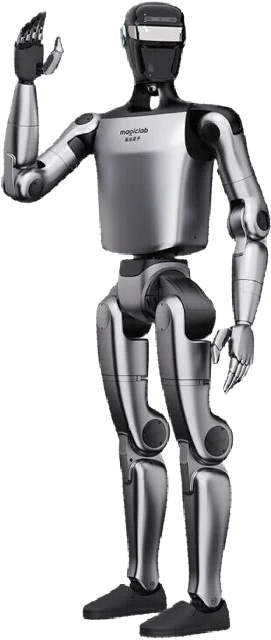
The MagicBot Z1 is a compact, high-dynamics bipedal humanoid robot developed by the Chinese embodied AI company MagicLab (officially Magic Atom Robotics Technology, headquartered in Wuxi, Jiangsu Province). Unveiled on July 8, 2025, the Z1 stands 140 cm (4 ft 7 in) tall, weighs about 40 kg (88 lb), and has 24 base degrees of freedom that can be expanded to 50, with self-developed joints producing more than 130 N-m of torque and a top walking speed of 2.5 m/s. It is MagicLab's agile, consumer-accessible counterpart to the larger industrial MagicBot G1, and it became globally known for performing martial arts spin kicks, backflips, and synchronized dance routines.[1][2][3]
MagicLab markets the Z1 as "The Intelligent & Agile Mini Hero" and positions it for education, research, commercial service, light industrial tasks, and home companionship.[1][19] The robot features self-developed high-performance joint modules with a joint motion range up to 320 degrees, and a multimodal sensor suite including 3D LiDAR, depth cameras, and binocular fisheye vision. The Standard Edition is priced at roughly $39,800 USD.[1][2]
The MagicBot Z1 captured global attention in July 2025 when MagicLab released footage of the robot performing martial arts spin kicks, backflips, and dodging an arrow with a side flip. The Z1 gained further prominence at the 2026 CCTV Spring Festival Gala, where six units performed synchronized dance choreography (including the Thomas 360 breakdance move) in a segment alongside pop stars Yi Yangqianxi and Jerry Yan. Units sold out on JD.com within minutes of the broadcast.[3][4][5]
ELI5: What is the MagicBot Z1?
The MagicBot Z1 is a child-sized robot that walks on two legs and can move like an athlete. It is about as tall as a 9-year-old kid (140 cm) but it can do backflips, spin kicks, and dance routines that most robots cannot do. A Chinese company called MagicLab built it to be smaller, faster, and cheaper than its big factory robot (the MagicBot G1), so schools, shops, and researchers can use it. You can teach it new moves, and it can see the world around it using cameras and a laser scanner so it does not bump into things.
Who makes the MagicBot Z1?
The MagicBot Z1 is made by MagicLab (Magic Atom Robotics Technology), a Chinese embodied AI startup. The company was founded in December 2023, with formal incorporation in January 2024, and it established its national headquarters in Wuxi, Jiangsu Province (Liangxi district).[7][20] MagicLab was established by Wu Changzheng and Wang He. Wu Changzheng previously led the development of Xiaomi's first-generation quadruped robot, the CyberDog, bringing substantial experience in robotics engineering and product development at scale. Wang He, born in 1992, studied electronic engineering at Tsinghua University and earned his doctorate at Stanford University under robotics researcher Leonidas Guibas before returning to China to establish a laboratory at Peking University focused on embodied perception and human-robot interaction.[6][7]
Although formally established in late 2023, MagicLab's core team began quadruped robot research and development as early as August 2020, entered the humanoid robot field at the end of 2022, and released its first humanoid prototype in early 2023. At the time of its angel funding round, MagicLab employed approximately 100 people, with over 80% dedicated to R&D and more than 50% holding master's degrees or higher. Core team members graduated from Tsinghua, Shanghai Jiao Tong University, Zhejiang University, Beihang University, and New York University.[7]
The company pursues an "Embodied Intelligence + X" strategy built on a "1+2+N" framework: one full-stack technology platform, two core product lines (humanoid robots and quadruped robots), and N ecosystem touchpoints. MagicLab's product portfolio includes the full-size MagicBot G1 humanoid, the compact MagicBot Z1, and the MagicDog family of quadruped robots (including the consumer MagicDog, the wheel-leg hybrid MagicDog W, and the industrial-grade MagicDog Y1).[8][9]
How is MagicLab funded?
| Round | Date | Amount | Lead investor(s) |
|---|---|---|---|
| Angel | December 2024 | 150 million RMB (~$20.6 million USD) | Zhui Chuang Venture Capital, Yi Pu Fund |
| Series A | March 2026 | 500 million RMB (~$68 million USD) | Tuopu Group and others |
Since commercial sales began in May 2025, MagicLab has secured 500 million RMB in letters of intent within six months, with firm orders totaling 130 million RMB (~$18 million USD). Through its "Thousand-Scenario Co-Creation" initiative, the company has partnered with over 100 organizations globally for proof-of-concept validation and pilot deployments.[8][10]
In March 2026, founder and CEO Wu Changzheng stepped down, and the company appointed several new leaders, including Li Xiang (Chief Scientist, Tsinghua professor), Zhang Tao (Head of Embodied Models, formerly at Alibaba and NIO), and Tan Yongzhou (Head of International Markets, formerly at UBTECH).[11]
What are the MagicBot Z1's specifications?
Physical characteristics
The MagicBot Z1 stands 140 cm tall and weighs approximately 40 kg, making it significantly smaller and lighter than the 174 cm, 67.5 kg MagicBot G1. Its compact dimensions (approximately 136.9 cm x 42.2 cm x 20.0 cm with battery) were chosen to bridge the physical scale of a human child with the sensing and strength of a modern humanoid platform. The chassis is constructed from high-strength aluminum alloy and engineering plastics, balancing durability with the low mass needed for agile, dynamic locomotion.[1][2]
Degrees of freedom and actuation
The Z1 is equipped with MagicLab's self-developed high-performance joint modules, providing 24 base degrees of freedom in the Standard Edition. This can be expanded to up to 50 degrees of freedom in the Development Edition through the addition of optional dexterous hands, advanced sensor packages, and extended arm joints.[1][12]
Each joint module uses a low-inertia, high-speed permanent magnet synchronous motor (PMSM) running at a 25 kHz control frequency. This design provides high burst power, rapid response times, and efficient heat dissipation. Maximum joint torque exceeds 130 N-m, enabling what MagicLab calls "high-explosive" movements, including large disturbance impact recovery, continuous fall-and-rise sequences, and dynamic acrobatic maneuvers. The joint motion range reaches up to 320 degrees, supporting movements like deep backbends and wide-amplitude kicks that most humanoids cannot achieve.[1][2][12]
The joint output bearings are industrial-grade high-rigidity roller bearings rated to withstand 8.7 kN (1,956 lbf) of impact force. Advanced thermal simulation and optimized air-duct design maintain stable internal temperatures during sustained operation.[12]
Manipulation and MagicHand S01
In its base configuration, the Z1 supports a per-arm payload of 3 kg (total 10 kg when using both arms). When fitted with MagicLab's optional MagicHand S01 dexterous hand, the robot gains significantly enhanced manipulation capabilities.[1][13]
The MagicHand S01 is an 11-DOF five-fingered dexterous hand that MagicLab developed in-house. Key specifications of the hand include:
| Specification | Value |
|---|---|
| Degrees of freedom | 11 |
| Hand weight | ~580 g |
| Individual finger grip force | ~2.5 kg |
| Combined four-finger grip force | ~9.1 kg |
| Payload capacity | 5 kg per hand |
| Force resolution | 0.1 N |
| Control synchronization frequency | Up to 100 Hz |
| Control method | Hybrid force/position (electric current + tactile feedback) |
The MagicHand S01 integrates MagicLab's proprietary six-axis electric actuator, encoder, and tactile sensors. MagicLab claims the hand can replicate approximately 70% of human hand gestures and handle objects of varying shapes, sizes, and weights, from delicate electronic components to everyday household items.[13][14]
Sensing and perception
The Z1 features a comprehensive multimodal sensor suite for autonomous navigation and environmental awareness:
- 3D LiDAR for environmental mapping and SLAM-based navigation
- Intel RealSense D435 depth camera for spatial depth perception
- Dual binocular fisheye cameras for wide-angle peripheral vision
- Head tactile sensor for physical interaction feedback
- Microphone array for voice interaction and sound localization
- IMU and gyroscope for inertial measurement and balance control
This sensor array feeds into MagicLab's proprietary Magic Atom Positioning and Navigation System, which enables precise localization and adaptive path planning. The robot can navigate complex environments reliably across flat ground, grass, gravel, steps, and obstacles up to 15 cm in height.[1][2][15]
Computing and software
The Z1 runs on an 8-core high-performance CPU as its baseline computing platform. An optional high-computing-power module is available for enterprise and research customers who require greater onboard processing for machine learning inference or advanced perception tasks.[2][12]
The software stack is built on MagicLab's Magic Atom Motion Control Platform, which supports both imitation learning and reinforcement learning for training new behaviors. MagicLab claims that developers can teach the Z1 an entirely new motion sequence in approximately 20 minutes using its multi-source data pipeline and standardized controller framework. Full training of new movement behaviors can be completed within a 24-hour cycle.[2][15]
The Z1 supports voice commands, gesture recognition, and mobile application control. MagicLab describes the platform as "Open-Source and Open-Minded, Creation in Your Hands," with open APIs available for developers building custom applications.[15][19] The Development Edition (50 DOF variant) offers "secondary development" support, including access to development tools for enterprise and academic customers. MagicLab provides SDKs for ROS 2, C++, and Python, along with prebuilt simulation environments and templates for pick-and-place, shelf scanning, autonomous navigation, and teleoperation tasks.[2][15][16]
Power and connectivity
| Specification | Value |
|---|---|
| Battery type | Lithium-ion polymer |
| Battery capacity | 10,000 mAh (15-cell configuration) |
| Runtime | ~2 hours per charge |
| Charging time | 3 to 4 hours |
| Battery lifespan | 3 to 5 years |
| Wi-Fi | Wi-Fi 6 (2.4/5 GHz dual-band) |
| Bluetooth | 5.2 |
| Software updates | Over-the-air (OTA) |
The 2-hour runtime is notably shorter than the MagicBot G1's 4-to-5-hour battery life, reflecting the trade-off between the Z1's compact form factor and its smaller battery capacity. MagicLab supports OTA firmware updates to improve performance and add capabilities over time.[1][2]
Full technical specifications
| Category | Specification | Value |
|---|---|---|
| Physical | Height | 140 cm (4 ft 7 in) |
| Physical | Weight | ~40 kg (88 lb) |
| Physical | Dimensions | 136.9 x 42.2 x 20.0 cm (with battery) |
| Physical | Materials | Aluminum alloy + engineering plastics |
| Mobility | Base degrees of freedom | 24 |
| Mobility | Max degrees of freedom | 50 (Development Edition) |
| Mobility | Max walking speed | 2.5 m/s (9.0 km/h / 5.6 mph) |
| Mobility | Obstacle climbing | Up to 15 cm |
| Mobility | Terrain types | Flat, grass, gravel, stairs |
| Actuation | Motor type | Low-inertia high-speed PMSM |
| Actuation | Control frequency | 25 kHz |
| Actuation | Peak joint torque | >130 N-m |
| Actuation | Joint motion range | Up to 320 degrees |
| Actuation | Impact tolerance | 8.7 kN (1,956 lbf) |
| Manipulation | Per-arm payload | 3 kg |
| Manipulation | Total payload (dual arm) | 10 kg |
| Manipulation | Hand option | MagicHand S01 (11 DOF, 5 kg per hand) |
| Sensors | LiDAR | 3D LiDAR |
| Sensors | Depth camera | Intel RealSense D435 |
| Sensors | Vision | Dual binocular fisheye cameras |
| Sensors | Other | Head tactile sensor, IMU, gyroscope, microphone array |
| Computing | CPU | 8-core high-performance processor |
| Computing | Optional | High-compute power module (enterprise) |
| Power | Battery | 10,000 mAh lithium-ion polymer (15-cell) |
| Power | Runtime | ~2 hours |
| Power | Charging time | 3 to 4 hours |
| Connectivity | Wireless | Wi-Fi 6, Bluetooth 5.2 |
| Software | Updates | OTA |
Product editions
The MagicBot Z1 is offered in two primary configurations:
Standard Edition
The Standard Edition is priced at approximately $39,800 USD and provides the base 24 degrees of freedom along with the full sensor suite, navigation system, and voice interaction capabilities. It targets robotics enthusiasts, educational institutions, exhibition operators, and entry-level research labs. This edition delivers the Z1's core motion and interaction capabilities out of the box.[2][12]
Development Edition
The Development Edition expands the platform to up to 50 degrees of freedom through additional arm joints and the 11-DOF MagicHand S01 dexterous hands. It includes enhanced computing packages and secondary development support for custom application building. This edition is designed for enterprise customers, university research groups, and organizations requiring advanced manipulation and extensibility. Pricing for the Development Edition follows an enterprise contact-sales model, with configurations reported to reach into six-figure territory depending on options selected.[2][12][16]
How does the MagicBot Z1 differ from the MagicBot G1?
The MagicBot Z1 and MagicBot G1 represent MagicLab's dual-model strategy, with each targeting distinct use cases and market segments. In short, the G1 is the larger, stronger industrial humanoid built for heavy manipulation and factory work, while the Z1 is the smaller, faster, and more affordable model built for dynamic agility, commercial service, education, and research.
| Specification | MagicBot Z1 | MagicBot G1 |
|---|---|---|
| Height | 140 cm (4 ft 7 in) | 174 cm (5 ft 8.5 in) |
| Weight | ~40 kg (88 lb) | ~67.5 kg (149 lb) |
| Degrees of freedom | 24 (expandable to 50) | 42 |
| Max walking speed | 2.5 m/s (9.0 km/h) | >2 m/s (~7.2 km/h) |
| Arm payload | 3 kg per arm (10 kg total) | 20 kg per arm (40 kg total) |
| Peak joint torque | >130 N-m | >525 N-m |
| Battery life | ~2 hours | 4 to 5 hours |
| Battery capacity | 10,000 mAh | 25 Ah (~1.35 kWh) |
| IP rating | Not disclosed | IP66 |
| Hand (base) | 6-DOF servo hand | 6-DOF servo hand |
| Hand (upgrade) | MagicHand S01 (11 DOF) | MagicHand S01 (11 DOF) |
| Joint motion range | Up to 320 degrees | Standard |
| AI compute | 8-core CPU (optional upgrade) | 8-core CPU, ~100 TOPS |
| Connectivity | Wi-Fi 6, Bluetooth 5.2 | Wi-Fi 6, 4G/5G, Bluetooth 5.2 |
| Price | ~$39,800 USD (Standard) | Enterprise pricing (est. $50K to $100K+) |
| Primary focus | Dynamic agility, consumer/commercial, research | Industrial automation, heavy manipulation, logistics |
| Release | July 2025 | 2024 |
The G1 is built for industrial strength, with its 20 kg per-arm payload, IP66 dust and water resistance, and 4G/5G cellular connectivity making it suitable for factory floors and heavy-duty tasks. The Z1 trades raw power for agility, speed, and affordability, with its lighter frame enabling acrobatic movements that the heavier G1 cannot perform. The Z1's wider joint range (320 degrees vs. standard) and faster walking speed also give it an edge in scenarios requiring dynamic mobility over brute strength.[2][3]
Demonstrations and milestones
Martial arts and acrobatics (July 2025)
The MagicBot Z1 was announced on July 8, 2025, with MagicLab releasing a 45-second demonstration video that rapidly went viral. The footage showed the Z1 performing a backflip, executing martial arts kicks with full spinning motions, and dodging an arrow by performing a side flip. A separate video released around the same time demonstrated the robot's ability to dance. Throughout these demonstrations, the Z1 exhibited strong agility, rapid recovery from complex dynamic movements, and precise balance control. MagicLab attributed this performance to the Z1's high-burst PMSM joint actuators, 320-degree joint range, and the low-inertia motor design running at 25 kHz control frequency.[3][12]
What happened at the 2026 CCTV Spring Festival Gala?
At the 2026 CCTV Spring Festival Gala, broadcast on the eve of Chinese New Year (February 16, 2026), six MagicBot Z1 units performed synchronized dance choreography at one of the most-watched television events in the world. The robots shared the stage with pop stars Yi Yangqianxi and Jerry Yan in a song-and-dance performance. The Z1 units executed rapid turns and connected jumps with zero-error precision, culminating in the Thomas 360 breakdance stunt. MagicLab stated that this was the first time a humanoid robot of similar size had completed the Thomas 360 move.[4][5]
The commercial impact was immediate. Within minutes of the broadcast, MagicLab's robots sold out on JD.com, the Chinese e-commerce platform that had listed multiple humanoid robots for sale during the Gala. Platform data showed that within two hours, searches for robots surged by 300%, customer service inquiries rose by 460%, and order volumes jumped by 150%. New orders arrived from over 100 cities across China.[5][17]
CES 2026
MagicLab made its international exhibition debut at CES 2026 in Las Vegas in January 2026, showcasing the MagicBot Z1 alongside the MagicBot G1 and the MagicDog quadruped robot family. The company used the event to accelerate its global expansion strategy and establish international distribution partnerships. MagicLab described the Z1 at CES as featuring "50 biomimetic joints with 320-degree range of motion" and highlighted its intelligent interaction, 360-degree sensing, and autonomous navigation capabilities.[9]
What is the MagicBot Z1 used for?
Education and research
The Z1 Standard Edition is positioned as an accessible platform for robotics education and university research. Its open API architecture and SDK support (ROS 2, C++, Python) enable academic teams to develop custom locomotion algorithms, perception pipelines, and manipulation behaviors. The 20-minute motion teaching capability through MagicLab's multi-source database and standardized controller lowers the barrier for researchers experimenting with imitation learning and reinforcement learning approaches.[2][15]
Commercial service
MagicLab promotes the Z1 for retail reception and shopping guidance, exhibition hosting, event ushering, and customer engagement in hospitality settings. The robot's voice interaction system, gesture recognition, and emotional intelligence capabilities (powered by the head tactile sensor and multiphone array) allow it to serve as an interactive concierge or guide. Its compact 140 cm stature makes it approachable in public-facing environments without the imposing presence of taller industrial humanoids.[1][15]
Light industrial operations
While the G1 handles heavy industrial tasks, the Z1 can perform lighter operational duties such as inventory scanning, quality inspection, and light material transport in settings where its 3 kg per-arm payload is sufficient. The Z1 integrates with MagicLab's MagicNet fleet management system, which enables shared maps, coordinated task scheduling, MES integration, and centralized fleet monitoring across multiple robot units.[16][18]
Home companionship
MagicLab positions the Z1 as a future home companion robot. Promotional materials have shown the Z1 performing household activities including folding clothes, making coffee with latte art, grilling, and watering plants. The robot's relatively compact size (comparable to a young child) and quiet electric actuation make it more suitable for domestic environments than larger industrial humanoids.[1][15]
MagicNet fleet management
The MagicBot Z1 is fully compatible with MagicLab's MagicNet multi-robot collaboration platform, the same system used by the MagicBot G1. MagicNet provides:
- Shared environmental maps across all connected robot units
- Task scheduling and assignment with dynamic reallocation based on workload and proximity
- MES integration for connecting to factory management systems
- Fault tolerance with automatic task reassignment if one robot encounters a malfunction
- Web dashboard for fleet management, job scheduling, OTA updates, and analytics
- Telemetry monitoring for real-time operational data
MagicNet supports deployment at scale in factory floors, retail campuses, and multi-building facilities where mixed fleets of Z1 and G1 robots may operate together, with lighter tasks assigned to Z1 units and heavier manipulation work routed to G1 units.[16][18]
How does the MagicBot Z1 compare to rival humanoids?
The MagicBot Z1 competes in the growing segment of compact, agile humanoid robots, primarily against other Chinese manufacturers targeting the sub-$50,000 price range.
| Robot | Manufacturer | Height | Weight | DOF | Max speed | Arm payload | Approximate price |
|---|---|---|---|---|---|---|---|
| MagicBot Z1 | MagicLab | 140 cm | 40 kg | 24 to 50 | 2.5 m/s | 3 kg/arm | ~$39,800 |
| Unitree G1 | Unitree Robotics | 127 cm | 35 kg | 43 | 2 m/s | ~2 kg/arm | From ~$16,000 |
| EngineAI PM01 | EngineAI | 138 cm | 35 kg | 29 | 1.5 m/s | N/A | ~$12,500 |
| Fourier N1 | Fourier Intelligence | 136 cm | 30 kg | 25 | 1.2 m/s | N/A | Enterprise pricing |
| AgiBot X2 | AgiBot | 130 cm | 30 kg | 36 | 1.5 m/s | 2 kg/arm | Enterprise pricing |
The Z1 differentiates itself through its high-burst dynamics (backflips, martial arts moves), wide joint range (320 degrees), and the optional MagicHand S01 upgrade for advanced manipulation. Its 2.5 m/s top speed is among the fastest in its size class. However, competitors like the Unitree G1 offer a significantly lower entry price, while the Z1's 2-hour battery life is shorter than some rivals. The availability of the MagicNet fleet management system also distinguishes MagicLab's offering for customers planning multi-robot deployments.[2][3]
MagicLab's broader strategy
The Z1 fits within MagicLab's strategy of building a multi-form robotics ecosystem. The company's product roadmap encompasses:
- MagicBot G1: Full-size industrial humanoid for factory automation, logistics, and heavy manipulation
- MagicBot Z1: Compact agile humanoid for commercial service, education, research, and consumer markets
- MagicDog: Consumer quadruped companion with 13 DOF and emotional interaction via head-tail coordination
- MagicDog W: Wheel-leg hybrid quadruped exceeding 3 m/s, capable of stair climbing and backward ascent
- MagicDog Y1: Industrial-grade quadruped for factory inspection and outdoor operations
MagicLab planned to produce approximately 400 humanoid robots in 2025, with targets scaling to thousands of units by 2026. The company's dual-model humanoid strategy allows it to address both heavy industrial automation (G1) and the broader consumer, education, and service markets (Z1) simultaneously. Wu Changzheng, before his departure, emphasized that the future of humanoid robotics would emerge from gradual integration into real-world systems rather than spectacular demonstrations, and that robotics adoption is fundamentally a process transformation challenge.[7][8][10]
In November 2024, MagicLab confirmed discussions with ByteDance to integrate the Doubao large language model into future MagicBot generations, potentially enhancing natural language understanding and multimodal reasoning capabilities. As of early 2026, this integration has not been formally announced for production units.[2]
See also
- Humanoid robots
- MagicBot G1
- MagicLab
- Unitree G1
- Unitree H1
- UBTECH Walker S2
- Embodied AI
- Robot learning
- Reinforcement learning
References
- ^1 ^2 ^3 ^4 ^5 ^6 ^7 ^8 ^9 ^10 ^11"MagicBot Z1 by MagicLab: Price, Details, Review 2025," OriginOfBots
- ^1 ^2 ^3 ^4 ^5 ^6 ^7 ^8 ^9 ^10 ^11 ^12 ^13 ^14 ^15"MagicLab MagicBot Review: Price, Specs & Factory Deployment," Robozaps, 2026
- ^1 ^2 ^3 ^4 ^5"MagicBot Z1 robot nails spin kicks, dodges arrow with a side flip," Interesting Engineering, July 2025
- ^1 ^2"Humanoid robots at Spring Festival Gala grab headlines, showcasing China's tech leap in just one year," Global Times, February 2026
- ^1 ^2 ^3"Orders for robots surge after Spring Festival Gala," China Daily, February 2026
- ^"China's 'Iron Legion': Wang Xingxing, Jiang Zheyuan, Wu Changzheng and Wang He and the Breakthrough Year of Embodied Intelligence," The Icons, March 2026
- ^1 ^2 ^3 ^4"Embodied Intelligence company Magic Atom completed a 150 million yuan Angel round of financing," 36Kr, December 2024
- ^1 ^2 ^3"MagicLab Officially Announces 500 Million Yuan New Funding," Gasgoo, March 2026
- ^1 ^2"CES 2026: MagicLab unveils multiple robots," Gasgoo, January 2026
- ^1 ^2"Watch China's humanoid robot valet cars, style hair, assist in hotels," Interesting Engineering, 2025
- ^"MagicLab's management undergoes major reshuffle," Gasgoo, March 2026
- ^1 ^2 ^3 ^4 ^5 ^6 ^7"Dobot's Hexplorer, MagicLab Z1, ROKAE HumanX," Mike Kalil, July 2025
- ^1 ^2"MagicLab Unveils MagicHand S01 Dexterous Hand, Progressing Toward Mass Adoption of Humanoid Robots," Yahoo Finance, February 2025
- ^"MagicLab Boasts MagicHand S01 Dexterity and Strength," Mike Kalil, 2025
- ^1 ^2 ^3 ^4 ^5 ^6 ^7"MagicBot Z1 Open Source Agile Humanoid Robot Debuts," Robotic Gizmos, 2025
- ^1 ^2 ^3 ^4"MagicLab MagicBot Z1: AI-Powered Humanoid Robot for Industry, Research & Education," Robots International
- ^"Four Chinese Robotics Leaders Leverage 2026 Spring Festival Gala for Market Validation," YT Finance, February 2026
- ^1 ^2"MagicLab MagicBot Collaborative Industrial Humanoid Robots," Mike Kalil, December 2024
- ^1 ^2"MagicBot Z1," MagicLab official product page
- ^"MagicLab Establishes National Headquarters in Wuxi," Gasgoo, 2026
Improve this article
Add missing citations, update stale details, or suggest a clearer explanation. Every suggestion is reviewed for sourcing before it goes live.
4 revisions · v5 · 4,044 words · full history
Fact-checks are independent of edits: a reviewer re-verifies the article against its sources and stamps the date. How we verify
Research and drafting on this wiki are AI-assisted, under named human editorial standards. How AI is used here
Cite this page: AI Wiki. "MagicBot Z1." aiwiki.ai, updated 28 Jun 2026. CC BY 4.0. https://aiwiki.ai/wiki/magiclab_magicbot_z1