

Xiao Tuo
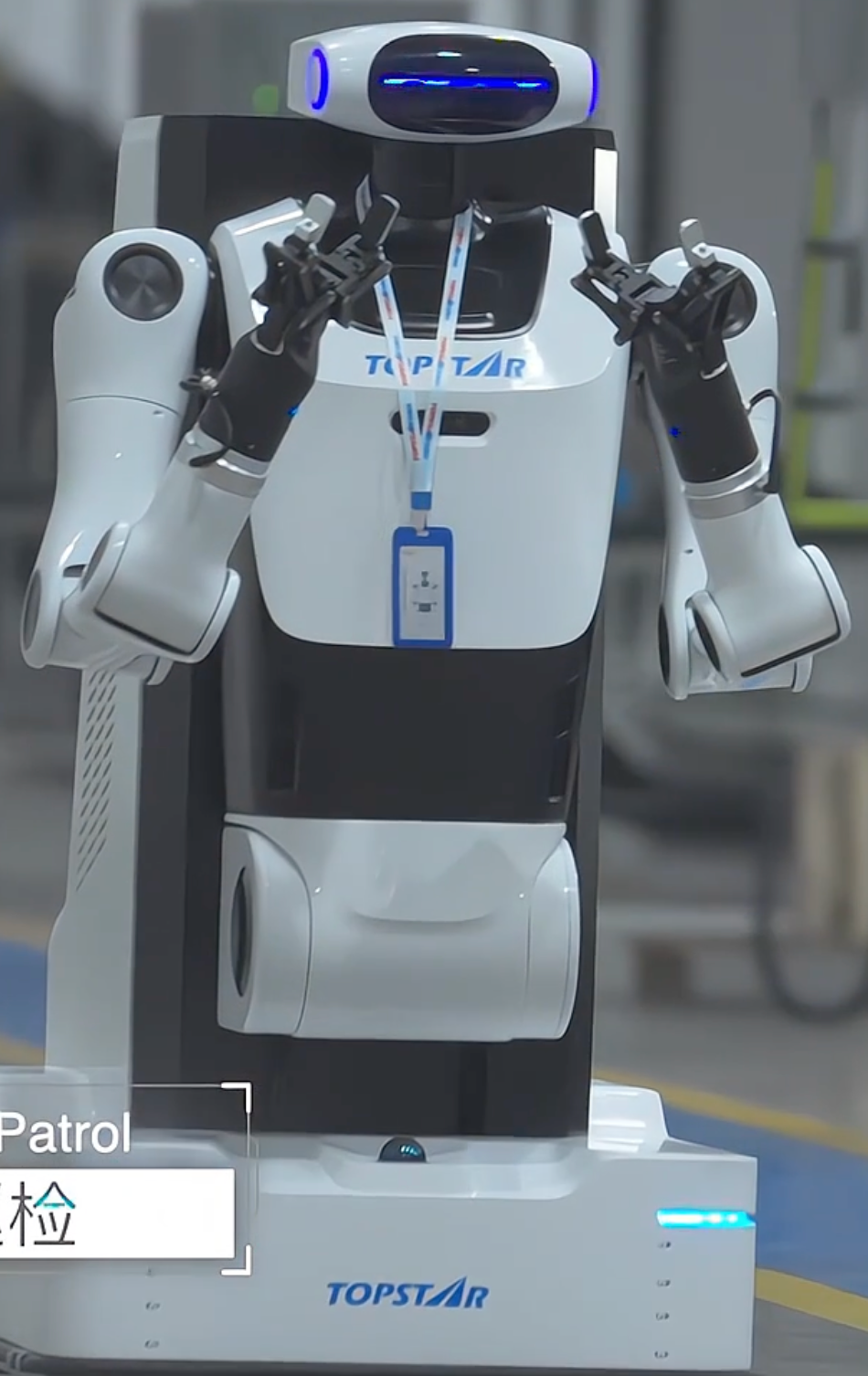
Xiao Tuo (Chinese: 小拓) is a wheeled humanoid robot developed by Guangdong Topstar Technology Co., Ltd., a publicly listed Chinese industrial automation company headquartered in Dongguan, Guangdong Province. Unveiled on September 12, 2025, at TOPSTAR's Global Open Day, Xiao Tuo is described as the first humanoid robot specifically designed for deployment on injection molding production lines. The robot is part of TOPSTAR's "Tuo Xing Ji" (拓星纪) product series and represents the company's expansion from traditional industrial automation equipment into embodied artificial intelligence and humanoid robotics.
| Xiao Tuo | |
|---|---|
 | |
| General information | |
| Manufacturer | Guangdong Topstar Technology |
| Country of origin | China |
| Year unveiled | 2025 |
| Status | Prototype / Early commercialization |
| Price | ~$21,000 USD |
| Series | Tuo Xing Ji (拓星纪) |
| Website | topstarmachine.com |
Xiao Tuo features a modular wheeled design with 21 degrees of freedom, adjustable height between 1.2 and 1.8 meters, and integration with Zhipu AI's GLM-4.5 large language model. The robot has completed multiple rounds of validation in real injection molding factory environments and is capable of autonomous sorting, visual quality inspection, tray loading, material handling, and screw assembly.
Background: Guangdong Topstar Technology
Guangdong Topstar Technology Co., Ltd. (stock code: 300607.SZ) is a leading Chinese industrial automation company founded in 2007 by Wu Fengli in Dongguan, Guangdong Province, with an initial capital of 500,000 yuan. The company's corporate mission centers on "making industrial manufacturing better." Wu Fengli, a military veteran, had arrived in Dongguan in 2001 and worked in sales before co-founding a small company in 2004 selling peripheral equipment for injection molding machines. By 2007, he had accumulated enough experience and capital to establish TOPSTAR, initially focusing on auxiliary equipment for injection molding.
The company developed its own controller and robotic arms early on, achieving domestic substitution for previously imported components while significantly reducing costs. In 2011, TOPSTAR expanded into robot body manufacturing and system integration. The company was listed on China's New Third Board (now the National Equities Exchange and Quotations) in December 2014. On February 9, 2017, TOPSTAR achieved a major milestone by listing on the Growth Enterprise Market (ChiNext) of the Shenzhen Stock Exchange, becoming the first publicly listed core robot enterprise in Guangdong Province.[1]
As of 2025, TOPSTAR employs approximately 3,000 people, including over 800 R&D staff. The company operates from more than 150,000 square meters of manufacturing facilities and has served over 15,000 industrial customers across more than 40 countries. Its product portfolio spans industrial robots (including six-axis, SCARA, and collaborative models), injection molding machines, CNC machine tools, auxiliary equipment, and smart factory solutions. Three core technology pillars underpin its products: controllers, servo drives, and computer vision systems.[2]
TOPSTAR holds a dominant market position in certain segments. It is the auxiliary equipment brand with the highest market share in the optical area of China and commands approximately 70% market share in the light guide plate (LGP) and LED equipment markets. The company serves major industries including 3C electronics, medical devices, automotive, and consumer goods manufacturing. In November 2025, TOPSTAR announced plans to issue H shares and pursue a dual listing on the Hong Kong Stock Exchange, a move analysts interpreted as a strategy to accelerate its embodied intelligence commercialization efforts.[3]
For the first three quarters of 2025, TOPSTAR reported operating revenue of 1.688 billion yuan (approximately $237 million), with its industrial robots and automation systems segment generating 544.55 million yuan at a gross margin of 36.67%.[4]
Development and launch
TOPSTAR's entry into humanoid robotics built on several years of foundational technology development. In late 2024, the company introduced the X5 robot motion control platform, a next-generation system developed in collaboration with GuoChuang Software and built on the openEuler operating system (an open-source Linux distribution originated by Huawei). The X5 platform serves as what TOPSTAR describes as the "small brain and spine" of embodied AI systems, bridging the gap between large language models and physical robot hardware through a cloud-edge-end architecture. It operates at a 500 Hz real-time motion control frequency, enabling millisecond-level responsiveness for multi-axis coordination.[5]
The X5 platform's integration of control, servo, and vision technologies provided the technical foundation for Xiao Tuo. TOPSTAR also leveraged its 2021 acquisition of AFMing (also referred to as Aifumi/Efformi), a manufacturer of five-axis CNC machine tools with over 20 years of development experience in precision machining. AFMing's DMU400 five-axis CNC machine, equipped with self-developed spindles and GTRT (Gear-driven Rotary Table) cradle turntable technology, is used to manufacture Xiao Tuo's core structural components with precision finer than one-third the thickness of a human hair.[6]
Xiao Tuo was formally unveiled on September 12, 2025, at TOPSTAR's "AI Without Boundaries, Co-Creating Intelligent Manufacturing" Global Open Day held in Dongguan. The event attracted over 1,000 industry professionals from across China. During the launch, Chairman Wu Fengli outlined three strategic growth pillars for the company's next decade: strengthening core business operations, advancing high-end equipment development, and integrating AI technology into industrial manufacturing scenarios.[7]
At the same event, TOPSTAR announced the formation of the "TOPSTAR Humanoid Robot Ecosystem Innovation Alliance," a collaborative initiative bringing together research institutions, universities, and industry partners to accelerate the deployment of humanoid robots across diverse industrial scenarios. Notable alliance members include the Greater Bay Area National Technology Innovation Center, Foxconn Technology Group, and multiple academic institutions.[7]
Design and architecture
Modular structure
Xiao Tuo employs a wheeled humanoid form factor rather than a bipedal design, prioritizing stability and practical utility in factory environments over human-like locomotion. The robot's most distinctive design feature is its full modularity. The body and arms are completely detachable: the robot can separate at the waist to function as a standalone upper-body humanoid mounted on a mobile base, while each arm can be removed and deployed independently as a standalone robotic arm. This flexibility enables multiple deployment configurations depending on the specific factory task at hand.
The robot's height is dynamically adjustable between 1.2 meters and 1.8 meters through a combination of waist elevation (0 to 550 mm range) and bending capability (0 to 95 degrees). This adjustable height allows Xiao Tuo to interact with equipment and workstations at varying levels on a production line without requiring infrastructure modifications.
Mobility system
Xiao Tuo's base features a four-wheel steering (four-steer-wheel) chassis that supports 360-degree omnidirectional movement with a maximum speed of 1.5 m/s (5.4 km/h). The omnidirectional capability allows the robot to navigate tight factory aisles, pivot in place, and approach injection molding machines from any angle. The wheeled design was a deliberate choice over bipedal locomotion, as it provides greater stability when carrying payloads and better suits the flat, structured environments of manufacturing floors.
Manipulator arms
Each of Xiao Tuo's dual arms has 7 degrees of freedom, providing human-like reach and dexterity for manipulation tasks. The single-arm maximum payload capacity is 10 kg, while coordinated dual-arm operations can handle loads up to 20 kg. With the arm assembly weighing only 15 kg (excluding gripper/end-effector), the load-to-weight ratio reaches 0.67, which TOPSTAR states substantially exceeds typical industrial robot arms. Arm repeatability (positioning accuracy) is rated at plus or minus 0.05 mm, a level of precision suited for tasks like screw insertion and component placement.
The manipulator system supports various interchangeable end-effectors through its modular design, allowing quick reconfiguration for different tasks such as gripping, suction, or tool use.
Technical specifications
| Category | Parameter | Value |
|---|---|---|
| Physical | Height (adjustable) | 1.2 - 1.8 m |
| Physical | Weight (arm assembly, excl. gripper) | 15 kg |
| Physical | Waist elevation range | 0 - 550 mm |
| Physical | Waist bending range | 0 - 95 degrees |
| Mobility | Locomotion type | Wheeled (four-steer-wheel) |
| Mobility | Maximum speed | 1.5 m/s (5.4 km/h) |
| Mobility | Omnidirectional movement | Yes, 360 degrees |
| Degrees of Freedom | Total DOF (excl. dexterous hands) | 21 |
| Degrees of Freedom | Per arm | 7 |
| Degrees of Freedom | Head | 2 |
| Degrees of Freedom | Waist | 2 |
| Degrees of Freedom | Chassis | 3 |
| Payload | Single-arm max payload | 10 kg |
| Payload | Dual-arm coordinated max payload | 20 kg |
| Payload | Load-to-weight ratio | 0.67 |
| Precision | Arm repeat positioning accuracy | +/- 0.05 mm |
| Computing | Edge computing power | 3,352 TOPS |
| Computing | LLM integration | Zhipu AI GLM-4.5 |
| Computing | AI model type | COT-VLA (Chain-of-Thought Vision-Language-Action) |
| Computing | Motion control frequency | 500 Hz |
| Computing | Control platform | X5 (openEuler-based) |
| Power | Battery capacity | 3 kWh |
| Power | Battery life (full load) | 6+ hours |
| Power | Charging | Self-charging, quick-swap battery |
| Sensors | Vision | 3D cameras, AI vision inspection system |
| Sensors | Navigation | LiDAR |
| Sensors | Interaction | Audio/voice system |
| Actuators | Servo bandwidth | ~1,000 Hz speed loop |
| Actuators | Encoder type | Dual-encoder joints |
| Connectivity | Interfaces | Ethernet, WiFi |
| Connectivity | Teleoperation | VR + PICO force-feedback controllers |
AI and software architecture
Embodied AI model
Xiao Tuo is powered by a COT-VLA (Chain-of-Thought Vision-Language-Action) embodied AI model, co-developed with Zhipu AI, one of China's leading AI companies. The model is built on Zhipu's flagship GLM-4.5 large language model and achieves inference speeds reported to be four times the industry average. With 3,352 TOPS of on-device (edge) computing power, the system supports efficient cloud-edge coordination, processing sensor data locally for real-time responsiveness while leveraging cloud resources for more complex reasoning tasks.[8]
The VLA architecture allows Xiao Tuo to integrate visual perception, natural language understanding, and physical action planning into a unified pipeline. When deployed on an injection molding line, the robot can observe a scene through its 3D cameras, reason about what actions to take using chain-of-thought processing, and execute physical manipulations accordingly. This approach enables the robot to handle variations in product placement, identify defective parts, and adapt its behavior without explicit reprogramming for each scenario.
X5 control platform
The X5 robot motion control platform serves as Xiao Tuo's core control infrastructure, functioning at the intersection of high-level AI reasoning and low-level motor control. Developed collaboratively with GuoChuang Software on the openEuler operating system, the platform provides real-time motion control at 500 Hz, enabling precise multi-axis coordination with millisecond-level latency.
The platform's cloud-edge-end architecture supports a closed-loop design of "process data, AI large model, execution," meaning that operational data collected during factory tasks feeds back into the AI model for continuous improvement. TOPSTAR describes this as enabling a transition from robots that are "capable of working" to robots that "understand how to work."[5]
Teleoperation
Xiao Tuo supports remote teleoperation via a VR-based system built on the X5 platform. Using PICO VR headsets and high-precision force-feedback handheld controllers, human operators can control the robot's movements remotely. This "VR + AI + Industrial Robot" collaborative system was demonstrated at the 2025 Global Open Day, where visitors controlled the robot using VR headsets and handheld controllers. The teleoperation capability serves dual purposes: it enables remote expert intervention in complex situations and provides a mechanism for collecting human demonstration data to train the robot's autonomous behaviors.[9]
Servo and vibration control
A key technical challenge in deploying humanoid robots for precision industrial tasks is mechanical end-effector vibration, which can degrade positioning accuracy during rapid movements. TOPSTAR's Chief Servo Technology Expert, Dr. Wang Zhicheng (Ph.D., Shenyang Institute of Computing, Chinese Academy of Sciences), developed a proprietary vibration suppression control technology that has been integrated into Xiao Tuo. The servo system achieves a speed loop bandwidth approaching 1,000 Hz, with dual-encoder joints providing high-fidelity position feedback. TOPSTAR positions this vibration suppression capability as a key enabler for large-scale humanoid deployment in precision manufacturing environments.[6]
Industrial applications
Injection molding production lines
Xiao Tuo's primary application domain is injection molding manufacturing, where TOPSTAR has deep expertise from its 18-year history serving the plastics processing industry. The robot has completed multiple rounds of validation in real injection molding workshops, performing a sequence of tasks that traditionally require human operators or multiple specialized machines.
In a typical deployment scenario, Xiao Tuo stations itself near an injection molding machine and performs the following workflow autonomously:
- Visual inspection: Using 3D cameras and an AI vision inspection system, the robot identifies freshly molded parts and evaluates their quality in real time, detecting surface defects and dimensional anomalies.
- Sorting: Based on inspection results, the robot sorts parts into categories (pass/fail) and organizes them for downstream processing.
- Tray loading: Accepted parts are placed into trays or pallets in organized arrangements for packaging or further assembly.
- Material handling: The robot transports materials between workstations, leveraging its omnidirectional mobility to navigate the production floor.
- Assembly tasks: For certain product lines, Xiao Tuo performs screw assembly and component insertion tasks requiring its sub-millimeter positioning accuracy.
Drone propeller inspection
One documented commercial application involves drone propeller manufacturing. In this use case, Xiao Tuo can independently identify three or more propeller types and detect six or more categories of appearance defects. The reported sorting efficiency reaches at least 1,500 pieces per hour, with the robot completing full-process autonomous operations including inspection, sorting, and palletizing.[10]
Target industries
Beyond injection molding, TOPSTAR envisions Xiao Tuo's deployment across the industries it already serves through its existing automation product lines:
| Industry | Potential Applications |
|---|---|
| 3C Electronics | Component inspection, assembly, packaging |
| Automotive | Parts sorting, quality control, material transport |
| Medical Devices | Precision assembly, sterile handling, inspection |
| Consumer Goods | Product packaging, palletizing, sorting |
| Education and Research | Robotics training, AI development platform |
Competitive context
Xiao Tuo enters a rapidly expanding Chinese humanoid robot market. Guangdong Province, where TOPSTAR is headquartered, produced over 240,000 industrial robots in 2024, a 31.2% year-on-year increase, ranking first among Chinese provinces for five consecutive years. Approximately 38% of the global humanoid robot supply chain is based in China, with roughly 57% concentrated in the Guangdong-Hong Kong-Macao Greater Bay Area.[11]
Several Chinese companies have introduced competing humanoid robots targeting industrial applications:
| Company | Robot | Form factor | Primary focus |
|---|---|---|---|
| TOPSTAR | Xiao Tuo | Wheeled humanoid | Injection molding, manufacturing |
| UBTECH | Walker S | Bipedal humanoid | Smart manufacturing, services |
| Unitree Robotics | G1 | Bipedal humanoid | General purpose, research |
| Fourier Intelligence | GR-2 | Bipedal humanoid | Rehabilitation, general industry |
| Agibot | A2 | Bipedal humanoid | Manufacturing, logistics |
| Deep Robotics | DR01 | Bipedal humanoid | Industrial inspection, logistics |
| LimX Dynamics | CL-1 | Bipedal humanoid | General purpose |
TOPSTAR's competitive advantage lies not in advanced bipedal locomotion but in its deep integration with existing industrial infrastructure. Unlike most humanoid robot startups, TOPSTAR already has an established customer base of over 15,000 manufacturing clients, existing factory automation ecosystems, and vertically integrated manufacturing capabilities (including the ability to produce its own precision components using five-axis CNC machines). The company's approach of building a wheeled humanoid optimized for a specific industrial vertical, rather than a general-purpose bipedal platform, reflects a pragmatic strategy focused on near-term commercial viability.
The broader Chinese humanoid robot industry received significant policy support in 2025 and 2026, with central and provincial governments issuing development plans and funding programs. Guangdong's government has encouraged cities like Dongguan to leverage their manufacturing advantages to build robot production bases, creating a favorable environment for TOPSTAR's humanoid ambitions.[12]
Pricing and availability
Xiao Tuo is priced at approximately $21,000 USD, positioning it as one of the more affordable humanoid robot platforms on the market. As of early 2026, the robot has progressed from prototype to early commercial validation. It has been deployed in factory trial scenarios, particularly in injection molding workshops, and TOPSTAR has indicated plans for broader commercialization.
Target markets include industrial manufacturing (primarily injection molding and related plastics processing), research institutions, and educational programs in robotics and AI. The formation of the TOPSTAR Humanoid Robot Ecosystem Innovation Alliance is intended to accelerate adoption across assembly, inspection, and other industrial use cases.
Future development
As of January 2026, reports indicated that TOPSTAR was developing additional members for its embodied intelligence product family beyond the initial Xiao Tuo platform. New application areas under exploration include forest fire emergency response and special industry inspection scenarios, representing a significant expansion from the robot's original industrial manufacturing focus into outdoor and field deployment contexts.[10]
TOPSTAR's planned Hong Kong Stock Exchange listing is expected to provide additional capital for its embodied intelligence initiatives. The company's stated development philosophy follows a "scenario-driven, product definition, data feedback, model evolution" cycle, leveraging real factory deployment data to continuously refine the robot's AI capabilities and expand its range of autonomous behaviors.
See also
References
- ^Guangdong Topstar Technology Co., Ltd. (300607.SZ) Company Profile - Yahoo Finance
- ^About Us - Topstar Injection Molding Machine
- ^拓斯达:拟发行H股股票并在香港联交所上市 - 36Kr
- ^拓斯达前三季度营收16.88亿元 - Sina Finance
- ^1 ^2拓斯达新一代X5机器人控制平台 - Sina Finance
- ^1 ^2拓斯达入局人形机器人 - 机器人大讲堂 (Robot Lecture Hall)
- ^1 ^2TOPSTAR Global Open Day 2025 - Official TOPSTAR Website
- ^"小拓"获评"新质生产力高成长性案例" - Sina Finance
- ^东莞拓斯达推出基于PICO头显的人形机器人遥操作系统 - QQ News
- ^1 ^2拓斯达"小拓"成功商业化落地 - China.com Tech
- ^Guangdong's Topstar enters humanoid robot market with first launch "Xiao Tuo" - South China Morning Post / NewsGD
- ^国内人形机器人公司推荐之拓斯达 - 36Kr
Improve this article
Add missing citations, update stale details, or suggest a clearer explanation. Every suggestion is reviewed for sourcing before it goes live.
7 revisions · v7 · 2,978 words · full history
Fact-checks are independent of edits: a reviewer re-verifies the article against its sources and stamps the date. How we verify
Research and drafting on this wiki are AI-assisted, under named human editorial standards. How AI is used here
Cite this page: AI Wiki. "Xiao Tuo." aiwiki.ai, updated 12 Apr 2026. CC BY 4.0. https://aiwiki.ai/wiki/topstar_xiao_tuo