

UBTECH Walker S1
| UBTECH Walker S1 | |
|---|---|
 | |
| General information | |
| Manufacturer | UBTECH Robotics |
| Country of origin | China |
| Year unveiled | October 2024 |
| Status | In production |
| Price | ~$75,000 USD |
| Predecessor | Walker X |
| Successor | Walker S2 |
| Website | ubtrobot.com/en/humanoid/products/walker-s1 |
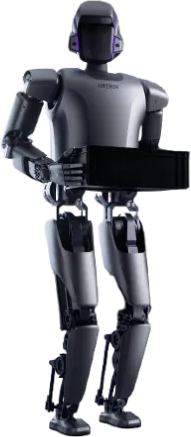
The UBTECH Walker S1 is a full-size industrial humanoid robot developed by UBTECH Robotics, a Shenzhen-based company listed on the Hong Kong Stock Exchange, designed for factory automation tasks such as material sorting, component handling, precision assembly, and quality inspection. Unveiled in October 2024, the Walker S1 is the first member of the Walker S Series built specifically for industrial manufacturing environments, and UBTECH has described it as "the world's first industrial Walker."
Standing 1.72 meters tall with a 15 kg payload and, according to third-party specification listings, 41 degrees of freedom, the Walker S1 is built to operate in workspaces designed for human workers. It performs tasks including material sorting, component handling, precision assembly, quality inspection, and logistics coordination. By early 2025, UBTECH had accumulated over 500 intent orders for the Walker S Series from major manufacturers, making it one of the most commercially deployed bipedal humanoid platforms in the world at the time of its release.[1][2]
The Walker S1's deployments span multiple industries and some of the largest companies in China, including BYD, Geely Auto (Zeekr), Foxconn, Audi FAW, FAW-Volkswagen, Dongfeng Liuzhou Motor, BAIC New Energy, and SF Express. At BYD's Shenzhen plant, the Walker S1 achieved 99.7% precision in component sorting and doubled overall sorting efficiency, while its visual inspection of components such as car logos and headlights exceeded 99% accuracy.[2][3] The robot was succeeded by the Walker S2 in mid-2025, which added autonomous battery swapping for 24/7 continuous operation and increased the degree-of-freedom count to 52.
Background
UBTECH Robotics
UBTECH Robotics was founded in March 2012 by Zhou Jian in Shenzhen, Guangdong, China. The company initially focused on consumer and educational robots, producing products such as the Alpha Mini portable humanoid, the Yanshee educational robot, and the Panda Robot for public service applications. UBTECH received Series-C funding from Tencent and ICBC, achieving a valuation of $5 billion before going public.[4]
On December 29, 2023, UBTECH completed its initial public offering on the Hong Kong Stock Exchange (ticker: SEHK 9880), becoming the first humanoid robot company to list on the exchange's main board. The offering of 11,282,000 shares at HK$90 each produced gross proceeds of HK$1,015.38 million and estimated net proceeds of HK$905.87 million, according to the company's allotment results announcement.[28] The listing event itself was notable: a Walker S robot struck the ceremonial gong to open trading, symbolizing the company's ambitions in humanoid robotics.[5][6] As of September 2025, the company's market capitalization had grown to approximately $6.4 billion, and it had secured a $1 billion credit line from Hong Kong investment firm Infini Capital.[7]
UBTECH's research and development investment has been substantial, accounting for 56.5% of the company's total revenue from 2020 through the first half of 2023. The company's vertically integrated approach includes in-house development of actuators, servo motors, sensors, and control systems, giving it control over key components that determine robot performance and cost.[5]
Walker Series Evolution
The Walker S1 represents the fifth major iteration of UBTECH's Walker humanoid platform, which has been in development since at least 2017. The series evolved from a consumer-focused bipedal concept into a purpose-built industrial automation platform over the course of seven years.
Walker (Generation 1, CES 2018): UBTECH first previewed the original Walker at CES 2018 in Las Vegas. This early prototype was a bipedal robot with legs but no arms, standing approximately 1.3 meters tall. It could walk, kick a soccer ball, and navigate stairs, but lacked upper-body manipulation capability. UBTECH marketed it as "the world's first bipedal intelligent humanoid robot for consumers" and announced plans to add arms and interactive functions later that year.[8][9]
Walker (Generation 2, CES 2019): At CES 2019, UBTECH unveiled a dramatically updated version standing 1.45 meters (4.75 feet) tall and weighing 77 kg. This version gained a full upper body with arms, dexterous hands, and a head. It featured U-SLAM navigation, face and object recognition, and smart home control capabilities. The robot could grasp and manipulate objects, pour water, and open doors. IEEE Spectrum described the upgrades as "massive" compared to the 2018 prototype.[10][11]
Walker X (2021): Shown at the World Artificial Intelligence Conference in Shanghai in July 2021, the Walker X introduced a quadranocular stereo camera system with dual RGB-D sensors and was positioned for household and service tasks such as serving tea, pouring liquids and operating vacuum cleaners.[12] UBTECH's specification lists a height of 130 cm, a weight of 63 kg, 41 degrees of freedom and a maximum walking speed of 3 km/h; the company says it can carry 10 kg, or walk carrying 3 kg with both hands.[30]
Walker C (2023): The Walker C was a compact commercial service humanoid standing 1.63 meters tall and weighing 43 kg with 20 degrees of freedom. Designed for reception, tour guidance, and visitor engagement in public spaces, the Walker C supported multilingual interaction and operated at speeds up to 6 km/h.[13]
Walker S Lite (July 2024): Before the Walker S1, UBTECH trialed the Walker S Lite at Zeekr's smart factory in Ningbo. During a 21-day operational trial for autonomous material transportation, the S Lite's performance fell short, achieving only about 20% of human labor equivalency due to slow speed and limited dexterity. This experience directly informed the engineering improvements incorporated into the Walker S1.[3]
| Model | Year | Height | Weight | DOF | Max Speed | Primary Application |
|---|---|---|---|---|---|---|
| Walker (Gen 1) | 2018 | ~1.30 m | N/A | Legs only | N/A | Consumer (prototype) |
| Walker (Gen 2) | 2019 | 1.45 m | 77 kg | Full body | N/A | Consumer / Smart home |
| Walker X | 2021 | 1.30 m | 63 kg | 41 | 3 km/h | Service / Research |
| Walker C | 2023 | 1.63 m | 43 kg | 20 | 6 km/h | Commercial reception |
| Walker S Lite | 2024 | ~1.70 m | ~70 kg | <41 | Slow | Industrial (trial) |
| Walker S1 | 2024 | 1.72 m | 76 kg | 41 | 0.83 m/s (3 km/h) | Industrial manufacturing |
| Walker S2 | 2025 | 1.76 m | 95 kg | 52 | 2.0 m/s (7.2 km/h) | Industrial (24/7) |
Design and Technical Specifications
What are the Walker S1's physical dimensions?
The Walker S1 stands 1.72 meters (5 feet 8 inches) tall and weighs 76 kilograms (167.6 pounds), closely matching the proportions of an average adult human. This human-scale design is intentional: the robot is built to navigate factory environments, walk through standard doorways, operate alongside human workers at shared workstations, and use tools designed for human hands. Compared to the Walker S Lite trialed earlier in 2024, the S1 features a 30% expanded workspace.[3]
How many degrees of freedom does the Walker S1 have?
The Walker S1 has 41 high-performance servo-driven joints, each powered by UBTECH's proprietary drive units. Each drive unit combines a frameless torque motor, a precision harmonic reduction gear, an integrated drive controller, and a dual encoder for position feedback. The 41 degrees of freedom are distributed across the body as follows:[14][15]
| Body Region | Degrees of Freedom |
|---|---|
| Legs (6 per leg) | 12 |
| Arms (7 per arm) | 14 |
| Hands (5+ per hand) | 10+ |
| Torso/Waist | 3 |
| Neck | 2 |
| Total | 41 |
All 41 servo joints incorporate individual force feedback sensors, providing the robot with whole-body proprioception. This means the Walker S1 can "feel" its own position and the forces acting on every limb simultaneously, enabling precise force control during manipulation tasks and adaptive responses to unexpected contacts or loads. The force feedback system also allows predictive maintenance, as the robot can detect mechanical wear before a joint fails.[14][15]
Sensor Suite and Perception
The Walker S1 employs a multi-modal sensor fusion architecture that combines several sensing modalities for robust environmental awareness:
| Sensor Type | Function |
|---|---|
| RGB-D cameras | Depth perception, object recognition, visual inspection |
| Intelligent cameras (360-degree) | Safety monitoring, visual quality inspection |
| 6-axis IMU | Inertial measurement for balance and orientation |
| Foot force sensors | Ground contact detection, balance feedback |
| Force-torque sensors (per joint) | Proprioception, force control, wear detection |
| Tactile sensors (hands) | Precision gripping, delicate object handling |
| Audio sensors | Sound detection, voice interaction |
| Distance sensors | Proximity detection, obstacle avoidance |
The self-balancing system uses a combination of 6-axis IMU data, foot force sensors, and real-time whole-body dynamics calculations to maintain stability during locomotion, load carrying, and manipulation tasks.[14][15]
Navigation
The Walker S1 uses Semantic VSLAM (Visual Simultaneous Localization and Mapping) for autonomous navigation. This system combines semantic perception, which allows the robot to identify and classify objects and features in the environment, with traditional visual positioning techniques. The semantic layer enables the robot to understand not just where it is, but what the objects around it are and how to interact with them. This is particularly valuable in dynamic factory environments where the layout of materials, vehicles, and personnel changes continuously.[16]
In multi-robot deployments, the Walker S1 units perform collective mapping, sharing their environmental models with each other through UBTECH's BrainNet system. This shared mapping capability means that when one robot maps a new area or identifies an obstacle, all robots in the fleet benefit from that information immediately.
Manipulation and Dexterity
The Walker S1's dual 7-degree-of-freedom arms are paired with dexterous hands equipped with tactile sensors, and provide a manipulation workspace spanning roughly 0 to 1.8 meters in vertical reach. The hands can perform a variety of industrial tasks requiring precision and force control, including:[14][15]
- Gripping and carrying parcels of varying sizes (up to 15 kg payload)
- Tightening screws with an electric screwdriver
- Assembling components with force-sensitive placement
- Sorting parts by visual classification
- Handling deformable materials with adaptive grasping force
The robot's hands use precision force control to prevent deformation of delicate components during assembly. For quality inspection tasks, the combination of dexterous manipulation and high-resolution visual perception allows the Walker S1 to position inspection tools with millimeter-level accuracy.[1][17]
Locomotion
The Humanoid.guide specification listing gives the Walker S1 a walking speed of 3 km/h (about 0.83 m/s or 1.9 mph) and a maximum speed of 5 km/h.[15] The S1's locomotion system prioritizes stability and load-bearing capacity over raw speed. The robot employs learning-based whole-body motion control, which uses reinforcement learning algorithms to generate stable walking gaits even while carrying heavy loads or navigating uneven terrain. The robot can climb stairs and navigate ramps, making it capable of operating in multi-level factory environments.[16][14]
How long does the Walker S1's battery last?
The Walker S1 operates on battery power with approximately 2 hours of continuous active operation per charge. This limited runtime was one of the primary motivations for developing the Walker S2's autonomous battery-swapping system. In Walker S1 deployments, battery management required scheduled breaks or manual intervention to swap or recharge batteries.[15]
Full Technical Specifications Summary
| Category | Specification | Value |
|---|---|---|
| Physical | Height | 1.72 m (5 ft 8 in) |
| Physical | Weight | 76 kg (167.6 lbs) |
| Mobility | Degrees of freedom | 41 |
| Mobility | Max walking speed | 0.83 m/s (3.0 km/h) |
| Mobility | Stair climbing | Yes |
| Manipulation | Arm DOF | 7 per arm (14 total) |
| Manipulation | Arm workspace (vertical reach) | ~0 to 1.8 m |
| Manipulation | Payload capacity | 15 kg (33 lbs) |
| Perception | Visual recognition speed | <70 milliseconds |
| Perception | Navigation | Semantic VSLAM |
| Power | Battery life | ~2 hours (continuous operation) |
| Accuracy | Quality inspection | >99% |
| Accuracy | Component sorting (BYD) | 99.7% |
AI and Software Architecture
What AI system runs the Walker S1?
The Walker S1 operates on UBTECH's BrainNet AI framework, a brain-inspired dual-level software architecture that separates high-level reasoning from low-level motor control. The system draws an analogy to the human brain's cerebrum and cerebellum. Jiao Jichao, Vice President of UBTECH, has described the design as combining a "super brain" for decision-making and "mini-brains" for real-time actions.[18][19][3]
Cerebrum (Cloud-Based Super Brain): The "super brain" runs a multimodal embodied reasoning model based on DeepSeek-R1 deep reasoning technology, trained on over 100 million industrial datasets. This component handles complex decision-making, task planning, and common-sense inference. It processes natural language instructions (integrating with Baidu's Ernie for Chinese language understanding), breaks them into executable sub-tasks, and coordinates the actions of multiple robots across a facility. The cerebrum uses hybrid decision-making that combines vision-based perception with rule-based logic to monitor dynamic targets on production lines.[18]
Cerebellum (Onboard Intelligent Sub-Brain): Each individual robot runs a local AI system based on Transformer models that manages real-time motor control, posture regulation, grip force adjustment, and perception fusion. The sub-brain supports parallel distributed learning, meaning individual robots can learn new skills independently and then transfer those skills to other robots in the fleet. This dramatically speeds up skill deployment across a multi-robot workforce.[18][19]
The BrainNet system also integrates Retrieval-Augmented Generation (RAG) technology, which enables rapid adaptation to specialized job functions by retrieving relevant procedural knowledge from a database rather than requiring full model retraining for each new task.[19]
Large Language Model Integration
The Walker S1 incorporates a large language model for general task planning, enabling what UBTECH calls "intention understanding and task planning." This means the robot can interpret high-level natural language instructions from human supervisors, such as "sort the defective components into the red bin," and autonomously decompose that instruction into a sequence of perception, navigation, and manipulation actions. The LLM integration also supports anomaly detection: if the robot encounters an unexpected situation (such as a missing component or a blocked pathway), it can reason about the situation and select an appropriate response.[16]
Swarm Intelligence and Multi-Robot Coordination
One of the Walker S1's most significant software capabilities is its support for multi-robot swarm intelligence through the BrainNet framework and UBTECH's Internet of Humanoids (IoH) protocol. The IoH serves as a centralized control hub for coordinating fleets of humanoid robots, enabling what UBTECH calls "Swarm Intelligence."
In practice, this means multiple Walker S1 units can:[19][20]
- Share environmental maps and obstacle data in real time
- Coordinate collaborative tasks (such as two robots lifting a crate together)
- Dynamically redistribute workloads when one robot is occupied or needs recharging
- Learn from each other's experiences, accelerating fleet-wide skill acquisition
- Operate alongside other robot types, including autonomous mobile robots (AMRs), automated guided vehicles (AGVs), and autonomous forklifts
At Zeekr's 5G smart factory in Ningbo, a dozen Walker S1 robots demonstrated this swarm capability, performing collaborative sorting, handling, and assembly tasks across multiple production areas simultaneously. In one demonstration, two Walker S1 units walked to a crate, lifted it together in synchronized motion, and then followed a self-planned delivery route while navigating around other moving robots.[19][20]
Industrial Deployments
Where is the Walker S1 deployed?
The Walker S1 has been deployed or is under active trial at facilities operated by some of China's largest manufacturers. UBTECH has stated that the Walker S Series is "the most extensively trained humanoid robot in car factories worldwide," and by late 2024 the company had accumulated over 500 intent orders from automotive and industrial partners.[1][2]
BYD
At BYD's Shenzhen manufacturing plant, the Walker S1 performs material sorting, component handling, and quality inspection tasks. The deployment achieved several notable performance benchmarks:[2][3][21]
- 99.7% precision in component sorting
- 120% improvement in sorting efficiency (more than doubling the previous rate)
- Doubled overall work efficiency compared to the earlier Walker S Lite trial
- Quality inspection accuracy exceeding 99% for non-destructive checks on automotive components such as car logos and headlights
The Walker S1 operates at BYD as part of an integrated logistics system alongside UBTECH's T3000 Autonomous Tractor (which tows six trolleys carrying up to 3.3 tons) and the Chitu Level 4 autonomous vehicle for cargo transport. This combination creates what UBTECH describes as "the world's first one-stop autonomous logistics application" involving humanoid robots, replacing material handlers, forklift operators, warehouse workers, and supervisors. UBTECH's chief brand officer stated that the goal is to "reduce human labor to only 10%" through humanoid robot deployment, targeting the roughly 30% of factory work that cannot currently be handled by conventional robotic arms.[2][21]
BYD scheduled the Walker S1 for scaled deployment in the second quarter of 2025.[3]
Geely Auto / Zeekr
A full fleet of approximately a dozen Walker S1 robots commenced operational deployment at Zeekr's 5G smart factory in Qianwan New Area, Ningbo, Zhejiang Province. Zeekr is an electric vehicle brand under Geely Auto. UBTECH described the deployment as "the world's first multi-robot, multi-task, and multi-scenario collaborative training" in an industrial environment.[19][20]
The robots operate across multiple production areas including final assembly, SPS (Sequence Parts Supply) instrumentation, quality inspection, and vehicle assembly. Tasks include material handling and transportation between stations, quality inspection using AI-powered vision systems, collaborative assembly on production lines, and real-time adaptive workflow adjustments. Jiao Jichao, Vice President of UBTECH and executive dean of the UBTECH Research Institute, stated that "developing swarm intelligence for humanoid robots represents a critical pathway to achieving scalable industrial applications."[20]
Foxconn
In January 2025, UBTECH entered a "comprehensive long-term partnership" with Foxconn, the world's largest electronics contract manufacturer and a key supplier to Apple. Walker S1 robots completed a two-month training program for logistics operations at Foxconn's Longhua facility in Shenzhen before commencing active deployment. Tasks include moving, sorting, and quality inspection of components.[22][23]
The deployment at Foxconn is particularly significant because it extends the Walker S1 beyond automotive manufacturing into consumer electronics production. Following the Shenzhen deployment, Foxconn planned to introduce Walker S1 robots at its automotive manufacturing plant in Zhengzhou, Henan Province, further expanding the robot's application scope.[22]
Audi FAW
Audi FAW NEV Company deployed the Walker S1 at its manufacturing base in Changchun, Jilin Province, marking the first time a humanoid robot was integrated into Audi's global production system. The robot performs quality inspection duties, specifically detecting refrigerant leaks in air-conditioning systems, a task that traditionally relied on manual labor and exposed workers to volatile gases posing respiratory hazards.[17][24]
The partnership between Audi FAW and UBTECH was formalized in August 2023, making this one of the earliest agreements in the Walker S1's development cycle. At the Changchun facility, the Walker S1 achieves millimeter-level operational accuracy and visual recognition speeds under 70 milliseconds. UBTECH described it as "the first humanoid robot deployed in a premium automobile production line."[17]
FAW-Volkswagen Qingdao
Walker S1 robots assist with manufacturing processes at FAW-Volkswagen's plant in Qingdao, Shandong Province. The deployment complements the Audi FAW trial in Changchun, extending UBTECH's presence across multiple facilities within the FAW-Volkswagen group.[1][2]
Dongfeng Liuzhou Motor
Dongfeng Liuqi Motor, a subsidiary of Dongfeng Motor Group, planned to acquire at least 20 Walker S1 units within one month of placing its order. This represented one of the larger single-customer orders during the Walker S1's initial deployment phase.[19]
Lynk & Co (Chengdu)
At Lynk & Co's facility in Chengdu (Lynk & Co is another brand under Geely Auto), the Walker S1's collaboration with autonomous forklifts reduced warehouse processing time by 40% and cut labor costs by 65%. This deployment demonstrated the robot's effectiveness in logistics optimization beyond the core automotive assembly line.[17]
SF Express
SF Express, one of China's largest logistics companies, conducted trials with Walker S1 robots for package handling and logistics operations. This cross-sector deployment extended the Walker S1's application beyond manufacturing into logistics and distribution.[1][2]
Deployment Summary
| Partner | Location | Industry | Key Tasks | Notable Results |
|---|---|---|---|---|
| BYD | Shenzhen | Automotive | Sorting, handling, inspection | 99.7% sorting precision; 120% efficiency gain |
| Geely/Zeekr | Ningbo | Automotive | Multi-task collaborative operations | World's first multi-humanoid factory coordination |
| Foxconn | Shenzhen (Longhua) | Electronics | Logistics, sorting, inspection | First humanoid in consumer electronics factory |
| Audi FAW | Changchun | Automotive | A/C leak detection, quality inspection | First humanoid in Audi global production |
| FAW-Volkswagen | Qingdao | Automotive | Manufacturing operations | Extended VW group deployment |
| Dongfeng Liuzhou | Liuzhou | Automotive | Manufacturing operations | 20+ unit single order |
| Lynk & Co | Chengdu | Automotive | Warehouse logistics | 40% faster processing; 65% lower labor costs |
| BAIC New Energy | Various | Automotive | Manufacturing operations | EV production integration |
| SF Express | Various | Logistics | Package handling | Cross-sector deployment |
Market Context and Significance
Addressing the Manufacturing Labor Gap
The Walker S1's development and deployment took place against the backdrop of a significant manufacturing labor shortage in China. Government projections estimated a shortfall of approximately 30 million skilled workers across 10 critical manufacturing sectors by 2025. This labor gap, driven by demographic shifts and younger workers' preference for service-sector jobs over factory work, created strong demand for automation solutions capable of performing the physical tasks traditionally handled by human workers.[2]
Conventional automation using robotic arms can handle approximately 70% of factory work, but the remaining 30% requires the mobility, dexterity, and adaptability that only humanoid robots or human workers can provide. UBTECH's strategy with the Walker S1 targets this 30% gap, with the stated goal of reducing the human labor requirement to just 10% of total factory operations.[21]
Commercial Milestone
With over 500 intent orders by late 2024 and deployments at eight or more major industrial facilities, the Walker S1 established UBTECH as the only humanoid robot company globally to have formed partnerships with multiple automobile manufacturers simultaneously. This commercial traction differentiated UBTECH from competitors whose humanoid robots remained primarily in research or limited pilot phases.[2]
The Walker S Series' commercial success also supported UBTECH's financial position. Following the Walker S1's launch and growing order pipeline, UBTECH's stock on the Hong Kong exchange appreciated significantly, with the share price more than doubling over the course of 2025.[7]
How does the Walker S1 compare to other humanoid robots?
The Walker S1 entered a market with several competing industrial humanoid platforms. Tesla's Optimus had been piloted in Tesla's own factories, and Figure AI's Figure 02 had been deployed at BMW facilities. Chinese competitors included Unitree's H1 and H2 series, Fourier Intelligence's GR-2, and Agibot's lineup. UBTECH's competitive advantage lay in its decade of humanoid robotics experience (dating to the company's 2012 founding), its vertically integrated supply chain, and its early-mover status in securing partnerships with major automotive manufacturers.[7][19]
Evolution to Walker S2
The Walker S1's factory deployments revealed both strengths and limitations that directly informed the design of its successor, the Walker S2, which was unveiled in July 2025.
The most significant limitation was battery life. With approximately 2 hours of continuous operation per charge, the Walker S1 could not match the 24/7 uptime expected in modern manufacturing facilities. The Walker S2 addressed this with an autonomous battery-swapping system that allows the robot to walk to a charging station, swap its own battery in under 3 minutes, and resume work without human intervention.[25]
Other key improvements in the Walker S2 included:[25][26]
| Feature | Walker S1 | Walker S2 | Improvement |
|---|---|---|---|
| Height | 1.72 m | 1.76 m | +4 cm |
| Weight | 76 kg | 95 kg | +19 kg (battery system) |
| Degrees of freedom | 41 | 52 | +27% |
| Max walking speed | 0.83 m/s | 2.0 m/s | +141% |
| Dexterous hands | Gen 3 | Gen 4 (sub-mm precision) | Major upgrade |
| Battery operation | Manual charging | Autonomous hot-swap | 24/7 capability |
| Waist rotation | Limited | +/-162 degrees | Expanded workspace |
| AI system | BrainNet | BrainNet 2.0 + Co-Agent | Enhanced architecture |
UBTECH began mass production of the Walker S2 in November 2025. The 1,000th Walker S2 rolled off the Liuzhou line in December 2025.[29] UBTECH had said in November 2025 that Walker-series orders since early 2025 exceeded 800 million yuan (approximately $112 million USD).[31] The production roadmap targets 5,000 units annually by 2026 and 10,000 units by 2027.[26][27]
Despite the Walker S2's introduction, the Walker S1 remains in production and continues to serve as an active deployment platform at facilities where its capabilities meet operational requirements. The learnings from thousands of hours of Walker S1 factory operation, including data from sorting, inspection, and logistics tasks across multiple industries, have been incorporated into the Walker S2's improved AI models and control algorithms.
See Also
- Humanoid robots
- UBTECH Robotics
- Walker S2
- Walker X
- Walker C
- Industrial robot
- Embodied AI
- BYD
- Foxconn
References
- ^1 ^2 ^3 ^4 ^5"UBTECH's new industrial robot used at BYD factory." EyeShenzhen, October 2024.
- ^1 ^2 ^3 ^4 ^5 ^6 ^7 ^8 ^9"BYD's China factory employs Walker S1 humanoid robot for manual work." Interesting Engineering, 2024.
- ^1 ^2 ^3 ^4 ^5 ^6"Humanoid robots clock in for work." People's Daily Online, April 2025.
- ^"UBtech Robotics." Wikipedia.
- ^1 ^2"As Walker S Strikes the Gong, UBTECH Robotics Becomes the First Humanoid Robot Company Listed on the Main Board of the HKEX." PR Newswire, December 2023.
- ^"Chinese Robot Maker UBTech Bags USD128 Million in Hong Kong IPO." Yicai Global, December 2023.
- ^1 ^2 ^3"Tencent-Backed Robot-Maker $6.4 Billion UBTech Robotics Secures $1 Billion Credit Line." Caproasia, September 2025.
- ^"UBTECH Previews All New Walker at CES 2018." Business Wire, January 2018.
- ^"UBTECH Announces Walker the World's First Bipedal Intelligent Humanoid Robot for Consumers." UBTECH Press Room, January 2018.
- ^"UBTECH Shows Off Massive Upgrades to Walker Humanoid Robot." IEEE Spectrum, January 2019.
- ^"UBTECH Unveils Next-Generation Intelligent Humanoid Robots at CES 2019." Business Wire, January 2019.
- ^"UBTECH Robotics unveils latest version of Walker X humanoid." Robotics and Automation News, August 2021.
- ^"Walker C." UBTECH Robotics Official Product Page.
- ^1 ^2 ^3 ^4 ^5"UBTECH Walker S Review." Robozaps, 2026.
- ^1 ^2 ^3 ^4 ^5 ^6"Walker S1." Humanoid.guide.
- ^1 ^2 ^3"Walker S1 Product Page." UBTECH Robotics.
- ^1 ^2 ^3 ^4"Audi integrates UBTech's Walker S1 humanoid robot in its China plant." Interesting Engineering, 2025.
- ^1 ^2 ^3"Humanoid Robots on Factory Floor Revolutionize Manufacturing with AI-Powered Collaboration." Tropical Hainan, 2025.
- ^1 ^2 ^3 ^4 ^5 ^6 ^7 ^8"Robotic Revolution: UBTech's Walker S1 Shapes the Future of Industrial Automation." AITechTrend, 2025.
- ^1 ^2 ^3 ^4"UBTech Humanoids Clock In: Walker S1 Robots Deployed at Zeekr Factory for Collaborative Tasks." Humanoids Daily, 2025.
- ^1 ^2 ^3"Fully Automated Logistics at BYD with UBTECH's Walker S1 Humanoid Robot." Mike Kalil, 2025.
- ^1 ^2"Humanoid robots to assemble iPhones in China with UBTech-Foxconn deal." Interesting Engineering, January 2025.
- ^"Apple's main contract manufacturer Foxconn brings in UBTech humanoids to work in its factories." Robotics and Automation News, January 2025.
- ^"China's UBTech Walker S1 becomes first humanoid robot working in Audi factory." VnExpress International, 2025.
- ^1 ^2"UBTECH Walker S2 Product Page." UBTECH Robotics.
- ^1 ^2"UBTECH Humanoid Robot Walker S2 Begins Mass Production and Delivery, with Orders Exceeding 800 Million Yuan." PR Newswire, November 2025.
- ^"UBTech to deploy 1,000 humanoid robots for factories by year-end." Interesting Engineering, 2025.
- ^"Announcement of Final Offer Price and Allotment Results." UBTECH Robotics Corp Ltd, December 28, 2023.
- ^"柳州优必选第1000台工业人形机器人下线 已进入东风柳汽产线" (Liuzhou UBTECH's 1,000th industrial humanoid robot rolls off the line and enters Dongfeng Liuzhou Motor's production line). Sina Tech, December 26, 2025.
- ^"Walker X Commercial Humanoid Robot." UBTECH Robotics Official Product Page.
- ^"UBTECH Humanoid Robot Walker S2 Begins Mass Production and Delivery, with Orders Exceeding 800 Million Yuan." UBTECH Robotics via PR Newswire, November 17, 2025.
Improve this article
Add missing citations, update stale details, or suggest a clearer explanation. Every suggestion is reviewed for sourcing before it goes live.
9 revisions · v10 · 4,702 words · full history
Fact-checks are independent of edits: a reviewer re-verifies the article against its sources and stamps the date. How we verify
Research and drafting on this wiki are AI-assisted, under named human editorial standards. How AI is used here
Cite this page: AI Wiki. "UBTECH Walker S1." aiwiki.ai, updated 25 Sept 2026. CC BY 4.0. https://aiwiki.ai/wiki/ubtech_walker_s1