

Tien Kung 2.0
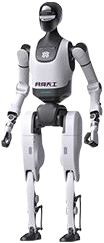
Tien Kung 2.0 (Chinese: 天工 2.0; pinyin: Tiangong 2.0) is a full-size, bipedal humanoid robot developed by the Beijing Humanoid Robot Innovation Center, commonly known as X-Humanoid. Unveiled in April 2025, it is the second-generation platform in the Tiangong ("Heavenly Craft") series and represents a comprehensive upgrade over the original Tiangong 1.0 in hardware, endurance, and application readiness. The name "Tien Kung" is a Wade-Giles-influenced romanization of the same Chinese characters (天工); the standard pinyin romanization is "Tiangong."
| Tien Kung 2.0 | |
|---|---|
 | |
| General information | |
| Manufacturer | Beijing Humanoid Robot Innovation Center (X-Humanoid) |
| Country of origin | China |
| Year revealed | 2025 |
| Predecessor | Tiangong 1.0 (April 2024) |
| Successor | Tiangong 3.0 (February 2026) |
| Status | Production / Deployed |
| Locomotion | Bipedal (fully electric) |
| AI platform | Wise KaiWu (Huisi Kaiwu) |
| Website | x-humanoid.com |
Tien Kung 2.0 is notable as China's first humanoid robot to achieve adaptive walking across complex outdoor terrain using real-time visual perception rather than pre-scanned 3D maps.[1] In February 2025, a pre-release version of the platform set a world-first record by autonomously climbing 134 irregular outdoor stairs at Haizi Wall Park in Beijing, navigating uneven step heights, loose stonework, and damaged surfaces without a single misstep.[2] The robot has since been deployed on live industrial production lines, used for athletic shoe testing at the Li-Ning Sports Science Lab, and demonstrated autonomous parts sorting at the 2025 World Robot Conference (WRC) and CES 2026.[3][4]
Tien Kung 2.0 is one member of a broader product family built on the open-source Tiangong platform. The same base technology has spawned derivative robots including the wheeled Tian Yi 2.0 for indoor industrial applications and the research-grade UBTECH Walker Tienkung, a jointly developed platform priced for academic institutions.
Background
Beijing Humanoid Robot Innovation Center
The Beijing Humanoid Robot Innovation Center (formally Beijing Innovation Center of Humanoid Robotics Co., Ltd.) was established on November 2, 2023, in the Beijing Economic-Technological Development Area (Beijing E-Town or Yizhuang).[5] It was jointly founded by four entities: Beijing Jingcheng Machinery Electric Company (28.57% stake), Xiaomi Robotics Technology (28.57%), UBTECH Robotics (28.57%), and Beijing Yizhuang Robotics Technology Industry Development, a state-owned subsidiary (14.29%). The center's general manager is Xiong Youjun, who also serves as UBTECH's chief technology officer.[6]
The center was China's first innovation platform dedicated specifically to core humanoid robot technologies, product development, and application ecosystem construction. Rather than manufacturing products for direct sale, the center focuses on conquering critical common technologies that have stalled the industry's progress and sharing its achievements through open-source releases.[7] In October 2024, it was upgraded to the status of a National and Local Co-built Embodied Artificial Intelligence Robotics Innovation Center, receiving support from both the Beijing municipal government and China's central government.[8]
In February 2026, X-Humanoid closed its first market-oriented funding round, raising over 700 million yuan (approximately $100 million USD). The round was led by state-linked investors including the Beijing Artificial Intelligence Industry Investment Fund, Yizhuang State-owned Assets Investment Co., and the Beijing Gaojingjian Industrial Development Investment Fund, with strategic participation from Baidu, Kyland Technology, Shun Xi Fund, and Tsinghua Holdings Capital.[9]
The Original Tiangong (1.0)
The original Tiangong humanoid robot was unveiled on April 27, 2024, at the Zhongguancun Forum in Beijing. It was described as the world's first full-size humanoid robot capable of human-like running using a purely electric drive system, distinguishing it from hydraulic platforms that dominated the field at the time.[10] Standing 163 cm tall and weighing approximately 43 kg, the original Tiangong demonstrated a steady jogging speed of 6 km/h and the ability to navigate slopes, stairs, grass, gravel, and sand.
Following the initial release, the platform evolved through several sub-versions before the 2.0 generation:
| Version | Focus | Key Characteristics |
|---|---|---|
| Tiangong 1.0 LITE | Locomotion | Human-like walking and running on pure electric drive |
| Tiangong 1.1 PRO | Coordination | Upper and lower limb coordination; intelligent interaction; 42 degrees of freedom |
| Tiangong 1.2 MAX | Full integration | Fully linked embodied intelligence with closed-loop perception-decision-execution |
In November 2024, X-Humanoid launched the Tiangong Open Source Initiative, publicly releasing structural blueprints, software architecture documentation, and electrical system designs for the Tiangong 1.0 LITE and Tiangong Pro variants. By this point, the center reported that over 100 Tiangong units had been distributed, creating what it described as the world's largest open community for embodied intelligent robots.[11]
Development and Unveiling
Tien Kung 2.0 was formally unveiled in April 2025 at a post-race exhibition held alongside the Beijing Yizhuang Half Marathon. The presentation coincided with the debut of the Tiangong Ultra, a taller, endurance-optimized variant that won the world's first humanoid robot half-marathon that same day.[12] While the Ultra was designed for athletic feats and speed records, Tien Kung 2.0 was positioned as the industrially focused second-generation platform, emphasizing durability, modularity, and practical deployment readiness over raw athletic performance.
The development of Tien Kung 2.0 was driven by lessons learned from deploying first-generation Tiangong units in warehouse logistics and power plant patrol scenarios since mid-2024. The center identified several critical gaps: limited battery endurance for full-shift operation, insufficient upper-body payload for industrial material handling, and a need for more robust terrain adaptation algorithms beyond flat indoor surfaces.[7]
134-Stair Climb Record
On February 17, 2025, a pre-production Tien Kung prototype achieved a world-first milestone by autonomously climbing all 134 outdoor stairs at Haizi Wall Park in Beijing. The achievement was widely reported in Chinese and international media as a breakthrough demonstration of real-world bipedal mobility.[2]
Challenge Conditions
The Haizi Wall Park staircase presented conditions that were deliberately chosen for their difficulty. The stairs featured height disparities of up to 35 centimeters between consecutive steps, with several steps that were damaged, loose, or irregularly shaped. The conditions were described as challenging even for human climbers, making it a rigorous test of the robot's adaptive locomotion system.[2]
Technical Approach
Previous humanoid robots that attempted stair climbing typically relied on pre-scanned 3D models of the environment and fixed gait patterns. This approach failed in unpredictable outdoor terrain where steps varied in height and surface condition. Tien Kung's approach was fundamentally different: the robot integrated real-time visual perception directly into its movement algorithms, allowing it to dynamically assess each step's height, width, and surface quality and adjust its footfall in real time. This perception-driven locomotion enabled seamless, collision-free navigation of multi-level stairs without any prior mapping of the environment.[2]
The robot completed the entire staircase without stepping on edges, slipping, or falling. It also demonstrated the ability to maintain balance when subjected to external impacts, including absorbing the force of a 10 kg weight strike without losing stability.[13]
Significance
The stair-climbing record marked the transition of Tiangong from a platform optimized for speed on flat surfaces to one capable of navigating genuinely complex real-world environments. This capability opened the door to deployment scenarios such as building inspections, disaster response in damaged structures, mountainous terrain operations, and other settings where stairs, rubble, or irregular surfaces are the norm rather than the exception.
Technical Specifications
Tien Kung 2.0 introduced comprehensive hardware upgrades over the original Tiangong. The following specifications are drawn from official X-Humanoid disclosures, exhibition materials, and third-party analyses. Some specifications remain unpublished by the manufacturer as of early 2026.
Hardware Overview
| Category | Specification | Details |
|---|---|---|
| Physical | Height | ~170 cm |
| Weight | >45 kg | |
| Locomotion | Bipedal, fully electric | |
| Degrees of freedom | 20 (base configuration) | |
| Actuation | Joint type | Independently developed integrated joints |
| Torque | High precision, large torque (exact figures undisclosed) | |
| Drive | Fully electric (no hydraulics) | |
| Mobility | Maximum speed | 12 km/h (7.5 mph) |
| Terrain capability | Stairs, slopes, snow, gravel, sand, grass, uneven surfaces | |
| Stair climbing | 134 consecutive outdoor stairs (world first) | |
| Power | Battery system | Dual-battery hot-swapping (industry first for humanoid robots) |
| Hot-swap capability | Battery changes while powered on (no shutdown required) | |
| Energy management | Multi-condition energy control technology | |
| Computing | Platform | Edge-intelligent computing platform |
| Processing | Real-time intelligent decision-making | |
| Upper Body | Load capacity | Industrial-grade |
| Lower limb system | Fully flexible for complex terrain adaptation | |
| Sensing | Vision | RGB cameras, stereo cameras, 3D vision |
| Ranging | LiDAR, ultrasonic rangefinder | |
| Balance | High-precision IMU, gyroscope | |
| Force feedback | Six-axis force/torque sensors | |
| Software | AI platform | Wise KaiWu (Huisi Kaiwu) |
| Operating system | ROS 2 on real-time Linux | |
| Control algorithm | State-Memory-Based Predictive Reinforcement Learning Imitation Learning | |
| Connectivity | Wireless | Wi-Fi, 5G |
| Wired | Gigabit Ethernet | |
| Cloud | SSH, MQTT |
Key Hardware Improvements Over Tiangong 1.0
The most significant hardware change in Tien Kung 2.0 is the independently developed integrated joint system. These upgraded joints combine the motor, reducer, encoder, and controller into a single module, supporting a body weight exceeding 45 kg while maintaining precise and flexible motion control. The high-torque design greatly improves athletic performance and the robot's ability to adapt to complex industrial and outdoor scenarios.[1]
The lower limb system was redesigned to be "fully flexible," incorporating compliance elements that allow the robot to absorb impacts and adapt to uneven surfaces dynamically. This was a direct response to the limitations encountered when deploying first-generation units on surfaces that were not perfectly flat.
Dual-Battery Hot-Swap System
One of Tien Kung 2.0's most commercially significant innovations is its self-developed dual-battery hot-swapping system. This feature allows one battery to be removed and replaced while the other continues powering the robot, eliminating the need to shut down and restart during battery changes. X-Humanoid describes this as the first implementation of industrial-grade perpetual operation capability in a humanoid robot.[1]
Combined with multi-condition energy control technology that dynamically adjusts power consumption based on the robot's current activity (standing, walking, running, or performing manipulation tasks), the dual-battery system delivers substantially longer operational endurance than the original Tiangong. For industrial deployments where robots must operate across full work shifts, this capability addresses one of the most commonly cited barriers to practical humanoid robot adoption.
Wise KaiWu (Huisi Kaiwu) AI Platform
Tien Kung 2.0 runs on X-Humanoid's proprietary Wise KaiWu general-purpose embodied AI platform, which serves as the shared intelligence layer across all X-Humanoid products. The platform uses a dual-brain architecture:[7]
- "Embodied brain" (cortex): Handles high-level reasoning, task planning, and natural language understanding using world models and vision-language models (VLMs). It enables the robot to understand its environment semantically, identify objects, decompose complex tasks into steps, and make autonomous decisions.
- "Embodied cerebellum": Manages real-time motor control, balance, reflexive responses, and low-level locomotion using vision-language-action models (VLAs). On Tien Kung 2.0, this component handles gait generation, terrain adaptation, and disturbance recovery.
The platform's "one brain, multiple machines; one brain, multiple skills" capability allows the same AI models trained for Tien Kung 2.0 to be deployed on other platforms in the X-Humanoid family, including the wheeled Tian Yi 2.0 and the research-grade Walker Tienkung.[7]
Tiangong Ultra: The Athletic Variant
Alongside Tien Kung 2.0, X-Humanoid developed the Tiangong Ultra (also called Tien Kung Ultra), a taller, performance-optimized variant designed specifically for endurance and speed demonstrations.
| Specification | Tien Kung 2.0 | Tiangong Ultra |
|---|---|---|
| Height | ~170 cm | 180 cm |
| Weight | >45 kg | 52 kg |
| Top speed | 12 km/h | 12 km/h |
| Primary focus | Industrial deployment | Athletic endurance |
| Battery system | Dual hot-swap | Swappable (3 changes per half-marathon) |
Half-Marathon World Record
On April 19, 2025, Tiangong Ultra won the world's first humanoid robot half-marathon, held as part of the Beijing Yizhuang Half Marathon. The robot completed the 21.0975 km course in 2 hours, 40 minutes, and 42 seconds, maintaining a steady pace of approximately 10 km/h with occasional bursts up to 12 km/h. The battery was changed three times during the race.[12]
The second-place finisher was the N2 humanoid from NOETIX Robotics (3 hours 37 minutes), followed by Shanghai DroidUP's X02 (4 hours 9 minutes). For comparison, the human men's winner finished in 1 hour and 2 minutes.[14]
100-Meter Sprint Championship
At the inaugural World Humanoid Robot Games in Beijing in August 2025, Tiangong Ultra won the 100-meter sprint final with a fully autonomous time of 21.50 seconds, becoming the world's first humanoid robot sprint champion.[15]
The training methodology for these athletic achievements involved disturbance training for turning, slopes, and rugged surfaces, teaching the robot to adjust its gait and movements in real time for more stable and generalized running. These locomotion improvements were subsequently integrated back into the industrial Tien Kung 2.0 platform.
Industrial Deployments
Tien Kung 2.0 has been deployed in several real-world industrial settings, moving beyond the laboratory demonstrations that characterized the first-generation platform.
| Partner | Application | Details |
|---|---|---|
| Foton Cummins | Engine manufacturing | Autonomous bin pickup, transport, and placement on production lines |
| China Electric Power Research Institute | Power grid inspections | Equipment monitoring and patrol in electrical facilities |
| Li-Ning Group (Sports Science Lab) | Athletic shoe testing | Simulating human running gaits for footwear evaluation |
| Bayer | Pharmaceutical manufacturing | Industrial process applications |
The Foton Cummins deployment is especially notable because it represents one of the first cases of a humanoid robot operating autonomously on a live, unmanned production line at a major industrial facility. Both Tien Kung 2.0 and Tian Yi 2.0 operate on the same production line, with each robot handling tasks suited to its locomotion type: the bipedal Tien Kung navigates between workstations and handles tasks requiring mobility across varied surfaces, while the wheeled Tian Yi handles high-volume material transport along smooth corridors.[3]
The Li-Ning partnership puts Tiangong Ultra's athletic capabilities to practical commercial use. At the Li-Ning Sports Science Lab, the robot precisely simulates human running gaits to test athletic shoes under controlled, repeatable conditions, providing data that would be difficult to collect consistently from human test subjects.[4]
Exhibition Showcases
World Robot Conference 2025
At the 2025 World Robot Conference (WRC) in Beijing (August 8 to 12), Tien Kung 2.0 demonstrated autonomous production line parts sorting, embodying the center's motto of moving "from fastest to most useful." The conference also served as the launch venue for four core technologies:[16]
- "WU" World Model: An embodied world model trained on over 5,000 hours of video, providing predictive capabilities for understanding and anticipating physical-world changes
- Pelican-VL: A multimodal vision-language model for visual perception and language understanding in robotic contexts
- XR-1 VLA Model: A cross-ontology vision-language-action model that converts high-level instructions into precise physical actions, capable of transferring learned skills across different robot platforms (Tien Kung, UR-5e, Franka Emika Panda)
- UVMC (Unified Vision-Motion Codes): A technology building direct connections between visual perception and motor execution
CES 2026
X-Humanoid exhibited its full product lineup at CES 2026 in Las Vegas in January 2026. The Embodied Tien Kung 2.0 performed live autonomous parts sorting demonstrations, where it autonomously grasped, sorted, and placed components on a simulated production line. The demonstration highlighted three core capabilities: speed (via UVMC technology), accuracy (precise component handling), and resilience (robust bimanual coordination where if one arm missed a part, the other immediately compensated to maintain continuous operation).[3]
Chinese humanoid robot firms made up approximately half of all humanoid exhibitors at CES 2026, reflecting the rapid growth of China's robotics industry.[17]
Open-Source Contributions
A defining feature of the Tiangong platform, including Tien Kung 2.0, is X-Humanoid's commitment to open-source releases. The center's leadership has described the initiative as an effort to build "the Android of humanoid robotics," providing shared infrastructure that lowers barriers to entry for the entire industry.[6]
Open-Source Timeline
| Date | Release | Content |
|---|---|---|
| November 2024 | Tiangong Open Source Initiative launch | Structural blueprints, software architecture, electrical system documentation for Tiangong 1.0 LITE and Tiangong Pro |
| 2024 | RoboMIND dataset | 107,000+ demonstration trajectories across 479 tasks involving 96 object classes from four robot platforms |
| August 2025 | WU world model, Pelican-VL, XR-1 VLA | Core AI models for embodied intelligence |
| Late 2025 | XR-1 open-source release | China's first VLA model to pass national embodied intelligence standards |
| Ongoing | Training toolchains, URDF packages, simulation assets | Integration with LeRobot framework and physics simulators |
GitHub Organization
X-Humanoid maintains the Open X-Humanoid organization on GitHub, which hosts the following key repositories:[18]
| Repository | Description |
|---|---|
| TienKung-Lab | Reinforcement learning-based locomotion control using IsaacLab (674 stars) |
| XR-1 | Vision-language-action model for versatile robotic manipulation (209 stars) |
| x-humanoid-training-toolchain | Training framework adapted for LeRobot integration (48 stars) |
| TienKung_URDF | Complete robot description files (URDF) and mesh files (STL) for simulation |
| TienKung_ROS | Low-level hardware control system based on ROS |
| Deploy_Tienkung | Deployment utilities (C++) |
| RoboMIND-Sim | Simulation environment for the RoboMIND dataset |
| xSIM_MUJOCO | MuJoCo physics simulation integration |
The TienKung_URDF package is particularly valuable for the research community, as it includes complete mechanical structure definitions, joint limits, and mass distribution parameters, enabling researchers to develop and validate motion planning and control algorithms in ROS environments and Gazebo or Isaac Sim simulation platforms before deploying to physical hardware.[18]
RoboMIND Dataset
The RoboMIND (Multi-embodiment Intelligence Normative Data) dataset is one of the largest multi-embodiment teleoperation datasets collected on a unified platform. It includes data from four different robot platforms:[19]
| Platform | Trajectories |
|---|---|
| Franka Emika Panda (single-arm) | 52,926 |
| Tien Kung humanoid | 19,152 |
| AgileX Cobot Magic V2.0 (dual-arm) | 10,629 |
| UR-5e (single-arm) | 25,170 |
| Total | 107,877 |
The dataset also contains 5,000 real-world failure demonstrations with detailed cause annotations, making it useful for training robust manipulation policies that can handle and recover from errors. It is hosted on Hugging Face and has been downloaded over 15,000 times.[19]
Derivative Platforms
The Tiangong platform has served as the technological foundation for several derivative robots, each targeting different market segments.
Tian Yi 2.0
Tian Yi 2.0 (Chinese: 天轶 2.0) is a wheeled humanoid robot that combines a humanoid upper body for manipulation with a wheeled mobile base optimized for structured indoor environments. It shares the same Wise KaiWu AI platform and many perception components with Tien Kung 2.0 but trades bipedal locomotion for greater energy efficiency, faster indoor travel, and higher payload capacity on smooth floors. Tian Yi 2.0 has been deployed on production lines at Foton Cummins and won first and second place in the material-handling competition at the 2025 World Humanoid Robot Games.[3]
UBTECH Walker Tienkung
The UBTECH Walker Tienkung is a research-grade humanoid jointly developed by UBTECH and X-Humanoid, launched in March 2025. Priced at RMB 299,000 (approximately $41,300 USD) for the base configuration, it was the first research-grade humanoid robot priced under RMB 300,000.[20] The Walker Tienkung comes in two versions: a Voice and Vision version with 21 degrees of freedom and 275 TOPS of computing power, and an Embodied Intelligence version with 42 degrees of freedom, five-finger dexterous hands, and up to 550 TOPS of computing power. UBTECH opened over 300 patents to the innovation center and established a Humanoid Robot Research Fund with RMB 10 million ($1.38 million) to support global academic research on the platform.[20]
A more advanced variant, the Tiangong Walker DEX, was subsequently introduced with improved stability and coordination between motion and cognition functions.
Tiangong 3.0
The third-generation Embodied Tiangong 3.0 was launched on February 10, 2026. Standing 169 cm tall and weighing 62 kg, it features 43 degrees of freedom and is described as the industry's first full-size humanoid robot to achieve high-dynamic whole-body motion control through tactile interaction. Tiangong 3.0 has demonstrated parkour capabilities, including a one-handed vault over a 1-meter-high obstacle, somersaults, dancing, and millimeter-level precision manipulation for industrial tasks.[21]
Development Timeline
The following table summarizes the major milestones in the Tiangong/Tien Kung program:
| Date | Event |
|---|---|
| November 2, 2023 | Beijing Humanoid Robot Innovation Center established |
| April 27, 2024 | Tiangong 1.0 LITE unveiled at Zhongguancun Forum; world's first full-size purely electric running humanoid |
| Mid-2024 | Initial deployments begin (warehouse logistics, power plant patrols) |
| 2024 | Tiangong 1.1 PRO and 1.2 MAX variants developed with up to 42 DOF |
| October 2024 | Center upgraded to National and Local Co-built Embodied AI Robotics Innovation Center |
| November 2024 | Tiangong Open Source Initiative launched; over 100 units distributed |
| February 17, 2025 | Tien Kung prototype climbs 134 outdoor stairs at Haizi Wall Park (world first) |
| March 2025 | UBTECH Walker Tienkung launched jointly with UBTECH |
| April 19, 2025 | Tiangong Ultra wins world's first humanoid half-marathon (2:40:42); Tien Kung 2.0 formally unveiled |
| August 2025 | Tien Kung 2.0 demonstrates parts sorting at WRC 2025; WU, Pelican-VL, and XR-1 released |
| August 2025 | Tiangong Ultra wins 100m sprint at World Humanoid Robot Games (21.50 seconds) |
| January 2026 | Full product lineup exhibited at CES 2026 in Las Vegas |
| February 2026 | $100 million funding round closed; Tiangong 3.0 launched |
Intelligence Grading System
X-Humanoid, in collaboration with partner robotics firms including Unitree and UBTECH, helped develop a five-level intelligence grading system for humanoid robots. The system encompasses 22 core indicators and over 100 technical criteria, intended to establish standardized industry benchmarks for assessing humanoid robot capabilities. This grading framework aims to provide a common language for comparing humanoid platforms across manufacturers and to guide development priorities for the industry.[7]
Manufacturing and Infrastructure
X-Humanoid has established pilot manufacturing infrastructure to transition from prototype to volume production:
- Pilot verification platform in Yizhuang: Annual production capacity of 5,000 robot units, supporting both Tien Kung bipedal and Tian Yi wheeled platforms
- Embodied intelligence data training base at Beitou Taihu Industrial Park: Provides facilities for collecting, processing, and curating the large-scale datasets needed to train the Wise KaiWu AI platform's models[7]
The $100 million funding raised in February 2026 is earmarked in part for scaling this manufacturing capacity and expanding the embodied AI software development team.
Naming Conventions
The Tiangong robot family uses several naming conventions across Chinese and English contexts, which can cause confusion:
| Chinese | Pinyin | English Variant | Notes |
|---|---|---|---|
| 天工 | Tiangong | Tien Kung | The bipedal humanoid series; "Tien Kung" follows Wade-Giles-influenced romanization |
| 天轶 | Tianyi | Tian Yi | The wheeled humanoid platform; distinct Chinese characters from Tiangong |
| 天工行者 | Tiangong Xingzhe | Walker Tienkung / Tiangong Walker | The UBTECH research variant; "xingzhe" means "walker" or "traveler" |
| 天工超越 | Tiangong Chaoyue | Tiangong Ultra / Tien Kung Ultra | The athletic/endurance variant; "chaoyue" means "surpassing" |
| 慧思开悟 | Huisi Kaiwu | Wise KaiWu | The AI platform name; not a robot model |
All variants share the Wise KaiWu AI platform and common technology heritage, but they target different market segments and have distinct hardware configurations.
See Also
- Humanoid robots
- Beijing Humanoid Robot Innovation Center
- Tian Yi 2.0
- UBTECH Walker Tienkung
- UBTECH
- Embodied AI
- Reinforcement learning
- Computer vision
- Robot Operating System
References
- ^1 ^2 ^3Beijing: Defining the "China Base" of the Humanoid Robot Industry, Gasgoo.
- ^1 ^2 ^3 ^4China's humanoid robot climbs 134 steps to set a world-first record, Interesting Engineering, February 2025.
- ^1 ^2 ^3 ^4Humanoid robots show autonomous sorting and mobility at CES 2026, Engineering.com, January 2026.
- ^1 ^2Marathon-winning Tiangong humanoid robot is working in factories and testing shoes, Interesting Engineering.
- ^Beijing Establishes Humanoid Robot Innovation Center, Beijing Municipal Government, November 2023.
- ^1 ^2China's humanoid robot half marathon winner wants to be 'Android' of robotics, South China Morning Post, April 2025.
- ^1 ^2 ^3 ^4 ^5 ^6China pools efforts to fuel development of embodied AI robotics, State Council of the People's Republic of China, October 2024.
- ^China launches open-source initiative for 'Tiangong' humanoid robot, State Council of the People's Republic of China, November 2024.
- ^China's X-Humanoid Raises $100M in First Funding Round, The AI Insider, February 2026.
- ^Chinese company unveils humanoid running robot with large-scale commercial potential, Global Times, April 2024.
- ^World's first electric running humanoid robot 'Tiangong' open sourced, to accelerate robots into human life, Global Times, November 2024.
- ^1 ^2Robot Sets World Record as First Humanoid to Complete Half-Marathon, Assembly Magazine, April 2025.
- ^Beijing's Tiangong Upgraded as Humanoid Robot Prepares for Race Day, Mike Kalil, 2025.
- ^Robots run a half-marathon, slowly, TechCrunch, April 2025.
- ^Tiangong Ultra clinches victory in 100m dash, EyeShenzhen, August 2025.
- ^Tiangong 2.0 parts sorting at WRC; WU world model, Pelican VLM, and XR-1 VLA released, CyberRobo via X, August 2025.
- ^China's humanoid robot firms make up half of exhibitors at CES 2026, Interesting Engineering, January 2026.
- ^1 ^2Open X-Humanoid GitHub Organization, GitHub.
- ^1 ^2RoboMIND: Benchmark on Multi-embodiment Intelligence Normative Data for Robot Manipulation, X-Humanoid RoboMIND Project.
- ^1 ^2UBTECH launches Tiangong Walker, a research humanoid robot, TechNode, March 2025.
- ^Beijing's Humanoid Robots See Another Upgrade: New Generation General-Purpose Robot Tien Kung 3.0 Launched, Beijing Municipal Government, February 2026.
Improve this article
Add missing citations, update stale details, or suggest a clearer explanation. Every suggestion is reviewed for sourcing before it goes live.
7 revisions · v7 · 4,317 words · full history
Fact-checks are independent of edits: a reviewer re-verifies the article against its sources and stamps the date. How we verify
Research and drafting on this wiki are AI-assisted, under named human editorial standards. How AI is used here
Cite this page: AI Wiki. "Tien Kung 2.0." aiwiki.ai, updated 12 Apr 2026. CC BY 4.0. https://aiwiki.ai/wiki/x_humanoid_tien_kung_2