

Zeroth M1
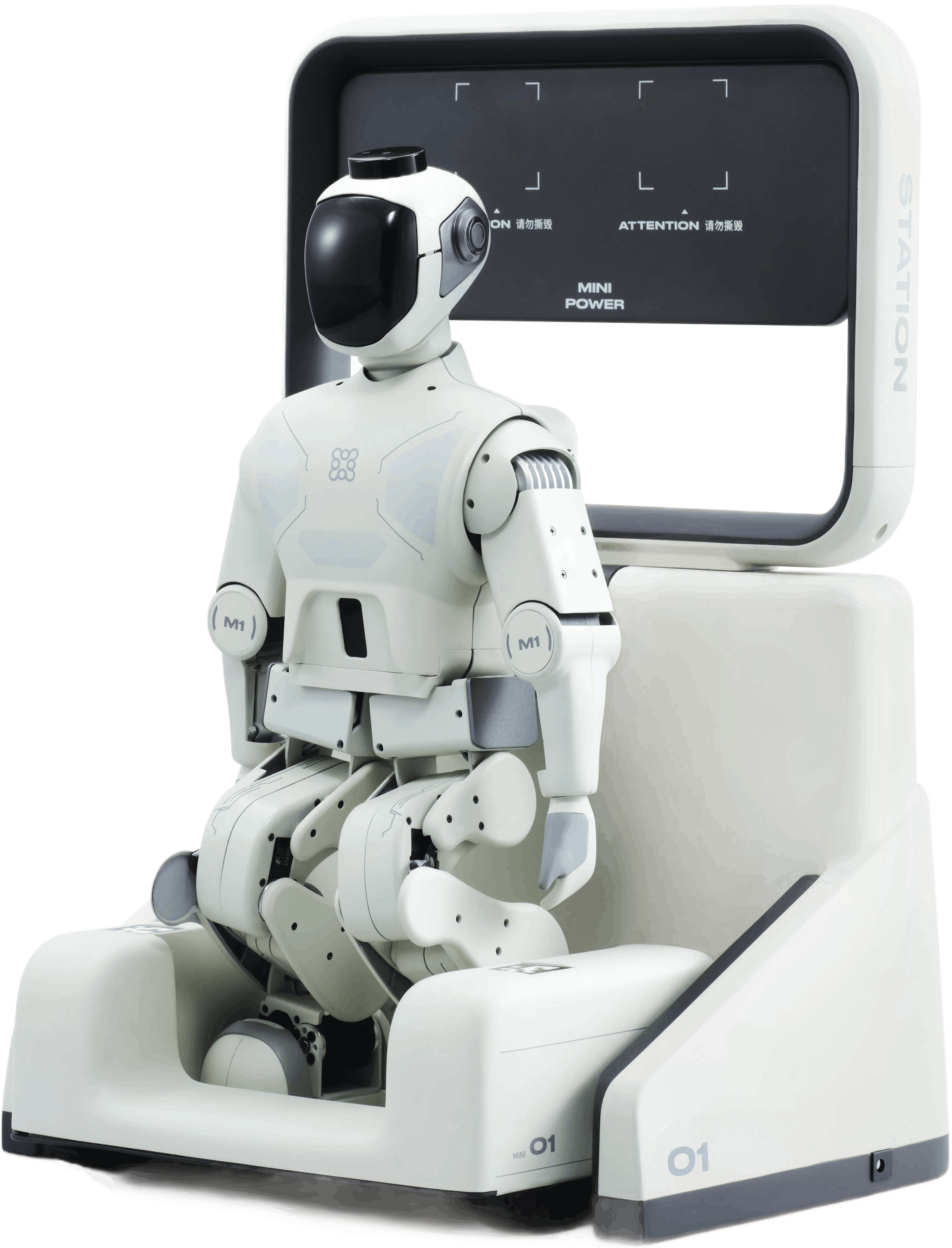
The Zeroth M1 is a compact humanoid robot developed by Zeroth Robotics, an AI robotics company operating under Suzhou JoyIn Intelligent Technology Co., Ltd. Standing approximately 494 mm (19.4 inches) tall and weighing 6.2 kg, the M1 is designed as an embodied intelligence home companion capable of natural language conversation, daily assistance, safety monitoring, and interactive learning. It was unveiled at CES 2026 in Las Vegas as Zeroth Robotics' flagship consumer product and the company's first commercial offering in the United States.[1][2]
| Zeroth M1 | |
|---|---|
 | |
| General information | |
| Manufacturer | Zeroth Robotics |
| Country of origin | China (U.S. market launch) |
| Year introduced | 2026 |
| Status | In production |
| Price | $2,499 USD as listed September 2026; $2,899 at the CES 2026 launch |
| Website | zeroth0.com |
The M1 is notable for its hybrid locomotion system, which combines bipedal walking with wheeled movement, its integration of Google Gemini as its core AI model, and its aggressive consumer pricing that undercuts most humanoid robots on the market by a wide margin. Pre-orders opened in early 2026 with general availability and shipping planned for April 2026, a target the company later moved: founder Renjie Guo told CNBC on 1 July 2026 that he planned to begin overseas sales in North America and Europe that autumn, once the company had cleared local compliance requirements.[3][17]
Zeroth Robotics
Zeroth Robotics was founded in December 2024 by Renjie Guo, a veteran executive in the consumer robotics industry; Chinese robotics trade press gives the establishment date of the registered entity, 苏州乐享智能科技有限公司, as 19 December 2024.[15] Guo entered Xi'an Jiaotong University at the age of 15 and holds degrees in engineering, economics, and financial economics. Before founding Zeroth, he served as China President of Dreame Technology, where he led a team of over 1,500 employees and took the China business from zero to about 6 billion yuan in annual sales, according to Chinese trade press and to an interview with him published in July 2026.[15][16] Prior to Dreame, Guo worked at Procter & Gamble.[4][5][15]
The company's leadership team includes two other notable figures from the consumer robotics industry. Wang Hui serves as Chief Operating Officer, bringing 17 years of experience at ECOVACS Robotics spanning R&D, supply chain management, and global marketing, during which she launched more than 50 robotic products and managed approximately RMB 10 billion in business volume. Tang Jinju serves as Chief Technology Officer; the company describes him as a former ECOVACS CTO with more than 20 years in technology leadership, who led the development of more than 50 robotic products.[4][18]
Zeroth Robotics operates under Suzhou JoyIn Intelligent Technology Co., Ltd., which the company's own site describes as a high-tech enterprise working on robotics and artificial intelligence. The company is based in Suzhou, in Jiangsu province: CNBC names Suzhou JoyIn Intelligent Technology as the Chinese entity behind the Zeroth brand, and the Zeroth store footer carries the Jiangsu ICP filing number 苏ICP备2025182809号. The company has secured over US$70 million in angel funding to support its research, development, and go-to-market expansion in North America and Asia.[4][6][17][18] Zeroth describes itself as "an AI robotics company on a mission to bring practical, emotionally aware robots into everyday life."[1]
Development and announcement
Zeroth Robotics operated in stealth mode from its founding in 2024 until its public debut in January 2026. The company held a brand launch event on January 5, 2026, in Las Vegas, featuring an in-person presentation with a global live stream. This was immediately followed by the company's participation at CES 2026 (January 6-9, 2026), where Zeroth maintained a dedicated booth (No. 10748) in the North Hall's micromobility section.[1][7]
At CES 2026, Zeroth unveiled a portfolio of five robots spanning consumer, developer, and commercial segments. The M1 was positioned as the lead product, with hands-on demonstrations available at the booth. The company announced that pre-orders for the M1 would open in Q1 2026, with an initial price point of $2,899 and general availability targeted for April 2026. Both the price and the date have moved since. Checked on 13 September 2026, the official product page lists the M1 at $2,499: the purchasable variant is titled "M1 - 2499", the page's structured product data gives the price as 2499.00 US dollars, and the page carries no higher list price and no shipping date.[2][8]
Prior to the U.S. launch, Zeroth showcased its technology at Bridge Summit 2025 in Abu Dhabi, where founder Renjie Guo participated in a panel discussion on the future of robotics. Guo emphasized that the industry "should not only focus on the iteration of technical parameters but also pay more attention to combining with real social needs," identifying emotional companionship and life assistance as "the key paths for robots to move from the laboratory to real life."[9]
Design
Physical design
The M1 adopts a compact, approachable humanoid form factor intended to be non-threatening for users of all ages. At 494 mm (19.4 inches) in height and 6.2 kg in weight, it is significantly smaller than most humanoid robots, which typically range from 1.2 to 1.8 meters in height. The robot's body is constructed from a combination of stainless steel, aluminum alloy, ABS plastic, rubber, silicone, and glass, creating a lightweight but durable structure. Its width measures 125 mm and its depth is 195 mm.[3][10]
The design philosophy reflects Zeroth's belief that "emotional connection matters" in consumer robotics. Rather than pursuing an industrial or utilitarian aesthetic, the M1 is shaped to feel like a companion. Multiple media outlets compared the robot's appearance to characters from animated films, with Yanko Design noting that Zeroth had "designed the WALL-E robot every millennial wanted."[11]
Locomotion system
One of the M1's distinguishing technical features is its dual locomotion system. The robot can operate in two movement modes:
| Mode | Type | Speed | Use case |
|---|---|---|---|
| Bipedal | Walking on two legs | 0.05 m/s | Desktop operation, demonstration |
| Wheeled | Rolling on integrated wheels | 0.6 m/s | Floor navigation, room-to-room travel |
The bipedal mode gives the M1 the ability to walk on surfaces such as desktops, while the wheeled mode provides faster and more efficient floor-level navigation. The robot can handle a maximum step height of 40 mm. The M1 also features self-recovery capabilities, meaning it can fall and right itself in both desktop and floor operating modes.[3][12]
Technical specifications
| Category | Parameter | Value |
|---|---|---|
| Physical | Height | 494 mm (19.4 in) |
| Width | 125 mm | |
| Depth | 195 mm | |
| Weight (with battery) | 6.2 kg | |
| Materials | Stainless steel, aluminum alloy, ABS plastic, rubber, silicone, glass | |
| Mobility | Degrees of freedom | 20 |
| Locomotion types | Bipedal walking + wheeled | |
| Max speed (wheeled) | 0.6 m/s | |
| Max speed (bipedal) | 0.05 m/s | |
| Max step height | 40 mm | |
| Sensors | LiDAR | LDS LiDAR (full-home mapping) |
| Depth sensor | iTOF (indirect time-of-flight) | |
| Camera | RGB vision camera | |
| IMU | 6-axis (posture and motion tracking) | |
| Microphones | 3-microphone circular array (16 ft / ~5 m range) | |
| Power | Battery life | ~120 minutes (active use) |
| Charging time | ~60 minutes (fast charge) | |
| Docking | Automatic return to charging dock | |
| AI | AI model | Google Gemini |
| Voice interaction | Multilingual conversational AI | |
| Actuators | Type | Standard precision servos |
| Software | Platform | Proprietary "Technology DNA" stack with open multi-language programming support |
| Updates | OTA (over-the-air) for at least 5 years |
Sensor suite
The M1 integrates a multi-modal perception system composed of several sensor types. The LDS LiDAR sensor provides 360-degree environmental mapping of the home, enabling the robot to build and navigate a spatial map of indoor spaces. An indirect time-of-flight (iTOF) depth sensor detects smaller obstacles and provides spatial awareness at close range. RGB vision cameras handle visual recognition, object identification, and obstacle avoidance. A 6-axis inertial measurement unit (IMU) tracks the robot's posture and motion, supporting balance during bipedal walking and self-recovery after falls.[3][10]
For audio input, the M1 uses a 3-microphone circular array capable of capturing voice commands from up to 16 feet (approximately 5 meters) away. This microphone configuration supports directional voice detection and noise filtering for reliable speech recognition in typical home environments.[10]
AI and software platform
The M1 runs on Google Gemini, enabling it to conduct conversational interactions, process natural language commands, and recognize contextual cues in its environment. The AI system supports multilingual voice interaction and can be accessed through both voice commands and a companion smartphone application.[2][3]
Zeroth has built its software ecosystem around what it calls its "Technology DNA," a unified stack shared across all of the company's robot products. This foundation consists of three pillars: advanced motion control software for natural movement, an adaptive interaction model that learns from user behavior over time, and proprietary actuator engineering that enables compact, high-performance designs.[1][5]
The M1 ships with a set of built-in skills at launch. Additional capabilities can be added through an app-based ecosystem and over-the-air (OTA) software updates. Zeroth has committed to providing OTA updates for at least five years, delivering new skills, behavioral improvements, and security patches over the robot's lifespan.[1][7]
For developers and technically inclined users, the M1 supports an open multi-language programming platform, VR integration, and reinforcement learning tools. This allows users to extend the robot's functionality, create custom behaviors, and experiment with robotics programming.[3]
Features and capabilities
Elderly care and safety
The M1's primary consumer use case centers on supporting independent living for older adults. The robot provides several safety-oriented features:
- Fall detection: The M1 monitors its environment and can detect when a person has fallen, triggering alerts to family members or caregivers.
- Mobile safety checks: The robot can patrol the home and check on residents at scheduled intervals or on demand.
- Daily assistance and reminders: The M1 delivers gentle reminders for medications, appointments, meals, and other daily routines.
- Scam prevention: The robot includes intelligent alert capabilities designed to warn elderly users about potential phone or online scams.[2][12]
- Remote interaction: Family members can connect to the M1 remotely to check on loved ones and communicate through the robot.[12]
Family and children
For families with children, the M1 offers interactive learning and entertainment capabilities. It can assist with routines, homework reminders, and educational play. The robot's conversational AI allows children to ask questions and engage in age-appropriate dialogues. Parents can use the M1 as a "second-hand" childcare assistant that supports scheduling, reminders, and play activities.[1][2]
Pet monitoring
The M1 includes pet behavior monitoring capabilities, using its camera and sensor systems to observe and report on pet activity within the home. This feature allows pet owners to check on their animals remotely when away from the house.[12]
Self-recovery and autonomous operation
The M1 is designed for continuous autonomous operation within the home. It can fall and self-recover in both desktop and floor operating modes. When its battery runs low, the robot automatically returns to its charging dock without user intervention. With approximately two hours of active battery life per charge and a one-hour fast charging time, the M1 can maintain near-continuous presence throughout the day by cycling between active use and charging.[3][12]
Zeroth product lineup
The M1 is part of a broader five-robot portfolio that Zeroth unveiled at CES 2026. All products share the same Technology DNA platform, enabling consistent software updates and interoperability across the lineup.
| Robot | Type | Description | Price (USD) |
|---|---|---|---|
| M1 | Compact humanoid | Home companion for families and elderly care | $2,499 as listed September 2026; $2,899 at CES 2026 |
| W1 | Wheeled assistant | Autonomous wheel-based assistant for homes and light commercial use; about 20 kg (44 lb), carrying up to about 50 kg (110 lb) | $7,999 as listed September 2026; $5,599 at CES 2026 |
| WALL-E | Companion robot | Expressive programmable companion developed with Disney and Pixar; targeted at families, classrooms, and retail (initially China market) | Not announced |
| A1 | Quadruped | Agile, developer-ready quadruped for universities, engineers, and R&D teams | Not announced |
| Jupiter | Full-size humanoid | 1.65 m tall humanoid combining autonomous mobility with remote teleoperation for real-world tasks | $89,999 |
The WALL-E robot was developed in collaboration with Disney and Pixar and initially launched in the Chinese market. A version without Disney branding (the W1) is sold in the U.S. market, designed to avoid copyrighted design elements while retaining similar functional capabilities.[11][12]
Market positioning and competition
The M1 occupies a distinctive niche in the humanoid robotics market. While most humanoid robots target industrial, commercial, or research applications at price points ranging from $16,000 (Unitree G1) to over $100,000 for platforms like Figure 02 and Tesla Optimus, the M1 is explicitly designed and priced for the consumer home market.[3]
At a listed $2,499 in September 2026, against the $2,899 quoted at CES 2026, the M1 is among the most affordable humanoid robots available for purchase. This pricing strategy reflects Zeroth's ambition to bring embodied intelligence into ordinary households rather than limiting it to laboratories and factories. However, the M1's compact size and limited degrees of freedom (20 DOF) mean it is not designed for the physical manipulation tasks that larger humanoids target. Instead, it competes more directly with home assistant robots and companion robots in terms of use cases.
The consumer home robot market in 2026 includes products from companies such as Amazon (Astro), Samsung, and various Chinese manufacturers. The M1 differentiates itself by offering a humanoid form factor with bipedal walking capability at a price point similar to high-end consumer electronics, rather than the wheeled-only designs common among home robots.
Zeroth's broader strategy, spanning from the $2,499 M1 to the $89,999 Jupiter, positions the company across multiple market segments. The company's leadership team, drawn from ECOVACS and Dreame, brings deep experience in mass-market consumer robotics, suggesting a focus on manufacturing efficiency and distribution scale that many robotics startups lack.[4][5]
Relationship to the Zeroth Bot project
The Zeroth M1 by Zeroth Robotics (zeroth0.com) should not be confused with the Zeroth Bot, a separate open-source humanoid robot project developed by K-Scale Labs. Despite the similar naming, the two are distinct and unaffiliated efforts.
The Zeroth Bot (also called Zeroth-01) is a 3D-printed, fully open-source miniature humanoid robot starting at $350, created by Jingxiang Mo, Kelsey Pool, and Denys Bezmenov. It is powered by a dual-core RISC-V processor (Milk-V DUO S with SG2000 SoC), features 18 metal gear actuators, and runs on the K-Scale Labs open-source software ecosystem (PyKOS for Python control, KOS for Rust-based real-time performance). The project uses the GitHub organization name "zeroth-robotics" and is licensed under the MIT License.[13][14]
In contrast, the Zeroth M1 is a commercial consumer product from a venture-funded company with proprietary technology. While the M1 does offer an open multi-language programming platform for developers, its core AI stack and Technology DNA platform are proprietary.[1][3]
| Feature | Zeroth M1 (Zeroth Robotics) | Zeroth Bot (K-Scale Labs) |
|---|---|---|
| Price | $2,499 as listed September 2026 | From $350 |
| Height | 494 mm | ~300 mm |
| DOF | 20 | 18 |
| Processor | Proprietary (not disclosed) | RISC-V (Milk-V DUO S) |
| Software | Proprietary Technology DNA | Open-source (MIT License) |
| AI model | Google Gemini | EdgeVLA (vision-language-action) |
| Target user | Consumers, families | Developers, researchers |
| Manufacturer | Suzhou JoyIn Intelligent Technology | K-Scale Labs / community |
Reception
The M1 received significant media coverage following its CES 2026 debut. NotebookCheck described it as signaling that "WALL-E is back," highlighting its affordable pricing and home-focused design as a departure from the industrial humanoid robots that dominate the market.[2] Yanko Design praised the robot's approachable aesthetic, calling it "the WALL-E robot every millennial wanted."[11] RoboHorizon noted Zeroth's "aggressively low" pricing strategy as a direct challenge to competitors charging $90,000 to $250,000 or more for humanoid robots.[3]
Some observers expressed caution about the robot's limited bipedal walking speed (0.05 m/s) and the practical utility of a 15-inch companion robot compared to larger humanoids designed for physical tasks. The two-hour battery life was also noted as a constraint, although the automatic docking and fast charging features partially address this limitation.
The unveiling of the full five-robot lineup, including the Disney-Pixar collaboration, was widely covered as evidence of Zeroth's ambitions beyond a single product. The company's experienced leadership team, drawn from major consumer robotics companies, lent credibility to its ability to execute on manufacturing and distribution at scale.[4][5]
See also
- Humanoid robots
- Zeroth Robotics
- Google Gemini
- Consumer Electronics Show
- Unitree G1
- ECOVACS Robotics
- K-Scale Labs
- Degrees of freedom
References
- ^1 ^2 ^3 ^4 ^5 ^6 ^7Zeroth Robotics Launches into the U.S. with Debut Lineup of Interactive AI Robots for Consumer and Commercial Buyers - PR Newswire (January 4, 2026)
- ^1 ^2 ^3 ^4 ^5 ^6WALL-E is back: Zeroth Robotics unveils affordable home robot - NotebookCheck (January 2026)
- ^1 ^2 ^3 ^4 ^5 ^6 ^7 ^8 ^9 ^10Zeroth Crashes Robot Party With Sub-$3,000 Humanoid and Cargo Bot - RoboHorizon (January 2026)
- ^1 ^2 ^3 ^4 ^5Zeroth Robotics Company Profile - Aparobot
- ^1 ^2 ^3 ^4Zeroth Robotics Emerges from Stealth, Enters U.S. Market & Debuts Lineup of Interactive AI Robots - The AI Insider (January 5, 2026)
- ^Zeroth Robotics, Suzhou Joyin Technology Co., Ltd. - Portal of Robotics and Artificial Intelligence
- ^1 ^2Zeroth Announces January 2026 Key Events: Brand Launch - Zeroth Blog
- ^Zeroth M1 Product Page - Zeroth Official Website
- ^Zeroth Shines at Bridge Summit: Anchoring Robotics' Future in Social Value - Zeroth Blog
- ^1 ^2 ^3M1 Robot Details, Use Case and Specifications - Aparobot
- ^1 ^2 ^3Zeroth Just Designed the WALL-E Robot Every Millennial Wanted - Yanko Design (January 6, 2026)
- ^1 ^2 ^3 ^4 ^5 ^6Photos: New WALL-E inspired robots turn sci-fi into real-life home helpers - Interesting Engineering (January 2026)
- ^zeroth-robotics/zeroth-bot: 3D-printed open-source humanoid robot platform for sim-to-real and RL - GitHub
- ^Zeroth Bot: An Opensource RISC-V Powered Humanoid Robot - Circuit Digest
- ^1 ^2 ^3前追觅中国区执行总裁创业!成立仅一个月的具身智能机器人研发商「乐享科技」完成2亿元天使轮融资! - 机器人大讲堂 (February 7, 2025)
- ^对话乐享科技 CEO 郭人杰:具身智能有希望诞生苹果级别的公司,我们有机会成为这家 - 爱范儿 (July 3, 2026)
- ^1 ^2Alibaba-affiliate Ant Group rushes into humanoid robots with a dozen deals in 18 months - CNBC (July 1, 2026)
- ^1 ^2Who We Are: Zeroth, The Pioneer of Consumer-Grade Embodied Intelligence - Zeroth Official Website
Improve this article
Add missing citations, update stale details, or suggest a clearer explanation. Every suggestion is reviewed for sourcing before it goes live.
10 revisions · v10 · 3,135 words · full history
Fact-checks are independent of edits: a reviewer re-verifies the article against its sources and stamps the date. How we verify
Research and drafting on this wiki are AI-assisted, under named human editorial standards. How AI is used here
Cite this page: AI Wiki. "Zeroth M1." aiwiki.ai, updated 14 Sept 2026. CC BY 4.0. https://aiwiki.ai/wiki/zeroth_m1