

Cartwheel Yogi
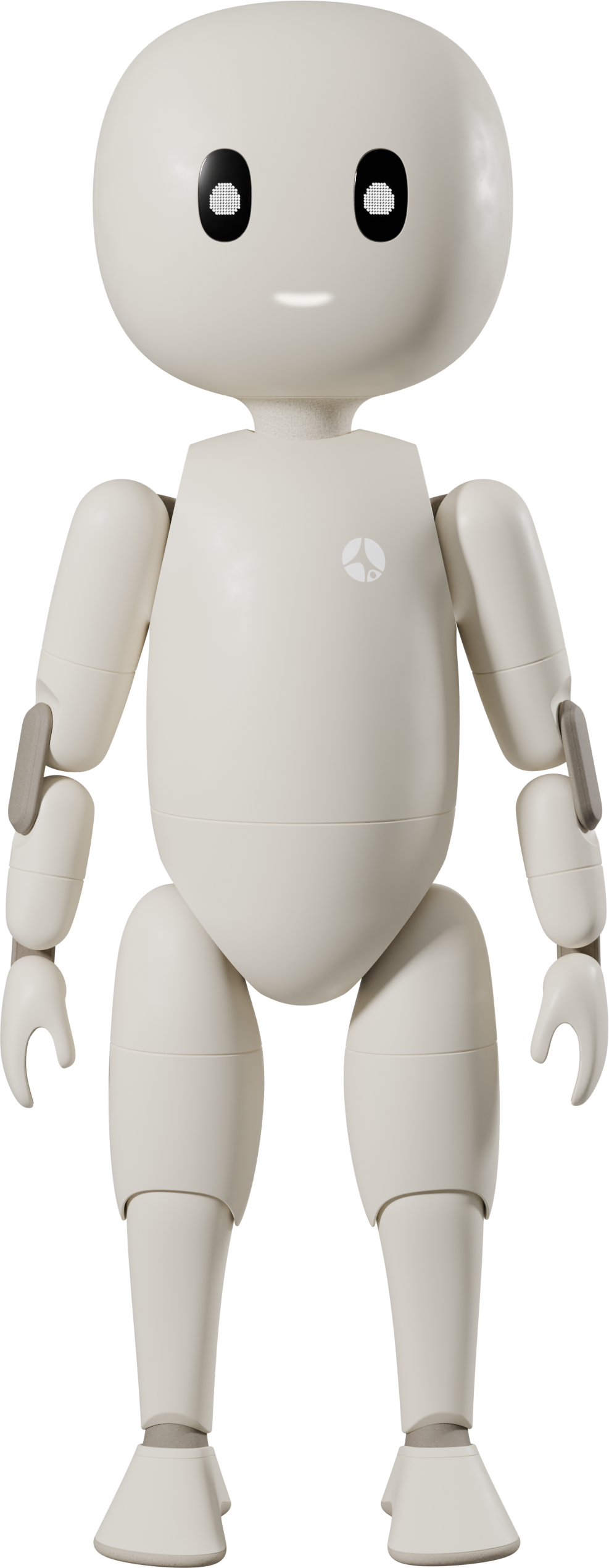
Yogi is a humanoid robot developed by Cartwheel Robotics, a robotics startup founded in 2021 and headquartered in Fallon, Nevada. Designed as a companion and social interaction robot rather than an industrial worker, Yogi featured child-like proportions, soft medical-grade silicone skin, and an AI-driven Motion Language Model (MLM) capable of generating expressive, emotionally resonant body movements from text or voice commands. The robot stood approximately 76 centimeters tall with over 50 degrees of freedom, custom actuators, and a hollow skeletal structure designed for thermal management.
 | |
| Developer | Cartwheel Robotics |
| Type | Humanoid robot |
| Country of origin | United States |
| Year unveiled | 2025 |
| Height | 76 cm (2 ft 6 in) |
| Weight | 8 kg (17.6 lb) |
| Degrees of freedom | 50+ |
| Battery | Lithium-ion (swappable), ~3 hours runtime |
| AI system | Motion Language Model (MLM) |
| Materials | Medical-grade silicone, aluminum, composite |
| Status | Cancelled (company shut down February 2026) |
| Website | cartwheelrobotics.com |
Cartwheel Robotics was founded by Scott LaValley, a veteran robotics engineer who previously spent seven years at Boston Dynamics working on the PETMAN and Atlas humanoid robots and five years at Walt Disney Imagineering leading the development of the autonomous Baby Groot robot through a program known as Project Kiwi. The company emerged from stealth in early 2025 with the goal of building "lovable" humanoids for homes, healthcare, hospitality, and entertainment. However, Cartwheel Robotics shut down in February 2026 after failing to secure sufficient funding, having raised only $3 million in outside capital with a team of seven employees.
Background
Cartwheel Robotics
Cartwheel Robotics was founded in November 2021 by Scott LaValley and his sister Samantha Conway in Fallon, Nevada. LaValley served as both CEO and CTO, while Conway served as COO. The company was initially funded through robotics engineering services provided to other businesses, supplemented by an initial funding round.[1][2]
The founding vision grew directly from LaValley's experiences at Boston Dynamics and Walt Disney Imagineering. At Boston Dynamics from 2009 to 2016, LaValley served as lead mechanical engineer and hardware lead on the company's three humanoid robot programs: PETMAN (Protection Ensemble Test Mannequin, the first bipedal robot built for evaluating Army chemical protection suits), Atlas One, and Atlas Two. He also contributed to Rex, a six-legged robot platform, and participated in the DARPA Robotics Challenge. During his tenure, LaValley created many of the complex robotic mechanisms and actuators used in Boston Dynamics' humanoid systems.[3][4]
After leaving Boston Dynamics, LaValley joined Walt Disney Imagineering as a principal imagineer from 2016 to 2021. There he led Project Kiwi, an initiative to build a free-walking, autonomous robotic character at the scale of an actual animated character. The first character realized through Project Kiwi was Baby Groot from Marvel's Guardians of the Galaxy franchise. The Baby Groot robot stood 76 centimeters tall, featured over 50 degrees of freedom, and used custom-built actuators because no commercially available components met the team's requirements for the small form factor. The robot was battery-powered and capable of autonomous interaction with theme park guests.[5][6] LaValley also contributed to Disney's BDX Droids projects during his time as an Imagineer.
A pivotal observation shaped LaValley's thinking about the future of humanoid robotics. He noticed that when his children saw Boston Dynamics' Atlas robot, they reacted with fear. But when they encountered Baby Groot, they responded with delight and affection. This contrast convinced LaValley that the robotics industry had become too focused on technical capability and cost reduction while neglecting whether people would actually want to live alongside robots.[7]
Founding philosophy
LaValley publicly criticized the design direction of most humanoid robot companies, describing their creations as "terrifying," "unfriendly," and "unsafe." He argued that the industry's focus on industrial automation and labor cost reduction overlooked the fundamental challenge of social acceptance. In an interview with The Register in September 2025, LaValley stated: "The pendulum is so pegged toward these robots as tools, and as a way of performing tasks and augmenting human labor in a lower-cost way" while neglecting whether humans would embrace them in daily life.[8]
Rather than building what he called a "soulless tool," LaValley set out to create "a character that happens to be empowered with humanoid technology." The company's stated mission was to build robots that offered "joy, warmth, and a bit of everyday magic" through emotional connection and social engagement.[7][8]
Design
Physical appearance
Yogi's physical design deliberately departed from the tall, angular, industrial aesthetics common among humanoid robots from companies like Tesla, Figure AI, and Boston Dynamics. Instead, the robot adopted "toddler proportions," featuring a large rounded head, wide expressive eyes, rounded body lines, and a slightly chubby build. Multiple commentators compared Yogi's appearance to Baymax from Disney's Big Hero 6 and Casper the Friendly Ghost.[9][10]
The design choices were intentional. Research in human-robot interaction has shown that robots with childlike proportions and rounded features tend to elicit more positive emotional responses and lower perceived threat levels. By making Yogi small (76 cm tall, roughly the height of a toddler) and visually approachable, Cartwheel aimed to create a robot that people, including children and elderly individuals, would feel comfortable interacting with physically.
Materials and safety
Yogi's exterior was covered in soft, medical-grade silicone skin designed to feel gentle to the touch and safe for physical contact. The silicone was durable enough for real-world use while remaining soft enough for comfortable interaction with children and families. Beneath the silicone exterior, the robot used an aluminum and composite skeletal structure.[11]
The structural design incorporated a hollow skeletal frame that served a dual purpose: reducing weight and providing pathways for internal cooling. This approach addressed one of the persistent engineering challenges in small-scale humanoid robots, where tightly packed actuators and electronics generate significant heat in a confined space.[10]
Actuators and mechanical systems
Yogi's mechanical design drew heavily on LaValley's experience building custom actuators for both Boston Dynamics' Atlas and Disney's Baby Groot. The robot used precision-engineered, high-torque brushless servo actuators with integrated overload protection mechanisms to safeguard the gearbox during unexpected impacts or excessive loads. The actuators achieved what the company described as "industry-leading torque density," enabling powerful yet fluid motion within the robot's compact frame.[11][12]
The overload protection was particularly important given Yogi's intended use in close proximity to humans, where accidental collisions or unexpected forces are inevitable. The actuator design allowed the robot to absorb impacts without damaging internal components, while also limiting the force the robot could exert on its surroundings.
Technical specifications
| Category | Parameter | Value |
|---|---|---|
| Physical | Height | 76 cm (2 ft 6 in) |
| Physical | Shoulder width | 40 cm |
| Physical | Depth | 30 cm |
| Physical | Weight | 8 kg (17.6 lb) |
| Physical | Exterior material | Medical-grade silicone |
| Physical | Skeletal material | Aluminum and composite |
| Physical | IP rating | IP42 |
| Mobility | Degrees of freedom | 50+ |
| Mobility | Locomotion type | Bipedal |
| Mobility | Walking speed | 1.5 km/h (0.9 mph) |
| Mobility | Surface compatibility | Flat indoor surfaces |
| Manipulation | Carrying capacity | 2 kg per arm |
| Manipulation | Maximum deadlift | 5 kg |
| Power | Battery type | Lithium-ion (removable/swappable) |
| Power | Battery capacity | 250 Wh |
| Power | Runtime | ~3 hours |
| Power | Charging time | ~2 hours |
| Power | Average power consumption | 40 W |
| Sensors | Vision | RGB cameras |
| Sensors | Depth | Depth sensors |
| Sensors | Audio | Microphones |
| Sensors | Touch | Tactile sensors (embedded in silicone skin) |
| Sensors | Orientation | Inertial measurement unit (IMU) |
| Sensors | Ambient | Light sensor (head-mounted) |
| AI | Core AI system | Motion Language Model (MLM) |
| AI | Cloud services | Cloud-based AI for learning |
| AI | NLP | Natural language processing |
| Connectivity | Wireless | Wi-Fi, Bluetooth 5.0 |
| Connectivity | Ports | USB-C, Ethernet, GPIO |
| Interface | Display | Touchscreen (chest-mounted) |
| Interface | Control | Voice commands, mobile app (iOS/Android) |
| Environment | Operating temperature | 10 to 40 degrees C |
| Environment | Humidity tolerance | 20 to 80% (non-condensing) |
| Environment | Noise level | 45 dB |
| Environment | Drop resistance | Up to 0.5 m |
| Other | LED mood indicator | Head-mounted |
| Other | OTA updates | Supported |
Motion Language Model
The core differentiating technology behind Yogi was Cartwheel's proprietary Motion Language Model (MLM), a generative AI system that converted text or voice commands into expressive, full-body robotic movement in real time. The MLM was developed under the leadership of Esteve Valls Mascaro, Cartwheel's Senior AI Engineer, who brought expertise in human intention recognition and prediction from his doctoral research at the Autonomous Systems Lab at TU Wien (Vienna University of Technology).[13][14]
How the MLM worked
Traditional approaches to robot motion rely on pre-programmed animations or scripted movement sequences. Each behavior must be manually choreographed, limiting the range and naturalness of a robot's physical expression. The MLM took a fundamentally different approach by using generative AI to produce movement from simple natural language prompts.
When given an input such as "dance happily" or "wave goodbye sadly," the MLM generated unique, contextually appropriate full-body motion sequences that conveyed the specified emotion through posture, gesture speed, amplitude, and timing. The system could produce dynamic movements including dances, cartwheels, personalized gaits, and emotional expressions. Crucially, each generated motion was unique; even identical inputs would produce slightly different outputs, creating the appearance of spontaneous, lifelike behavior rather than mechanical repetition.[13][15]
Scott LaValley demonstrated the MLM's capabilities in a video posted to social media, showing Yogi's head and torso performing fluid dancing motions that observers initially mistook for computer animation. LaValley emphasized: "This isn't animation. This is Yogi, our humanoid robot, dancing in the real world."[15]
Broader significance
The MLM represented Cartwheel's vision for a new category of robot intelligence focused on embodied emotional expression rather than task completion. While most robotics AI research in 2024 and 2025 focused on vision-language-action models for manipulation tasks (such as Figure AI's Helix or Google DeepMind's RT-2), Cartwheel's MLM addressed a different problem: generating believable, emotionally resonant physical behavior that would make a robot feel like a living presence rather than a tool.
The company developed all of its AI software in-house, including custom state estimators, motion language models, and Model Predictive Control systems. LaValley noted in his interview with The Register that the company was "not using ROS," instead building specialized proprietary systems optimized for real-time, biologically natural motion generation.[8]
Sensor suite
Yogi incorporated a multimodal sensor array designed to enable awareness of its environment and the people within it.
The robot's vision system combined RGB cameras for color imaging with depth sensors for three-dimensional spatial understanding. Microphones enabled voice recognition and natural language interaction. An array of tactile sensors embedded throughout the silicone skin allowed Yogi to detect physical contact, enabling it to respond appropriately to touch, such as being petted or hugged. An inertial measurement unit (IMU) provided orientation and balance data for bipedal locomotion, while a head-mounted light sensor helped the robot adapt its behavior to ambient lighting conditions.[11][16]
The chest-mounted touchscreen served as both a display for visual feedback (such as facial expressions or status indicators) and an input device for direct interaction. An LED mood indicator on the head provided at-a-glance information about the robot's current emotional state or operational mode.
Speedy platform
Alongside Yogi, Cartwheel developed a second robot called Speedy. Designed as a less complex, more modular commercial platform, Speedy was intended as the company's near-term revenue product while Yogi continued development toward its long-term vision of a home companion.
Speedy featured a simplified design with a special torso configured to accept different "costumes" or character skins, allowing the robot to be customized to embody various characters for different venues and applications. This modular approach meant that a single Speedy platform could appear as different characters at museums, science centers, theme parks, or retail environments.[7][17]
Cartwheel planned to begin delivering Speedy units to museums and science centers within 12 months of the company's emergence from stealth in early 2025. Speedy served as the more immediate commercial product while Yogi remained the company's flagship development platform and long-term "north star."[7]
Target applications
Cartwheel positioned Yogi for several market segments, all centered on social interaction rather than manual labor.
Healthcare
The company entered preliminary discussions with a leading North American medical institution regarding co-development and pilot programs. Potential healthcare applications included patient companionship, therapeutic interaction for children and elderly patients, and assistance with routine non-clinical tasks in medical facilities.[12]
Hospitality and entertainment
Yogi's expressive capabilities and character-driven design made it a natural fit for hospitality and entertainment venues. Hotels, museums, science centers, and theme parks were identified as early target customers where the robot could serve as a greeter, guide, or interactive exhibit.[11]
Education and research
Multiple North American universities expressed interest in Yogi through letters of intent for research and testing collaborations. The academic market offered both revenue potential and valuable feedback from robotics researchers studying human-robot interaction.[12]
Home companionship
LaValley described general-purpose home companionship as Cartwheel's ultimate "north star," while acknowledging it was not an immediate goal. He estimated that consumer availability for a home companion version of Yogi was approximately four years away, contingent on successful pilot deployments in institutional settings. The company envisioned pricing the robot at a level "more expensive than appliances but less costly than vehicles."[7][8]
Funding and business development
Investors
In June 2025, New Wave Holdings Corp. (CSE: NWAI) announced a strategic investment of US$150,000 in Cartwheel Robotics. New Wave CEO Joshua Matettore described the investment as "a bold step into the future of intelligent automation," highlighting Cartwheel's focus on "compact, adaptive humanoids designed not for factories, but for homes." Shortly after, New Wave Holdings changed its name to Humanoid Global Holdings Corp. (CSE: ROBO) and included Cartwheel in its portfolio of humanoid robotics investments alongside companies such as Agility Robotics.[18][19]
In October 2025, Humanoid Global reported on Cartwheel's progress with Yogi, noting the expansion to a new facility and the planned walking prototype debut.[12]
In total, Cartwheel Robotics raised approximately $3 million in outside capital during its four years of operation.[20]
| Date | Investor | Amount | Notes |
|---|---|---|---|
| 2021-2024 | Initial round / services revenue | Undisclosed | Funded through engineering services and early investment |
| June 2025 | New Wave Holdings (later Humanoid Global) | US$150,000 | Strategic investment |
| Late 2025 | Seed round (initiated) | Target undisclosed | Intended for engineering, hardware production, full-stack development |
Facilities
Cartwheel initially operated from Fallon, Nevada. In late 2025, the company began expanding to Reno, Nevada, where construction of a new facility called "Oddie" was underway. The Oddie facility was expected to be completed in January 2026 to support scaled development and testing operations.[12]
Timeline and milestones
| Date | Event |
|---|---|
| November 2021 | Cartwheel Robotics founded by Scott LaValley and Samantha Conway in Fallon, Nevada |
| 2021-2024 | Stealth period; company funded through engineering services and initial investment round |
| Early 2025 | Cartwheel emerges from stealth, unveils Yogi and Speedy prototypes |
| June 2025 | New Wave Holdings invests US$150,000; later rebrands as Humanoid Global Holdings |
| Mid-2025 | MLM demonstration video gains attention; Yogi waitlist opens for early access |
| September 2025 | Scott LaValley discusses Yogi's design philosophy in The Register interview |
| October 2025 | Humanoid Global reports progress; Oddie facility construction underway in Reno |
| December 2025 | Planned debut of full-body walking Yogi prototype at Humanoid Summit (Silicon Valley) |
| January 2026 | Oddie facility in Reno expected completion |
| February 6, 2026 | Scott LaValley announces closure of Cartwheel Robotics on LinkedIn |
| March 2026 | LaValley joins Google DeepMind to work on robotics and physical AI |
Shutdown
On February 6, 2026, Scott LaValley announced on LinkedIn that Cartwheel Robotics was closing its doors, ending the company's four-year effort to build emotionally intelligent humanoid robots. LaValley cited a failure to secure sufficient capital as the primary reason, writing: "We didn't find the right capital partner to bridge the gap between our progress and our potential." He added a pointed observation about the realities of hardware startups: "In hardware, capital is oxygen."[20]
At the time of closure, Cartwheel had operated with a lean team of just seven employees and approximately $3 million in total outside funding. Despite generating corporate venture capital interest and securing letters of intent from global customers, the capital-intensive nature of hardware development proved insurmountable without a larger funding round.[20]
LaValley also offered advice to other founders in the space: "No money is better than the wrong money," suggesting the company had turned down investment terms it considered unfavorable. He expressed gratitude for his team and his co-founder and sister, Samantha Conway.[20]
As a farewell gesture, LaValley released a final video of Speedy (the Yogi-derived prototype) walking along Moore Pier with the Golden Gate Bridge visible in the background, symbolizing the optimism that had driven the team's work.[20]
Aftermath
Shortly after the shutdown, LaValley joined Google DeepMind to work on robotics and physical AI. He was reunited with Aaron Saunders, the former CTO of Boston Dynamics, who had joined DeepMind as VP of Hardware Engineering in late 2025. LaValley framed the move as a return to the frontier of robotics research, stating: "In many ways, this moment feels like coming back to the frontier, but at a very different scale. The hardest problems in robotics won't be solved incrementally... they require deep AI research, serious infrastructure, long time horizons, and a willingness to pursue foundational breakthroughs."[21]
Competitive context
Cartwheel Robotics occupied an unusual position in the humanoid robotics landscape. While the vast majority of well-funded humanoid robot companies in 2024 and 2025 focused on industrial applications (factory automation, logistics, warehouse operations), Cartwheel targeted social interaction and emotional companionship.
Companion robot predecessors
The social and companion robot market has seen several notable attempts and failures. Jibo, a social robot designed for family interaction, raised over $70 million in funding but failed to achieve commercial success and was shut down. Moxie by Embodied, a child-focused companion robot that received initial acclaim, similarly ceased operations. These precedents highlighted the difficulty of building a sustainable business around consumer companion robots.[22]
Industrial humanoid competitors
The broader humanoid robotics market in 2025 was dominated by companies targeting industrial use cases.
| Company | Robot | Focus | Funding (approximate) |
|---|---|---|---|
| Figure AI | Figure 02 / Figure 03 | Manufacturing, logistics | $1.9 billion |
| Tesla | Optimus | Factory automation, consumer | Internal (Tesla-funded) |
| Boston Dynamics | Atlas (electric) | Research, automotive | Hyundai-backed |
| Agility Robotics | Digit | Logistics, warehousing | $2.1 billion valuation |
| 1X Technologies | NEO | Home, general purpose | $400+ million |
| Unitree Robotics | G1 / H1 | Research, general purpose | Varies |
| Cartwheel Robotics | Yogi | Companionship, healthcare | ~$3 million |
The funding disparity between Cartwheel and its competitors was stark. While Figure AI raised $1.9 billion and achieved a $39 billion valuation, Cartwheel operated on $3 million. LaValley's inability to close a larger funding round despite demonstrating a technically compelling prototype and generating investor interest underscored the challenge facing hardware startups outside the dominant industrial automation narrative.
Emerging companion competitors
AheadForm, a Chinese startup developing emotionally intelligent humanoid robots for AI companionship, emerged as one of the few direct competitors to Cartwheel's vision. 1X Technologies' NEO also targeted home environments, though with a broader general-purpose mandate rather than Cartwheel's specific focus on emotional intelligence and character-driven interaction.[22]
Legacy
Despite its brief existence and limited funding, Cartwheel Robotics contributed several ideas to the humanoid robotics field. The Motion Language Model concept, which used generative AI to produce emotionally expressive robot motion from natural language, represented a novel approach to the problem of robot behavior generation. The company's emphasis on character design, social acceptance, and emotional intelligence challenged the industry's overwhelming focus on industrial productivity and task performance.
LaValley's move to Google DeepMind suggests that the ideas explored at Cartwheel may continue to influence research at one of the world's leading AI laboratories, particularly as the field of physical AI and embodied intelligence continues to mature.
See also
- Humanoid robot
- Humanoid robots
- Cartwheel Robotics
- Boston Dynamics
- Atlas (robot)
- Google DeepMind
- Social robot
- Human-robot interaction
- Companion robot
- Motion planning
References
- ^"Cartwheel Robotics." Crunchbase. Accessed April 2026. crunchbase.com/...cartwheel-robotics
- ^"Cartwheel Robotics." Tracxn. Accessed April 2026. tracxn.com/...cartwheel
- ^"Cartwheel Robotics Unveils Yogi Humanoid Robot." Mike Kalil, 2025. mikekalil.com/...heel-robotics-yogi-humanoid-robot
- ^"Congrats to former BattleBots Builder Scott LaValley." BattleBots / Facebook. m.facebook.com/...10152917386461406
- ^"Disney Imagineering's Project Kiwi is a free-walking robot that will make you believe in Groot." TechCrunch, April 23, 2021. techcrunch.com/...t-will-make-you-believe-in-groot
- ^"How Disney Imagineering Crammed a Humanoid Robot Into a Groot Suit." IEEE Spectrum. spectrum.ieee.org/...anoid-robot-into-a-groot-suit
- ^1 ^2 ^3 ^4 ^5"Cartwheel Robotics Steps Out of Stealth, Aiming for 'Lovable' Humanoids." Humanoids Daily, 2025. humanoidsdaily.com/...aiming-for-lovable-humanoids
- ^1 ^2 ^3 ^4"Cartwheel Robotics' Scott LaValley: Today's robots too scary." The Register, September 13, 2025. theregister.com/...to_make_a_humanoid_robot
- ^"Upcoming 'Yogi' humanoid robot to focus on human connections." Interesting Engineering, 2025. interestingengineering.com/...-humanoid-robot-yogi
- ^1 ^2"Cartwheel Robotics Unveils Yogi Humanoid Robot." Mike Kalil, 2025. mikekalil.com/...heel-robotics-yogi-humanoid-robot
- ^1 ^2 ^3 ^4"Yogi by Cartwheel Robotics: Price, Details, Review 2025." OriginOfBots. originofbots.com/...-details-specifications-rating
- ^1 ^2 ^3 ^4 ^5"Humanoid Global Reports Progress on Cartwheel Robotics' Flagship Humanoid Yogi." GlobeNewsWire, October 16, 2025. globenewswire.com/...botics-Flagship-Humanoid-Yogi
- ^1 ^2"Cartwheel Robotics Shows Off Eerily Smooth, AI-Generated Robot Motion." Humanoids Daily, 2025. humanoidsdaily.com/...th-ai-generated-robot-motion
- ^"Esteve Valls Mascaro." TU Wien. tuwien.at/...esteve-valls-mascaro
- ^1 ^2"Introducing Cartwheel Robotics' Motion Language Model." Scott LaValley, LinkedIn. linkedin.com/...-activity-7328086810679476226-Erbj
- ^"Can Cartwheel Robotics Redefine Humanoids as Our New Best Friends?" IEEE Spectrum, 2025. spectrum.ieee.org/cartwheel-robotics-humanoid
- ^"Cartwheel Robotics develops cuddly humanoid robots." Heise Online, 2025. heise.de/...velops-cuddly-humanoid-robots-10381779
- ^"New Wave Announces Investment in Cartwheel Robotics." GlobeNewsWire, June 13, 2025. globenewswire.com/...to-Build-Humanoids-for-Humans
- ^"Humanoid Global Holdings Corp." CSE: ROBO. humanoidglobal.ai
- ^1 ^2 ^3 ^4 ^5"Cartwheel Robotics Shuts Down, Joining the Humanoid Startup 'Valley of Death'." Humanoids Daily, February 2026. humanoidsdaily.com/...noid-startup-valley-of-death
- ^"Cartwheel Robotics Founder Scott LaValley Joins Google DeepMind." Humanoids Daily, 2026. humanoidsdaily.com/...valley-joins-google-deepmind
- ^1 ^2"Robot Friends Emerge as AI Companion Market Surges." Mike Kalil. mikekalil.com/...ai-robot-friends
Improve this article
Add missing citations, update stale details, or suggest a clearer explanation. Every suggestion is reviewed for sourcing before it goes live.
4 revisions · v4 · 3,812 words · full history
Fact-checks are independent of edits: a reviewer re-verifies the article against its sources and stamps the date. How we verify
Research and drafting on this wiki are AI-assisted, under named human editorial standards. How AI is used here
Cite this page: AI Wiki. "Cartwheel Yogi." aiwiki.ai, updated 11 Apr 2026. CC BY 4.0. https://aiwiki.ai/wiki/cartwheel_robotics_yogi