

Social Robot
A social robot is an autonomous or semi-autonomous robot designed to interact and communicate with humans (and sometimes with other robots) by following social behaviors and rules attached to its role. Social robots form a distinct subset of robotics and a central research area within human-robot interaction (HRI). Unlike industrial robots, which prize precision and throughput, social robots are evaluated on whether people perceive their behavior as appropriate, engaging, comprehensible, and emotionally satisfying. The global social robots market was valued at roughly US$7 to US$8 billion in 2025 and is forecast to grow at about a 31% compound annual rate, reaching the tens of billions of dollars by the early 2030s.[25]
The field grew out of late-1990s work at the MIT Artificial Intelligence Laboratory, most famously Cynthia Breazeal's expressive head Kismet, and has since produced therapy robots used in dementia care, classroom assistants for children with autism, animatronic pets, telepresence avatars, museum receptionists, and a long line of consumer companions.[5] Many of those consumer products have failed commercially despite enthusiastic launches; the field has churned through a graveyard of well-funded shutdowns including Jibo, Anki's Cozmo and Vector, Mayfield Robotics' Kuri, and Embodied's Moxie.[10][11] The arrival of capable large language models after 2022 has revived the category by making fluent open-ended conversation feasible without scripting every dialogue branch by hand.
What is a social robot?
The most widely cited working definition was given by Christoph Bartneck and Jodi Forlizzi in 2004: a social robot is an autonomous or semi-autonomous robot that interacts and communicates with humans by following the behavioral norms expected by the people with whom it is intended to interact.[2] Their framework characterizes social robots along five properties: form, modality, social norms, autonomy, and interactivity.[2] A robot is more or less social depending on where it sits on each of those axes, not on whether it crosses a fixed threshold.
Breazeal's earlier work proposed a complementary taxonomy that distinguished four classes by how socially capable a robot really is.[1] Socially evocative robots simply rely on people's natural tendency to attribute feelings to anything with eyes; they do not actually model the user. Social interface robots use human-like cues such as gaze and gesture so that interaction feels natural, but the underlying model of the human is shallow. Socially receptive robots respond to social cues from humans, learning passively from interaction. Sociable robots actively pursue social goals of their own, modeling the human as a partner with beliefs, desires, and intentions.[1] In her 2002 book "Designing Sociable Robots," Breazeal framed the most capable class in aspirational terms: "A sociable robot is socially intelligent in a humanlike way, and interacting with it is like interacting with another person."[1] Most products on the market today fall into the first two classes; almost none reach the fourth.
How do social robots differ from voice assistants?
Social robots differ from voice assistants like Alexa and Google Assistant in that the body matters. Embodiment lets a social robot orient toward speakers, follow a person around a room, share gaze with an object on a table, hand things over, and use posture and proxemics. HRI experiments have found that people perceive a physically present robot differently from a simulated one shown on a screen.[21]
What types of social robots are there?
Social robots are usually grouped by application domain rather than by mechanical form. The boundaries between categories are loose, and many products straddle two or three.
| Category | Purpose | Representative robots |
|---|---|---|
| Companion robots | Daily emotional engagement, conversation, presence | Jibo, ElliQ, Buddy, Lovot, Samsung Ballie |
| Robot pets | Animal-like affection without animal-care burden | Sony Aibo, PARO, NeCoRo, Joy For All cats |
| Therapeutic robots | Clinical or quasi-clinical use in care settings | PARO, NAO, Milo, Stevie |
| Educational robots | Tutoring, language learning, coding instruction | NAO, Pepper, Cozmo, Vector, Moxie |
| Service and reception robots | Greeting, wayfinding, light retail tasks | Pepper, Wakamaru, Hitchhike, Reachy |
| Telepresence robots | Embodied remote presence for work, school, care | Beam, Double, Ohmni, BeamPro |
| Research platforms | Open hardware for HRI experiments | NAO, iCub, Furhat, Reachy, Pepper |
Most of these robots are stationary or wheeled. Bipedal social robots remain rare because the engineering cost of stable walking is hard to justify when the robot's job is to chat or to sit on a side table.
History
Precursors (1980s to mid-1990s)
Before there was a recognized field, scattered projects hinted at what was coming. Toshitada Doi and colleagues at Sony explored entertainment robots in the late 1980s. Rodney Brooks's behavior-based architecture at the MIT AI Lab produced Cog in the early 1990s, an upper-torso humanoid intended to study social and developmental learning. The Furby toy from Tiger Electronics in 1998, while not a research robot, sold tens of millions of units by exploiting exactly the social-evocative response Breazeal would later formalize. Furby's commercial success made it clear that consumers were willing to pay for an object that pretended to have feelings.
Kismet and the founding of sociable robotics (1997 to 2002)
Kismet was built by Cynthia Breazeal at the MIT Artificial Intelligence Laboratory beginning in 1997 and is widely credited as the first social robot in the modern sense.[5] Kismet was a disembodied head with movable lips, ears, eyebrows, and eyelids. It used cameras and microphones to track faces and recognize prosody, and it could express anger, calm, disgust, fear, happiness, interest, sadness, surprise, and tiredness through its face and through nonsense vocalizations.[5] Crucially, Kismet was designed as an infantile creature so that adults would naturally treat it the way they treat a baby, scaffolding the interaction without realizing they were doing the work. Breazeal's 2002 book "Designing Sociable Robots" laid out the theoretical framework, the architecture, and the empirical results from Kismet and gave the subfield its name.[1]
Robot pets and the consumer wave (1999 to 2006)
Sony released the Aibo ERS-110 on 1 June 1999 at a retail price of about US$2,500.[8] The first batch of 3,000 units sold out in twenty minutes online.[8] Three generations followed through 2006, ending with the ERS-7 line first sold in 2003.[8] Sony killed the line in January 2006 as part of a profitability drive.[8] Around the same period Omron released NeCoRo, a furry robotic cat marketed for emotional companionship.
The most influential therapy robot from this era was PARO, a baby harp seal designed by Takanori Shibata of Japan's National Institute of Advanced Industrial Science and Technology (AIST).[6] Shibata began the project in 1993 and modeled the seal on harp seal pups he had observed in northeastern Canada, recording their cries to use for the robot's voice.[7] PARO was first publicly exhibited in late 2001 and has been sold commercially since 2004.[7] Guinness World Records certified PARO as the world's most therapeutic robot in 2002, a citation the manufacturer still uses in marketing.[7][26] PARO is used mainly in hospitals and care facilities, especially in dementia care, and its US distributor says it has been found to reduce stress for patients and their caregivers.[6][7]
Humanoid platforms and Pepper (2005 to 2016)
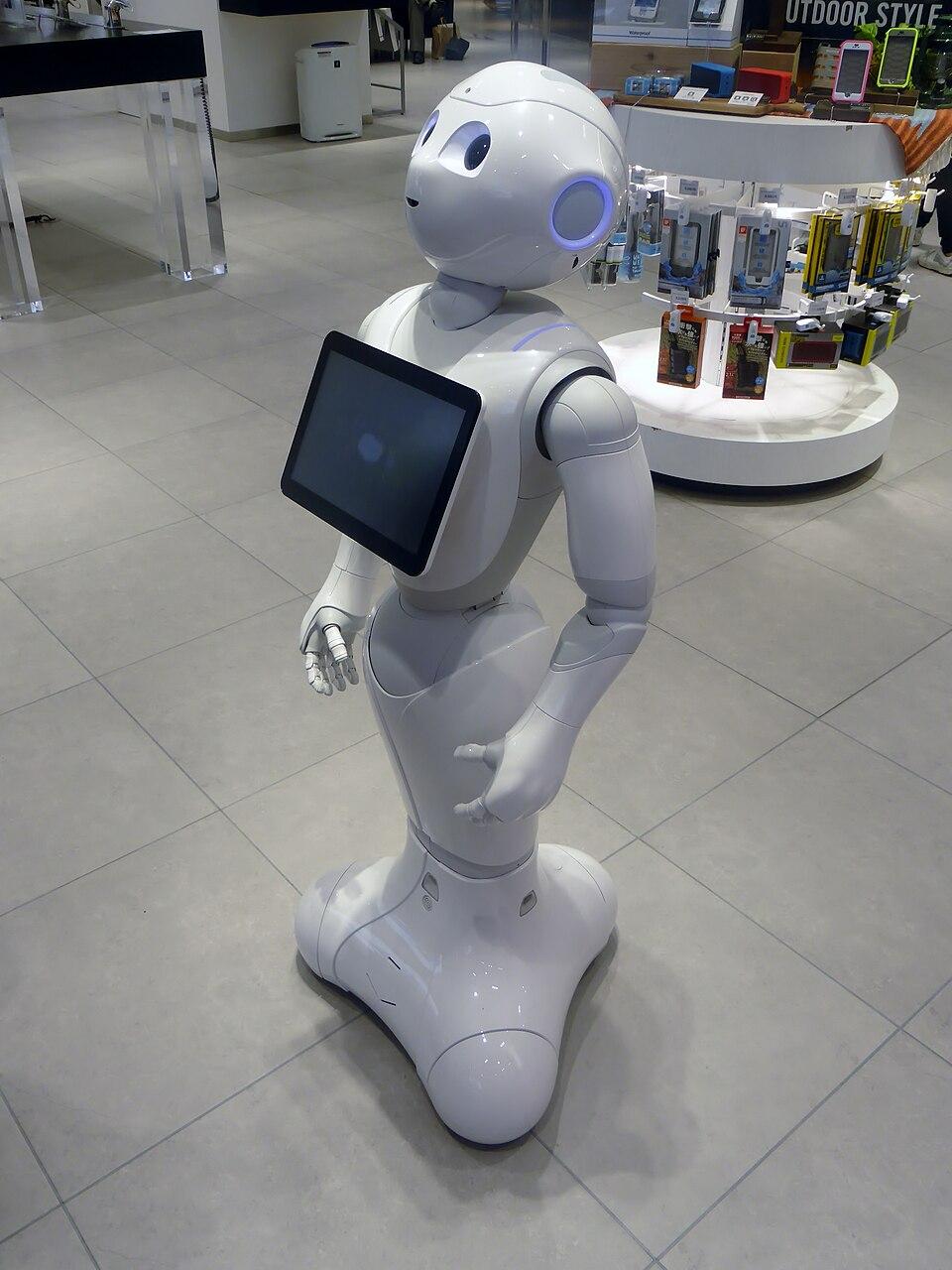
Mitsubishi Heavy Industries launched Wakamaru in Japan in 2005, a 1-meter yellow humanoid designed by Toshiyuki Kita to live with elderly users, recognize family faces, read out email, and offer reminders.[17] It cost roughly US$14,000, sold poorly, and went off the market around 2008, though it remained available for rent as a receptionist.[17] The French company Aldebaran Robotics released NAO in 2008, a 58-cm bipedal humanoid that became the standard research platform for HRI labs; it has been used by more than 200 academic institutions, with over 13,000 units fielded across more than 70 countries.[19][27] SoftBank acquired Aldebaran in 2012 and in 2014 introduced Pepper, a 1.2-meter wheeled humanoid pitched as the world's first robot designed to read human emotion. Pepper saw significant deployment in Japanese banks, retail stores, and reception desks, although by the early 2020s SoftBank had paused production amid lukewarm demand.
The first consumer-companion bubble (2014 to 2019)
A cluster of well-funded startups attempted to build the social-robot equivalent of the iPhone in the mid-2010s. Cynthia Breazeal founded Jibo in 2012 and ran a 2014 Indiegogo campaign that raised about US$3.7 million, which Guinness World Records lists as the most crowdfunded social robot.[29] Jibo eventually raised nearly US$73 million in venture funding.[28] The robot, a 28-cm rotating tabletop unit with a single animated eye, finally shipped to backers in late 2017 (three years after the campaign), by which point Amazon Echo and Google Home had taken the voice-assistant market.[9] Jibo Inc. withdrew its Massachusetts registration in November 2018 after its IP passed to New York-based investment firm SQN Venture Partners,[28] and owners reported in March 2019 that its servers were shutting down.[9] Jibo broke the news of its own death to owners with a short farewell speech that briefly went viral.[9]
Mayfield Robotics, a 2015 spinoff of Bosch's Startup Platform, built Kuri, a 50-cm wheeled home robot with expressive eyes and ambient sensing.[12] Kuri shipped to backers in late 2017 at US$700.[12] In July 2018 Bosch concluded there was no business fit, ceased manufacturing, and refunded all pre-orders.[12] The company shut down on October 31, 2018.[30]
Anki, a San Francisco company founded by Carnegie Mellon graduates, raised US$200 million across multiple rounds and shipped Cozmo (2016) and Vector (2018), both palm-sized expressive robots.[13] By August 2018 Anki said it had sold 1.5 million robots across all its products, including "hundreds of thousands" of Cozmo units.[31] A late-stage funding round collapsed and Anki shut down in April 2019.[14] In December 2019 the IP was acquired by Pittsburgh-based edtech startup Digital Dream Labs, which later released Cozmo 2.0 and Vector 2.0 with limited success.[14]
IEEE Spectrum coverage at the time offered competing explanations. Robotics editor Evan Ackerman wrote in July 2018 that Kuri, Jibo, and similar robots had to contend with smart speakers that affordably duplicated much of their functionality, and had trouble establishing compelling use cases and long-term value relative to their cost.[12] In a May 2019 guest post, roboticist Guy Hoffman pointed instead to the unsolved problem of long-term engagement (critics said the robots' tricks got old quickly), immature dialogue and gesture technology, and too little investment in design, and he disputed the view that social robots were just voice agents with little added value.[10]
Therapy and care robots (2017 onward)
While consumer companions were collapsing, robots aimed at care continued to gain ground because the buyers (hospitals, care homes, government aging agencies) judged value differently. Intuition Robotics of Tel Aviv launched ElliQ in 2017, a small swiveling head and screen designed for adults aging at home.[16] The New York State Office for the Aging began deploying ElliQ at scale in 2022; in August 2023 the agency and Intuition Robotics reported a 95% reduction in loneliness among participants in the pilot, which had reached more than 800 New Yorkers, with users interacting with their ElliQ more than 30 times per day, six days a week, and more than 75% of those interactions tied to social, physical, or mental well-being.[15] ElliQ 3, announced at CES 2024, integrates large language model technology to handle open-ended conversation while keeping a goal-based supervisor that screens responses for vulnerable users.[16]
Groove X, founded by ex-SoftBank engineer Kaname Hayashi, unveiled Lovot in Japan in December 2018, taking reservations ahead of first shipments planned for late 2019.[18] Lovot is explicitly designed not to be useful: it has no fixed task list and instead asks to be picked up, follows owners, and reacts to touch with around fifty body sensors.[18] Pricing began near US$3,000 plus a monthly service fee. Lovot has remained in production and expanded to Hong Kong and other markets.
In special education, the NAO robot has been used for autism therapy in dozens of clinical settings.[19] RoboKind's Milo, a 60-cm humanoid with a screen on its chest, launched in 2014 specifically for children with autism spectrum disorder; RoboKind markets its programs as evidence-based instruction for classrooms and therapy settings.[20]
LLM revival and the second wave (2023 to present)
The public release of ChatGPT by OpenAI in late 2022, followed by Claude, Gemini, and others, removed one of the biggest engineering bottlenecks in social robotics: scripting believable open-ended dialogue. A new wave of products either embedded LLMs or were rebuilt around them. Embodied Inc. launched Moxie in 2020 for children aged five to ten and updated it in 2024 with GPT-style conversational capability, marketing it especially to families with autistic children at US$799.[11] Samsung revived its Ballie concept at CES 2024 as a softball-sized rolling robot with a built-in 1080p projector and LLM-driven conversational interface, targeting a 2025 release.[23] Samsung missed that window, and by December 2025 it had given no new release date.[33] Numerous smaller startups have released LLM-driven companion robots aimed at desk users.
The new wave has not avoided the old failure modes. Embodied announced in December 2024 that an expected funding round had collapsed and that the Moxie cloud servers would be shut down within days, bricking thousands of robots that families had bonded with because the robot's intelligence lived entirely in the cloud rather than on the device.[11] The shutdown drew unusually emotional press coverage; on December 20, 2024 Embodied said that former members of its technical team were developing OpenMoxie, a community-driven local server application that owners could run on their own computers to keep basic functions working without Embodied's cloud.[32] The episode renewed long-standing debates about whether selling cloud-dependent companion robots to children is ethically defensible.
What are social robots used for?
| Domain | Typical use | Notable deployments |
|---|---|---|
| Eldercare and aging in place | Loneliness mitigation, cognitive stimulation, medication reminders | ElliQ in New York State, PARO in Danish and Japanese care homes, Lovot in Japan |
| Dementia care | Calming, reducing agitation, lowering antipsychotic use | PARO in nursing homes worldwide |
| Autism intervention | Social-skills practice, emotional recognition, predictable interaction partner | Milo (RoboKind), NAO (multiple research consortia), Kaspar (University of Hertfordshire) |
| K-12 education | Coding, language learning, STEAM | NAO, Cozmo, Vector, Pepper |
| Higher education and research | HRI, developmental robotics, embodied AI | NAO, iCub, Pepper, Reachy, Furhat |
| Hospital pediatrics | Distraction during procedures, emotional support | NAO, MEDi (Calgary trials) |
| Retail and reception | Greeting, wayfinding, simple Q&A | Pepper in SoftBank stores, Wakamaru historically |
| Hospitality | Hotel check-in, novelty | Pepper in hotels, the Henn na Hotel chain in Japan |
| Workplace telepresence | Meeting attendance, lab oversight, remote teaching | Double Robotics Double 3, Beam |
| Astronaut companionship | Stress reduction in isolation studies | PARO in Mars Society analog-habitat trials |
Notable Social Robots
The table below lists widely studied or commercially significant social robots. Status reflects the status of the originating company's commercial offering, not whether individual hardware units still function.
| Robot | Maker | First released | Form | Status |
|---|---|---|---|---|
| Kismet | MIT AI Lab (Breazeal) | 1997 (research) | Expressive head | Retired to MIT Museum |
| Aibo (ERS-110) | Sony | 1999 | Robot dog | Discontinued 2006, revived 2018 |
| PARO | AIST (Shibata) | 2004 commercial | Baby harp seal | Active |
| Wakamaru | Mitsubishi Heavy Industries | 2005 | 1 m humanoid | Discontinued |
| NeCoRo | Omron | 2001 | Robot cat | Discontinued |
| NAO | Aldebaran / SoftBank | 2008 | 58 cm bipedal humanoid | Active (research) |
| Beam | Suitable Technologies | 2012 | Telepresence | Acquired by Blue Ocean Robotics, sold by Awabot |
| Pepper | Aldebaran / SoftBank | 2014 | 1.2 m wheeled humanoid | Production paused 2021 |
| Buddy | Blue Frog Robotics | 2015 (crowdfunding) | Wheeled tabletop | Repeatedly delayed, intermittent shipments |
| Jibo | Jibo Inc. (Breazeal) | 2017 | Rotating tabletop | Discontinued 2018, servers down 2019 |
| Kuri | Mayfield Robotics (Bosch) | 2017 | Wheeled home robot | Discontinued 2018 |
| Cozmo | Anki | 2016 | Tracked tabletop | Anki shut 2019; IP bought by Digital Dream Labs, which rebranded as Anki in 2025 |
| Vector | Anki | 2018 | Tracked tabletop | Anki shut 2019; IP bought by Digital Dream Labs, which rebranded as Anki in 2025 |
| Lovot | Groove X | 2019 (unveiled 2018) | Wheeled fuzzy companion | Active |
| ElliQ | Intuition Robotics | 2017, ElliQ 3 in 2024 | Tabletop head plus tablet | Active |
| Aibo (ERS-1000) | Sony | 2018 | Robot dog | Active |
| Milo | RoboKind | 2014 | 60 cm humanoid | Active (education) |
| Moxie | Embodied Inc. | 2020 | 38 cm tabletop humanoid | Discontinued December 2024 |
| Ballie | Samsung | CES 2024 prototype | Rolling sphere with projector | Missed 2025 launch target; not released |
| Reachy | Pollen Robotics | 2020 | Open-source humanoid torso | Active |
| iCub | Italian Institute of Technology | 2008 | Child-sized humanoid | Active (research) |
| Furhat | Furhat Robotics | 2014 | Back-projected face on a torso | Active |
Theoretical Frameworks
Anthropomorphism
Anthropomorphism is the human tendency to attribute mental states and human-like traits to non-human entities. Social robotics depends on it. Designers deliberately add or remove cues (eyes, eyebrows, head tilt, vocal prosody, hesitation pauses, breath-like idle motion) to push users into treating the device as a social agent. Research by Bartneck, Eyssel, and others has shown that even minimal cues such as a pair of camera-lens eyes are enough to trigger the social response.[2] Over-anthropomorphizing carries cost, however; users hold an obviously social-looking robot to higher conversational and social standards than they would hold a tabletop speaker.
What is the uncanny valley?
The Japanese roboticist Masahiro Mori proposed in 1970 that as a robot is made more humanlike, the human emotional response becomes more positive and empathetic, until at a point very close to (but not quite at) human appearance, the response flips into revulsion.[3] Mori called the dip the bukimi no tani genshou or uncanny valley.[3] Movement amplifies the effect.[3] Most successful social robots avoid the valley by stopping well short of realism: PARO is a seal, Lovot is fuzzy and abstract, Cozmo is a small box, Jibo had a single eye. Robots that have tried to look photoreal, such as Hanson Robotics' Sophia, are often cited as walking the edge of the valley.
Social agency and intentional stance
Daniel Dennett's notion of the intentional stance, the idea that observers will treat a system as if it has beliefs and desires whenever doing so usefully predicts its behavior, underlies many design choices in social robotics. If the robot's behavior is consistent enough that the user can adopt the intentional stance, the interaction works even when no real understanding sits underneath. Critics including Sherry Turkle have warned that this can produce relationships that feel real to the user but are not reciprocated, with implications for vulnerable populations such as children and people with dementia.[22]
Embodiment effects
Wainer, Feil-Seifer, Shell, and Mataric tested in 2006 whether physical embodiment has a measurable effect on how people perform and perceive a social interaction, comparing a physical robot with a simulated one and a co-located robot with a remote telepresent one in a Towers of Hanoi task. Their pilot study found differences in how participants perceived the physical and simulated agents' attention to the task, and in how much they enjoyed the task.[21] Embodiment effects have remained a recurring theme in later HRI research.
Key Researchers
| Researcher | Affiliation | Contribution |
|---|---|---|
| Cynthia Breazeal | MIT Media Lab; founder of Jibo | Pioneered sociable robotics with Kismet, authored "Designing Sociable Robots" (2002) |
| Takanori Shibata | AIST, Japan | Designer of PARO, leading figure in robot-assisted therapy |
| Masahiro Mori | Tokyo Institute of Technology | Proposed the uncanny valley hypothesis (1970) |
| Maja Mataric | University of Southern California | Socially assistive robotics, founder of the field; stroke rehabilitation and autism work |
| Brian Scassellati | Yale University | Social robotics for autism intervention, joint attention |
| Kerstin Dautenhahn | University of Waterloo (formerly Hertfordshire) | Kaspar robot for autism, theoretical foundations of HRI |
| Hiroshi Ishiguro | Osaka University | Geminoid androids, Telenoid, theoretical work on presence and the uncanny valley |
| Christoph Bartneck | University of Canterbury | Foundational definition of social robots, godspeed questionnaire for HRI evaluation |
| Selma Sabanovic | Indiana University Bloomington | Cultural and ethnographic studies of robots in care |
| Bilge Mutlu | University of Wisconsin-Madison | Designing robot gaze, gesture, and conversational behavior |
| Sherry Turkle | MIT (sociology) | Critical scholarship on emotional bonds with robots and AI |
Why do consumer social robots keep failing?
The consumer social-robot category has a high failure rate.[10] Common patterns across the canceled products include:
- Hardware economics. Sub-US$1,000 hardware that depends on cloud services rarely sustains the recurring revenue needed to pay for the cloud.
- Voice-assistant competition. Once Amazon Echo and Google Home shipped at low prices, the basic utility of a tabletop conversational device dropped to near zero. Robots needed to justify a 5x to 10x price premium on charm alone.
- Slow shipping. Jibo took three years from funded to delivered, by which point its category had been redefined by competitors.[9]
- Novelty decay. Critics of the first-generation products said their tricks got old quickly, and sustaining long-term engagement proved to be the central unsolved problem.[10]
- Cloud dependency and abandoned users. When the company fails, the robot dies. The Jibo and Moxie shutdowns prompted public debate about whether companion robots should be required to support an offline mode or open-source release on end-of-life.[11] Companions.wiki's guide to repair, support and decommissioning lists what to ask about a robot's cloud and support before buying one.
Care-sector robots have had a higher survival rate because purchasers (clinics, care homes, government programs) make purchase decisions on measured outcomes such as reductions in agitation, antipsychotic use, or loneliness scores rather than on novelty.[15]
Ethical and Social Considerations
Social robots raise distinctive ethical questions because their entire design goal is to be treated as a social agent by people who know they are not. Key debates include:
- Deception and informed consent. Is it acceptable to use anthropomorphic cues with users (especially children, people with cognitive impairment, or isolated elders) who may genuinely come to believe the robot understands them?[22]
- Privacy. Always-on cameras and microphones in intimate settings raise data-handling concerns, especially when audio is sent to cloud LLMs.
- Replacement of human contact. Critics including Sherry Turkle argue that social robots should supplement, not substitute for, human caregivers.[22] Proponents reply that the realistic alternative for many isolated elders is no contact at all.
- End-of-life support. Cloud-dependent robots that suddenly stop working when the company collapses can cause genuine grief, particularly when they have been positioned as friends to children.[11]
- Bias in dialogue. LLM-powered companions inherit the biases of their underlying models, which is harder to audit when the conversation is private and the user is vulnerable.
Groups including the IEEE Global Initiative on Ethics of Autonomous and Intelligent Systems and the Foundation for Responsible Robotics have published guidelines on these issues, though regulation specific to social robots remains rare.
Current Trends
As of 2026 the field shows several active trends:
- LLM-grounded dialogue. Most new social robots ship with at least one large-model API integration, often with a goal-tracking supervisor layered on top to keep behavior on-mission.
- On-device models. Concerns about latency, privacy, and the Moxie-style shutdown risk are pushing manufacturers (and several open-source projects) to advocate for running smaller models locally on the robot.
- Open-source survival kits. Projects such as OpenMoxie, the Anki / Vector escape pod community, and the Aibo developer SDK indicate growing pressure for vendor-independent runtimes.[11]
- Care-focused expansion. Government aging agencies, such as the New York State Office for the Aging, have begun subsidizing care-companion robots for older adults.[15]
- Multimodal embodied AI research. The convergence of LLMs, vision-language-action models, and humanoid robot work at companies including Figure, Apptronik, 1X, and Tesla has begun to blur the line between social robots, service robots, and general-purpose humanoids.
Continue reading
- AheadFormAheadForm (Chinese: 首形科技) is a Shanghai-based robotics company, founded in 2024 by the Columbia University roboticist Dr. Yuhang Hu, that builds hyper-realistic robotic faces and head-and-bust units rather…Listed in See also
- RoboticsRobotics is the interdisciplinary study and engineering of robots: embodied machines whose mechanisms, sensors, computation, and actuators are organized to perform tasks in the physical world.Mentioned 24 times above
- Human-Robot InteractionHuman-Robot Interaction (HRI) is the interdisciplinary field that studies how humans and robots perceive, communicate with, and physically share space and tasks with one another, and how to design robots that…Linked in the introduction
- Industrial robotAn industrial robot is an automatically controlled, reprogrammable, multipurpose manipulator programmable in three or more axes, which can be either fixed in place or mobile for use in industrial automation…Linked in the introduction
- Pepper (Robot)Pepper is a semi-humanoid robot designed for social interaction, originally manufactured by the French company Aldebaran (later SoftBank Robotics Europe, then Aldebaran again after 2022).Mentioned 11 times above
- Uncanny valleyThe uncanny valley is the dip in human affinity that occurs when a robot, computer-generated character, or other artificial figure looks and moves almost like a real person but not quite, triggering a sudden…Mentioned 4 times above

More to read
Topics:Robotics
Related Topics
- Human-Robot Interaction: the parent academic field
- Robotics: the broader engineering discipline
- Humanoid Robot: the bipedal robot class increasingly converging with social robots
- Pepper (Robot): flagship social humanoid from SoftBank Robotics
- Companion Robot: robots designed primarily for emotional engagement
- Cynthia Breazeal: founder of the sociable-robotics subfield
- Large Language Model: the technology powering modern conversational behavior
- HRI: abbreviation for human-robot interaction
References
- ^1 ^2 ^3 ^4Breazeal, C. (2002). *Designing Sociable Robots*. MIT Press. ISBN 978-0-262-52431-5.
- ^1 ^2 ^3Bartneck, C., & Forlizzi, J. (2004). A design-centred framework for social human-robot interaction. *RO-MAN 2004: 13th IEEE International Workshop on Robot and Human Interactive Communication*, 591-594.
- ^1 ^2 ^3Mori, M. (1970). The uncanny valley. *Energy*, 7(4), 33-35. English translation: Mori, M., MacDorman, K. F., & Kageki, N. (2012). The Uncanny Valley. *IEEE Robotics & Automation Magazine*, 19(2), 98-100.
- International Journal of Social Robotics. Springer Nature. Founded 2009. link.springer.com/...12369
- ^1 ^2 ^3"Kismet, the robot." MIT Artificial Intelligence Laboratory project page. ai.mit.edu/...kismet
- ^1 ^2Shibata, T. "PARO Therapeutic Robot." PARO Robots U.S., Inc. parorobots.com
- ^1 ^2 ^3 ^4"Paro (robot)." Wikipedia. en.wikipedia.org/...Paro_(robot)
- ^1 ^2 ^3 ^4"AIBO." Wikipedia. en.wikipedia.org/...AIBO
- ^1 ^2 ^3 ^4Heater, B. (2019, March 4). The lonely death of Jibo, the social robot. *TechCrunch*. techcrunch.com/...y-death-of-jibo-the-social-robot
- ^1 ^2 ^3 ^4Hoffman, G. (2019, May 1). Anki, Jibo, and Kuri: What We Can Learn from Social Robots That Didn't Make It. *IEEE Spectrum*. spectrum.ieee.org/...from-social-robotics-failures
- ^1 ^2 ^3 ^4 ^5 ^6Fried, I. (2024, December 10). Maker of AI robots for kids abruptly shutters. *Axios*. axios.com/...moxie-kids-robot-shuts-down
- ^1 ^2 ^3 ^4Ackerman, E. (2018, July 25). "Mayfield Robotics Cancels Kuri Social Home Robot." *IEEE Spectrum*. spectrum.ieee.org/...ancels-kuri-social-home-robot
- ^"Anki (American company)." Wikipedia. en.wikipedia.org/...Anki_(American_company)
- ^1 ^2"Inside Anki shutdown." *The Robot Report*. therobotreport.com/...s-auction-failed-partnership
- ^1 ^2 ^3"NYSOFA's Rollout of AI Companion Robot ElliQ Shows 95% Reduction in Loneliness." New York State Office for the Aging. aging.ny.gov/...lliq-shows-95-reduction-loneliness
- ^1 ^2"Intuition Robotics Releases ElliQ 3 Robot With Upgraded Hardware Augmented by Generative AI." *Voicebot.ai*, January 9, 2024. voicebot.ai/...hardware-augmented-by-generative-ai
- ^1 ^2"Wakamaru." Wikipedia. en.wikipedia.org/...Wakamaru
- ^1 ^2"GROOVE X Introduce a New Companion Robot, LOVOT." PR Newswire, December 2018. prnewswire.com/...-companion-robot-lovot-300767937
- ^1 ^2"World Autism Awareness Day: Humanoid robots helping children with autism." SoftBank Robotics. softbankrobotics.com/...d-autism-awareness-day-nao
- ^"Robokind's Milo Robot." RoboKind press materials. robokind.com
- ^1 ^2Wainer, J., Feil-Seifer, D. J., Shell, D. A., & Mataric, M. J. (2006). The role of physical embodiment in human-robot interaction. *RO-MAN 2006: 15th IEEE International Symposium on Robot and Human Interactive Communication*, 117-122.
- ^1 ^2 ^3Turkle, S. (2011). *Alone Together: Why We Expect More from Technology and Less from Each Other*. Basic Books.
- ^"A Day in the Life With Ballie: An AI Companion Robot for the Home." Samsung Newsroom, January 2024. news.samsung.com/...nion-robot-home-video-ces-2024
- ACM/IEEE International Conference on Human-Robot Interaction (HRI), proceedings 2006-present. humanrobotinteraction.org
- ^"Social Robots Market Report: Industry Analysis, Size and Forecast Trends." Mordor Intelligence, 2025. mordorintelligence.com/...social-robots-market
- ^"PARO: Awards and Records." PARO Robots (Intelligent System Research Institute, AIST). paro.jp/...prize
- ^"Nao (robot)." Wikipedia. en.wikipedia.org/...Nao_(robot)
- ^1 ^2Crowe, S. (2018, November 27). Social robot maker Jibo sells off assets. *The Robot Report*. therobotreport.com/jibo-assets-acquired-sqn
- ^"Most crowdfunded social robot." Guinness World Records. guinnessworldrecords.com/...most-crowdfunded-robot
- ^Fingas, J. (2018, August 22). Say goodbye to the company that made the cute Kuri robot. *Engadget*. engadget.com/...tor-mayfield-robotics-to-shut-down
- ^Heater, B. (2019, April 29). Cozmo maker Anki is shutting its doors. *TechCrunch*. techcrunch.com/...maker-anki-is-shutting-its-doors
- ^Harding, S. (2024, December 20). Startup set to brick $800 kids robot is trying to open source it first. *Ars Technica*. arstechnica.com/...tential-open-source-second-life
- ^Romero, A. (2025, December 8). Samsung Ballie launch window flies by, and it's still delayed. *9to5Google*. 9to5google.com/...samsung-ballie-still-delayed-again
Improve this article
Add missing citations, update stale details, or write a clearer explanation. Anyone can edit: changes go live when you publish, and every edit is checked by an editor.
8 revisions · v8 · 4,677 words · full history
Fact-checks are independent of edits: a reviewer re-verifies the article against its sources and stamps the date. How we verify
Research and drafting on this wiki are AI-assisted, under named human editorial standards. How AI is used here
Reviewer note: Independent fact-check of the full article against its cited sources (115 claims, 33 sources fetched); 12 material + 23 minor fixed
Cite this page: AI Wiki. "Social Robot." aiwiki.ai, updated 22 Jul 2026, fact-checked 4 Nov 2026. CC BY 4.0. https://aiwiki.ai/wiki/social_robot