

Cyan Robotics ORCA
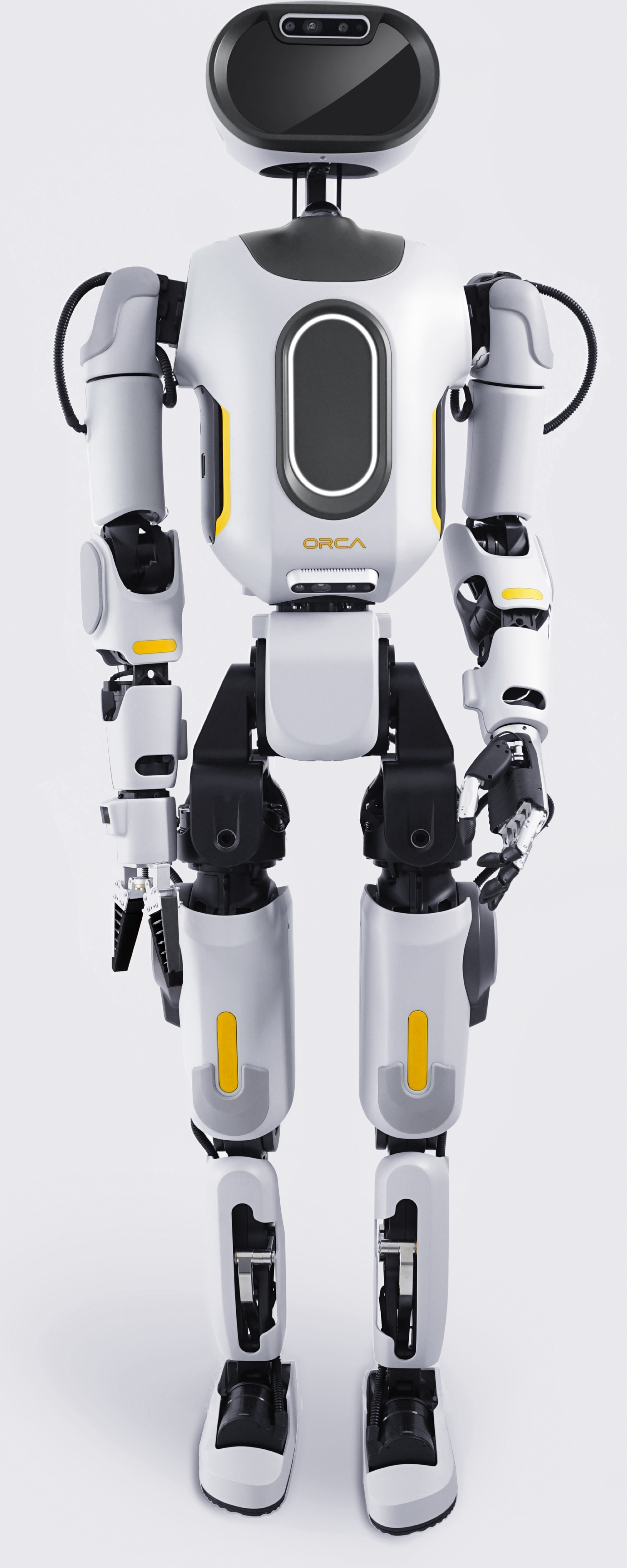
ORCA (also styled Orca I or ORCA 1) is a general-purpose humanoid robot developed by Cyan Robotics, a Shanghai-based startup formally registered as Shanghai Qingxin Yichuang Technology Co., Ltd. (also operating under the trade name Cyanborg Robotics Co., Ltd.). Unveiled in October 2024, less than a year after the company's founding, ORCA is designed for research, education, eldercare, and early industrial applications. The robot is notable for its "emotional gait" system, which uses a large language model to modulate the robot's walking patterns so they express different emotional states, and for its straight-knee bipedal locomotion, a capability that remains uncommon among humanoid platforms.
 | |
| Developer | Cyan Robotics (Cyanborg Robotics Co., Ltd.) |
| Type | Humanoid robot |
| Generation | 1st |
| Unveiled | October 2024 |
| Height | 145 cm (4 ft 9 in) |
| Weight | 42 kg (93 lb) with battery |
| Degrees of Freedom | 28 |
| Battery Life | ~2 hours |
| Walking Speed | 0.83 m/s (3.0 km/h) |
| Payload | 5 kg total |
| AI System | Proprietary emotional gait LLM; macr language model |
| Actuators | Electric servo motors (harmonic/planetary mixed gearing) |
| Price | $40,000 - $50,000 USD |
| Status | Available (backorder on JD.com) |
| Country of Origin | China |
| Website | cyanborg.com |
ORCA stands approximately 145 cm tall and weighs 42 kg with its battery. It features a dual-arm manipulation system, an OLED display head for expressive interaction, and a layered sensor suite including depth cameras, IMU sensors, and force/torque sensors. The robot is priced between $40,000 and $50,000 and is available for purchase on JD.com, one of China's largest e-commerce platforms.
Company Background
Cyan Robotics
Cyan Robotics was founded near the end of 2023 in Shanghai by Niu Tengdi, a former autonomous driving researcher who previously worked at Toyota and Huawei. The company is officially registered as Shanghai Qingxin Yichuang Technology Co., Ltd. (the Chinese name translates roughly to "Cyan Innovation Technology") and also operates under the international trade name Cyanborg Robotics Co., Ltd.[1][2]
The company emerged from the Humanoid Robot Innovation Incubator at the Caohejing Hi-Tech Park in Shanghai's Xuhui district, one of the city's most established technology development zones. With support from the incubator, Cyan achieved rapid technological breakthroughs and introduced its first humanoid robot in under a year.[3]
Cyan claims to maintain full-stack in-house capabilities across the robotic hardware, motion control, decision-making systems, dual-arm manipulation, data processing, and human-machine interaction layers of its platform. The company's stated philosophy centers on building humanoid robots that prioritize emotional connection and natural interaction, arguing that these qualities are essential for robots to transition from exhibition showpieces to practical household companions.[1]
Industrial Design Partnership
Cyan Robotics collaborated with TEAMS Design, an international industrial design consultancy, on the external design of the ORCA platform. The design brief focused on creating an approachable, domestic-friendly aesthetic rather than an industrial or utilitarian appearance. The resulting design features sleek, rounded contours and a vibrant color scheme intended to make the robot feel at home in everyday living spaces rather than factories or laboratories.[4]
The collaboration prioritized cost-effectiveness and scalability, aiming to produce a platform that could support widespread adoption while maintaining visual appeal and functional ergonomics.[4]
Policy Context
Cyan's founding coincided with a significant push by the Chinese government to develop the country's humanoid robotics sector. In November 2023, China's Ministry of Industry and Information Technology (MIIT) published the "Opinions on the Innovation and Development of Humanoid Robots," which set targets for mass-producing humanoid robots at an internationally advanced level by 2025 and establishing humanoid robots as an important engine of economic growth by 2027.[5] The guidelines called for breakthroughs in key technologies related to environmental perception, behavioral control, mechanical arms, and lightweight skeletons, and aimed to nurture two to three world-leading companies and create industrial development hubs.[5]
Shanghai itself has been a focal point for this national initiative, establishing multiple humanoid robot innovation centers and incubators. China's first heterogeneous humanoid robot training facility was set up in the city, and by 2025, over 150 humanoid robots were being showcased at Shanghai's annual World Artificial Intelligence Conference (WAIC).[6]
Technical Specifications
Overview
ORCA is a full-size bipedal humanoid designed to operate in both indoor and outdoor environments. The robot combines a lightweight aluminum and polymer frame with electric servo actuators and a multi-sensor perception system. Its software stack integrates proprietary artificial intelligence models for locomotion control, manipulation, emotional expression, and natural language interaction.
Detailed Specifications
| Category | Parameter | Value |
|---|---|---|
| Physical | Height | 145 cm (4 ft 9 in) |
| Physical | Width | 280 mm |
| Physical | Depth | 520 mm |
| Physical | Weight (with battery) | 42 kg (93 lb) |
| Physical | Frame material | Aluminum + polymer shell |
| Physical | IP rating | IP20 |
| Mobility | Degrees of freedom | 28 |
| Mobility | Locomotion type | Bipedal (straight-knee walking) |
| Mobility | Max walking speed | 0.83 m/s (3.0 km/h, 1.9 mph) |
| Manipulation | Total payload capacity | 5 kg |
| Manipulation | Fingers per hand | 5 |
| Manipulation | Dual-arm system | Yes |
| Power | Battery life | Approximately 2 hours |
| Computing | AI models | Emotional gait LLM; macr language model |
| Computing | Operating system | Linux (ROS2-based) |
| Computing | ROS compatible | Yes |
| Sensors | OLED display head | Yes (expressive face interface) |
| Sensors | Depth cameras | Yes (3D mapping) |
| Sensors | IMU | Yes (balance/orientation) |
| Sensors | Force/torque sensors | Yes (manipulation feedback) |
| Sensors | Microphone arrays | Yes (voice interaction) |
| Actuators | Type | Electric servo motors |
| Actuators | Gear technology | Harmonic/planetary mixed |
| Connectivity | WiFi | 2.4 GHz / 5 GHz |
| Connectivity | Cloud integration | Yes (updates and monitoring) |
| Connectivity | Additional | Bluetooth, Ethernet, USB |
Note: Some third-party databases list different specifications (for example, 160 cm height, 50 kg weight, and 40 degrees of freedom). The figures above are drawn from the Aparobot technical database, which cites the robot's dimensions as measured with battery installed.[7][8]
Locomotion and the Emotional Gait System
ORCA's most distinctive technical feature is its emotional gait system. The robot uses what Cyan describes as an "emotional gait large language model" to control its bipedal locomotion, enabling the robot to vary its walking patterns in ways that express different emotional states. This approach draws on psychological research showing that humans naturally express emotions through their gait: bouncy, energetic steps when happy; a slumped, heavy posture when sad; and forceful, sharp movements when angry.[1]
Cyan implemented this capability through machine learning applied to motion capture data. The system analyzes the emotional context of a given interaction, whether determined by a conversation topic, a user's tone of voice, or a programmed scenario, and adjusts the robot's stride length, cadence, posture, and arm swing accordingly. The result is a robot that does not merely walk from point A to point B but does so in a manner that conveys an appropriate emotional tone.[1]
Beyond emotional expression, ORCA features straight-knee bipedal walking, a capability that remains technically challenging for many humanoid platforms. Most bipedal robots walk with permanently bent knees to maintain stability, which looks notably unnatural to human observers. ORCA's straight-knee gait more closely mirrors natural human walking biomechanics, contributing to the robot's approachable appearance.[3][9]
The robot can also climb stairs, spin, recover autonomously from falls, and maintain balance during dynamic actions such as performing splits. According to Cyan, ORCA's joint ranges exceed those of a typical human in several axes of movement.[7][9]
Manipulation
ORCA integrates a dual-arm manipulation system with five-fingered hands. The arms are designed for tasks such as grasping, sorting, and positioning objects with reliable control. While the robot's total payload capacity of 5 kg limits it to light-duty manipulation tasks, the dual-arm configuration allows coordinated bimanual operations that single-arm systems cannot perform.[7]
The manipulation system is controlled by proprietary AI models that allow the robot to learn and execute complex task sequences. Force/torque sensors at the joints provide feedback for precise control during object handling.[7]
Perception and Interaction
ORCA's head features an OLED screen that functions as an expressive face interface. Rather than attempting to replicate a human face with mechanical features, the display shows animated facial expressions, delivering emotions, notifications, and contextual information in a format that is both readable and engaging. This design choice aligns with Cyan's emphasis on emotional connection as a core interaction principle.[4][7]
The robot's perception system includes depth cameras for 3D environmental mapping, an inertial measurement unit (IMU) for balance and orientation tracking, force/torque sensors for manipulation feedback, and microphone arrays for voice interaction. Together, these sensors give ORCA the ability to detect obstacles, identify objects, and adjust its movement in response to environmental changes.[7]
Natural language interaction is handled by the macr language model, a proprietary system that supports conversational abilities and emotional expression through speech. The combination of verbal communication, expressive body language via the emotional gait system, and the animated OLED face gives ORCA a multi-channel interaction capability that Cyan positions as industry-leading in terms of immersive, anthropomorphic user experience.[7][9]
Computing and Software
ORCA runs on a Linux-based operating system built on the ROS 2 (Robot Operating System 2) framework, making it compatible with the broad ecosystem of ROS tools and packages used in robotics research. The robot supports cloud-based updates and monitoring, allowing Cyan to push software improvements and new capabilities remotely. Advanced customization is available through Modbus scripting for users who need to program specialized behaviors.[7]
Beijing Humanoid Robot Half Marathon
On April 19, 2025, ORCA participated in the Beijing E-Town Half-Marathon, which included the world's first Humanoid Robot Half-Marathon as a concurrent event. The race took place in Beijing's Yizhuang district (also known as the Beijing Economic-Technological Development Area, or E-Town) and featured 21 bipedal robots running alongside approximately 12,000 human runners on a 21.1 km course. The robots were given 3.5 hours to complete the distance.[10][11]
Preparation
In advance of the race, Cyan's development team made several modifications to improve ORCA's endurance for the unprecedented long-distance outdoor challenge. The team reduced the robot's weight by over 2 kilograms to lower energy consumption and extend battery life. Custom non-slip insoles were installed on the robot's feet to provide better traction on varied road surfaces.[3]
Performance
ORCA covered approximately 1.8 kilometers before timing out, according to a Sixth Tone report based on interviews with four participating startups including Cyan.[12] The company's marketing director, Bai Zhaoyang, described the participation as "a large-scale experiment" rather than an expectation of completing the full course. A key finding from the event was that the robot's motors could overheat above 80 degrees Celsius and trigger a protection mode, a failure condition that would have been difficult to reproduce in standard laboratory testing.[12]
The Shanghai municipal government's official account of the event stated that Orca I "completed the course without any malfunctions or falls" and executed a battery swap in just two minutes, marking the robot's first successful long-distance outdoor run since its public debut. This suggests the robot may have completed a shorter designated course segment or that the Shanghai report emphasized fault-free operation within the distance covered rather than completion of the full 21.1 km.[3]
Overall Race Results
The half marathon served as a reality check for the humanoid robotics industry. Only 6 of the 21 participating robots completed the full course. The winner was Tiangong Ultra (also known as Tien Kung), developed by the Beijing Innovation Center of Humanoid Robotics, which finished in 2 hours and 40 minutes. Noetix Robotics' N2 placed second at 3 hours 37 minutes, and DroidUp's X02 finished third at 4 hours 9 minutes. Many robots experienced falls, overheating, frozen control systems, or mechanical failures during the race.[10][11][12]
For comparison, the human men's winner finished in 1 hour 2 minutes 36 seconds, and the women's champion completed the course in 1 hour 11 minutes 7 seconds.[10]
| Placement | Robot | Developer | Time / Distance |
|---|---|---|---|
| 1st | Tiangong Ultra | Beijing Innovation Center of Humanoid Robotics | 2:40:27 |
| 2nd | N2 | Noetix Robotics | 3:37:00 |
| 3rd | X02 | DroidUp | 4:09:00 |
| Did not finish | ORCA I | Cyan Robotics | ~1.8 km covered |
| Did not finish | G1 | Unitree Robotics | Struggled during race |
| Did not finish | Kuavo | Leju Robot | Did not finish main race |
Applications
Cyan positions ORCA as a versatile platform spanning multiple application domains.
Eldercare and Home Assistance
The primary application that Cyan and its design partner TEAMS emphasize is home assistance, particularly for aging populations. The robot's emotional interaction capabilities, approachable design, and multi-channel communication (speech, facial expressions, body language) are intended to make it a companion rather than a mere tool. Potential eldercare tasks include monitoring daily routines, providing reminders, assisting with light household tasks, and offering social interaction to reduce isolation.[4][1]
Research and Education
ORCA is marketed as a platform for robotics research and educational institutions. Its ROS 2 compatibility, modular software architecture, and cloud-based update system make it accessible to researchers who need a full-size humanoid for experimentation with locomotion, manipulation, human-robot interaction, and embodied AI algorithms. The $40,000 to $50,000 price point, while not inexpensive, is significantly lower than many comparable humanoid platforms.[7][8]
Physical Therapy
Cyan has identified physical therapy as a potential application area. The robot's ability to demonstrate and adapt movements with emotional engagement could support rehabilitation exercises where patient motivation and proper form demonstration are important.[1]
Commercial Services
ORCA's perception system, navigation capabilities, and natural language interaction support potential deployment in commercial service environments such as retail, hospitality, and reception settings, where the robot could greet customers, provide information, and guide visitors.[7]
Pricing and Availability
ORCA is priced between $40,000 and $50,000 USD (approximately 280,000 to 360,000 CNY). The robot is available for purchase on JD.com, one of China's largest online retail platforms, making it one of the first humanoid robots to be sold through a major consumer e-commerce channel. As of early 2026, the robot's availability status is listed as backorder on some tracking databases, suggesting demand exceeds current production capacity.[1][8]
Some third-party databases list the price at $34,000, which may reflect a lower-specification configuration or updated pricing.[8]
Competitive Context
ORCA enters a rapidly growing humanoid robotics market, particularly within China, where dozens of startups and established companies are developing humanoid platforms in response to government policy incentives.
Chinese Humanoid Robot Landscape
China's humanoid robotics sector has expanded dramatically since the MIIT's November 2023 guidelines. By 2025, the country was on track to manufacture at least 10,000 humanoid robots, fueled by a strong domestic supply chain and aggressive investment. Major Chinese competitors include:
| Company | Robot | Notable Features |
|---|---|---|
| Unitree Robotics | H1, G1 | Low cost, open ecosystem, high agility |
| UBTECH Robotics | Walker S2 | Commercial deployment, Foxconn partnership |
| Fourier Intelligence | GR-2 | Rehabilitation and research focus |
| Noetix Robotics | N2 | Half-marathon finisher, Beijing-based |
| AgiBot | A2 | Backed by Shanghai AI Laboratory |
| LimX Dynamics | CL-1 | Dynamic locomotion specialist |
| XPeng Robotics | Iron | Automotive company crossover |
ORCA differentiates itself primarily through its emotional interaction capabilities and its emphasis on companionship and social engagement rather than raw physical performance or industrial productivity. While competitors like Unitree's H1 focus on athletic capability and speed, and UBTECH's Walker series targets factory automation, Cyan has carved out a niche centered on human-robot emotional connection.[1]
International Context
Globally, the humanoid robotics market includes well-funded Western competitors such as Figure AI (Figure 02/03), Tesla (Optimus), Boston Dynamics (Atlas), and Agility Robotics (Digit). These companies generally target industrial automation and logistics applications with larger, heavier platforms. ORCA's smaller size, lower price point, and focus on emotional interaction and home assistance position it in a different market segment from most Western humanoid developers, which have prioritized factory and warehouse environments.[13]
Disambiguation
The name "ORCA" is also used by several unrelated robotics products:
- ORCA Hand: An open-source dexterous robotic hand developed by ETH Zurich's Soft Robotics Lab, featuring 17 degrees of freedom and a tendon-driven design. This is a separate project with no connection to Cyan Robotics.[14]
- ORCA Series Linear Actuators: Force-controlled smart linear motors manufactured by Iris Dynamics, a Canadian company. Despite some third-party databases describing ORCA's actuators as "ORCA Series smart linear actuators," these are a distinct product line from a different manufacturer.[15]
See Also
- Humanoid robot
- Humanoid robots
- Cyan Robotics
- Embodied AI
- Large language model
- Robot Operating System
- Unitree H1
- UBTECH Walker S2
- Fourier Intelligence GR-2
References
- ^1 ^2 ^3 ^4 ^5 ^6 ^7 ^8Kalil, Mike. "Cyan Orca Humanoid Robot's Emotional Walking Gait." MikeKalil.com, 2025. mikekalil.com/...bot-boasts-emotional-walking-gait
- ^"Orca, humanoid robot, Cyanborg Robotics Co., Ltd., Shanghai, China." Portal of Robotics and Artificial Intelligence, 2025. pr.ai/...borg-robotics-co-ltd-shanghai-china.27461
- ^1 ^2 ^3 ^4"Shanghai-made robot excels in world's first humanoid half-marathon." Shanghai Municipal Government, April 22, 2025. english.shanghai.gov.cn/...35441f1ba646ef834e1d232
- ^1 ^2 ^3 ^4"Cyan Robotics - the future is curious." TEAMS Design, 2025. teamsdesign.com/...-robotics-the-future-is-curious
- ^1 ^2"China says humanoid robots are new engine of growth, pushes for mass production by 2025 and world leadership by 2027." South China Morning Post, November 2023. scmp.com/...s-production-2025-and-world-leadership
- ^"China showcases over 150 humanoid robots at WAIC 2025." Global Times, July 2025. globaltimes.cn/...1339392.shtml
- ^1 ^2 ^3 ^4 ^5 ^6 ^7 ^8 ^9 ^10"Orca 1 - Robot Details, Use Case and Specifications." Aparobot, 2025. aparobot.com/...orca-1
- ^1 ^2 ^3 ^4"ORCA." HumanoidSpecs.com, 2025. humanoidspecs.com/...cyan-robotics-orca
- ^1 ^2 ^3"Orca Humanoid Robot by Cyan Robotics." Humanoid.guide, updated March 30, 2026. humanoid.guide/...orca
- ^1 ^2 ^3"The World's First Humanoid Robot Half Marathon in Beijing." MikeKalil.com, April 2025. mikekalil.com/...jing-humanoid-robot-half-marathon
- ^1 ^2"China's humanoid robot half-marathon puts technology's limits on public display." South China Morning Post, April 2025. scmp.com/...puts-technologys-limits-public-display
- ^1 ^2 ^3"'Robot Marathon Just the Start': China's Engineers on Testing Their Creations." Sixth Tone, April 2025. sixthtone.com/...1017046
- ^"U.S. tech giants are betting big on humanoid robots, but China's already ahead, analysts say." CNBC, March 2025. cnbc.com/...s-in-humanoid-robot-race-analysts-say-
- ^"ORCA: An Open-Source, Reliable, Cost-Effective, Anthropomorphic Robotic Hand for Uninterrupted Dexterous Task Learning." arXiv:2504.04259, April 2025. arxiv.org/...2504.04259
- ^"ORCA Series Linear Actuators." Iris Dynamics. irisdynamics.com/orca-series-linear-actuator
Improve this article
Add missing citations, update stale details, or suggest a clearer explanation. Every suggestion is reviewed for sourcing before it goes live.
5 revisions · v5 · 3,108 words · full history
Fact-checks are independent of edits: a reviewer re-verifies the article against its sources and stamps the date. How we verify
Research and drafting on this wiki are AI-assisted, under named human editorial standards. How AI is used here
Cite this page: AI Wiki. "Cyan Robotics ORCA." aiwiki.ai, updated 11 Apr 2026. CC BY 4.0. https://aiwiki.ai/wiki/cyan_robotics_orca