

Intel RealSense
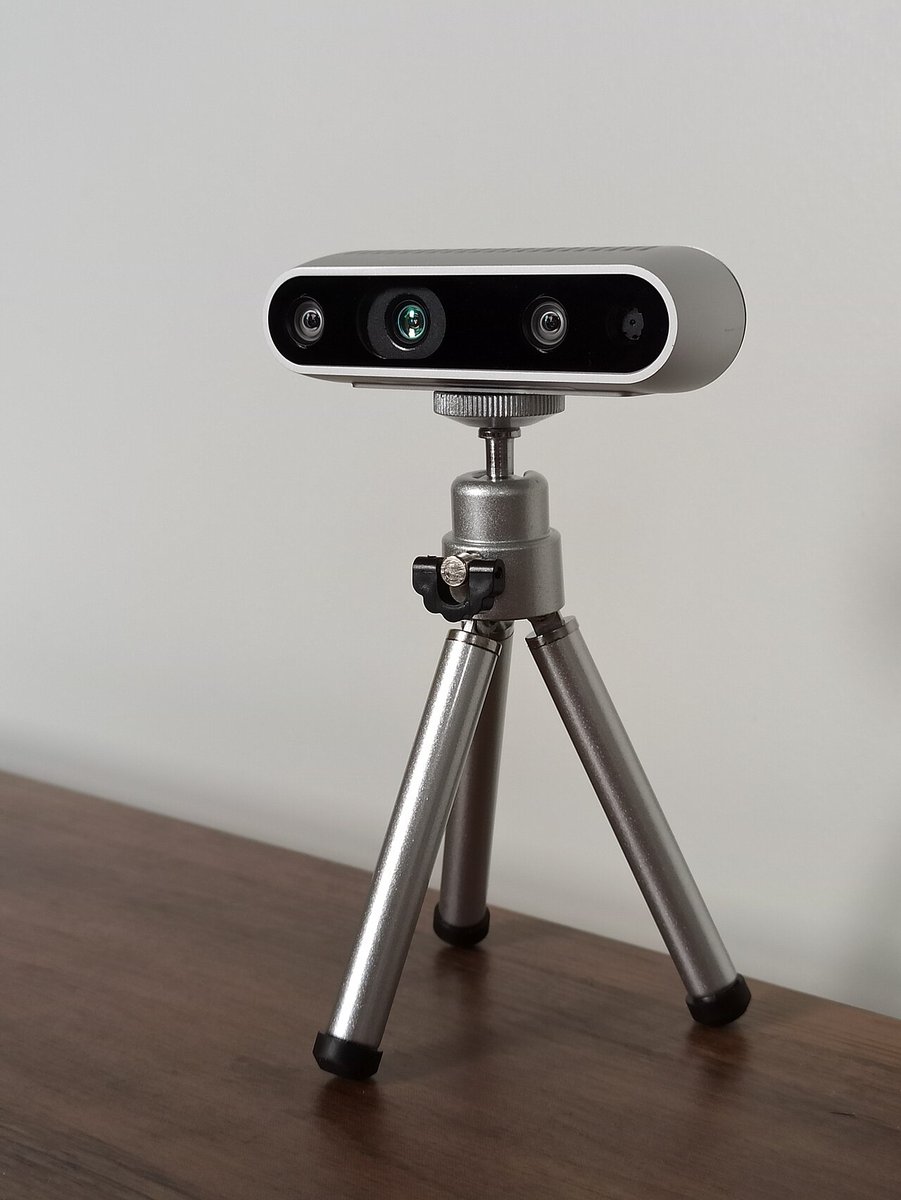
Intel RealSense is a line of depth cameras, depth modules and computer vision software that Intel began selling under that name in 2014, and the name of the company that has made the products since Intel spun the business out in July 2025. The company now calls itself simply RealSense. The line started as a 3D camera built into laptops and tablets for gesture control, then shifted to stand-alone stereo depth cameras for robots, drones and developers with the D400 series in 2018.[1][2][4] Intel announced in August 2021 that it was winding the business down, kept a reduced set of stereo depth products, and in January 2025 said it would spin RealSense out as a separate company.[8][10][2] The spin-out closed on July 11, 2025, with a $50 million Series A round.[11][12] On September 22, 2026, the machine vision company Cognex agreed to buy RealSense for about $500 million in cash, after RealSense first spins its facial authentication business out as a separate company; as of Cognex's November 4, 2026 results release, the deal was still expected to close in the fourth quarter of 2026.[18][19][20]
RealSense cameras are a common perception sensor on autonomous mobile robots, quadruped robots and humanoid robots, and the company's open-source RealSense SDK 2.0 (librealsense) supports them on the major desktop operating systems and in ROS.[2][11][12][21]
History
Perceptual computing and the 2014 launch
Intel's depth-sensing work began under its Perceptual Computing effort in 2013, and the group was renamed Intel RealSense in 2014.[2] Intel introduced the RealSense family of hardware and software at CES in January 2014. The centerpiece was a RealSense 3D camera that could measure distance as well as take pictures, which Intel planned to build into ultrabooks, all-in-ones and tablets from Acer, Asus, Dell, Fujitsu, HP, Lenovo and NEC. Demonstrations at the launch included 3D object scanning, real-time video editing that could isolate objects or remove the background, and hand-gesture control.[1]
Development kits from this period featured the R200, SR300 and ZR300 cameras. Intel discontinued the RealSense development kits built on those three cameras in a product change notice dated December 1, 2017, with last orders on December 31, 2017 and last shipments on January 31, 2018. The same notice said the new D415 and D435 cameras and a new SDK 2.0 would start shipping on January 8, 2018, and that SDK 2.0 supported depth from the SR300 but none of the earlier middleware.[3]
D400 series and the move to robotics
The D415 and D435 were the first cameras of the D400 family. Intel sold them as ready-to-use, USB-powered cameras built around its RealSense D4 vision processor, priced at $149 for the D415 and $179 for the D435, and marketed them to developers, makers and educators for robotics, drones and augmented and virtual reality projects. The D435 has the wider field of view of the two.[4] Later D400 models added an inertial measurement unit (the D435i), a 95 mm stereo baseline for longer range (the D455) and a short-range design (the D405).[21][23][24]
Intel widened the line beyond stereo depth in 2019. The Tracking Camera T265, offered for pre-order in January 2019 at $199, used two fisheye cameras and an Intel Movidius Myriad 2 vision processing unit to run simultaneous localization and mapping on the device itself, so a robot or drone did not need a separate computer for tracking.[5] In December 2019 Intel announced the RealSense LiDAR Camera L515, priced at $349, which scanned the scene with a MEMS mirror, had a range of 0.25 to 9 m, and output 1024 x 768 depth at 30 frames per second, or more than 23 million depth points per second.[6] In January 2021 Intel added RealSense ID, a facial authentication system for devices such as smart locks and ATMs. It scanned the shape of a face with an active depth sensor and ran a neural network locally on its own chip rather than in the cloud; Intel claimed a false acceptance rate of one in one million. The F455 peripheral cost $99 and the F450 module $750 for a pack of ten, with shipments from March 1.[7]
By 2021, robotics customers named in trade-press coverage included Aethon, Brain Corp, Double Robotics, RightHand Robotics and Simbe, and drone makers also used the cameras.[9] Intel itself pointed to ANYbotics' ANYmal quadruped, which uses six D435 cameras to build elevation maps for navigation and stair climbing.[2]
The 2021 wind-down
In August 2021 Intel confirmed a report by CRN that it was "winding down our RealSense business and transitioning our computer vision talent, technology and products," while saying it would honor commitments to existing customers.[8][9] Chief executive Pat Gelsinger told CRN that the unit did not fit one of the six business units he had laid out.[10] The news followed the departure of Sagi Ben Moshe, the head of RealSense, who had announced about two weeks earlier that he was leaving Intel.[8] A distributor quoted by CRN said the products did not sell well and that only a few customers bought multiple units, 10 to 40 at a time.[9] CNX Software attributed the decision to small sales volumes and a lack of profit.[26]
The wind-down turned out to be partial. Anders Grunnet-Jepsen, chief technology officer of the RealSense group, said the LiDAR, facial authentication and tracking product lines would reach end of life in August 2021, but that most stereo products would continue, and Intel said it would focus on supporting the autonomous mobile robot market.[10] An employee quoted by The Robot Report listed the D410, D415, D430 and D450 modules and the D415, D435 and D435i cameras as continuing.[10] The SDK removed the code for the T265 in its June 2023 release (v2.54.1), naming v2.50.0 as the last validated release for it, and listed the L515 and SR300 as still recognized but no longer tested.[22] Intel kept adding products after the reversal, including the entry-level D421 depth module in September 2024.[2]
Spin-out as an independent company
On January 8, 2025, Intel announced that it would spin RealSense out as a stand-alone Intel Capital portfolio company in the first half of 2025. Intel described the move as the end of "ten years of incubation," said it was not a direct result of its financial difficulties, and said the new company would keep the same product roadmap, SKUs and support while continuing work on depth cameras, facial authentication and autonomous mobile robotics.[2]
The spin-out was completed on July 11, 2025. RealSense raised a $50 million Series A round led by a semiconductor private equity firm it did not name, with Intel Capital and the MediaTek Innovation Fund as strategic investors; the valuation was not disclosed.[11][12] Nadav Orbach became chief executive.[12] At the time the company said it had more than 3,000 customers and more than 80 patents, and it said its depth cameras were used in 60% of the world's autonomous mobile robots and humanoid robots.[12] Reuters reported that its products were made mainly in Thailand and elsewhere in Asia while its headquarters stayed in the United States, and named Unitree Robotics and ANYbotics as clients.[11] The press release gave Santa Clara, California, as the company's location; Cognex's September 2026 announcement described RealSense as headquartered in Cupertino.[12][18]
In August 2025 RealSense announced a collaboration with NVIDIA around its new D555 camera: streaming depth data into Isaac Sim, validated pipelines on Jetson Thor, and low-latency sensor fusion through the Holoscan Sensor Bridge. The company said independence let it be more open about its work with NVIDIA than it could be inside Intel.[13] In November 2025 the access control company dormakaba took a minority stake in RealSense for an undisclosed amount, aimed at biometric access systems for sites such as airports and data centers.[14] The Robot Report gave the spin-out one of its 2026 RBR50 Robotics Innovation Awards.[17]
Planned acquisition by Cognex
On September 22, 2026, Cognex announced a definitive agreement to acquire RealSense for about $500 million, paid from existing cash and investments, plus a three-year cash retention program for RealSense employees with a target of $56.5 million and restricted stock units worth about $50 million. Before closing, RealSense is to spin its facial authentication product line out as an independent company, which is not part of the acquisition. Cognex said RealSense expected 2026 revenue of $80 million to $90 million, more than 50% above the previous year.[18] Biometric Update reported that the biometrics company would be called RealSense ID, that Orbach said it made up as much as 5% of RealSense, and that Orbach planned to sit on its board.[19] In its third-quarter results on November 4, 2026, Cognex said it had sold investments to help fund the purchase and still expected the all-cash transaction to close in the fourth quarter of 2026.[20]
Technology
Most current RealSense products are active infrared stereo vision cameras. Two image sensors a fixed distance apart (the baseline) view the scene from slightly different positions, and a vision processor on the camera computes depth from the pair, so no external computer is needed for depth processing.[16][21][23] Depending on the model, the cameras also carry an RGB sensor, an IMU and infrared projectors; the D585 Pro has two projectors.[17][23][24] The D400 cameras use the RealSense Vision Processor D4.[4][23] Newer products use a fifth-generation chip: the D555 uses the V5 vision processor, and the D585 Pro uses a Gen 5 system-on-chip with a depth engine, image signal processor, DSP, AI accelerators and a quad-core Arm processor.[13][17]
The other product lines used different methods. The L515 was a lidar camera that steered a laser with a MEMS mirror, the T265 tracked its own position from fisheye images, and RealSense ID uses depth and near-infrared imaging for face authentication.[5][6][7][15]
Products
| Product | Type | Introduced | Notes |
|---|---|---|---|
| R200, SR300, ZR300 | Consumer and developer 3D cameras | 2014 onward | Development kits discontinued, last shipments January 2018[3] |
| D415, D435 | Stereo depth cameras | January 2018 | USB-powered, D4 vision processor, $149 and $179[4] |
| D435i | Stereo depth camera with IMU | 0.3 to 3 m ideal range, 87 x 58 degree depth field of view[24] | |
| T265 | Tracking camera | January 2019 | Two fisheye cameras, Movidius Myriad 2, $199; end of life 2021[5][10] |
| L515 | Lidar camera | December 2019 | 0.25 to 9 m, $349; end of life 2021[6][10] |
| D455 | Long-range stereo depth camera | 95 mm baseline, 0.6 to 6 m ideal range, global-shutter RGB, IMU[23] | |
| RealSense ID F450, F455 | Facial authentication | January 2021 | On-device neural network, $99 (F455)[7] |
| D405 | Short-range stereo depth camera | Sub-millimeter accuracy at close range[21] | |
| D457 | Stereo depth camera, GMSL/FAKRA | First GMSL/FAKRA model, IP65 enclosure[21] | |
| D421 | Entry-level depth module | September 2024 | [2] |
| D555 | Stereo depth camera, Power over Ethernet | 2025 | V5 vision processor, native ROS 2 support[13] |
| RealSense ID Pro | Facial authentication | March 2026 | Authentication in under 250 ms, up to 10,000 face templates[15] |
| D585 Pro | Stereo depth camera | Announced June 2026 | 120 x 100 degree field of view, shipping expected Q1 2027[17] |
The D455 has a 95 mm baseline, an ideal range of 0.6 to 6 m, a depth field of view of 87 x 58 degrees, depth output up to 1280 x 720 at up to 90 frames per second, a global-shutter RGB sensor and a Bosch BMI055 IMU, and connects over USB-C 3.1 Gen 1.[23] The D435i shares the 87 x 58 degree depth field of view and 1280 x 720 depth output but has a shorter ideal range of 0.3 to 3 m and a rolling-shutter RGB sensor.[24]
The D555, which began shipping in 2025, introduced Power over Ethernet on chip to the line, alongside existing USB and GMSL/FAKRA models, and has native support for ROS 2; its first production run sold out.[13][21] In April 2026, at Hannover Messe, RealSense added GMSL versions of the D401, D430 and D415 alongside the existing GMSL D457, supporting up to eight synchronized cameras per system over FAKRA connectors.[16] In June 2026, at Automate 2026, it announced the D585 Pro: a 120 x 100 degree field of view, depth at 1280 x 960 and 60 frames per second, a stated minimum range under 15 cm and an operating range of more than 10 m, an IP65 rating on every unit, GMSL2 and USB-C interfaces, and on-camera person detection in beta, with shipping expected in the first quarter of 2027.[17]
The RealSense ID Pro, shown at ISC West in March 2026, is the successor to the F450. RealSense said it authenticates about 70% faster than the F450, in under 250 milliseconds, stores up to 10,000 face templates, and adds on-device person detection that tracks walking direction, distance and speed. Its anti-spoofing software passed iBeta Level 2 presentation attack detection testing under ISO/IEC 30107.[15]
Software
The RealSense SDK 2.0, also called librealsense, is a cross-platform library for streaming depth and color data and reading the cameras' calibration. It is released under the Apache License 2.0, runs on Windows, Linux, macOS and Android and in Docker, and has wrappers for Python, ROS, C# and Unity, among others.[21] The repository was created on GitHub in November 2015 and had about 9,100 stars as of November 2026. It and the other RealSense repositories have moved from the IntelRealSense organization to realsenseai, with a redirect from the old name left in place.[21] A separate repository holds the ROS wrapper.[25]
Alongside the open-source SDK, RealSense now distributes new closed-source libraries through Perception Studio, a beta program announced in June 2026 for registered developers. Its first features were close-range depth, person detection, and visual-inertial odometry using NVIDIA's cuSLAM on an NVIDIA host.[17][21] Most SDK releases in 2026, including the latest, v2.59.2 of November 15, 2026, are titled as beta releases; the last release without that label was v2.58.1 in May 2026.[27] The README says beta releases are now also pushed to the main branch, and that the last validated official release is the one marked on the releases page.[21]
Applications
RealSense has aimed its products mainly at robotics. Its 2025 spin-out announcement listed humanoid robots and autonomous mobile robots, AI-powered access control and security, industrial automation, healthcare and biometrics as target markets.[12] Uses described in coverage include obstacle avoidance and navigation for mobile robots, elevation mapping on legged robots, mapping and localization for drones in places without GPS, and face-based access control.[2][5][13][14] At the 2014 launch, Intel demonstrated the PC camera for gesture control, 3D scanning and background removal.[1]
Continue reading
- Intel RealSense D555The Intel RealSense D555 (also branded simply as RealSense D555 PoE) is a stereoscopic depth camera announced in mid-2025 that is the first product in the RealSense D400 family to integrate Power over Ethernet…Mentioned 4 times above
- Computer VisionComputer vision is the study of computational methods that extract, estimate, or generate useful representations from visual measurements.Mentioned twice above
- Depth estimationDepth estimation is the computer vision task of predicting how far each surface in a scene is from the camera, producing a dense per-pixel depth map from one or more images.Listed in See also
- 3D reconstruction3D reconstruction is the problem in computer vision of recovering the three-dimensional shape and layout of a scene or objectListed in See also
- Physical AIPhysical AI is a contested umbrella term for artificial intelligence systems whose decisions are coupled to sensing and action in the physical world.Listed in See also
- IntelIntel Corporation is an American multinational semiconductor company headquartered in Santa Clara, California, that designs CPUs, GPUs, and Gaudi AI accelerators and operates Intel FoundryMentioned 28 times above

More to read
References
- ^1 ^2 ^3Matthew S. Smith. "Intel embraces immersion, debuts RealSense 3D camera". Digital Trends, January 6, 2014. digitaltrends.com/...on-debuts-realsense-3d-camera
- ^1 ^2 ^3 ^4 ^5 ^6 ^7 ^8 ^9Steve Crowe. "Intel spinning out RealSense as standalone company". The Robot Report, January 8, 2025. therobotreport.com/...lsense-as-standalone-company
- ^1 ^2Intel. "PCN 115963-00, Product Discontinuance, End Of Life: Intel RealSense Development Kit Featuring the R200, SR300, ZR300". Intel, December 1, 2017. cdrdv2-public.intel.com/...PCN115963-00.pdf
- ^1 ^2 ^3 ^4Brittany Roston. "Intel RealSense D415, D435 Depth Cameras Launch With D4 Vision Processor". SlashGear, January 18, 2018. slashgear.com/...with-d4-vision-processor-18516337
- ^1 ^2 ^3 ^4Geo Week News Staff. "Intel introduces $199 RealSense 3D sensor for robot (and UAV?) SLAM". Geo Week News, January 25, 2019. geoweeknews.com/...d-sensor-for-robot-and-uav-slam
- ^1 ^2 ^3James Dawson. "Intel unveils its new RealSense lidar camera L515". KitGuru, December 15, 2019. kitguru.net/...its-new-realsense-lidar-camera-l515
- ^1 ^2 ^3Chris Davies. "Intel RealSense ID Promises Face ID-Style Security For ATMs And Smart Locks". SlashGear, January 6, 2021. slashgear.com/...for-atms-and-smart-locks-06653717
- ^1 ^2 ^3Duncan Riley. "Intel shutting down RealSense division to focus on core chip business". SiliconANGLE, August 17, 2021. siliconangle.com/...e-division-focus-core-business
- ^1 ^2 ^3Steve Crowe. "Report: Intel RealSense business being shut down [updated]". The Robot Report, August 17, 2021. therobotreport.com/...era-business-being-shut-down
- ^1 ^2 ^3 ^4 ^5 ^6Steve Crowe. "Intel provides update about RealSense". The Robot Report, August 20, 2021. therobotreport.com/...vides-update-about-realsense
- ^1 ^2 ^3 ^4Akash Sriram (Reuters). "RealSense spins out from Intel, secures $50 million to drive AI vision in robotics". BNN Bloomberg, July 11, 2025. bnnbloomberg.ca/...-to-drive-ai-vision-in-robotics
- ^1 ^2 ^3 ^4 ^5 ^6 ^7RealSense. "RealSense Completes Spinout from Intel, Raises $50 Million to Accelerate AI-powered Vision for Robotics and Biometrics". Edge AI and Vision Alliance, July 2025. edge-ai-vision.com/...-for-robotics-and-biometrics
- ^1 ^2 ^3 ^4 ^5Steve Crowe. "RealSense deepens NVIDIA ties with new D555 depth camera". The Robot Report, August 29, 2025. therobotreport.com/...s-with-new-d555-depth-camera
- ^1 ^2Lu-Hai Liang. "RealSense secures strategic investment from dormakaba". Biometric Update, November 20, 2025. biometricupdate.com/...c-investment-from-dormakaba
- ^1 ^2 ^3Chris Burt. "New RealSense face biometrics camera adds intent, performance capabilities". Biometric Update, March 23, 2026. biometricupdate.com/...nt-performance-capabilities
- ^1 ^2RealSense. "RealSense Demonstrates Industry's Most Comprehensive GMSL Depth Camera Portfolio at Hannover Messe 2026". RealSense, April 16, 2026. realsenseai.com
- ^1 ^2 ^3 ^4 ^5 ^6The Robot Report Staff. "RealSense unveils AI-native D585 Pro depth camera for robots". The Robot Report, June 18, 2026. therobotreport.com/...-pro-depth-camera-for-robots
- ^1 ^2 ^3Cognex Corporation. "Cognex to Acquire RealSense, Expanding Machine Vision Leadership into High-Growth Robotic Perception Market". PR Newswire, September 22, 2026. prnewswire.com/...otic-perception-market-302885738
- ^1 ^2Chris Burt. "RealSense spinning out face biometrics business amid $500M acquisition". Biometric Update, September 22, 2026. biometricupdate.com/...iness-amid-500m-acquisition
- ^1 ^2Cognex Corporation. "Cognex Reports Third Quarter 2026 Results". PR Newswire, November 4, 2026. prnewswire.com/...d-quarter-2026-results-302929644
- ^1 ^2 ^3 ^4 ^5 ^6 ^7 ^8 ^9 ^10RealSense. "librealsense: RealSense SDK" (repository README). GitHub, accessed November 18, 2026. github.com/...librealsense
- ^Intel. "Intel RealSense SDK 2.0 (v2.54.1)" (release notes). GitHub, June 7, 2023. github.com/...v2.54.1
- ^1 ^2 ^3 ^4 ^5 ^6RealSense. "RealSense Depth Camera D455" (product page). RealSense, accessed November 18, 2026. realsenseai.com/...real-sense-depth-camera-d455f
- ^1 ^2 ^3 ^4RealSense. "RealSense Depth Camera D435i" (product page). RealSense, accessed November 18, 2026. realsenseai.com/...depth-camera-d435i
- ^RealSense. "realsense-ros: ROS Wrapper for RealSense Cameras". GitHub, accessed November 18, 2026. github.com/...realsense-ros
- ^Jean-Luc Aufranc. "RealSense end-of-life - Intel is phasing out its RealSense 3D depth cameras". CNX Software, August 19, 2021. cnx-software.com/...its-realsense-3d-depth-cameras
- ^RealSense. "librealsense releases". GitHub, accessed November 18, 2026. github.com/...releases
Improve this article
Add missing citations, update stale details, or write a clearer explanation. Anyone can edit: changes go live when you publish, and every edit is checked by an editor.
2 revisions · v2 · 3,032 words · full history
Fact-checks are independent of edits: a reviewer re-verifies the article against its sources and stamps the date. How we verify
Research and drafting on this wiki are AI-assisted, under named human editorial standards. How AI is used here
Reviewer note: Independent fact-check before publication on November 18, 2026: 92 claims checked against 31 cited and independent sources; 1 material and 5 minor corrections applied before publication.
Cite this page: AI Wiki. "Intel RealSense." aiwiki.ai, updated 18 Nov 2026, fact-checked 18 Nov 2026. CC BY 4.0. https://aiwiki.ai/wiki/intel_realsense