

Lumos LUS 2
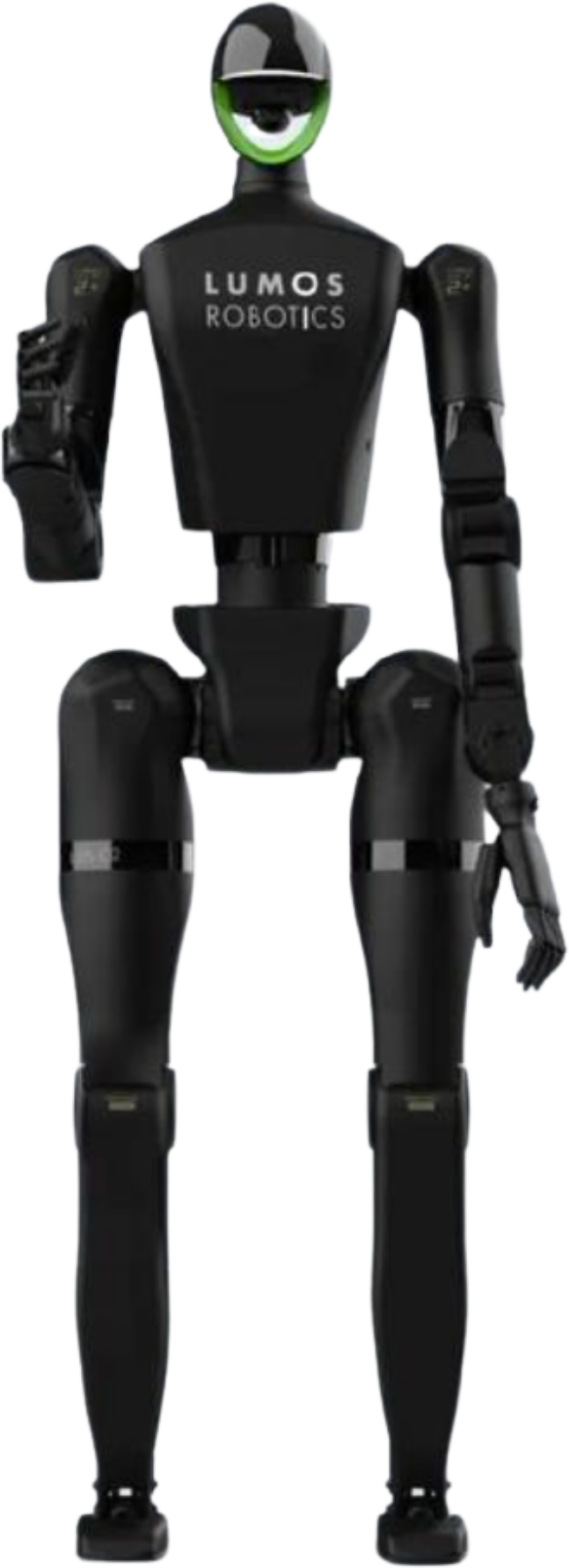
The Lumos LUS 2 (often written as LUS2) is a full-size, general-purpose humanoid robot developed by Lumos Robotics, a Shenzhen-based Chinese robotics startup founded in September 2024. The LUS 2 is the company's flagship humanoid platform, standing 160 cm tall and weighing 57 kg, and is designed for research, education, entertainment, and industrial applications. It is best known as the world's first full-size humanoid robot able to rise from a prone position to a stable upright stance in under one second, a feat unprecedented among full-size humanoids at the time of its debut.[1][2][3]
| Lumos LUS 2 | |
|---|---|
 | |
| General information | |
| Manufacturer | Lumos Robotics |
| Country of origin | China |
| Year unveiled | 2025 |
| Status | Pre-production |
| Price | ~$99,000 USD (estimated) |
| Availability | Limited (volume shipments pending) |
| Website | lumosbot.tech |
The LUS 2 is powered by a proprietary actuator delivering 380 N.m of peak torque and an ultra-high-speed dynamic balance control system that processes center-of-gravity adjustments in as little as 1 millisecond, roughly 30 times faster than the human reflex arc.[3] Combined with reinforcement learning-trained locomotion policies, visuotactile sensing, and NVIDIA Jetson Orin AGX computing (275 TOPS), the LUS 2 positions Lumos Robotics as a notable new entrant in China's rapidly expanding humanoid robot market alongside established competitors such as Unitree Robotics, UBTECH, and Fourier Intelligence.
At the inaugural World Humanoid Robot Games in August 2025, a trio of LUS 2 robots earned the silver medal in the group dance competition with a score of 89.06, demonstrating coordinated bionic motion control.[4][17] The robots subsequently performed at commercial events including the Shenzhen Qianhai Ice and Snow World opening ceremony in September 2025.[5] In the first half of 2026, Mitsubishi Electric led back-to-back Series A1 and A2 rounds that together raised nearly RMB 1 billion (about USD 140 million), the company's largest financing to date.[15]
Who makes the Lumos LUS 2?
Lumos Robotics
Lumos Robotics (formally Lumos Robot Technology (Shenzhen) Co., Ltd.) was founded on September 6, 2024 in Bao'an District, Shenzhen, by Yu Chao, a graduate of Tsinghua University with degrees in mathematics, energy and power engineering, and aerospace.[17] Yu had accumulated over a decade of experience in embodied robotics research, development, and commercialization before founding the company. He previously served as the director of the Embodied Robot Laboratory (known as MagicLab) at Dreame Technology, where he led the teams responsible for the development and mass production of the Xiaomi CyberDog quadruped robot, overseeing the delivery of more than 1,000 units. During his time at Dreame, Yu is credited with creating the world's first backflipping embodied robot powered solely by electric drive.[6][7]
The core team at Lumos includes alumni from Tsinghua University, Shanghai Jiao Tong University, and the Chinese University of Hong Kong. Over 70% of the company's staff are dedicated to research and development, with more than 12 doctorate holders on the team. The CTO, Cao Junliang, holds a doctorate in mechanical engineering from Shanghai Jiao Tong University, and co-CTO Ding Yan holds an AI doctorate from SUNY and previously worked at the Shanghai AI Laboratory.[8]
Industry observers have described Lumos Robotics as "the most anticipated new force" in embodied intelligence to emerge after Unitree Robotics and Zhipu AI, noting that the company accomplished in under one year what competitors typically required several years to achieve.[3]
Funding
Lumos Robotics has progressed through multiple rounds of financing at a rapid pace since its founding:
| Round | Date | Lead Investors | Other Investors |
|---|---|---|---|
| Angel | Early 2025 | Innoangel Fund | SenseCapital, Plum Ventures, Puhua Capital, Gao Bingqiang |
| Angel+ | Mid 2025 | Multiple | Additional angel investors |
| Angel++ | May 2025 | Damon Technology | Fosun RZ Capital, Wuzhong Financial Holdings |
| Pre-A1 | December 2025 | CDH Investments | Nanjing Venture Capital, JinJing Capital, Jingu Shares |
| Pre-A2 | December 2025 | Shenergy Chengyi Investment | - |
| A1 and A2 | February and May 2026 | Mitsubishi Electric | Puhua Capital, Wuzhong Financial Holdings, Hundsun Technologies, Zhejiang Heico Holdings, Shenzhen Kunshi |
The three angel rounds raised a cumulative total of approximately RMB 200 million (around USD 28 million) within the company's first six months of operation.[6] The subsequent Pre-A1 and Pre-A2 rounds, closed in December 2025, raised additional hundreds of millions of yuan, directed toward embodied intelligence data infrastructure and hardware development.[8][13] Strategic shareholders include Fosun Group and SenseTime, along with component maker Damon Technology, which signed a strategic cooperation agreement with Lumos covering control and drive systems in 2025.[14]
In February and May 2026, Lumos closed back-to-back Series A1 and Series A2 rounds led by Mitsubishi Electric, which together raised nearly RMB 1 billion (about USD 140 million), the largest financing in the company's history.[15] Participating investors included Puhua Capital, Wuzhong Financial Holdings, Hundsun Technologies, Zhejiang Heico Holdings, and Shenzhen Kunshi. Mitsubishi Electric, which had started the relationship as an industrial partner on PLC quality inspection, disclosed its investment on March 13, 2026, framing the goal as building humanoid robot solutions for unmanned factories in China.[16] Lumos founder Yu Chao said the partnership with Mitsubishi Electric, a global leader in factory automation, would "strengthen our AI data infrastructure, improve performance, and accelerate practical application."[16] The company said the new capital would support embedding its robots into real production systems, continued embodied large-model research, and expanded deployment across industrial and logistics settings.[15]
Development history
Lumos Robotics' product development has followed an aggressive timeline:
LUS 1 was the company's first-generation full-size humanoid, standing 170 cm tall and weighing 60 kg with a maximum walking speed of 8 km/h and a 7 kg payload capacity. The LUS 1 served as a proof-of-concept platform, demonstrating reinforcement learning-based balance recovery, terrain adaptation, and high-speed motion control in extreme test scenarios including uphill and downhill navigation, kicks, and perturbation recovery. It was priced at approximately $16,000.[9]
The LUS 2 was unveiled at the World Robot Conference (WRC) 2025, held August 8 to 12 at the Beiren Yichuang International Convention and Exhibition Center in Beijing. At the event, the robot performed synchronized dance movements and then demonstrated its explosive recovery capability, bouncing up from the ground in one second to a stable standing position. The WRC 2025 debut marked the LUS 2 as a major step forward over the LUS 1, with a more compact frame (160 cm, 57 kg), substantially higher actuator torque, enhanced sensor suites, and integrated large language model support.[3]
By mid-2025, the LUS series had entered pre-production, with volume shipments expected to begin later that year.[2] The company reported advancing from "pilot verification" to "pre-mass-production lock-in" stage ahead of its internal schedule.
What are the Lumos LUS 2's technical specifications?
Physical dimensions and construction
The LUS 2 stands 160 cm tall (approximately 5 feet 3 inches), weighs 57 kg, and has external dimensions of roughly 160 x 50 x 30 cm. The frame is constructed from aluminum alloy and composite materials, providing a balance between structural rigidity and low weight that supports dynamic maneuvers. The robot's proportions are designed to approximate adult human body ratios, enabling it to operate effectively in environments built for humans.
Actuation system
The LUS 2's joints are driven by proprietary high-power-density electric servo motors developed entirely in-house by Lumos Robotics. The flagship actuator specifications include:
- Peak torque: 380 N.m (compared to 360 N.m on competitors like the Unitree H1)
- Torque density: 233 N.m/kg, among the highest reported for humanoid robot actuators
- Instantaneous response time: 0.2 seconds
- Gear technology: Combination of harmonic and planetary reducers
Lumos has also developed PEEK (polyether ether ketone) cycloidal reduction modules that achieve a 40% reduction in weight and a 60% improvement in torque density compared to conventional metal cycloidal drives, while maintaining low-noise operation.[8] These modules represent a significant advance in lightweight actuator design, as PEEK is both lighter and more wear-resistant than traditional metal gearing components.
The total body has 28 degrees of freedom (DOF), with 6 DOF per leg, enabling the robot to perform complex bipedal locomotion including walking, running, stair climbing, and the signature one-second stand-up maneuver.[10]
Sensor suite
The LUS 2 integrates a comprehensive multi-modal perception system:
| Sensor | Type | Function |
|---|---|---|
| Intel RealSense D435i | Stereo depth camera with IMU | Close-range 3D perception, visual-inertial odometry |
| 360-degree LiDAR | Solid-state laser scanner | Long-range environment mapping and localization |
| IMU | Inertial measurement unit | Balance control, state estimation |
| Joint torque sensors | Proprioceptive | Force feedback, compliance control |
| Joint angle encoders | Dual absolute encoders | Precise position and velocity feedback |
| Finger tactile sensors | Visuotactile | Contact detection, force regulation |
| Palm tactile sensors | Visuotactile | Grasp force estimation, object recognition |
The visuotactile sensors are a key differentiator for Lumos Robotics. These sensors combine optical (camera-based) and tactile modalities to estimate contact states and regulate grasping forces, enabling the robot to handle delicate or deformable objects more safely than robots relying solely on vision. Lumos claims its visuotactile modules achieve a spatial resolution of 0.06 mm at 30 frames per second.[11]
Computing architecture
The LUS 2 employs a dual-processor computing architecture:
- Main AI processor: NVIDIA Jetson AGX Orin, delivering 275 TOPS (trillion operations per second) of AI computing performance. This module handles perception pipelines, neural motion planning, large language model integration, and high-level task planning.[10]
- Real-time control processor: A dedicated processor running deterministic control loops for joint-level motor commands, balance algorithms, and safety systems.
The system communicates internally via EtherCAT for low-latency, deterministic motor control, and supports Wi-Fi for external connectivity. The software stack is Linux-based with full ROS 2 compatibility, and Lumos provides open APIs and SDKs for developer integration.
Power system
The LUS 2 is powered by a lithium battery pack with a capacity of 10 Ah at a rated voltage of 54V DC. The battery provides approximately 2 hours of high-intensity sports endurance, sufficient for demonstration performances, inspection rounds, or research sessions. Under lighter operating conditions, runtime may extend somewhat beyond this figure.[3][10]
Summary of specifications
| Category | Specification | Value |
|---|---|---|
| Physical | Height | 160 cm (5 ft 3 in) |
| Physical | Weight | 57 kg (125.7 lb) |
| Physical | Materials | Aluminum alloy + composites |
| Mobility | Total degrees of freedom | 28 |
| Mobility | DOF per leg | 6 |
| Mobility | Maximum walking speed | 2 m/s (7.2 km/h, 4.5 mph) |
| Mobility | Stand-up time (prone to upright) | <1 second |
| Manipulation | Arm payload | 3 kg (single arm) |
| Manipulation | Fingers per hand | 5 |
| Actuation | Peak joint torque | 380 N.m |
| Actuation | Torque density | 233 N.m/kg |
| Actuation | Motor type | Electric servo (brushless) |
| Actuation | Gear technology | Harmonic/Planetary + PEEK cycloidal |
| Computing | Main processor | NVIDIA Jetson AGX Orin (275 TOPS) |
| Computing | Control processor | Dedicated real-time processor |
| Computing | Operating system | Linux (ROS 2 compatible) |
| Computing | LLM integration | Yes |
| Sensors | Depth camera | Intel RealSense D435i |
| Sensors | LiDAR | 360-degree solid-state |
| Sensors | Tactile sensors | Visuotactile (fingers + palms) |
| Sensors | IMU | Yes |
| Power | Battery capacity | 10 Ah / 54V DC |
| Power | Runtime | ~2 hours (high intensity) |
| Connectivity | Internal bus | EtherCAT |
| Connectivity | External | Wi-Fi, Ethernet, USB |
Key technologies
Ultra-high-speed dynamic balance control
The LUS 2's most distinctive technical achievement is its ultra-high-speed dynamic balance control system. Through a bionic posture algorithm trained using reinforcement learning, the robot can complete center-of-gravity migration decisions in approximately 1 millisecond, a reaction speed roughly 30 times faster than the human reflex arc. This capability enables the robot to transition from a fully prone position to a stable upright stance in under one second, compared to the 3 to 5 seconds that was the industry standard for full-size humanoids at the time of the LUS 2's debut.[3]
The proprietary actuator delivers peak torque of 380 N.m with an instantaneous response capability of 0.2 seconds, generating lower-limb explosive force equivalent to approximately 1.8 times that of an adult male. These numbers, combined with the high-speed control loop, give the LUS 2 the agility needed for rapid recovery from falls, disturbance rejection, and dynamic locomotion on uneven terrain.
Visuotactile sensing and the LUX series
Lumos Robotics places tactile sensing at the center of its technical differentiation strategy. Rather than relying solely on vision and language models for manipulation (as many competitors do), Lumos integrates visuotactile sensors that combine optical imaging with physical contact feedback.
The company's LUX series is a dedicated product line of visuotactile hardware components. The flagship product, the LUX-G gripper, uses end-to-end imitation learning to tightly couple haptic sensing, visual recognition, and motion control. Lumos claims the LUX-G is "nearly as sensitive as a human fingertip," capable of detecting small changes in torque and force during manipulation tasks.[6]
Lumos is actively developing what it calls a VTLA (Vision-Tactile-Language-Action) model, which extends the standard VLA (Vision-Language-Action) framework used in embodied AI by incorporating tactile data as a first-class input modality. This integration is intended to improve the robot's ability to perform contact-rich manipulation tasks such as grasping deformable objects, opening doors and drawers, and handling fragile items.
FastUMI data collection
Lumos Robotics has developed the FastUMI Pro, a backpack-mounted universal manipulation interface device for collecting robot training data at scale. Based on the UMI (Universal Manipulation Interface) framework originally proposed by researchers at Stanford University, Columbia University, and the Toyota Research Institute, FastUMI Pro decouples data acquisition from specific robot hardware, allowing collected data to generalize across different robot morphologies.[12]
Key performance metrics for FastUMI Pro include:
- 3x efficiency gain: For tasks like clothing folding, collection time drops from 50 seconds to 10 seconds per demonstration
- 5x cost reduction: Per-demonstration cost falls from RMB 3-5 (approximately $0.42-0.70) to under RMB 0.6 (roughly $0.08)
- 1-3 mm accuracy: Sufficient for most manipulation tasks
By 2025, Lumos had established a dedicated data collection center and achieved an annualized production capacity of 100,000 hours of real-machine training data. The company's 2026 target is one million annual hours of data, with plans to deploy 10,000 FastUMI Pro units across six environment categories: industrial sites, homes, hotels, restaurants, shopping malls, and offices. Lumos has also launched a "data supermarket" on its website, offering standardized manipulation datasets for purchase by other robotics developers.[12]
How does the LUS 2 compare to the LUS 1?
The LUS 2 represents a significant evolution over the first-generation LUS 1:
| Specification | LUS 1 | LUS 2 |
|---|---|---|
| Height | 170 cm | 160 cm |
| Weight | 60 kg | 57 kg |
| Maximum speed | 8 km/h (2.2 m/s) | 7.2 km/h (2 m/s) |
| Peak joint torque | Not disclosed | 380 N.m |
| Torque density | Not disclosed | 233 N.m/kg |
| Arm payload | 7 kg | 3 kg |
| Stand-up time | Several seconds | <1 second |
| Main processor | AI accelerator (unspecified) | NVIDIA Jetson AGX Orin (275 TOPS) |
| LiDAR | Not confirmed | 360-degree solid-state |
| Depth camera | Vision-based | Intel RealSense D435i |
| Tactile sensors | Not included | Visuotactile (fingers + palms) |
| LLM integration | No | Yes |
| ROS compatibility | Yes | Yes (ROS 2) |
| Battery runtime | 3 hours | ~2 hours |
| Approximate price | $16,000 | ~$99,000 |
| Status | Development | Pre-production |
While the LUS 2 trades some raw speed and payload capacity for a more compact form factor, its primary advances lie in actuation quality, sensing capability, computing power, and dynamic balance control. The addition of visuotactile sensing and LLM integration positions the LUS 2 as a substantially more capable research and commercial platform than its predecessor.
How does the LUS 2 compare to the NIX?
Alongside the LUS series, Lumos Robotics developed the NIX, a compact child-sized humanoid designed for entertainment, education, and home companionship. The two platforms target fundamentally different market segments:
| Specification | LUS 2 | NIX |
|---|---|---|
| Height | 160 cm | 80 cm |
| Weight | 57 kg | 20 kg |
| Target market | Research, industrial, commercial | Entertainment, education, home |
| Walking speed | 7.2 km/h (2 m/s) | 2-3 km/h |
| DOF | 28 | ~21 (estimated) |
| Actuator model | Custom (380 N.m peak) | Lumos 60-30 (102 N.m peak) |
| Main processor | NVIDIA Jetson AGX Orin | Intel/NVIDIA (comparable to Orin) |
| Battery runtime | ~2 hours | 1.5-2 hours |
| Notable capability | 1-second stand-up | Backflips, side flips, martial arts kicks |
| Price | ~$99,000 | ~$12,000 (estimated) |
| Status | Pre-production | Prototype |
The NIX, standing just 80 cm tall and weighing 20 kg, is notable for its acrobatic capabilities. It can perform backflips, side flips, and dynamic martial arts movements (often marketed as "Kung Fu mode") using its Lumos 60-30 joint modules, which deliver 102 N.m of peak torque with a 30:1 planetary reducer. Despite its small size, the NIX serves as a powerful demonstration of Lumos' reinforcement learning and neural motion planning technologies in a lightweight, approachable form factor.[11] The NIX was showcased at WRC 2025 and the 27th China Hi-Tech Fair.
Product family and broader portfolio
Lumos Robotics' product lineup extends beyond the LUS and NIX humanoids:
| Product Line | Description |
|---|---|
| LUS series | Full-size humanoid robots (LUS 1, LUS 2) for research and commercial deployment |
| MOS (Hercules) | Industrial dual-arm wheeled humanoid with 50 kg payload capacity, targeting logistics and manufacturing |
| NIX | Compact child-sized humanoid (80 cm) for entertainment, education, and home companionship |
| LUX series | Visuotactile hardware components, including the LUX-G gripper with end-to-end imitation learning |
| Joint modules | Self-developed high-performance integrated joints with PEEK cycloidal drives |
| Visuotactile sensors | 0.06 mm resolution tactile sensing modules at 30 fps |
| FastUMI Pro | Backpack-mounted data collection system for robot training |
| 7-DOF data acquisition arms | Standardized arms for manipulation data collection |
The MOS (Hercules) series is particularly notable for its 50 kg dual-arm load capacity, which fills a gap in the market where most competing dual-arm wheeled robots are limited to approximately 20 kg. The MOS is designed specifically for high-load industrial scenarios such as warehouse logistics and manufacturing line operations.[3]
What is the Lumos LUS 2 used for?
Research and education
The LUS 2 is designed as an open research platform with full ROS 2 support, open APIs, and SDKs. Its combination of advanced sensing (visuotactile, LiDAR, depth camera), high-performance computing (275 TOPS), and LLM integration makes it suitable for research in bipedal locomotion, whole-body control, sim-to-real transfer, manipulation, and human-robot interaction. Lumos positions the platform as particularly well-suited for applied humanoid R&D, where researchers need a robot capable of dynamic movement and contact-rich manipulation.
Entertainment and performance
The LUS 2's silver medal at the World Humanoid Robot Games and subsequent performances at commercial events demonstrate its capabilities in choreographed movement and entertainment. The robot's ability to execute synchronized dance routines, rapid stand-up sequences, and dynamic poses makes it attractive for exhibitions, theme parks, and cultural tourism applications. Lumos has indicated plans to explore "deep integration of robots and the cultural tourism industry."[5]
Industrial applications
Through partnerships with Mitsubishi Electric and COSCO Shipping, Lumos is actively developing industrial applications for its robot platforms. With Mitsubishi Electric, the company is developing embodied intelligence solutions for flexible quality inspection of PLC products, with plans to promote these solutions globally.[8] The COSCO Shipping partnership focuses on logistics, intelligent manufacturing, port operations, and supply chain optimization.[6]
Using the FastUMI Pro data collection system and its MOS dual-arm robot, Lumos demonstrated a complete factory quality inspection workflow (data collection, policy training, and model inference) in five hours under lab conditions and seven hours in real-world deployment at a facility in Hefei.[12]
Service and healthcare
Lumos targets service applications including guided tours, reception, and healthcare assistance. The LUS 2's human-like proportions and dynamic balance capabilities allow it to navigate environments designed for humans, while its visuotactile sensing enables safer physical interaction than robots that rely solely on vision.
How does the LUS 2 compare to other humanoid robots?
The LUS 2 enters a rapidly growing Chinese humanoid robot market. GGII (Gaogong Industry Research Institute) projects 12,400 humanoid robot unit shipments in 2025, valued at approximately RMB 6.34 billion, scaling to roughly 340,000 units by 2030 (RMB 64+ billion) and over RMB 400 billion by 2035.[3]
The following table provides context for the LUS 2 among selected competing platforms:
| Feature | Lumos LUS 2 | Unitree H1 | Unitree G1 | Fourier GR-2 | UBTECH Walker S |
|---|---|---|---|---|---|
| Height | 160 cm | 180 cm | 127 cm | 175 cm | 170 cm |
| Weight | 57 kg | 47 kg | 35 kg | 63 kg | 77 kg |
| DOF | 28 | 19 | 23-43 | 53 | 41 |
| Max speed | 2 m/s | 3.3 m/s | ~2 m/s | 2 m/s | 1.5 m/s |
| Peak torque | 380 N.m | 360 N.m | Not disclosed | Not disclosed | Not disclosed |
| Tactile sensing | Visuotactile | No | No | No | No |
| LLM integration | Yes | No | Yes | Yes | Yes |
| Stand-up speed | <1 second | Not demonstrated | Not demonstrated | Not demonstrated | Not demonstrated |
| Price | ~$99,000 | ~$90,000 | ~$16,000 | ~$100,000+ | Not disclosed |
| Status | Pre-production | In production | In production | In production | In production |
Lumos Robotics differentiates itself from competitors through several factors:
- Tactile-first approach: The emphasis on visuotactile sensing and the development of a VTLA model distinguishes Lumos from competitors that rely primarily on vision-language-action frameworks.
- Dynamic agility: The one-second stand-up capability and 380 N.m peak actuator torque demonstrate class-leading dynamic performance.
- Full-stack ownership: Lumos develops its own actuators, joint modules, sensors, control software, and data collection infrastructure, giving it end-to-end control over the technology stack.
- Data infrastructure: The FastUMI Pro system and data supermarket represent a unique approach to scaling robot training data, an increasingly critical bottleneck in embodied AI.
Strategic partnerships
Lumos Robotics has established partnerships with several major industrial and technology companies:
| Partner | Area of Cooperation |
|---|---|
| Mitsubishi Electric | Quality inspection for PLC products; global digital factory solutions; lead investor |
| COSCO Shipping | Logistics, port operations, intelligent manufacturing |
| Damon Technology | Robot core components (control and drive systems); strategic investment |
| Fosun Group | Strategic investment and ecosystem integration |
| SenseTime | Strategic investment; AI technology synergy |
Mitsubishi Electric's role expanded significantly in 2026, moving from an industrial collaborator into the lead investor of Lumos Robotics when it headed the company's Series A1 and A2 funding rounds.[15][16]
Achievements and milestones
- August 2025: LUS 2 unveiled at the World Robot Conference (WRC) 2025 in Beijing, demonstrating one-second stand-up capability.[3]
- August 2025: Silver medal in the group dance competition at the inaugural World Humanoid Robot Games, scoring 89.06 in a competition held at the National Speed Skating Oval (the "Ice Ribbon") in Beijing.[4][17]
- September 2025: Performance at the Shenzhen Qianhai Ice and Snow World grand opening ceremony.[5]
- November 2025: Lumos Robotics' silver-medal dance team performed at the closing ceremony of the 15th National Games.[17]
- December 2025: Completion of Pre-A1 and Pre-A2 financing rounds, raising hundreds of millions of yuan.[8][13]
- February and May 2026: Series A1 and A2 rounds led by Mitsubishi Electric, together raising nearly RMB 1 billion (about USD 140 million), the company's largest financing to date.[15]
- March 2026: Mitsubishi Electric disclosed its strategic investment in Lumos to co-develop humanoid robot solutions for unmanned factories in China.[16]
- 2025 (ongoing): Accumulation of 10,000+ hours of real-machine training data via the FastUMI Pro system.[12]
What are the LUS 2's limitations?
Despite its technical achievements, the LUS 2 has several notable limitations:
- Lower payload than LUS 1: The LUS 2's single-arm payload of 3 kg is less than half the LUS 1's 7 kg capacity, limiting the weight of objects it can manipulate. For heavy industrial tasks, Lumos directs customers to its MOS (Hercules) platform instead.
- Battery runtime: Approximately 2 hours of high-intensity operation is adequate for demonstrations and research sessions but may prove insufficient for extended autonomous deployment in industrial settings.
- Pre-production status: As of mid-2026, the LUS 2 has not yet entered full mass production. Prospective buyers must engage directly with Lumos for quotations and delivery timelines.
- Speed trade-off: The LUS 2's maximum speed of 2 m/s, while respectable, is significantly slower than the Unitree H1's record-setting 3.3 m/s, reflecting design trade-offs favoring compact size and dynamic balance over raw locomotion speed.
- Ecosystem maturity: As a startup founded in 2024, Lumos Robotics' developer ecosystem, documentation, and third-party support are less mature than those offered by established competitors with multi-year head starts.
See also
- Humanoid robot
- Humanoid robots
- Lumos Robotics
- NIX (robot)
- Unitree H1
- Unitree G1
- Reinforcement learning
- Visuotactile sensing
- Embodied AI
- ROS (Robot Operating System)
References
- ^"Shenzhen's Lumos Robotics Unveils Lus2: A Next-Gen Housebot with Incredible Agility." HouseBots News, 2025.
- ^1 ^2"Lumos Robotics Introduces Lus2: A Leap in Humanoid Robot Agility." DataGlobalHub, 2025.
- ^1 ^2 ^3 ^4 ^5 ^6 ^7 ^8 ^9"WRC 2025's 'Disruptor Sample': The Born-Mature Luming Robot." 36Kr, August 2025.
- ^1 ^2"Dance Forest Competition Witnesses China's Speed: Luming Robot LUS2 Won The Runner-up in The Group Dance Competition Of The World Humanoid Robot Games." Sango Automation, August 2025.
- ^1 ^2 ^3"The Silver Medal Dance Team Of Luming Robot Helped The Opening Ceremony Of The Ice And Snow World." Sango Automation, September 2025.
- ^1 ^2 ^3 ^4"Touch-enabled robots inch closer to reality as Lumos Robotics secures new funding." KrASIA, May 2025.
- ^Lumos Robotics official website.
- ^1 ^2 ^3 ^4 ^5"Tsinghua-Affiliated Embodied Intelligence Firm Bags Hundreds of Millions in Pre-A Round Financing, Gets Orders from Top Clients like Mitsubishi." 36Kr, December 2025.
- ^"Lumos Robotics LUS1." RobGen catalog.
- ^1 ^2 ^3Lumos Robotics LUS2 product page.
- ^1 ^2"NIX Humanoid Robot." ChipSilicon, 2025.
- ^1 ^2 ^3 ^4"This company has built a backpack-style system for robotics data collection." KrASIA, 2025.
- ^1 ^2"Lumos Robotics Secures Pre-A1 and Pre-A2 Financing Rounds." Pandaily, December 2025.
- ^"Damon and Lumos Robotics Signed a Strategic Cooperation Agreement." Damon Technology Group, 2025.
- ^1 ^2 ^3 ^4 ^5"Lumos Robotics Closes ~1B RMB Across A1 and A2 Rounds, Mitsubishi Electric Leads." Pandaily, 2026.
- ^1 ^2 ^3 ^4"Mitsubishi Electric Invests in Chinese Humanoid Robot Company Lumos to Build Humanoid Robot Solutions for Unmanned Factories in China." Kikai-news.net (Sanki Tsushin), March 2026.
- ^1 ^2 ^3 ^4"Lumos Robot Technology (Shenzhen) Co., Ltd." Baidu Baike.
Improve this article
Add missing citations, update stale details, or suggest a clearer explanation. Every suggestion is reviewed for sourcing before it goes live.
6 revisions · v6 · 4,608 words · full history
Fact-checks are independent of edits: a reviewer re-verifies the article against its sources and stamps the date. How we verify
Research and drafting on this wiki are AI-assisted, under named human editorial standards. How AI is used here
Cite this page: AI Wiki. "Lumos LUS 2." aiwiki.ai, updated 11 Jul 2026. CC BY 4.0. https://aiwiki.ai/wiki/lumos_robotics_lus2