

Keenon XMAN-R1
| Keenon XMAN-R1 | |
|---|---|
 | |
| General information | |
| Manufacturer | KEENON Robotics |
| Country of origin | China |
| Year unveiled | 2025 |
| Status | In deployment |
| Price | ~$100,000 USD (third-party estimate) |
| Website | keenon.com |
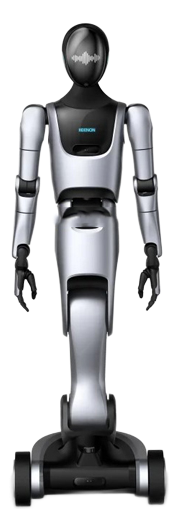
The Keenon XMAN-R1 is a humanoid service robot built by KEENON Robotics, a Shanghai-based commercial robotics company, and unveiled on March 31, 2025.[1] It is designed not for general-purpose or industrial work but specifically for service-industry tasks such as guest greeting, food delivery, luggage handling, and room cleaning, and it is powered by KEENON's proprietary KOM2.0 Vision-Language-Action (VLA) model, which the company calls "the world's first Vision-Language-Action (VLA) model for the service industry."[3][16] In October 2025 the XMAN-R1 went into commercial use at the Shangri-La Traders Hotel at Shanghai Hongqiao Airport, in what KEENON described as the world's first hotel to run a collaborative model combining a general-purpose humanoid with task-specific service robots.[4]
KEENON entered humanoid robotics after more than 15 years of building and deploying specialized service robots for the hospitality, restaurant, and healthcare industries.[1] Rather than operating as a standalone machine, the XMAN-R1 is engineered to coordinate KEENON's existing fleet of specialized robots in a multi-robot deployment strategy.[3] The robot was later showcased at CES 2026 in Las Vegas, where it greeted visitors, handed out candy, and performed expressive gestures.[5]
What is the Keenon XMAN-R1?
The XMAN-R1 is KEENON's first humanoid robot and the flagship of its XMAN series of embodied AI products. According to the report describing its hotel debut, it is "an embodied service robot developed entirely in-house" by KEENON, "built using vast real-world data collected over years of research into service environments."[3] It performs extended-range service tasks such as meal delivery and collection, luggage handling, and room cleaning while adapting to dynamic surroundings, and in a hospitality setting it is positioned as a front-desk greeter that engages guests through natural language, answers questions, and offers welcome gifts.[3]
KEENON positions the XMAN-R1 against a different backdrop than most humanoid programs. Where companies like Tesla (with Optimus) or Figure AI (with Figure 02) pursue a broad "general-purpose humanoid" narrative, KEENON has emphasized a gradual, role-specific strategy grounded in its existing service-robot business.[6] Founder and CEO Li Tong (Tony Li) has framed the rollout in stages: "The deployment of humanoid robots will evolve gradually, from single tasks to multiple tasks, from limited versatility to broader capabilities."[6]
Who makes the Keenon XMAN-R1?
Company history
KEENON Robotics was founded in 2010 in Shanghai, China, by Tony Li (Li Tong), who serves as the company's CEO.[6] The company's name reflects its founding motto: "Keen on Robots, Keen on the Future." During its early years, KEENON focused on developing autonomous navigation and delivery technologies for indoor commercial environments. A pivotal milestone came in 2016 with the launch of the DINERBOT T1, which KEENON described as the world's first autonomous restaurant delivery robot.[7]
By 2018, KEENON had established mass production lines for catering robots and formed a notable collaboration with Haidilao, one of China's largest hot pot restaurant chains, to develop an intelligent restaurant concept.[7] The COVID-19 pandemic in 2020 and 2021 accelerated demand for contactless service solutions, leading KEENON to rapidly develop and deploy medical delivery robots (the M1) and disinfection robots (the M2) for hospitals and public facilities.[7]
Global expansion and market leadership
Since establishing its International Business Division in 2022, KEENON has rapidly expanded its presence across more than 600 cities in over 60 countries and regions, including the United States, Germany, Japan, South Korea, the Netherlands, and the United Arab Emirates.[8] The company operates wholly owned subsidiaries in several of these markets and maintains more than 70 after-sales service and operations centers worldwide.[8]
According to IDC's 2024 market reports (released in July 2025), KEENON holds three simultaneous number-one global rankings in the commercial service robot market:[9]
| Ranking | Market Segment | KEENON Market Share |
|---|---|---|
| #1 worldwide | Overall commercial service robot shipments | 22.7% |
| #1 worldwide | Delivery service robot shipments | 29.8% |
| #1 worldwide | Food delivery robot shipments and revenue | 40.4% |
The company has shipped over 100,000 robot units globally as of 2024 and commands approximately 44.8% of the catering delivery robot export market.[10] Chinese vendors overall contributed 84.7% of global commercial service robot shipments in 2024.[9]
How is KEENON funded and valued?
KEENON has raised a total of approximately $244 million across seven funding rounds.[11] The largest single round was a $200 million Series D announced on September 15, 2021, led by SoftBank Vision Fund 2, with participation from CICC ALPHA and Prosperity7 Ventures (the venture arm of Saudi Aramco).[12] Earlier investors include Alibaba (through Ele.me), Source Code Capital, Yunqi Partners, Walden International, and Vision Ventures. Shanghai's state-backed Sci-Tech Innovation Fund has also invested in the company.[6] As of 2023, KEENON was valued at approximately $1 billion, reaching unicorn status.[11] The company has indicated it is exploring public listing opportunities.[6]
Product portfolio
Prior to entering the humanoid robot space, KEENON built a comprehensive product portfolio of specialized service robots:
| Product Series | Models | Application |
|---|---|---|
| DINERBOT | T3, T8, T9, T9 Pro, T10, T11 | Restaurant food delivery |
| BUTLERBOT | W3 | Hotel in-room delivery |
| KLEENBOT | C20, C30, C40, C55 | Commercial cleaning |
| Heavy Load | S100 | Industrial and luggage transport |
| Medical | M1, M2, X-series | Hospital delivery and disinfection |
| Lawn Care | Keenmow K1 | Autonomous lawn mowing |
The DINERBOT series remains KEENON's flagship product line. The BUTLERBOT hotel delivery series saw a 244% revenue increase as the hospitality sector adopted robotic solutions.[7] KEENON's non-humanoid robots typically start at around $13,000, making them accessible to a wide range of commercial operators.[13]
How was the XMAN-R1 designed and developed?
Design philosophy
The XMAN-R1 reflects KEENON's pragmatic, task-oriented approach to humanoid robotics. Rather than pursuing the all-purpose humanoid narrative that dominates much of the industry, KEENON has emphasized a gradual, role-specific strategy that leans on its existing service-robot deployments. CEO Li Tong has been blunt about the commercialization bar: "Only when a robot can fully perform a job more efficiently than a human can it be deployed at scale. Otherwise, it's just a gimmick."[18]
This philosophy draws on KEENON's 15 years of accumulated data from real-world service environments, its manufacturing expertise in electromechanical systems, and its existing deployment infrastructure spanning 60+ countries.[6] The company views its deep understanding of service workflows as a competitive advantage that pure humanoid startups lack.
Development of the XMAN series
The XMAN-R1 was first officially introduced on March 31, 2025, alongside new additions to the KLEENBOT cleaning robot lineup (the C40, C55, and C20).[1] At launch, KEENON presented the XMAN-R1 as a robot "developed to interact with people and collaborate with other KEENON robots," naming the DINERBOT T10, KLEENBOT C30, and KEENON S100 as collaborators.[1]
Following the XMAN-R1, KEENON unveiled the XMAN-F1 at the World Artificial Intelligence Conference (WAIC) 2025 in Shanghai from July 26 to 29, 2025. The XMAN-F1 is a bipedal variant that demonstrated more advanced mobility and dexterity, performing tasks such as preparing popcorn and mixing customized cocktails (including a collaboration with Johnnie Walker Blue Label for a bartending demonstration).[14] While the XMAN-R1 focuses on service greeting and coordination roles, the XMAN-F1 demonstrated capabilities in more physically demanding manipulation tasks.
What are the XMAN-R1's specifications?
KEENON has not released a comprehensive technical specification sheet for the XMAN-R1. The following figures are compiled from a third-party robot database (which lists them as "Not Verified") together with press releases and demonstration reports, and should be treated as estimates rather than official numbers:[19]
| Category | Specification | Details |
|---|---|---|
| Physical | Height | Approximately 172 cm (5 ft 8 in) |
| Physical | Weight | Approximately 110 kg |
| Mobility | Degrees of freedom (total) | 36 |
| Mobility | DOF per hand | 6 |
| Mobility | Fingers per hand | 5 |
| Mobility | Maximum walking speed | 0.8 m/s (2.9 km/h) |
| Manipulation | Payload capacity (per arm) | 3 kg |
| Power | Estimated battery life | ~3 hours |
| Computing | Operating system | Linux |
| AI | Core AI model | KOM2.0 (VLA) |
| AI | Domain model | KEENON ProS |
| Navigation | Positioning technology | SLAM (centimeter-level accuracy) |
| Sensors | Perception | 3D vision, voice recognition, multimodal fusion |
The XMAN-F1 variant (showcased at WAIC 2025) features dual robotic arms with 7 degrees of freedom per arm, force-feedback sensors for precise manipulation, and a reinforcement learning-based dynamic balance system.[15] It is not confirmed whether all of these specifications carry over identically to the XMAN-R1.
What AI powers the XMAN-R1?
KOM2.0 Vision-Language-Action model
The XMAN-R1 is powered by KOM2.0, which KEENON describes as "the world's first Vision-Language-Action (VLA) model for the service industry," forming "the foundation of the robot's general intelligence."[4] VLA models integrate visual perception, natural language processing, and physical action planning into a single unified framework, allowing a robot to observe its environment, understand spoken or written instructions, and execute physical tasks in response.
KOM2.0 was trained on massive volumes of scenario-specific data collected from KEENON's extensive deployments across restaurants, hotels, hospitals, and other service environments. The model incorporates few-shot learning capabilities, enabling rapid adaptation to new work environments without extensive retraining.[15] Key capabilities enabled by KOM2.0 include:
- Multimodal fusion perception: Combining 3D vision, audio input, and spatial awareness to understand complex environments
- Natural language interaction: Understanding and responding to high-level human commands in conversational language
- Spatial awareness and navigation: Mapping and navigating complex indoor environments with centimeter-level precision using SLAM technology
- Domain-specific knowledge graphs: Encoding structured knowledge about service workflows, guest interaction protocols, and task sequences
- Autonomous task execution: In KEENON's demonstrations, KOM2.0-powered humanoids interpret complex instructions such as preparing a cup of tea at a specified temperature, selecting the tea type, adjusting water settings, and completing the brewing process without human assistance (a capability shown for the bipedal XMAN-F1 variant)[15]
KEENON ProS
Complementing KOM2.0, the XMAN-R1 also uses KEENON ProS, a vertically optimized domain model that provides what the company describes as "professional job skills" for specific industries, functioning like comprehensive "vocational training."[4] While KOM2.0 handles general perception and action planning, KEENON ProS equips the robot with specialized knowledge for its assigned role, comparable to industry-specific professional training. This two-layer architecture allows the same hardware platform to be adapted for different service contexts (hotel greeting, restaurant service, healthcare support) by swapping or fine-tuning the ProS layer.
Custom chip and hardware
KEENON has developed a proprietary processor chip that is used across its robot product line. This custom chip is designed to boost computing power while reducing energy consumption, enabling robots to operate efficiently for extended periods.[15] The XMAN-R1 features an integrated AI compute platform for navigation, balance, and manipulation, though KEENON has not publicly disclosed the exact specifications of the SoC or GPU hardware.
How does multi-robot collaboration work?
One of the XMAN-R1's defining features is its ability to function as the centerpiece of a coordinated multi-robot deployment. Rather than operating as a standalone system, the XMAN-R1 is designed to work alongside KEENON's specialized service robots using distributed task coordination and swarm intelligence.
KEENON calls this the "Robot-to-Role" correspondence model, which it describes as "deconstructing commercial service scenarios into independent work modules, where each module corresponds to a single, standardized role with clearly defined boundaries and responsibilities."[4] Each robot type handles the tasks it is best suited for, while the XMAN-R1 serves as the general-purpose "face" of the operation, handling unstructured human interactions that require social intelligence and adaptability.
In the Shangri-La hotel deployment, the robot collaboration matrix operates as follows:[4]
| Robot | Role | Tasks |
|---|---|---|
| XMAN-R1 | General-purpose humanoid | Guest greeting, Q&A interaction, welcome gift presentation |
| W3 (BUTLERBOT) | Delivery robot | In-room item deliveries |
| S100 | Heavy-load transport | Luggage handling |
| C40 (KLEENBOT) | Cleaning robot | Hotel cleaning and sanitation |
| T10 and T3 (DINERBOT) | Food delivery | Restaurant food delivery to tables |
This deployment model reflects KEENON's position that current humanoid robot technology is better suited for coordinated, role-specific deployment than for all-purpose autonomy. By pairing the XMAN-R1 with proven specialized robots, KEENON can offer a comprehensive service automation solution while the humanoid platform continues to mature.
Where has the XMAN-R1 been deployed?
Shangri-La Traders Hotel (October 2025)
The most significant real-world deployment of the XMAN-R1 occurred at the Shangri-La Traders Hotel at Shanghai Hongqiao Airport, officially announced on October 31, 2025.[4] The hotel classified its robots as "employees" and integrated them across multiple service touchpoints. The XMAN-R1 was stationed at the front desk area, where it performs the following duties:
- Proactively greeting arriving guests with natural language interaction and anthropomorphic gestures
- Engaging in intelligent Q&A interactions, answering questions about hotel facilities and services
- Presenting a welcome gift to each guest
- Creating what KEENON described as "an immersive experience infused with a strong sense of futuristic technology"[16]
KEENON positioned this deployment as the world's first smart scenario model demonstrating collaborative operations between general-purpose and special-purpose robots.[4] The deployment served as both a commercial pilot and a proof of concept for KEENON's multi-robot collaboration architecture.
World Artificial Intelligence Conference (July 2025)
At WAIC 2025 in Shanghai, KEENON showcased the XMAN-F1 variant in an "Embodied Service Experience Hub" featuring three interactive demonstration scenarios:[14]
- Medical station: The XMAN-F1 partnered with the M104 logistics robot to create a closed-loop smart healthcare solution, demonstrating robotic coordination in clinical settings
- Lounge bar: The humanoid robot served as a bartender, mixing personalized chilled beverages (Sprite, Coke, cocktails) with adjustable ice levels, collaborating with the DINERBOT T10 for delivery. This demonstration featured a branded collaboration with Johnnie Walker Blue Label
- Performance space: The robot delivered digital presentations using multimodal interaction and large language model integration
CES 2026 (January 2026)
KEENON brought the XMAN-R1 to CES 2026 in Las Vegas, marking the robot's first appearance at the major consumer electronics trade show.[5] During the demonstration, the XMAN-R1 drew attention for its interactive abilities, "deftly handing out candies and performing anthropomorphic gestures like making a heart shape or waving," with its broader skill set including making popcorn and pouring drinks.[5] The company also used CES 2026 to unveil the Keenmow K1, its first autonomous robotic lawn mower (which uses a 3D LiDAR-Vision fusion perception system to map gardens and navigate passages as tight as 0.8 meters), signaling expansion into the home robotics market.[5]
Additional pilots
KEENON has indicated that pilot deployments are underway with Walmart for warehouse logistics applications, although details of this pilot have not been publicly disclosed.[15]
How does the XMAN-R1 compare to other humanoid robots?
The XMAN-R1 enters a crowded and rapidly evolving humanoid robot market. KEENON's approach differs meaningfully from many of its competitors in that it targets the service sector specifically, leveraging existing commercial relationships and deployment infrastructure.
Service robot competitors entering humanoid space
Pudu Robotics, KEENON's most direct competitor in the restaurant delivery robot market with over 80,000 units deployed globally, launched its own bipedal humanoid, the PUDU D9, in 2025.[17] Like KEENON, Pudu brings deep service-industry expertise and an established global customer base to the humanoid market.
General-purpose humanoid competitors
Several well-funded companies are pursuing broader humanoid robot platforms:
| Company | Robot | Focus | Notable Detail |
|---|---|---|---|
| Tesla | Optimus | General-purpose, manufacturing | Targeting mass production |
| Figure AI | Figure 02 | Warehouse, logistics | BMW factory deployment |
| Agility Robotics | Digit | Warehouse logistics | First humanoid manufacturing plant in US |
| UBTECH | Walker S | Industrial, service | NIO factory deployment |
| Unitree | G1, H1 | Research, general-purpose | Sub-$20,000 pricing |
KEENON's competitive differentiation rests on three factors: its established global deployment network spanning 60+ countries, its proprietary service-industry-specific AI (KOM2.0), and its proven business model of leasing robots to businesses at costs well below local hiring expenses.[6] The company's existing customer relationships in the hospitality sector provide a direct pathway for humanoid deployment that pure technology companies must build from scratch.
What is KEENON's business model, and how much does the XMAN-R1 cost?
KEENON frames its commercial proposition around robots as a form of labor. "Robots are labor. We joke that we're essentially a labor company," CEO Li Tong has said, adding that "commercialization is about whether robots can truly become labor."[18] Rather than simply selling hardware, the company emphasizes that its robots "can replace human staff and cost just one-third to one-half as much," a value proposition that is particularly attractive in high-income markets and regions facing labor shortages due to aging populations, such as Japan, South Korea, and parts of Europe.[18]
Li favors hybrid deployments over a single robot form factor: "Some roles are best suited for general-purpose robots, like waitstaff who multitask. Others, like pure delivery roles, are better handled by specialized robots or robotic arms," he has said, concluding that "the future lies in hybrid deployments."[18] That view directly underpins the XMAN-R1's collaboration model, in which the humanoid handles social, multitasking roles while specialized robots handle high-volume single tasks.
The XMAN-R1 has been listed at approximately $100,000 by a third-party robot database, positioning it in the premium segment of the emerging humanoid robot market, though KEENON has not published an official price.[19] Given KEENON's leasing model, most deployments are expected to be structured as service contracts rather than outright purchases.
What is next for the XMAN-R1?
KEENON has stated that the XMAN-R1 platform will benefit from "ongoing advancements in intelligent learning and task optimization" and is expected to continuously improve its coordination with other robotic solutions.[1] The company's roadmap calls for expanding the humanoid robot's capabilities from single tasks to multiple tasks over time, following a gradual commercialization path rather than attempting to achieve full general-purpose autonomy immediately.[6]
The company is also establishing R&D centers in Germany, the United States, and Japan to support global product development and localization.[15] With its existing installed base of over 100,000 specialized service robots generating continuous real-world operational data, KEENON is positioned to iteratively improve its humanoid platform using feedback from actual service deployments rather than relying solely on simulation or laboratory testing.
Simple explanation (ELI5)
KEENON is a company that already makes lots of small robots that bring food to restaurant tables and clean hotels. The XMAN-R1 is its first robot shaped like a person. It stands at a hotel front desk, says hello to guests, answers their questions, and hands them a little gift. It is not meant to do everything by itself. Instead, it acts like the friendly "team leader" and lets KEENON's other special robots carry the bags, mop the floors, and deliver the food. A special computer brain called KOM2.0 lets it see, listen, and decide what to do.
See also
- Humanoid robots
- Service robot
- KEENON Robotics
- Pudu Robotics
- Vision-Language-Action model
- Embodied AI
- SLAM
References
- ^1 ^2 ^3 ^4 ^5KEENON Robotics Marks a New Milestone with the Unveiling of the Humanoid Robot XMAN-R1 and the Latest KLEENBOT Additions - PR Newswire, March 31, 2025
- KEENON Robotics Unveils its XMAN-R1 Humanoid Robot - Humanoid Robotics Technology
- ^1 ^2 ^3 ^4Keenon deploys 'world's first' humanoid service robot at Shangri-La - Interesting Engineering, October 2025
- ^1 ^2 ^3 ^4 ^5 ^6 ^7Keenon Humanoid Robot Joins Hotel Workforce, Pioneering World's First General-Purpose + Special-Purpose Robot Collaboration Model - PR Newswire, October 31, 2025
- ^1 ^2 ^3 ^4KEENON Robotics Showcases Humanoid Robot at CES 2026 for First Time and Unveils First Robotic Lawn Mower - PR Newswire, January 6, 2026
- ^1 ^2 ^3 ^4 ^5 ^6 ^7 ^8Back to basics: SoftBank-backed Keenon Robotics takes pragmatic approach with humanoids - South China Morning Post, July 2025
- ^1 ^2 ^3 ^4Keenon Robotics: Service with a Digital Smile - RoboHorizon Magazine
- ^1 ^2KEENON Robotics Ranked Number One in Catering Delivery Robot Exports, with Over 100,000 of Its Service Robots Shipped Globally - PR Newswire, November 2024
- ^1 ^2KEENON Robotics Continues Global Lead in Commercial Service Robot Market, Securing Triple No.1 Rankings, IDC Reports - PR Newswire, July 21, 2025
- ^KEENON Robotics Tops Global Rankings in Service Robots - Techeela Magazine
- ^1 ^2Keenon Robotics Stock Price, Funding, Valuation, Revenue & Financial Statements - CB Insights
- ^Keenon Robotics raises $200 million in Series D funding - The Robot Report, September 2021
- ^Top 20+ Chinese Humanoid Robots from Summer 2025 - Mike Kalil
- ^1 ^2KEENON Debuts First Bipedal Humanoid Service Robot at WAIC, Showcasing Role-Specific Embodied AI Solutions - PR Newswire, July 2025
- ^1 ^2 ^3 ^4 ^5 ^6KEENON Robotics drives intelligent transformation of service robot technology - TechNode, October 31, 2025
- ^1 ^2China's service robots take lead with world's first hotel using humanoid and specialized robots - Global Times, October 2025
- ^PUDU D9: The First Bipedal Humanoid from Pudu Robotics - Mike Kalil
- ^1 ^2 ^3 ^4"Don't operate in a vacuum": Keenon Robotics CEO on surviving industry shakeouts - KrASIA, September 9, 2025
- ^1 ^2Keenon XMAN-R1 - Humanoid.guide robot database
Improve this article
Add missing citations, update stale details, or suggest a clearer explanation. Every suggestion is reviewed for sourcing before it goes live.
8 revisions · v9 · 3,564 words · full history
Fact-checks are independent of edits: a reviewer re-verifies the article against its sources and stamps the date. How we verify
Research and drafting on this wiki are AI-assisted, under named human editorial standards. How AI is used here
Cite this page: AI Wiki. "Keenon XMAN-R1." aiwiki.ai, updated 27 Jun 2026. CC BY 4.0. https://aiwiki.ai/wiki/keenon_robotics_xman_r1