

TARS (robot)
TARS is a series of humanoid robots developed by TARS Robotics (Chinese: 它石智航), a Beijing and Shanghai-based embodied AI startup founded in February 2025.[8] The company's name stands for "Trusted AI and Robotics Solution." TARS Robotics publicly unveiled two prototype platforms in December 2025: the industrial A-Series, which can be outfitted with wheels or operate in a stationary configuration, and the general-purpose T-Series, which walks on two legs.[12] Both platforms share the same AI brain and dexterous upper body but differ in their lower-body locomotion designs.
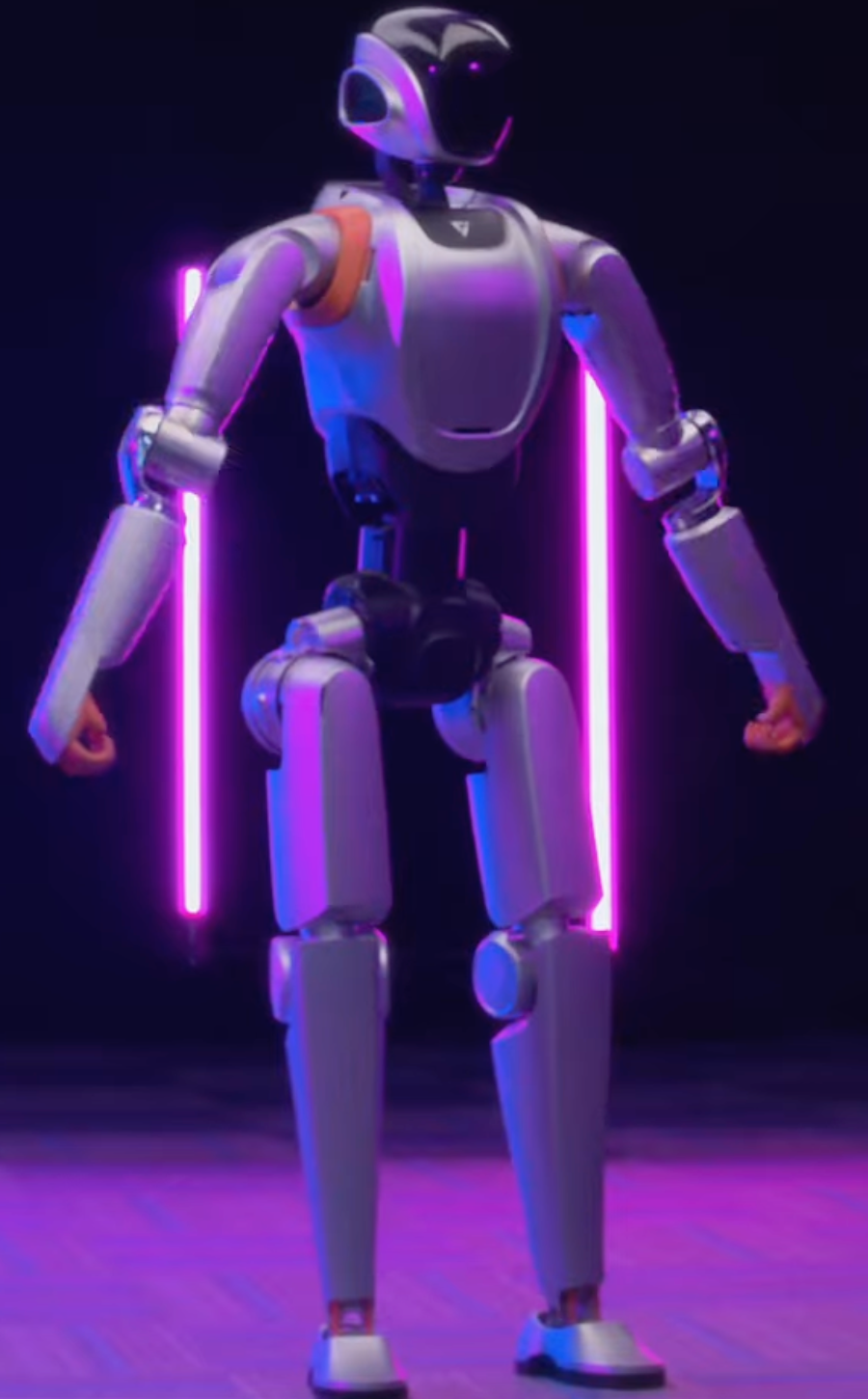 | |
| Developer | TARS Robotics (它石智航) |
| Type | Humanoid robot |
| Country of origin | China |
| Unveiled | December 2025[12] |
| Status | Prototype |
| Variants | T-Series (bipedal), A-Series (wheeled/stationary) |
| Hands | Five-fingered dexterous end effectors |
| AI System | AWE 2.0 (AI World Engine) |
| Sensors | SenseHub (RGB-D cameras, tactile sensors, IMU) |
| Actuators | Custom electric actuators (low-vibration) |
| Website | tarsrobotics.com |
The TARS robots gained international attention in December 2025 when the company demonstrated what it claimed was the world's first humanoid robot capable of performing hand embroidery, a task requiring sub-millimeter precision, adaptive force control, and coordinated bimanual manipulation of flexible materials.[1][2] The company has also demonstrated wire harness assembly capabilities, targeting a longstanding automation bottleneck in automotive and aerospace manufacturing.[6] TARS Robotics has raised approximately $242 million in funding within its first year of operation, making it one of the most well-funded embodied intelligence startups in China.[3][4]
Company Background
Founding and Leadership
TARS Robotics was officially established on February 5, 2025, in Beijing, with additional operations in Shanghai.[8] The company was co-founded by three technology executives with extensive backgrounds in autonomous driving, computer vision, and robotics, primarily from Huawei, Baidu, and DJI.
| Name | Title | Background |
|---|---|---|
| Dr. Chen Yilun | Founder and CEO | Former CTO and Chief Scientist of Huawei's Autonomous Driving System (Intelligent Automotive Solution Business Unit); former Chief Machine Vision Engineer at DJI; former Chief Scientist for Robotics at Tsinghua University's Institute for AI Industry Research |
| Li Zhenyu | Chairman | Former Senior Vice President of Baidu Group and head of Baidu's Intelligent Driving Business Group; led development of the Apollo autonomous driving open platform and the Luobo Kuaipao autonomous ride-hailing service |
| Dr. Ding Wenchao | Chief Scientist | Former Huawei "Genius Youth" recruit (2020); headed Huawei's ADS prediction and decision-making team; contributed to Huawei ADS 1.0 and 2.0; researcher at Fudan University's Robotics Institute where he developed Fudan's first humanoid robot |
| Dr. Chen Tongqing | Chief Architect | Ph.D. from Tsinghua University; former Head of Huawei's ADS Intelligent Navigation Division; Chief Spatial Perception Expert |
The founding team's collective experience in autonomous driving is notable because many of the core technical challenges in self-driving vehicles (perception, decision-making, control) overlap significantly with those in embodied AI and humanoid robotics. TARS describes itself as the only company in the industry that simultaneously possesses capabilities in embodied intelligence large models, hardware research and development, and mass production of integrated software-hardware products.
Name Origin
The company's English name, TARS, is an acronym for "Trusted AI and Robotics Solution." The name also evokes the fictional robot character TARS from Christopher Nolan's 2014 science fiction film Interstellar, which featured an AI-powered robot known for its adaptability and problem-solving capabilities. The Chinese name, 它石智航 (Tashi Zhihang), carries a different meaning.
Funding
TARS Robotics has attracted substantial venture capital investment at an unusually rapid pace, raising approximately $242 million across two funding rounds within the first five months of the company's existence.
| Round | Date | Amount | Lead Investors | Other Participants |
|---|---|---|---|---|
| Angel Round | March 2025 | $120 million (~800 million RMB) | Lanchi Ventures (BlueRun Ventures), Qiming Venture Partners | Linear Capital, Hengxu Capital, Hongtai Aplus (Hongtai Fund), Lenovo Capital[3][8] |
| Angel+ Round | July 2025 | $122 million | Meituan (strategic investment arm) | Junshan Capital, Bihong Investment, Guoqi Investment, Lingang Sci-Tech Venture Capital, SAIF Partners, C&D Emerging Industry Investment; Linear Capital and Xianghe Capital (increased stakes)[4][5] |
The $120 million Angel Round, announced on March 26, 2025, less than two months after the company's founding, was reported as the largest angel round in China's embodied intelligence sector at the time.[8][9] The follow-up Angel+ Round in July 2025, led by Meituan's strategic investment arm, marked the food delivery and services giant's first appearance as a lead investor in the embodied intelligence space.[4][5] Industry analysts noted that Meituan's investment reflected a desire to secure a position in the next generation of physical AI, to avoid "missing the next Unitree Robotics."[5]
Funding has been allocated toward product and technology research and development, embodied intelligence model training, and application scenario expansion.
Technology
DATA-AI-PHYSICS Trinity
TARS Robotics has developed what it calls a "DATA-AI-PHYSICS trinity solution," a closed-loop framework that integrates three core pillars: real-world data collection, AI model training, and physical robot deployment. According to CEO Dr. Chen Yilun, this framework establishes "a complete technological closed loop, from real-world data generation and intelligent decision-making to physical execution, providing a replicable, scalable engineering pathway for embodied intelligence to enter real-world production and daily life, aligned with Scaling Law."
The three pillars are:
- SenseHub (Data Collection): A human-centric data capture system that gathers rich, real-world operational information from diverse environments.
- AWE 2.0 (AI Models): The AI World Engine, an embodied AI model that learns generalizable skills for precise physical control.
- T-Series and A-Series Robots (Physical Execution): Hardware platforms engineered with what TARS describes as a "minimal digital-to-physical gap" to translate AI capabilities into stable real-world actions.
SenseHub Data Collection System
SenseHub is TARS's proprietary first-person, human-centric data collection framework. Unlike conventional approaches that rely on controlled laboratory settings or specialized data factories, SenseHub captures authentic human operational workflows across diverse real-world sectors, including hotel laundry operations, supermarket assembly tasks, and logistics work.
The system synchronously captures multiple data modalities with high spatiotemporal alignment:
| Data Modality | Details |
|---|---|
| Visual | RGB imagery from egocentric perspective |
| Depth | RGB-D camera data (branded as TARS-Vision) |
| Tactile | Pressure signals from hand-mounted tactile sensors |
| Action | Finger joint pose and trajectory data |
| Language | Natural language task descriptions and annotations |
SenseHub can reportedly generate up to 1.8 TB of high-precision 6D motion data per operator, per day. The collected data is processed through in-house cloud-based foundation models that generate high-precision labels, including 2D semantics, scene depth, task decomposition, object affordance, and motion trajectories.
AWE 2.0 (AI World Engine)
AWE 2.0 (AI World Engine 2.0) is TARS's proprietary embodied AI model. Rather than being programmed for individual tasks, AWE 2.0 learns generalizable physical manipulation skills that can transfer across environments and industries. The model is trained on data collected by SenseHub and is designed to follow scaling laws, meaning that increasing the quantity and diversity of training data leads to corresponding improvements in robot performance.
According to Chief Scientist Dr. Ding Wenchao, data scaling drives measurable progress across multiple manipulation tasks simultaneously. TARS has reported that its data-driven approach raised robot success rates on complex manipulation tasks in unstructured environments from approximately 8% to approximately 60%.
WIYH Dataset
In October 2025, TARS announced the World In Your Hands (WIYH) dataset, which the company described as the world's first large-scale, real-world Vision-Language-Tactile-Action (VLTA) multimodal dataset designed specifically for embodied intelligence.[7] The dataset was made available for open access to research institutions and industry partners beginning in December 2025.[19]
WIYH contains over 1,000 hours of human manipulation data captured in diverse real-world environments with rich multimodal annotations.[19] The dataset has four defining characteristics:
- Authentic: Sourced from genuine embodied tasks that reflect real application scenarios, not simulated environments.
- Rich: Spans multiple industries and skill sets, supporting model transfer and generalization.
- Comprehensive: Integrates fully annotated vision, language, tactile, and action data to facilitate multimodal alignment during pre-training.
- Massive: Designed to match the scale of large language model corpora, supporting long-term development in embodied intelligence.
The release of WIYH positioned TARS as a contributor to the broader embodied AI research community, not just a proprietary robotics developer.
Robot Platforms
Overview
TARS unveiled its first two robot prototypes at a live demonstration event in December 2025.[12] The two platforms, the T-Series and A-Series, share an identical AI system (AWE 2.0) and dexterous upper body but differ in their lower-body configurations to serve different use cases.
| Feature | T-Series | A-Series |
|---|---|---|
| Target use case | General-purpose | Industrial manufacturing |
| Locomotion | Bipedal (two legs) | Wheeled or stationary |
| Upper body | Shared dexterous design | Shared dexterous design |
| AI system | AWE 2.0 | AWE 2.0 |
| Hands | Five-fingered dexterous end effectors | Five-fingered dexterous end effectors |
| Key applications | Logistics, service, household | Manufacturing, wire harness assembly, textile work |
The T-Series is designed for environments requiring mobile navigation and versatility, such as logistics centers, service facilities, and eventually household settings. The A-Series targets factory floors and fixed workstation environments where wheeled mobility or stationary operation is more practical and efficient than bipedal walking.
Dexterous Manipulation
Both the T-Series and A-Series feature five-fingered dexterous end effectors (hands) that are central to TARS's differentiation in the humanoid robot market. The hands continuously adjust tactile and force feedback in real time, enabling the precise, adaptive manipulation required for tasks involving flexible and delicate materials.
Key capabilities of the hand system include:
- Real-time tactile and force feedback for adaptive grip control
- Sub-millimeter positioning precision
- Coordinated bimanual manipulation (both hands working together on a single task)
- Handling of flexible, deformable materials such as fabric and wire bundles
The custom actuators used in the hands and arms are designed to minimize vibrations, providing stable hybrid position and force control. This low-vibration actuation is critical for tasks like needle threading, where even small oscillations could cause failure.
Sensor Suite
The robots are equipped with a multi-modal sensor system branded as SenseHub, which includes:
- TARS-Vision: RGB-D cameras providing color imagery and depth data for spatial perception
- Tactile sensors: Embedded in the hands for pressure and contact detection
- IMU (Inertial Measurement Unit): For balance and orientation tracking
This sensor configuration provides the perceptual foundation for AWE 2.0's real-time decision-making and manipulation control.
Key Demonstrations
Hand Embroidery (December 2025)
On December 22, 2025, TARS Robotics held a live demonstration event at which a TARS humanoid robot performed hand embroidery, a task the company described as a world first for a humanoid robot.[1] The robot used both hands to thread a needle and stitch a logo onto fabric, handling the complete sequence of sub-tasks involved in embroidery.[11]
The significance of this demonstration lies in the combination of capabilities required:
| Capability | Description |
|---|---|
| Sub-millimeter precision | Needle threading requires positioning accuracy below one millimeter |
| Adaptive force control | Varying pressure when handling fabric, thread, and needle |
| Bimanual coordination | Both hands must work together in synchronized, complementary motions |
| Flexible material handling | Fabric and thread deform unpredictably, requiring real-time adaptation |
| Long-sequence planning | Embroidery involves a long chain of dependent steps that must be executed in order |
Hand embroidery has historically been considered one of the hardest unsolved problems in robotic manipulation because it simultaneously demands precision, dexterity, force sensitivity, and the ability to handle materials that do not hold a fixed shape. Prior to this demonstration, automated embroidery was limited to machine embroidery systems that use rigid frames and pre-programmed stitch patterns, not free-hand stitching by a humanoid form.
It should be noted that the demonstration has drawn some skepticism from industry observers. Only a single video documenting the embroidery feat has been released publicly, with no independent verification or live press access confirmed. Some commentators have noted the presence of computer-animated elements in the video and the absence of visible technicians or reporters. As of early 2026, no complete unedited recording of the full demonstration has been made public.
Wire Harness Assembly
Following the embroidery demonstration, TARS has also showcased its robots performing wire harness assembly, a manufacturing process that involves manipulating flexible cable bundles and inserting connectors into dense ports.[6] Wire harness assembly has been a persistent bottleneck in automotive and aerospace manufacturing because the cables are flexible, tangled, and difficult for conventional robotic arms to handle reliably.
TARS claims to be the first robotics firm to solve the wire harness manufacturing bottleneck using a humanoid platform. Demonstration footage shows the robot handling flexible wires and navigating dense connector ports without snagging.[6] The company positions this capability as a direct industrial application of the same dexterous manipulation skills demonstrated in the embroidery task.
CES 2026
TARS was featured among the humanoid robot exhibitors at CES 2026 in Las Vegas, where it was characterized as a "versatile service humanoid with strong manipulation capabilities, excellent for logistics, reception, and repetitive tasks." The presence at CES 2026 marked the company's international exhibition debut, alongside numerous other Chinese humanoid robot companies that had a major showing at the event.[18]
Applications
TARS Robotics targets several sectors for its humanoid platforms:
| Sector | Application Examples |
|---|---|
| Manufacturing | Wire harness assembly, textile and garment production, electronics assembly |
| Logistics | Package handling, sorting, warehouse operations |
| Service | Hospitality, reception, customer-facing tasks |
| Medical | Assistive tasks (future target) |
| Household | General-purpose domestic tasks (long-term vision) |
The company's initial focus is on industrial and manufacturing applications, where the economic case for humanoid robots is strongest. The dexterous manipulation capabilities demonstrated in embroidery and wire harness assembly are directly applicable to a range of manufacturing tasks that have resisted automation due to the flexibility and unpredictability of the materials involved.
Competitive Landscape
TARS Robotics operates in an increasingly crowded Chinese humanoid robot market. By early 2026, China's humanoid robotics sector has grown rapidly, with Chinese companies controlling an estimated 90% of global humanoid robot shipments.[14][15]
| Company | Robot | Key Differentiator | 2025 Shipments |
|---|---|---|---|
| Unitree Robotics | G1, H1, R1 | Low cost ($5,900 entry), high volume | ~5,500 units |
| Agibot | A2 series | Manufacturing focus, rapid scaling | ~5,168 units |
| UBTECH | Walker S series | Consumer and commercial | Multiple deployments |
| Figure AI | Figure 02 | BMW deployment, Helix VLA | ~150 units |
| Tesla | Optimus | Massive scale ambition | ~150 units |
| TARS Robotics | TARS T/A-Series | Dexterous manipulation, flexible materials | Prototype stage |
TARS differentiates itself from competitors primarily through its emphasis on fine manipulation of flexible materials, a capability that most other humanoid robot platforms have not demonstrated at the same level of precision. While Unitree and Agibot have moved aggressively toward mass production and high-volume shipments,[14] TARS remains at the prototype stage as of early 2026. The company's substantial funding ($242 million) and experienced founding team position it as a serious contender, but it has yet to demonstrate commercial-scale manufacturing or sustained deployment.
The embodied AI market globally reached $4.44 billion in 2025 and is projected to exceed $23 billion by 2030, with the humanoid robot segment expected to represent approximately half of the global embodied AI market share. China has designated embodied AI as a strategic future industry, providing government financing support and policy incentives that benefit companies like TARS.
Reception and Analysis
TARS Robotics has received significant media coverage since its founding, particularly around its record-breaking angel round funding and the hand embroidery demonstration. The speed at which the company moved from founding (February 2025) to raising $242 million (July 2025) to demonstrating working prototypes (December 2025) has been noted as unusually fast, even by Chinese tech startup standards.
Industry observers have highlighted several points of interest:
- The founding team's deep roots in autonomous driving technology (particularly from Huawei's ADS system) give TARS strong foundations in perception, planning, and control.
- The DATA-AI-PHYSICS trinity approach, with its emphasis on real-world data collection at scale, mirrors the data-centric strategies that proved successful in training large language models.
- The company's claim to be approximately six months ahead of comparable projects, including Tesla's Optimus, in terms of data collection methodology, remains difficult to independently verify.
Some skepticism has been directed at the limited evidence provided for the embroidery demonstration, and the company's rapid progression from founding to prototype raises questions about whether the technology has been sufficiently validated for industrial deployment. TARS has not yet disclosed detailed technical specifications (such as height, weight, or degrees of freedom) for either the T-Series or A-Series robots, making direct technical comparisons with competitors difficult.
See Also
- Humanoid robot
- Humanoid robots
- Embodied AI
- Autonomous driving
- Unitree Robotics
- Agibot
- Figure AI
- Tesla Optimus
- Robot learning
- Dexterous manipulation
References
- ^1 ^2"TARS Demonstrates a Robot That Can Perform Hand Embroidery, Breaking Through a Key Automation Bottleneck in Flexible Manufacturing." PR Newswire, December 22, 2025. prnewswire.com/...flexible-manufacturing-302648045
- ^"Chinese humanoid robot achieves world's first embroidery feat in demo." Interesting Engineering, December 2025. interestingengineering.com/...-stitches-embroidery
- ^1 ^2"800 Million Yuan! China's Embodied Intelligence Seizes Record-Breaking Angel-Round Haul." CMRA, March 2025. cnmra.com/...izes-record-breaking-angel-round-haul
- ^1 ^2 ^3"Embodied AI startup TARS completes $122 million angel+ funding round: report." TechNode, July 9, 2025. technode.com/...million-angel-funding-round-report
- ^1 ^2 ^3"Meituan's Major Bet on Embodied Intelligence." 36Kr, July 2025. eu.36kr.com/...3371630393119233
- ^1 ^2 ^3"TARS Claims Humanoid Solves Wire Harness Assembly." Mike Kalil, December 2025. mikekalil.com/...noid-robot-wire-harnless-assembly
- ^"TARS Unveils World's First Scalable Real-World Multimodal Dataset for Embodied Intelligence, Opening Access in December 2025." PR Newswire, October 2025. prnewswire.com/...ccess-in-december-2025-302586218
- ^1 ^2 ^3 ^4"China AI Tech Startup TARS (Tashi Zhihang) Raised $120 Million in Fund Raising Round." Caproasia, March 28, 2025. caproasia.com/...tners-linear-capital-hengxu-capit
- ^"China's TARS raises $120m in biggest angel round in embodied intelligence." DealStreetAsia, March 2025. dealstreetasia.com/...lanchi-qiming-tars-436079
- "Chinese Company Claims This AI Robot Just Achieved A World's-First Dexterity Feat." SlashGear, December 2025. slashgear.com/...s-first-hand-embroidery-stitching
- ^"China's TARS humanoid robot becomes world's first to achieve two-handed stitching." VnExpress International, December 2025. e.vnexpress.net/...ve-two-handed-stitching-4998932
- ^1 ^2 ^3"China Startup TARS Unveils Humanoid Robots Performing Precision Manufacturing Tasks." ExpoLume, December 2025. expolume.com/...ming-precision-manufacturing-tasks
- "TARS Robotics Demonstrates World-First Humanoid Robot Capable of Hand Embroidery." Robotics Business News, December 2025. roboticsbusinessnews.com/...ble-of-hand-embroidery
- ^1 ^2"China's Humanoid Robot Output to Surge 94% in 2026; Unitree and AgiBot to Capture Nearly 80% Market Share, Says TrendForce." TrendForce, April 2026. trendforce.com/...20260409-13007
- ^"China is winning the humanoid robot race while Tesla's Optimus lags." Rest of World, 2026. restofworld.org/...ts-unitree-agibot-tesla-optimus
- "TARS." ExpoLume Company Profile. expolume.com/...tars
- "TARS Humanoid Robot." Humanoid.guide. humanoid.guide/...tars
- ^"Humanoids conquered CES 2026." Humanoid.guide. humanoid.guide/humanoids-ces-2026
- ^1 ^2"World In Your Hands - WiYH Dataset." TARS Robotics. wiyh.tars-ai.com
- "TARS Robotics." Humanoid Robotics Technology, December 2025. humanoidroboticstechnology.com/...-hand-embroidery
Improve this article
Add missing citations, update stale details, or suggest a clearer explanation. Every suggestion is reviewed for sourcing before it goes live.
8 revisions · v8 · 3,175 words · full history
Fact-checks are independent of edits: a reviewer re-verifies the article against its sources and stamps the date. How we verify
Research and drafting on this wiki are AI-assisted, under named human editorial standards. How AI is used here
Cite this page: AI Wiki. "TARS (robot)." aiwiki.ai, updated 16 Jul 2026. CC BY 4.0. https://aiwiki.ai/wiki/tars_robotics_tars