

Terafab
Terafab (styled "Terafab" on the project's official site, "TERAFAB" in Elon Musk's announcement post, and frequently written "TeraFab" in press coverage) is a planned semiconductor fabrication venture between Tesla and SpaceX, announced by Musk in a livestreamed event in Austin, Texas, on the night of March 21, 2026.[1][2][3] The project aims to combine logic chip fabrication, memory production, and advanced packaging "under one roof" and to produce custom AI chips for Tesla vehicles, the Tesla Optimus humanoid robot, and SpaceX's planned orbital AI compute constellation.[1][2] The company states a long-term output target of 1 terawatt of AI compute per year from a facility that would eventually span 100 million square feet, roughly ten times the footprint it cites for Tesla's Gigafactory Texas; both figures are company targets, not demonstrated capabilities.[1] Reported cost figures have varied widely by source and by project phase: roughly $20 billion (Tom's Hardware) to $25 billion (Electrek) at announcement, and $55 billion for the first phase, rising to as much as $119 billion at full buildout, in a property tax filing SpaceX made in Grimes County, Texas, in May 2026.[2][3][5][6] Intel joined the project in April 2026, and Tesla says it plans to use Intel's 14A process at the facility.[5][7] On August 6, 2026, SpaceX and Tesla confirmed that Terafab will be built in Grimes County and put the initial phase at approximately $16.8 billion.[15][16]
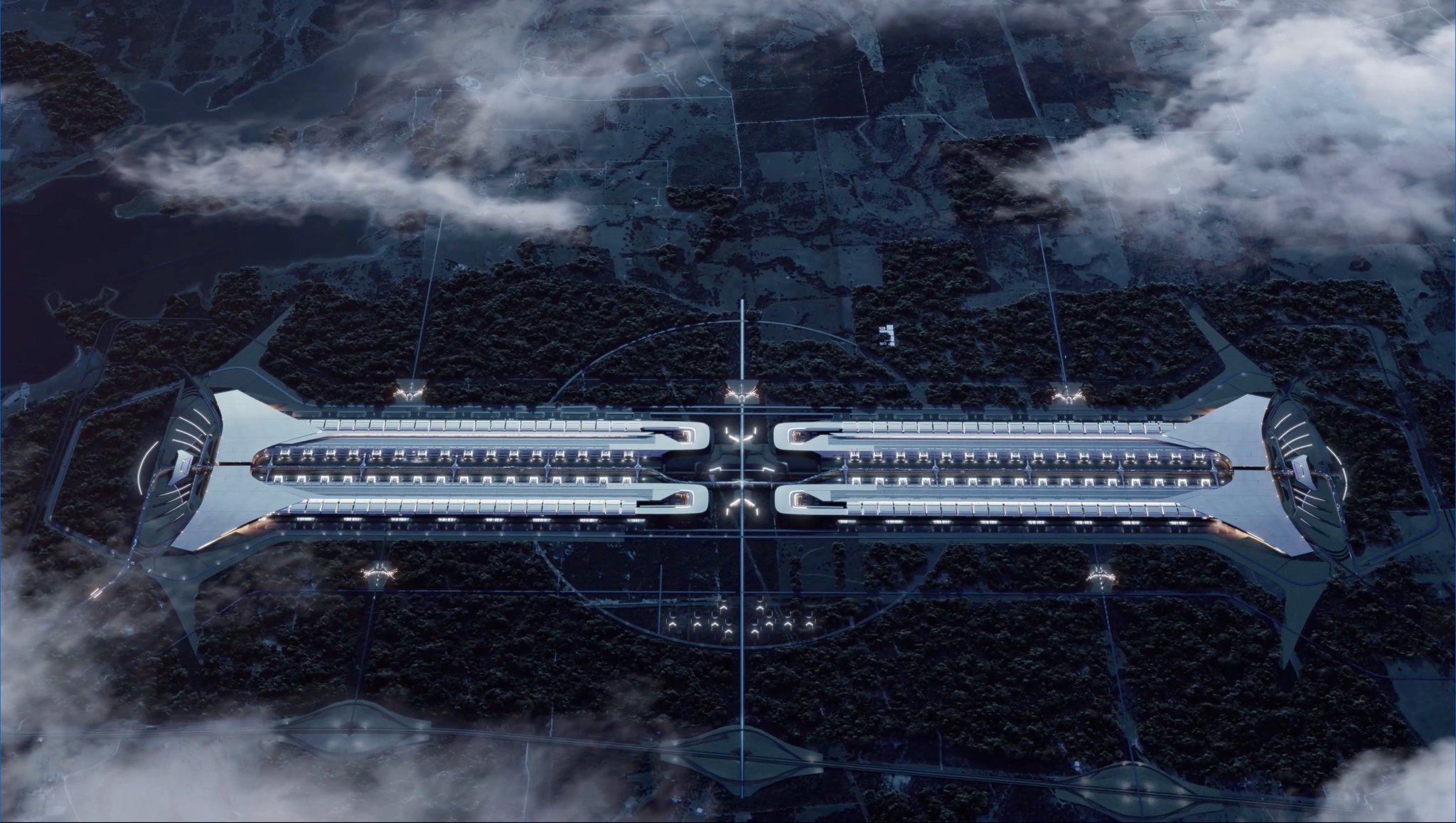
Aerial rendering of the planned Terafab complex, posted by Elon Musk on X on August 6, 2026.[14]
Key facts
| Project | Terafab (also written TeraFab, TERAFAB) |
| Type | Vertically integrated semiconductor fab (logic, memory, advanced packaging) |
| Partners | Tesla and SpaceX (joint venture); xAI named at announcement, later absorbed into SpaceX; Intel joined April 2026 as process technology partner[3][5][9] |
| Announced | Livestream from the Seaholm Power Plant, Austin, Texas, night of March 21, 2026 (announcement post dated March 22, 2026 UTC)[2][3] |
| Sites | R&D pilot fab at Tesla's Austin campus (about $3 billion; broke ground April 2026); volume fab confirmed August 6, 2026, at Gibbons Creek Reservoir site, Grimes County, Texas ($55 billion first phase, up to $119 billion, per May 2026 tax filing; $16.8 billion initial phase per the August 2026 announcement)[5][6][15][17] |
| Process technology | Intel 14A planned; Tesla cited a 2 nm-class target at announcement[3][5] |
| Planned products | AI5 (FSD and Optimus), AI6 (Optimus), D3 (space-hardened)[1] |
| Company targets | 1 TW of AI compute output per year; 100 million sq ft at full scale; 100,000 wafer starts per month initially, 1 million at full capacity[1][3] |
| Status (August 2026) | Site confirmed August 6, 2026 (Grimes County); initial phase put at about $16.8 billion from SpaceX and Tesla; at least 3,000 jobs planned; no production timeline announced[15][16] |
| Website | terafab.ai |
Background
Musk first floated the idea publicly at Tesla's annual shareholder meeting on November 6, 2025, saying "I think we may have to do a Tesla TeraFab. It is like [TSMC's] Giga[fab] but way bigger," and that even best-case expansion by Tesla's suppliers would not deliver the chip volumes he projected for AI, robotics, and data centers.[4] The remark followed Tesla's cancellation of its Dojo training supercomputer program and consolidation around the AI5 and AI6 chip family, which is dual-sourced from TSMC and Samsung.[4] TSMC uses "Gigafab" for complexes with more than 100,000 wafer starts per month; a "Terafab" implies capacity well beyond that scale.[4] NVIDIA CEO Jensen Huang reacted skeptically at the time: "Building advanced chip manufacturing is extremely hard. It is not just build the plant, but the engineering, the science, and the artistry of doing what TSMC does for a living is extremely hard."[4]
On Tesla's January 2026 earnings call, Musk added a geopolitical argument, saying key suppliers could not produce enough hardware for Tesla's needs and that building a Terafab was "actually also going to be very important to ensure that we are protected against any geopolitical risks."[5] In the same period SpaceX acquired xAI in an all-stock deal (see SpaceX-xAI merger); Musk later said xAI "will be dissolved as a separate company" within SpaceX.[3][5]
Announcement
Musk unveiled the project on the evening of March 21, 2026, at the defunct Seaholm Power Plant in downtown Austin, in an event livestreamed on X; his announcement post, "Announcing TERAFAB: the next step towards becoming a galactic civilization," was dated March 22, 2026 (UTC), the date most coverage carries.[2][3] He called the project "the most epic chip building exercise in history by far" and framed it as forced by supply constraints: "We're very grateful to our existing supply chain, to Samsung, TSMC, Micron and others," but "there's a maximum rate at which they're comfortable expanding."[2][3] In the broadcast he put global AI chip output at roughly 20 gigawatts per year, which he said was about 2 percent of his companies' eventual needs, projecting demand of 100 to 200 gigawatts per year of terrestrial chips and "on the order of a terawatt of chips in space."[2] Summing up the rationale, he said: "We either build the TeraFab, or we don't have the chips, and we need the chips, so we build the TeraFab."[2]
Tom's Hardware reported the project as carrying a $20 billion price tag; Electrek reported $25 billion, and noted that Tesla's CFO acknowledged the full cost, which Electrek gave as an estimated $20 to 25 billion, was not yet incorporated into Tesla's 2026 capital expenditure plan.[2][3] The venture was presented as a joint project of Tesla, SpaceX, and xAI, planned at the time for the North Campus of Gigafactory Texas.[2][3] Musk gave no timeline for production and said Tesla, SpaceX, and xAI would keep buying chips from TSMC, Samsung, and Micron in the meantime.[2] Electrek also reported announcement-day targets of 100,000 wafer starts per month initially, scaling to 1 million wafer starts per month, which it noted would be roughly 70 percent of TSMC's entire current output, a 2-nanometer process target, and a Musk claim that the facility would eventually produce "between 100 and 200 billion custom AI and memory chips per year," with millions of Optimus robots helping to build and operate it.[3]
Sites, filings, and cost estimates
The project's structure was clarified on Tesla's first-quarter 2026 earnings call on April 22, 2026: Tesla would build a research fab at its Austin factory costing around $3 billion and "capable of maybe a few thousand wafers per month," while "SpaceX is going to take care of the initial phase of the scaled up Terafab," with Musk adding that Tesla was "still working out the details of the Terafab deployment."[5]
On May 6, 2026, a public hearing notice revealed that SpaceX had filed a property tax abatement application in Grimes County, Texas, for a "multi-phase, next-generation, vertically integrated semiconductor manufacturing and advanced computing fabrication facility" at the Gibbons Creek Reservoir site, roughly 90 miles northeast of Austin and about 20 miles east of Bryan-College Station.[5][6] The filing put capital investment at $55 billion for the initial phases and up to $119 billion if all planned expansions are completed, far above the announcement-day figures.[5][6] The site is a brownfield that hosted a coal-fired power station from 1982 until 2018.[6] Tom's Hardware noted that the $55 billion initial figure alone would exceed the roughly $52.7 billion the CHIPS Act authorized for the entire US semiconductor industry, and that $119 billion approaches TSMC's total planned investment across its multi-fab Arizona campus.[6]
In the first week of June 2026, Grimes County commissioners voted 4 to 1 to approve a reinvestment zone and a 35-year agreement that fully exempts SpaceX from property taxes on the project in exchange for a $10 million lump sum plus $20 million per year, following a public hearing that drew more than 100 residents, many opposed over transparency, water and power strain, and loss of rural land.[10] Musk defended the abatement on X as "standard practice for massive capital investments," arguing that property tax on chipmaking tools would put the project "at a serious competitive disadvantage relative to other chip fabs in the world," while noting that "other locations are still in the running."[10]
The site was confirmed on August 6, 2026. In an update titled "Breaking Ground on Terafab in Texas," SpaceX announced that "Terafab will be built in Grimes County, Texas," restated the plan for a vertically integrated factory with more than 100 million square feet of manufacturing space, and put the initial phase at approximately $16.8 billion in capital investment from SpaceX and Tesla, "with potential future expansion phases bringing total investment much higher."[15][16] The update says the facility will employ at least 3,000 people, many from Grimes and neighboring Brazos County, and commits to drawing industrial water from the Gibbons Creek Reservoir rather than local groundwater, with on-site wastewater treatment and water reuse.[15] Tesla's companion post on X added that the research fab at the North Campus of Gigafactory Texas, which the companies describe as the precursor to Terafab, had broken ground in April 2026.[17] The confirmation came a day after another heavily attended Grimes County meeting where residents raised concerns over the project's tax breaks and transparency, and followed SpaceX's first earnings call, earlier the same week, on which the company did not discuss Terafab.[16] Electrek noted that the $16.8 billion initial-phase figure was lower than the roughly $25 billion reported at the March announcement, with the size of later phases left unspecified.[17]
Musk promoted the announcement in a series of posts on X: a video rendering captioned "Terafab Texas will be the largest and most valuable building on Earth by far. And it will be stunningly beautiful," a single-word post reading "Terafab" with an aerial rendering of the complex, and, later that day, the claim that "Terafab will be 50 times the size of the Pentagon when complete."[14][19][20] All of these are Musk's own characterizations of a facility that has not been built. Tom's Hardware observed that imagery SpaceX published shows the complex as four large buildings, and that "100 million square feet of manufacturing space" is not the same as cleanroom space; for comparison, it put the total area of Samsung's Pyeongtaek campus at about 31.1 million square feet.[18]
Technology and products
The stated premise of Terafab is vertical integration: equipment for logic, memory, advanced packaging, testing, and lithography mask production in a single building, which Musk claimed exists at no other facility and would allow a rapid iteration loop of making, testing, and revising chips without shipping wafers between sites.[1][2]
In April 2026, Intel announced it would join the project to help "design, fabricate, and package ultra-high-performance chips at scale," its first major external commitment for its foundry business, and on the April 22 earnings call Musk said Tesla plans to use Intel's forthcoming 14A process at the facility, making the project 14A's first announced major customer.[5][7] Intel's shares rose on the news and the stock more than doubled in value in April 2026.[5] Any leading-edge fab would also depend on lithography systems from ASML, whose CEO Christophe Fouquet confirmed in May 2026 that he had spoken directly with Musk about the project, calling him "very serious" about it.[8]
The official site lists three chip lines: AI5, powering Tesla's Full Self-Driving system and Optimus; AI6, powering Optimus; and D3, "powering space."[1] At the announcement Musk described two broad categories: edge inference chips for vehicles and Optimus, and a higher-power chip hardened for the space environment, designed to run hotter than terrestrial parts to minimize radiator mass on satellites.[2] The AI5 chip taped out in April 2026 and is produced by outside foundries independent of Terafab, with Electrek reporting that TSMC handles AI5 production while Samsung's 2 nm line is tied to the follow-on AI6.[13]
Stated targets and the terafab.ai website
The project website, terafab.ai, presents company targets rather than verified capabilities. It states that at full scale Terafab would cover 100 million square feet, against 10 million square feet for Tesla Gigafactory Texas, and produce "1 TW/Year" of AI compute, which it compares to a current annual US electricity consumption figure of 0.5 TW.[1] The site frames the project in terms of the Kardashev scale of civilizations, lists supporting goals of "1 Billion Tesla Optimus robots to do the work," 10 million tons of mass launched to orbit per year, and "1 TW+" of solar power, argues that space is "the only truly scalable solution for the future of AI," and names "lunar mass drivers" as a next step; its footer states the site was "Designed and built with Grok."[1] Job listings are hosted on Tesla's careers site under a dedicated Terafab department.[1]
The domain initially carried only a teaser page reading "Join Us On Our Journey" around the March 2026 announcement; the full site was live by June 17, 2026, when its opening line credited "Tesla, SpaceX, and xAI."[11][12] By August 2026 the same line read "Tesla and SpaceX" only, consistent with xAI's absorption into SpaceX.[1][12]
The orbital side of these targets connects Terafab to SpaceX Starmind, the satellite AI-compute constellation SpaceX announced in 2026. In its IPO registration statement, SpaceX told investors that "our ability to achieve orbital AI at scale depends on our ability to access a sufficient number of AI chips, significantly more than are currently available to us," and positioned Terafab as the intended remedy.[9]
Reception and skepticism
Coverage of Terafab has been notably more skeptical than for most Musk manufacturing announcements. Electrek's Fred Lambert called the project "Tesla's Battery Day on steroids," noting that Tesla's 2020 battery-cell targets were largely missed, with the company at an estimated 2 percent of its original cell-volume goal more than five years later, and argued that a single facility producing 70 percent of TSMC's output at 2 nm from companies with no chipmaking experience "reeks of desperation"; he cited industry benchmarks of roughly $28 billion and about 38 months of construction for a single US 2 nm fab with 50,000 wafer starts per month.[3] Bernstein analysts estimated that reaching the 1 terawatt per year output target would require on the order of $5 trillion in capital and up to 358 individual fabs.[6] Jensen Huang's November 2025 warning that advanced chipmaking is "extremely hard" is frequently quoted in this context.[4] Chip analyst Ben Bajarin of Creative Strategies described the project as a rational "15-year strategy" for supply-chain control, while cautioning: "You don't just wake up one day and say, 'I'm going to be a foundry.'"[5]
SpaceX's own IPO risk factors, filed in May 2026, acknowledge that "Terafab may not be successful," that SpaceX has only a framework agreement with Tesla, that "neither Tesla nor Intel are obligated to remain a part of the project," and that SpaceX expects to keep sourcing a significant portion of its compute hardware from third-party suppliers.[9]
See also
References
- ^1 ^2 ^3 ^4 ^5 ^6 ^7 ^8 ^9 ^10 ^11Terafab. Official website. Accessed August 5, 2026. terafab.ai
- ^1 ^2 ^3 ^4 ^5 ^6 ^7 ^8 ^9 ^10 ^11 ^12 ^13Luke James. "Elon Musk unveils $20 billion 'TeraFab' chip project to make chips, memory, and package processors all under one roof." Tom's Hardware, March 22, 2026. tomshardware.com/...0-billion-terafab-chip-project
- ^1 ^2 ^3 ^4 ^5 ^6 ^7 ^8 ^9 ^10 ^11 ^12 ^13Fred Lambert. "Tesla and SpaceX announce $25B 'Terafab' chip factory - here's why it reeks of desperation." Electrek, March 22, 2026. electrek.co/...terafab-chip-factory-ai-desperation
- ^1 ^2 ^3 ^4 ^5Anton Shilov. "Elon Musk says building his own 'TeraFab' chip fab may be the only answer to Tesla's colossal AI semiconductor demand." Tom's Hardware, November 7, 2025. tomshardware.com/...ainst-extremely-hard-challenge
- ^1 ^2 ^3 ^4 ^5 ^6 ^7 ^8 ^9 ^10 ^11 ^12 ^13CNBC. "Elon Musk's SpaceX chip fab in Texas to cost up to $119 billion." May 6, 2026. cnbc.com/...fab-in-texas-to-cost-up-to-119-billion
- ^1 ^2 ^3 ^4 ^5 ^6 ^7Luke James. "SpaceX files for $55 billion semiconductor fab in rural Texas for Musk's Terafab." Tom's Hardware, May 6, 2026. tomshardware.com/...miconductor-fab-in-rural-texas
- ^1 ^2Zaheer Kachwala and Stephen Nellis (Reuters). "Intel lands key first customer for '14A' chip tech with Tesla's Terafab project, Musk says." April 22, 2026. finance.yahoo.com/...b-project-musk-says-222942947
- ^Luke James. "ASML CEO says Elon Musk is 'very serious' about TeraFab chipmaking megaproject, confirms direct talks." Tom's Hardware, May 21, 2026. tomshardware.com/...s-with-elon-musk-about-terafab
- ^1 ^2 ^3Anton Shilov. "SpaceX admits it can't find enough chips for orbital AI yet, requires 'significantly more than are currently available to us'." Tom's Hardware, May 27, 2026. tomshardware.com/...-project-may-not-be-successful
- ^1 ^2Etiido Uko. "Elon Musk's SpaceX secures 100% property tax exemption for planned $55 billion Terafab semiconductor factory in Texas." Tom's Hardware, June 4, 2026. tomshardware.com/...ions-despite-resident-backlash
- ^Wayback Machine snapshot of terafab.ai, March 22, 2026. web.archive.org/...terafab.ai
- ^1 ^2Wayback Machine snapshot of terafab.ai, June 17, 2026. web.archive.org/...terafab.ai
- ^Electrek. "Tesla taped out AI5 chip, Musk says, nearly 2 years behind schedule." April 15, 2026. electrek.co/...a-ai5-chip-taped-out-musk-ai6-dojo3
- ^1 ^2Elon Musk on X: "Terafab" (post with aerial rendering). August 6, 2026. x.com/...2085381095248318721
- ^1 ^2 ^3 ^4 ^5SpaceX. "Breaking Ground on Terafab in Texas." August 6, 2026. spacex.com/updates
- ^1 ^2 ^3 ^4Sean O'Kane. "Tesla and SpaceX will invest $16.8B to start building 'Terafab' chip factory in Texas." TechCrunch, August 6, 2026. techcrunch.com/...ng-terafab-chip-factory-in-texas
- ^1 ^2 ^3Fred Lambert. "Tesla, SpaceX confirm 'Terafab' chip fab site - $16.8B first phase." Electrek, August 6, 2026. electrek.co/...-terafab-grimes-county-16-8-billion
- ^Anton Shilov. "Elon Musk's massive Terafab chip-making facility starts to take shape - 100 million square feet of manufacturing space and $16.8B initial capital investment." Tom's Hardware, August 7, 2026. tomshardware.com/...-8b-initial-capital-investment
- ^Elon Musk on X: "Terafab Texas will be the largest and most valuable building on Earth by far. And it will be stunningly beautiful." August 6, 2026. x.com/...2085377974396752305
- ^Elon Musk on X: "Terafab will be 50 times the size of the Pentagon when complete." August 7, 2026 (UTC). x.com/...2085530890759749760
Improve this article
Add missing citations, update stale details, or suggest a clearer explanation. Every suggestion is reviewed for sourcing before it goes live.
4 revisions · v4 · 2,948 words · full history
Fact-checks are independent of edits: a reviewer re-verifies the article against its sources and stamps the date. How we verify
Research and drafting on this wiki are AI-assisted, under named human editorial standards. How AI is used here
Reviewer note: August 6, 2026 site confirmation and rendering verified against SpaceX's own update, Musk's posts (image byte-identical to the original), and same-week coverage on August 8, 2026; cost figures are attributed to their distinct sources.
Cite this page: AI Wiki. "Terafab." aiwiki.ai, updated 7 Aug 2026, fact-checked 7 Aug 2026. CC BY 4.0. https://aiwiki.ai/wiki/terafab