

Tesla Autopilot
Tesla Autopilot is the family of driver-assistance features that Tesla builds into its cars, together with the more capable add-on package that Tesla has sold since 2016 under the Full Self-Driving name and now markets as Full Self-Driving (Supervised). The basic package combines Traffic-Aware Cruise Control, an adaptive cruise control that keeps a set gap to the car ahead, with Autosteer, which keeps the car centered in its lane; Tesla describes both as SAE Level 2 features that leave the driver responsible for the vehicle at all times.[1] Tesla began fitting Autopilot hardware to the Model S in October 2014, released the Autopilot software in October 2015, parted ways with its original vision-chip supplier, Mobileye, in 2016, and began moving its driving software to end-to-end neural networks at the end of 2023.[2][3][4][5] Despite the name, Full Self-Driving does not make a car autonomous: Tesla's investor materials attach the footnote "Active driver supervision required; does not make the vehicle autonomous" to the product.[6]
The system has drawn sustained scrutiny from regulators and courts. The U.S. National Highway Traffic Safety Administration (NHTSA) has opened a series of defect investigations into it since 2016, and Tesla filed two software recalls after discussions with the agency, covering 362,758 vehicles in February 2023 and 2,031,220 vehicles in December 2023.[7][1] The National Transportation Safety Board (NTSB) found that the system's design contributed to fatal crashes in Florida in 2016 and California in 2018.[8][9] California's Department of Motor Vehicles (DMV) ruled in December 2025 that Tesla's use of "Autopilot" and "Full Self-Driving" in marketing was misleading, and in August 2025 a federal jury in Miami found Tesla 33 percent responsible for a 2019 Autopilot crash, leaving the company liable for about $243 million in compensatory and punitive damages, a verdict Tesla is appealing.[10][11][12] As of September 30, 2026, Tesla reported 1.74 million active FSD subscriptions, a count that includes owners who bought the package outright.[13]
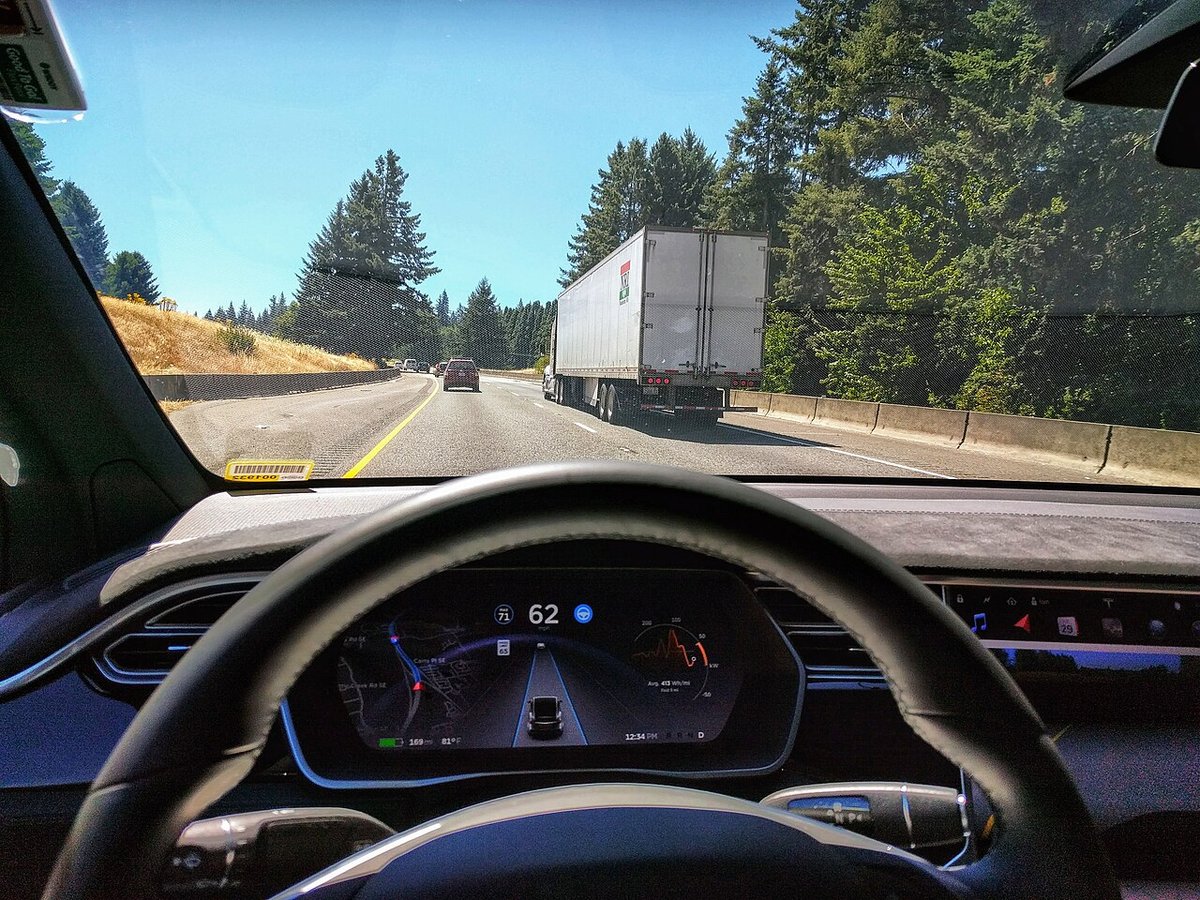
Names and features
Tesla has renamed the products several times, and the names themselves have been part of the dispute over them.
| Name | What it covers |
|---|---|
| Autopilot ("Basic Autopilot") | Traffic-Aware Cruise Control plus Autosteer, designed for controlled-access highways.[1] |
| Enhanced Autopilot | A package Tesla introduced alongside its 2016 hardware.[14] |
| Full Self-Driving Capability | The add-on package, offered with the 2016 hardware; the California DMV's misleading-marketing case covered Tesla's use of this label on its website from May 2021.[14][10] |
| FSD Beta | City-streets software released to a limited group of owners from October 2020 and widely in North America in late 2022.[15][5] |
| Full Self-Driving (Supervised) | The current U.S. name; Tesla's 2025 annual report says it also covers the "FSD (Capability)" name used in Europe, the Middle East and Asia-Pacific.[10][16] |
| Tesla Assisted Driving (TAD) | The new name of the European version for cars with HW4 or later, approved by the Dutch authority on November 3, 2026.[17] |
Tesla's early filings compared the system to aviation. Its 2015 annual report said that although the driver is ultimately responsible for controlling the vehicle, Autopilot provides functionality "that allows our customers to rely on it much like the system that airplane pilots use when conditions permit."[2] NHTSA later criticized the name. In its 2024 summary of a two-year engineering analysis, the agency wrote that the term "Autopilot" "does not imply an L2 assistance feature, but rather elicits the idea of drivers not being in control," and noted that other manufacturers generally use words such as "assist," "sense" or "team."[18]
In January 2026 Tesla stopped including Autosteer on new cars configured in the United States and Canada, leaving Traffic-Aware Cruise Control as the standard feature while the online configurator promoted the $99-a-month FSD (Supervised) subscription, according to Not a Tesla App.[19] The DMV said in February 2026 that Tesla had stopped using the word "Autopilot" in its California marketing.[10]
History
Mobileye hardware (2014 to 2016)
Tesla revealed the dual-motor Model S and its Autopilot system in October 2014, and from that month it equipped every Model S with hardware "to allow for the incremental introduction of autopilot technology."[20][2] The company's 2015 annual report listed the hardware as a forward radar, a forward-looking camera, 12 long-range ultrasonic sensors and an electric assist braking system.[2] Image processing for the camera ran on Mobileye's EyeQ3 chip, which NHTSA said classified targets using a large dataset of the rear images of vehicles.[3] Tesla released Autopilot in October 2015 and kept changing it through over-the-air software updates.[3] Its 2015 annual report warned investors that Autopilot "is a completely new feature that U.S. and foreign regulators have limited experience with."[2]
On May 7, 2016, a 2015 Model S operating on Autopilot struck a tractor-trailer that was crossing a highway near Williston, Florida, killing the Tesla's driver. The car's automatic emergency braking gave no warning, and the driver did not brake or steer.[3] On July 26, 2016, Mobileye said on its earnings call that it would not supply Tesla beyond the EyeQ3. Its chief technology officer, Amnon Shashua, did not say which company had ended the arrangement, and Mobileye called Tesla's business "not material" to its revenue.[4] On September 23, 2016, Tesla pushed software version 8 to its fleet; it shortened the time a driver could keep hands off the wheel before an alert and made Autosteer unavailable for an hour, or until the car was restarted, after a driver had been warned on three separate occasions.[8]
Tesla's own hardware (2016 to 2019)
In October 2016 Tesla announced that "all newly produced Tesla vehicles have the hardware needed for full self-driving capability." The new suite had eight surround cameras with up to 250 meters of range and twelve enhanced ultrasonic sensors, and Tesla said computing power had increased 40-fold over the previous generation. Tesla presented Enhanced Autopilot and "hardware for Full Self-Driving Capability" as new product capabilities.[14]
In April 2019 Tesla held its first Autonomy Investor Day to show an in-house "full self-driving (FSD) computer," which it said could process 2,300 images per second, about 21 times more than the processor it replaced.[21] Tesla's 2019 annual report said the company was fitting all new vehicles with "hardware needed for full self-driving in the future," and that data from the cars' camera, radar, ultrasonic sensors and GPS was used to train and improve its neural network.[22]
FSD Beta and cameras only (2020 to 2023)
Tesla said in October 2020 that its Autopilot team had been working on "a fundamental architectural rewrite of our neural networks and control algorithms," and that it had sent the first update built on the rewrite, called City Streets, to a limited number of Early Access Program users.[15] Tesla recognized no revenue for the software given to these first beta testers.[23]
In May 2021 Tesla began delivering Model 3 and Model Y cars built for North America without forward radar, relying on cameras and neural-network processing in a system it called Tesla Vision. Tesla said some features would be limited at first, including a 75 mph cap on Autosteer and a longer minimum following distance.[24] Elon Musk had called radar one of the last "crutches" Tesla wanted to remove.[25] With the switch to cameras, Tesla deployed a "degradation detection system" meant to tell the driver when the cameras could not see properly; that system later became the subject of a federal investigation (see below).[26]
Tesla released FSD Beta widely in North America in the fourth quarter of 2022.[5] In January 2023 NHTSA told Tesla it had concerns about the software's behavior in four roadway situations, including stale yellow lights, stop signs, variable speed zones and turn-only lanes, and asked it to file a recall. Tesla recalled 362,758 vehicles in February 2023 (recall 23V-085) while "not concurring with the agency's analysis," and agreed to address it with an over-the-air software update.[7]
End-to-end networks (2024 to 2026)
Tesla began rolling out version 12 of FSD Beta in late December 2023 and said it "utilizes end-to-end training."[5] By April 2024 Tesla was calling the product FSD (Supervised); it cut the U.S. subscription price to $99 a month and the purchase price to $8,000, and offered eligible cars in the U.S. and Canada a 30-day free trial.[27] In the same update Tesla wrote that it believed "a scalable and profitable autonomy business can be realized through a vision-only architecture with end-to-end neural networks, trained on billions of miles of real-world data."[27] In the third quarter of 2024 it released the 12.5 series of FSD (Supervised), which it said had five times as many parameters as before, along with Actually Smart Summon, which lets a car drive itself to its owner in a parking lot, and a Cybertruck release that Tesla said brought end-to-end neural nets to highway driving for the first time.[28]
In January 2026 Tesla described its latest version, v14, as an "end-to-end foundation model trained on both customer and Robotaxi real-world data."[6] Version 14.3 followed in April 2026; Tesla said it upgraded the reinforcement learning stage of training, improved the vision encoder for low-visibility scenes, and cut inference latency by up to 20 percent.[29] The fleet passed 10 billion cumulative miles on FSD (Supervised) by early May 2026, according to Tesla's safety page as reported by Electrek; Musk had said in January 2026 that about 10 billion miles of data would be needed for safe unsupervised driving, after Tesla missed his goal of unsupervised FSD by the end of 2025; by May 2026 he had moved unsupervised FSD for customer-owned cars to the fourth quarter of 2026 at the earliest, according to Electrek.[30]
Tesla also uses its driving software without anyone in the driver's seat in Tesla Robotaxi, its ride-hailing service, which offered unsupervised rides in Austin, Dallas and Houston by April 2026, and in the two-seat Tesla Cybercab. Its 2025 annual report ties "future autonomous capabilities" to the further improvement of FSD (Supervised), and its October 2026 update said the Robotaxi service had reached nearly two million cumulative unsupervised miles.[16][29][13]
Hardware generations
| Generation | First fitted | Sensors and computer |
|---|---|---|
| Hardware 1 | October 2014 (Model S) | Forward radar, forward-looking camera, 12 long-range ultrasonic sensors; camera processing on Mobileye EyeQ3.[2][3] |
| Hardware 2 | October 2016 | Eight surround cameras, 12 enhanced ultrasonic sensors, 40 times the computing power of Hardware 1 (per Tesla).[14] |
| Hardware 3 ("FSD computer") | 2019 | Tesla-designed computer, about 21 times the image throughput of the processor it replaced (per Tesla).[21][22] |
| Tesla Vision | May 2021 | Forward radar removed from North American Model 3 and Model Y.[24] |
Tesla said it completed the transition to a fourth generation, Hardware 4.0, in the first quarter of 2024; the Dutch authority's November 2026 approval of the renamed European "Tesla Assisted Driving" software applies to models with HW4 or later.[27][17] Owners of Hardware 3 cars who bought FSD outright face retrofits to newer hardware to run current versions, an issue that Not a Tesla App said had led to disputes and lawsuits.[31] Tesla's next in-house chip is Tesla AI5.
Pricing and subscriptions
Tesla charged as much as $15,000 for a one-time FSD purchase in September 2022 and $8,000 from April 2024, when it also set the U.S. subscription at $99 a month.[31][27] In January 2026 Musk announced that Tesla would stop selling FSD outright after February 14, 2026, and offer it only as a monthly subscription.[31] Tesla's update for the fourth quarter of 2025 said monthly subscriptions had "more than doubled in 2025" and that it was "transitioning access to FSD (Supervised) to monthly subscriptions only." The same update said that in certain states, Tesla Insurance customers receive a premium discount when they drive with FSD engaged.[6]
Active FSD subscriptions are one of the operational milestones in Musk's 2025 CEO performance award, which sets a target of 10 million. Tesla's count includes both up-front purchases and monthly subscriptions and excludes free trials.[12][13]
| End of period | Active FSD subscriptions (Tesla figures) |
|---|---|
| 2021 | 0.4 million |
| 2022 | 0.5 million |
| 2023 | 0.6 million |
| 2024 | 0.8 million |
| 2025 | 1.1 million |
| Q1 2026 | 1.28 million |
| Q2 2026 | 1.48 million |
| Q3 2026 | 1.74 million |
Figures for 2021 to 2025 are from Tesla's Q4 2025 update and quarterly figures for 2026 from its Q3 2026 update.[6][13]
Outside North America
Tesla launched FSD (Supervised) in South Korea in the fourth quarter of 2025, and in January 2026 said it was still pursuing regulatory approval in China and Europe.[6] In April 2026 it said it continued to make progress on approval in China.[29] The Netherlands' vehicle authority, the RDW, approved the software for general road use from April 10, 2026, making the Netherlands the first European country to allow it outside test drives. The approval was granted under Article 39 of the EU's vehicle type-approval rules, which allow national approval of technology that lacks harmonized EU requirements, for an SAE Level 2 system whose driver must be able to take control at any time.[32] Other member states then recognized the Dutch approval. By November 3, 2026, the RDW listed Belgium, Croatia, Czechia, Denmark, Estonia, Latvia, Lithuania, Slovakia and Slovenia as having accepted it, while EU-wide approval was still under discussion in the Technical Committee on Motor Vehicles.[17] Tesla reported in October 2026 that more than 100,000 customers in the EU used the software and had driven more than 160 million kilometers with it since the first approval.[13]
On November 3, 2026, the RDW approved a set of changes requested by Tesla. The European system was renamed Tesla Assisted Driving (TAD) for cars with HW4 or later, and the maximum speed offset, the margin by which the driver can let the car exceed the speed limit, was cut from 50 percent to 10 percent and set to 0 percent each time the car starts. The RDW said, "The name change does not affect how the system works."[17]
Investigations and recalls
NHTSA's Office of Defects Investigation (ODI) does not approve driver-assistance systems before sale, but it can investigate them as possible safety defects and press manufacturers to recall them. Its main actions on Autopilot and FSD are listed below; statuses are as recorded by NHTSA on November 18, 2026.
| Investigation | Opened | Subject | Vehicles (NHTSA estimate) | Status |
|---|---|---|---|---|
| PE16-007 | 2016-06-28 | Autopilot and emergency braking, after the Williston crash | 43,781 | Closed 2017-01-19 without a defect finding[3] |
| PE21-020 | 2021-08-13 | Crashes into first-responder scenes | 765,000 | Upgraded to EA22-002 in June 2022[33][34] |
| PE22-002 | 2022-02-16 | Unexpected braking ("phantom braking") in 2021-2022 Model 3 and Model Y | 416,000 | Closed 2026-06-29[50][35] |
| EA22-002 | 2022-06-08 | Autopilot driver-engagement controls | 830,000 | Led to recall 23V-838; closed April 2024[51][34][1] |
| RQ24-009 | 2024-04-25 | Whether the 23V-838 remedy works | 2,031,220 | Open[36][37] |
| PE24-031 | 2024-10-17 | FSD crashes in reduced visibility | 2,410,002 | Upgraded to EA26-002 in March 2026[38][26] |
| AQ25-002 | 2025-08-19 | Late crash reports under the Standing General Order | 2,600,000 | Open[52][39] |
| PE25-012 | 2025-10-07 | FSD traffic-law violations | 2,882,566 | Open[40][41] |
| EA26-002 | 2026-03-18 | FSD degradation detection in poor visibility | 3,203,754 | Open[26][42] |
Williston crash (2016)
NHTSA found that the Tesla driver's last recorded action was raising the cruise speed to 74 mph less than two minutes before the crash, and that the trailer should have been visible to him for at least seven seconds.[3] The agency concluded that the emergency braking system was not designed to brake for crossing traffic, which it said was in line with the industry state of the art for 2016 models, and closed its investigation in January 2017 without identifying a defect.[3] In the same report NHTSA said its analysis of Tesla's mileage and airbag-deployment data showed that the crash rate of the vehicles "dropped by almost 40 percent after Autosteer installation," while noting that the rates covered all miles driven, not only miles on Autopilot.[3] After Tesla cited the figure in 2018, NHTSA said the comparison "did not evaluate whether Autosteer was engaged" and "did not assess the effectiveness of this technology," describing it as a "cursory comparison" of airbag-deployment rates.[49]
The NTSB report, adopted in September 2017, found that the probable cause was the truck driver's failure to yield combined with the car driver's inattention due to overreliance on vehicle automation. It added that the automation's "operational design, which permitted his prolonged disengagement from the driving task," contributed to that overreliance.[8] During the 41-minute trip, Autopilot was active for 37 minutes and detected the driver's hands on the wheel for a total of 25 seconds.[8]
Mountain View crash (2018)
On March 23, 2018, a 2017 Model X using Traffic-Aware Cruise Control and Autosteer moved into a paved gore area on U.S. 101 in Mountain View, California, and struck a damaged, nonoperational crash attenuator at about 71 mph, killing its driver.[43] The NTSB report, adopted in February 2020, found the probable cause to be "the Tesla Autopilot system steering the sport utility vehicle into a highway gore area due to system limitations," together with the driver's distraction, likely from a game on his phone, and his overreliance on Autopilot. It named "the Tesla vehicle's ineffective monitoring of driver engagement" as a contributing factor.[9]
First-responder crashes and the 2023 Autopilot recall
NHTSA opened PE21-020 in August 2021 after identifying 11 crashes since January 2018 in which Teslas using Autopilot or Traffic-Aware Cruise Control struck vehicles at first-responder scenes; most happened after dark.[33] The probe became engineering analysis EA22-002 in June 2022.[34] ODI reviewed 956 crashes up to August 2023 in which Autopilot was alleged to have been in use. In 211 of them the front of the Tesla struck a vehicle, object or person in its path, in crashes that killed 14 people. Where data allowed a measurement, the hazard was visible five seconds or more before impact in 59 of 109 crashes, and in 82 percent of 135 incidents the driver either did not brake or braked less than one second before the crash.[18] NHTSA concluded that before the recall, "Autopilot's design was not sufficient to maintain drivers' engagement," and described Tesla as "an industry outlier in its approach to L2 technology by mismatching a weak driver engagement system with Autopilot's permissive operating capabilities."[18]
On December 12, 2023, Tesla filed recall 23V-838 for 2,031,220 Model S, X, 3 and Y vehicles equipped with Autosteer. Tesla wrote that "the prominence and scope of the feature's controls may not be sufficient to prevent driver misuse." While not concurring with NHTSA's analysis, it agreed to an over-the-air remedy with more prominent visual alerts, simpler engagement and disengagement of Autosteer, extra checks away from controlled-access highways and near traffic controls, and eventual suspension from Autosteer for drivers who repeatedly fail to show they are paying attention.[1] In April 2024 NHTSA opened recall query RQ24-009 to assess whether the remedy was adequate. It cited crashes after the remedy, results from its own preliminary tests, and Tesla's statement that part of the remedy requires the owner to opt in and lets a driver readily reverse it.[36]
Phantom braking
PE22-002 began in February 2022 after a rise in owner complaints that Model 3 and Model Y cars slowed sharply with no obstacle ahead while Traffic-Aware Cruise Control, Autopilot or FSD was engaged. NHTSA said Tesla's data showed behavior that aligned with the mid-2021 move from radar-vision fusion to vision only. It found no collisions, noted that reported incidents had fallen to 45 in 2024 and 19 in 2025, and closed the investigation in June 2026, citing a low demonstrated hazard.[35]
FSD in poor visibility
NHTSA opened PE24-031 on October 17, 2024, after four crashes in which FSD was engaged in reduced roadway visibility such as sun glare, fog or airborne dust; in one, the Tesla struck and killed a pedestrian.[38] On March 18, 2026, it upgraded the probe to engineering analysis EA26-002, covering an estimated 3,203,754 vehicles. ODI said that in the crashes it reviewed, the system "did not detect common roadway conditions that impaired camera visibility and/or provide alerts when camera performance had deteriorated until immediately before the crash occurred," and that in additional crashes found in Tesla's responses, FSD also lost track of, or never detected, a vehicle ahead.[26] Tesla's own analysis said an updated degradation-detection system might have affected 3 of the 9 incidents ODI identified, and Tesla described data and labeling limitations that ODI said "could have led to under-reporting of subject crashes."[26] Tesla settled a lawsuit brought by the pedestrian's daughter in June 2026; terms were not disclosed.[44]
Traffic violations and crash reporting
PE25-012, opened on October 7, 2025, examines reports that FSD "induced vehicle behavior that violated traffic safety laws," most often by proceeding into intersections against a red light or by changing lanes into opposing traffic.[40] NHTSA's opening count was 58 incidents, including 14 crashes and 23 injuries. Six of the crashes involved a Tesla entering an intersection on a red light, and several incidents happened at the same intersection in Joppa, Maryland.[40][45] In August 2025 NHTSA also opened audit query AQ25-002 after finding that Tesla had filed many crash reports under the agency's Standing General Order months after the crashes; Tesla attributed the delay to a data-collection problem that it said had been fixed.[39]
Marketing, lawsuits and verdicts
California DMV case
The California DMV accused Tesla in 2022 of advertising that suggested its cars could drive themselves.[46] After a hearing in July 2025, an administrative law judge issued a proposed decision on November 20, 2025, recommending 30-day suspensions of Tesla's manufacturer and dealer licenses in the state. On December 16, 2025, the DMV adopted the judge's findings that Tesla had used "Autopilot" and "Full Self-Driving" misleadingly, permanently stayed the manufacturer suspension, and gave Tesla 60 days to act on its use of "Autopilot." The DMV said the vehicles could not operate as autonomous vehicles when the advertisements ran and still could not.[10] On February 17, 2026, the DMV announced that Tesla had stopped using "Autopilot" in its California marketing and had therefore avoided the suspension.[10]
Benavides v. Tesla
On April 25, 2019, George McGee was driving a 2019 Model S on Autopilot in Key Largo, Florida, when he bent down to look for his dropped phone and drove through an intersection at about 62 mph. He struck an SUV parked on the shoulder, where Naibel Benavides Leon and Dillon Angulo were standing. Benavides, 22, was killed and Angulo was severely injured. McGee settled with the plaintiffs before trial.[11] On August 1, 2025, a jury in the U.S. District Court for the Southern District of Florida awarded $129 million in total compensatory damages, finding the driver 67 percent at fault and Tesla 33 percent, plus $200 million in punitive damages.[12] Reuters described it as the first federal jury verdict involving a fatal Autopilot crash.[11] In February 2026 Judge Beth Bloom denied Tesla's post-trial motions, writing that the evidence at trial "more than supported" the verdict.[11][12] Tesla filed its opening brief in the U.S. Court of Appeals for the Eleventh Circuit on July 2, 2026.[12] In a July 2026 brief, the attorneys general of Florida, Alabama and Georgia asked the appeals court to reverse the judgment or order a new trial, or failing that to reverse or reduce the punitive award, at minimum to three times the net compensatory damages.[47]
Other cases
- Consumer class action. A proposed class action filed in the Northern District of California on September 14, 2022, alleged misrepresentations about Tesla's driver-assistance systems. The court sent four of the five named plaintiffs to arbitration in 2023 and certified a limited class of California consumers in August 2025, but the Ninth Circuit vacated that certification on October 16, 2026. A separate proposed consumer class action on the same subject was filed in the same court on June 4, 2026.[12]
- Securities suit. A proposed class action filed in the Western District of Texas on August 4, 2025, alleges that Tesla, Musk and other executives misrepresented the effectiveness of Autopilot, FSD (Supervised) and Robotaxi. Tesla's motion to dismiss had been fully briefed by October 2026.[12]
- Fire truck crash. Electrek reported on September 2, 2026, that Tesla had settled, on confidential terms, Caleb Mendoza et al. v. Tesla, Inc., a suit over a February 2023 crash in which a 2014 Model S on Autopilot struck a fire truck parked across lanes at an earlier accident scene on Interstate 680 in California, killing the driver and seriously injuring his brother. In May 2025 Judge Vince Chhabria had allowed fraudulent misrepresentation claims to proceed in the case, finding the "Autopilot" name "plausibly misleading."[48]
- Government inquiries. Tesla's quarterly filings say it receives requests for information, including subpoenas, from NHTSA, the NTSB, the Securities and Exchange Commission and the Department of Justice on topics that include driver-assistance systems and Robotaxi, and that to its knowledge no agency in any ongoing investigation has concluded that wrongdoing occurred.[12]
Safety statistics
Tesla publishes its own crash figures. Electrek reported in May 2026 that Tesla's safety page showed one major collision per 5.3 million miles driven on FSD (Supervised), compared with one per 660,000 miles for the average U.S. driver, and noted that experts have criticized how Tesla counts crashes.[30] NHTSA's 2024 summary of EA22-002 said that Tesla largely receives crash data only when airbags or other pyrotechnic restraints deploy, that only 18 percent of police-reported crashes in the national data it reviewed involved an airbag deployment, and that Tesla's published crash rates are typically expressed in miles driven per pyrotechnic deployment. The agency said "Tesla is not aware of every crash involving Autopilot even for severe crashes because of gaps in telematic reporting," and that it "did not rely on a simplistic crash rate comparison" between Tesla and other Level 2 systems.[18]
Continue reading
- Autonomous vehicleAn autonomous vehicle, also known as a self-driving car, driverless car, or robotic vehicle, is a vehicle that uses artificial intelligence, sensors, and software to navigate and operate without human input.Listed in See also
- Advanced Driver-Assistance SystemsAdvanced Driver-Assistance Systems (ADAS) are electronic technologies that help drivers operate, steer, brake, and park a vehicle by warning of hazards or taking momentary or sustained control of the driving…Listed in See also
- Autonomous drivingAutonomous driving is the sustained performance by a vehicle system of part or all of the dynamic driving task.Listed in See also
- WaymoWaymo LLC is an American autonomous driving technology company and subsidiary of Alphabet Inc. that develops the Waymo Driver, a Level 4 autonomous driving system, and operates Waymo OneListed in See also
- openpilotopenpilot is an open-source driver-assistance system developed by comma.ai and its user community.Listed in See also
- MobileyeMobileye Global Inc. (Nasdaq: MBLY) is an Israeli technology company headquartered in Jerusalem that develops vision-based advanced driver-assistance systems (ADAS) and autonomous driving technologyMentioned 6 times above


More to read
References
- ^1 ^2 ^3 ^4 ^5Tesla, Inc. "Part 573 Safety Recall Report 23V-838". National Highway Traffic Safety Administration, December 12, 2023. static.nhtsa.gov/...RCLRPT-23V838-8276.PDF
- ^1 ^2 ^3 ^4 ^5 ^6Tesla Motors, Inc. "Form 10-K for the fiscal year ended December 31, 2015". U.S. Securities and Exchange Commission, February 24, 2016. sec.gov/...tsla-10k_20151231
- ^1 ^2 ^3 ^4 ^5 ^6 ^7 ^8 ^9NHTSA Office of Defects Investigation. "ODI Resume, Investigation PE 16-007: Automatic vehicle control systems" (closing report). National Highway Traffic Safety Administration, January 19, 2017. static.nhtsa.gov/...INCLA-PE16007-7876.PDF
- ^1 ^2Etherington, Darrell. "Mobileye won't supply Tesla self-driving tech beyond current EyeQ3 processor". TechCrunch, July 26, 2016. techcrunch.com/...h-beyond-current-eyeq3-processor
- ^1 ^2 ^3 ^4Tesla, Inc. "Q4 and FY 2023 Update" (Form 8-K, Exhibit 99.1). U.S. Securities and Exchange Commission, January 24, 2024. sec.gov/...tsla-ex99_1
- ^1 ^2 ^3 ^4 ^5Tesla, Inc. "Q4 and FY 2025 Update" (Form 8-K, Exhibit 99.1). U.S. Securities and Exchange Commission, January 28, 2026. sec.gov/...exhibit991
- ^1 ^2Tesla, Inc. "Part 573 Safety Recall Report 23V-085". National Highway Traffic Safety Administration, February 15, 2023. static.nhtsa.gov/...RCLRPT-23V085-3451.PDF
- ^1 ^2 ^3 ^4National Transportation Safety Board. "Collision Between a Car Operating With Automated Vehicle Control Systems and a Tractor-Semitrailer Truck Near Williston, Florida, May 7, 2016" (NTSB/HAR-17/02). Adopted September 12, 2017. ntsb.gov/...HAR1702.pdf
- ^1 ^2National Transportation Safety Board. "Collision Between a Sport Utility Vehicle Operating With Partial Driving Automation and a Crash Attenuator, Mountain View, California, March 23, 2018" (NTSB/HAR-20/01). Adopted February 25, 2020. ntsb.gov/...HAR2001.pdf
- ^1 ^2 ^3 ^4 ^5 ^6California Department of Motor Vehicles. "Tesla Takes Corrective Action to Avoid DMV Suspension". February 17, 2026. dmv.ca.gov/...ctive-action-to-avoid-dmv-suspension
- ^1 ^2 ^3 ^4Stempel, Jonathan. "Judge Upholds $243M Verdict Against Tesla Over Fatal Autopilot Crash". Reuters, republished by Claims Journal, February 20, 2026. amp.claimsjournal.com/...335814
- ^1 ^2 ^3 ^4 ^5 ^6 ^7 ^8Tesla, Inc. "Form 10-Q for the quarterly period ended September 30, 2026". U.S. Securities and Exchange Commission, October 22, 2026. sec.gov/...tsla-20260930
- ^1 ^2 ^3 ^4 ^5Tesla, Inc. "Q3 2026 Update" (Form 8-K, Exhibit 99.1). U.S. Securities and Exchange Commission, October 21, 2026. sec.gov/...exhibit9914
- ^1 ^2 ^3 ^4Tesla Motors, Inc. "Tesla Third Quarter 2016 Update" (Form 8-K, Exhibit 99.1). U.S. Securities and Exchange Commission, October 26, 2016. sec.gov/...d273228dex991
- ^1 ^2Tesla, Inc. "Q3 2020 Update" (Form 8-K, Exhibit 99.1). U.S. Securities and Exchange Commission, October 21, 2020. sec.gov/...tsla-ex991_57
- ^1 ^2Tesla, Inc. "Form 10-K for the fiscal year ended December 31, 2025". U.S. Securities and Exchange Commission, January 29, 2026. sec.gov/...tsla-20251231
- ^1 ^2 ^3 ^4RDW. "RDW approves changes to Tesla driver assistance system". November 3, 2026. rdw.nl/...hanges-to-tesla-driver-assistance-system
- ^1 ^2 ^3 ^4NHTSA Office of Defects Investigation. "Additional Information Regarding EA22002". National Highway Traffic Safety Administration, April 25, 2024. static.nhtsa.gov/...INCR-EA22002-14496.pdf
- ^Singh, Karan. "New Teslas No Longer Come With Autopilot, Now Only Include Cruise Control". Not a Tesla App, January 26, 2026. notateslaapp.com/...ow-only-include-cruise-control
- ^Tesla Motors, Inc. "Form 10-K for the fiscal year ended December 31, 2014". U.S. Securities and Exchange Commission, February 26, 2015. sec.gov/...tsla-10k_20141231
- ^1 ^2Tesla, Inc. "Tesla First Quarter 2019 Update" (Form 8-K, Exhibit 99.1). U.S. Securities and Exchange Commission, April 24, 2019. sec.gov/...tsla-ex991_6
- ^1 ^2Tesla, Inc. "Form 10-K for the fiscal year ended December 31, 2019". U.S. Securities and Exchange Commission, February 13, 2020. sec.gov/...tsla-10k_20191231
- ^Tesla, Inc. "Q4 and FY2020 Update" (Form 8-K, Exhibit 99.1). U.S. Securities and Exchange Commission, January 27, 2021. sec.gov/...tsla-ex991_99
- ^1 ^2Stumpf, Rob. "Tesla Removes Radar Sensors From Model 3 and Model Y, so Autopilot Will Use Cameras Only". The Drive, May 26, 2021. thedrive.com/...so-autopilot-will-use-cameras-only
- ^Hull, Dana. "Tesla Phases Out Radar Sensors, Shifts to Camera-Based Autopilot". Bloomberg, republished by Claims Journal, May 26, 2021. amp.claimsjournal.com/...303968
- ^1 ^2 ^3 ^4 ^5NHTSA Office of Defects Investigation. "ODI Resume, Investigation EA26002: FSD Collisions in Reduced Roadway Visibility Conditions". National Highway Traffic Safety Administration, March 18, 2026. static.nhtsa.gov/...INOA-EA26002-10023.pdf
- ^1 ^2 ^3 ^4Tesla, Inc. "Q1 2024 Update" (Form 8-K, Exhibit 99.1). U.S. Securities and Exchange Commission, April 23, 2024. sec.gov/...tsla-ex99_1
- ^Tesla, Inc. "Q3 2024 Update" (Form 8-K, Exhibit 99.1). U.S. Securities and Exchange Commission, October 23, 2024. sec.gov/...exhibit
- ^1 ^2 ^3Tesla, Inc. "Q1 2026 Update" (Form 8-K, Exhibit 99.1). U.S. Securities and Exchange Commission, April 22, 2026. sec.gov/...exhibit991
- ^1 ^2Lambert, Fred. "Tesla reaches 10 billion FSD miles - is there's a magical milestone for autonomy". Electrek, May 3, 2026. electrek.co/...miles-no-magical-milestone-autonomy
- ^1 ^2 ^3Singh, Karan. "Tesla Announces FSD Purchase Option Will Go Away Next Month - Here's Why". Not a Tesla App, January 15, 2026. notateslaapp.com/...l-go-away-next-month-heres-why
- ^Ernst, Nico. "Tesla's FSD approved in the Netherlands - only in the Netherlands". heise online, April 11, 2026. heise.de/...lands-only-in-the-Netherlands-11253269
- ^1 ^2NHTSA Office of Defects Investigation. "ODI Resume, Investigation PE 21-020: Autopilot & First Responder Scenes" (opening report). National Highway Traffic Safety Administration, August 13, 2021. static.nhtsa.gov/...INOA-PE21020-1893.PDF
- ^1 ^2 ^3National Highway Traffic Safety Administration. "EA22002: Autopilot System Driver Controls" (investigation record). Accessed November 18, 2026. api.nhtsa.gov/...byNhtsaId
- ^1 ^2National Highway Traffic Safety Administration. "PE22002: Unexpected Brake Activation" (investigation record). Accessed November 18, 2026. api.nhtsa.gov/...byNhtsaId
- ^1 ^2NHTSA Office of Defects Investigation. "ODI Resume, Investigation RQ24009: Recall 23V838 Remedy Effectiveness". National Highway Traffic Safety Administration, April 25, 2024. static.nhtsa.gov/...INOA-RQ24009-12046.pdf
- ^National Highway Traffic Safety Administration. "RQ24009: Recall 23V838 Remedy Effectiveness" (investigation record). Accessed November 18, 2026. api.nhtsa.gov/...byNhtsaId
- ^1 ^2NHTSA Office of Defects Investigation. "ODI Resume, Investigation PE24031: FSD Collisions in Reduced Roadway Visibility Conditions". National Highway Traffic Safety Administration, October 17, 2024. static.nhtsa.gov/...INOA-PE24031-23232.pdf
- ^1 ^2National Highway Traffic Safety Administration. "AQ25002: Compliance with Standing General Order 2021-01 Reporting Requirements" (investigation record). Accessed November 18, 2026. api.nhtsa.gov/...byNhtsaId
- ^1 ^2 ^3NHTSA Office of Defects Investigation. "ODI Resume, Investigation PE25012: Traffic safety violations while Full Self Driving ('FSD') is engaged". National Highway Traffic Safety Administration, October 7, 2025. static.nhtsa.gov/...INOA-PE25012-19171.pdf
- ^National Highway Traffic Safety Administration. "PE25012: Traffic safety violations while Full Self Driving ('FSD') is engaged" (investigation record). Accessed November 18, 2026. api.nhtsa.gov/...byNhtsaId
- ^National Highway Traffic Safety Administration. "EA26002: FSD Collisions in Reduced Roadway Visibility Conditions" (investigation record). Accessed November 18, 2026. api.nhtsa.gov/...byNhtsaId
- ^National Transportation Safety Board. "Investigation HWY18FH011: Collision Between a Sport Utility Vehicle Operating With Partial Driving Automation and a Crash Attenuator". NTSB investigation page. ntsb.gov/...HWY18FH011
- ^Popa, Darius. "Tesla settles a fatal Full Self-Driving crash lawsuit". The Next Web, June 29, 2026. thenextweb.com/...fsd-fatal-crash-settlement-nhtsa
- ^Shepardson, David. "US Probes Driver Assistance Software in 2.9 Million Tesla Vehicles Over Traffic Violations". Reuters, republished by Insurance Journal, October 13, 2025. insurancejournal.com/...843431
- ^Moon, Mariella. "Tesla used deceptive language to market Autopilot, California judge rules". Engadget, December 16, 2025. engadget.com/...t-california-judge-rules-035826786
- ^Lambert, Fred. "Florida AG asks court to erase Tesla's $243M Autopilot crash verdict". Electrek, July 20, 2026. electrek.co/...ida-ag-tesla-243m-autopilot-verdict
- ^Lambert, Fred. "Tesla settles fatal Autopilot fire truck lawsuit, avoiding jury trial". Electrek, September 2, 2026. electrek.co/...-autopilot-fire-truck-death-lawsuit
- ^Shepardson, David. "U.S. Safety Chief Contradicts Tesla Safety Claims on Autopilot". Reuters, republished by Insurance Journal, May 3, 2018. insurancejournal.com/...488036
- ^NHTSA Office of Defects Investigation. "ODI Resume, Investigation PE22-002: Unexpected Brake Activation" (opening report). National Highway Traffic Safety Administration, February 16, 2022. static.nhtsa.gov/...INOA-PE22002-4385.PDF
- ^NHTSA Office of Defects Investigation. "ODI Resume, Investigation EA 22-002: Autopilot & First Responder Scenes" (opening report). National Highway Traffic Safety Administration, June 8, 2022. static.nhtsa.gov/...INOA-EA22002-3184.PDF
- ^NHTSA Office of Defects Investigation. "ODI Resume, Investigation AQ25002: Compliance with Standing General Order 2021-01 Reporting Requirements" (opening report). National Highway Traffic Safety Administration, August 19, 2025. static.nhtsa.gov/...INOA-AQ25002-18184.pdf
Improve this article
Add missing citations, update stale details, or write a clearer explanation. Anyone can edit: changes go live when you publish, and every edit is checked by an editor.
2 revisions · v2 · 5,606 words · full history
Fact-checks are independent of edits: a reviewer re-verifies the article against its sources and stamps the date. How we verify
Research and drafting on this wiki are AI-assisted, under named human editorial standards. How AI is used here
Reviewer note: Independent fact-check before publication on November 18, 2026: 160 claims checked against 56 cited and independent sources; 1 material and 11 minor corrections applied before publication.
Cite this page: AI Wiki. "Tesla Autopilot." aiwiki.ai, updated 18 Nov 2026, fact-checked 18 Nov 2026. CC BY 4.0. https://aiwiki.ai/wiki/tesla_autopilot