

AgiBot A2-W
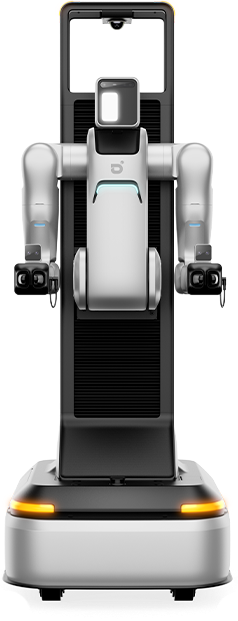
The AgiBot A2-W (Chinese: 远征A2-W, Yuanzheng A2-W) is a wheeled dual-arm mobile manipulator built for factory automation by AgiBot (Zhiyuan Robotics), a Shanghai-based Chinese robotics company. It is the wheeled member of AgiBot's second-generation Yuanzheng (Expedition) A2 family: it stands 1,630 mm tall, weighs 230 kg, carries two seven-degree-of-freedom arms rated for 5 kg per arm, and runs about 5 hours on a hot-swappable 2 kWh battery. AgiBot officially markets it as a "Flexible Manufacturing Robot," describing it as "a wheeled general-purpose robot designed for flexible manufacturing scenarios, capable of performing tasks such as grabbing, placing, transporting, and plugging."[1] Unveiled on August 18, 2024, the A2-W replaces the standard AgiBot A2's bipedal legs with a four-wheel-drive omnidirectional chassis, trading humanlike walking for the stability, endurance, and repeatability that factory floors demand.[1][2][7]
| AgiBot A2-W | |
|---|---|
 | |
| General information | |
| Manufacturer | AgiBot |
| Series | Yuanzheng (Expedition) A2 |
| Type | Wheeled dual-arm manufacturing robot |
| Country of origin | China |
| Year introduced | August 2024 |
| Status | In production |
| Price | $150,000 - $190,000 USD (estimated) |
| Website | agibot.com/products/A2_W |
The A2-W has emerged as one of AgiBot's most commercially significant products because it directly addresses real production needs in automotive and electronics manufacturing. It has been deployed on the SAIC Motor-GM battery assembly line for the Buick Electra E7, ordered in quantities approaching 100 units by automotive parts manufacturer Fulin Precision, and adopted by BYD for logistics and quality control. These deployments make the A2-W a leading example of humanoid robots transitioning from laboratory demonstrations to actual factory work.[3][4][5]
History
Who makes the A2-W, and when was it released?
AgiBot was founded in February 2023 by former Huawei engineers Peng Zhihui (known online as "Zhihui Jun") and Deng Taihua.[6] The company's first product, the RAISE A1, debuted in August 2023 as a bipedal humanoid with 49 degrees of freedom. While the A1 demonstrated industrial capabilities such as bolt tightening and vehicle inspection, its bipedal design was not optimized for the flat, predictable surfaces found inside factories, where stability and runtime matter more than the ability to navigate stairs or uneven terrain.[6]
Recognizing this gap, AgiBot developed the A2-W as a factory-specialized variant of its second-generation platform. On August 18, 2024, AgiBot founder Peng Zhihui presented five new robot models at a product launch event: three members of the Yuanzheng (Expedition) A2 family, namely the standard A2, the heavy-duty A2 Max, and the wheeled A2-W, plus two Lingxi models, the open-source X1 and the data-collection X1-W. While the A2 and A2 Max targeted a broad range of service and industrial roles, the A2-W was positioned specifically for flexible manufacturing scenarios where wheeled locomotion offered clear advantages over walking.[7]
Mass production and early deployments (2025)
AgiBot began mass production in December 2024, having manufactured 962 units across its entire product line by that date. The A2-W entered production alongside the rest of the A2 family at AgiBot's Shanghai manufacturing facility.[8]
In July 2025, AgiBot achieved what it described as the world's first industrial deployment of humanoid robots with continuous on-site operations when A2-W units began live production work at Fulin Precision's manufacturing plant in Mianyang, Sichuan Province. Four robots were initially installed to identify and sort deliveries, handling over 800 boxes in three hours during the demonstration.[3] That same month, AgiBot released Lingqu OS, its embodied intelligent operating system, which provides the software foundation for A2-W factory deployments.[9]
By the end of 2025, AgiBot had shipped over 5,100 robots across all models, capturing approximately 39% of the global humanoid robot market according to research firm Omdia.[8]
Scaled factory adoption (2026)
In early 2026, the A2-W gained further prominence through high-profile automotive deployments. In March 2026, SAIC-GM deployed an A2-W-based robot named "Nengzai No. 1" on the Buick Electra E7 battery production line at its Ultium Center in Shanghai. The same month, AgiBot announced it had reached a cumulative production milestone of 10,000 robots, scaling from 5,000 to 10,000 units in just three months.[4][8]
At CES 2026 in January, AgiBot made its U.S. market debut, showcasing the full A2 Series alongside its other product lines. The A2 Series received multiple "Best of CES 2026" awards.[10]
Design and engineering
Wheeled chassis
The A2-W's most distinctive feature is its four-wheel-drive omnidirectional base, which replaces the bipedal leg system used in other A2 variants. The chassis supports zero turning radius, crab-walking (lateral movement without rotation), and precise trajectory following in confined spaces. This design allows the robot to navigate tight aisles between production line stations, dock precisely at workstations, and travel smoothly across the flat concrete or epoxy floors typical of modern factories.[1][2]
The wheeled base also contributes to the robot's significantly higher weight (230 kg, compared to 55 to 85 kg for bipedal A2 variants), which provides a stable center of gravity during manipulation tasks. The four independently steered wheels enable the robot to approach workstations from any angle and reposition without needing to execute multi-point turns, a critical advantage in factory environments where floor space is limited and movement paths must be repeatable.
Dual-arm manipulation
The upper body of the A2-W features bionic dual arms, each with seven degrees of freedom, giving the robot 22 total degrees of freedom when combined with waist elevation and tilt. The arms can operate in parallel (both performing the same synchronized motion) or asynchronously (each arm performing a different task), enabling complex operations such as mid-air relay and hand-off between arms.[1]
Each arm supports a payload of up to 5 kg, which covers the weight range of most components handled in electronics and light automotive assembly. The arms incorporate high-precision force control through two six-dimensional force sensors, allowing the robot to apply calibrated pressure during tasks like terminal plugging, workpiece loading, and component placement. The waist can elevate and tilt to extend the operational height range from 0 to 2 meters, covering the full height envelope of standard industrial workstations.[2]
Sensor suite and perception
The A2-W integrates multi-modal perception hardware designed for factory environments:
| Sensor | Details |
|---|---|
| LiDAR | 360-degree coverage for navigation, mapping, and obstacle avoidance |
| AI vision sensors | 4 cameras for object recognition, pose estimation, and quality inspection |
| Force sensors | 2 six-dimensional force/torque sensors (one per arm) for contact-sensitive manipulation |
| Computing power | 275 TOPS for real-time AI inference |
The sensor fusion system achieves millisecond-level detection and intelligent obstacle avoidance. When a human worker approaches, the robot halts its current activity as a safety measure. The perception system supports real-time object recognition and pose estimation using AgiBot's proprietary embodied AI algorithms, including UniGrasp (for adaptive grasping), Uni6DPose (for six-degree-of-freedom pose estimation), and UniPlug (for connector insertion tasks).[1][2]
Power and endurance
One of the A2-W's key advantages for factory use is its 2,000 Wh (2 kWh) battery, nearly three times the capacity of the standard A2's 700 Wh battery. This provides approximately 5 hours of continuous operation on a single charge, with a full recharge taking roughly 2 hours. The battery is hot-swappable, meaning it can be replaced without shutting down the robot, allowing near-continuous operation across multiple shifts.[1]
The robot also supports autonomous charging, enabling it to navigate to a charging station when battery levels drop below a configurable threshold. This combination of high battery capacity, hot-swap capability, and autonomous charging makes the A2-W viable for 24/7 factory operations with minimal human intervention for power management.
Technical specifications
| Category | Specification | Value |
|---|---|---|
| Physical | Length | 770 mm (30.3 in) |
| Physical | Width | 620 mm (24.4 in) |
| Physical | Height | 1,630 mm (64.2 in / ~5 ft 4 in) |
| Physical | Weight | 230 kg (507 lb) |
| Manipulation | Degrees of freedom | 22 (7 per arm + waist + base) |
| Manipulation | Arm DOF | 7 per arm |
| Manipulation | Single-arm payload | 5 kg (11 lb) |
| Manipulation | Operating height range | 0 to 2 m |
| Mobility | Drive system | Four-wheel drive, omnidirectional |
| Mobility | Turning radius | Zero (in-place rotation) |
| Mobility | Crab-walking | Supported |
| Perception | LiDAR | 360-degree |
| Perception | Vision sensors | 4 AI cameras |
| Perception | Force sensors | 2 six-dimensional force/torque sensors |
| Computing | AI compute | 275 TOPS |
| Power | Battery capacity | 2,000 Wh (2 kWh) |
| Power | Runtime | ~5 hours |
| Power | Charging time | ~2 hours |
| Power | Battery swap | Hot-swappable |
| Power | Autonomous charging | Supported |
| Environment | Operating temperature | 0 to 45 degrees C (32 to 113 degrees F) |
| Software | OTA updates | Supported |
| Software | Secondary development | Open interfaces and tools |
Software and AI
Lingqu OS
The A2-W runs on Lingqu OS, AgiBot's embodied intelligent operating system released in July 2025. Lingqu OS consists of three layers: a real-time middleware layer built on AimRT (a custom C++20 runtime that outperforms ROS 2 in benchmarks), a standardized intelligent agent service layer, and a comprehensive toolchain for simulation, training, and deployment.[9]
Embodied intelligence algorithms
The robot's task execution relies on a suite of proprietary embodied AI algorithms:
- UniGrasp: An adaptive grasping algorithm that can handle previously unseen objects by synthesizing 3D models and planning grasp strategies in real time.
- Uni6DPose: A pose estimation system that determines the precise six-degree-of-freedom position and orientation of target objects, enabling accurate pick-and-place operations.
- UniPlug: A connector insertion algorithm designed for tasks like terminal plugging, where the robot must align and insert connectors with sub-millimeter precision.
These algorithms leverage the A2-W's 275 TOPS computing platform to perform real-time object recognition, pose estimation, and operational decision-making. According to AgiBot, the system can adapt to new objects within hours using 3D model synthesis and reinforcement learning, significantly reducing the time required to reprogram the robot for new tasks compared to traditional industrial automation.[1][2]
GO-1 foundation model
The A2-W benefits from AgiBot's GO-1 (Genie Operator-1) foundation model, launched in March 2025. GO-1 uses the Vision-Language-Latent-Action (ViLLA) framework, which combines a Vision-Language Model (VLM) with a Mixture of Experts (MoE) architecture. Unlike conventional Vision-Language-Action (VLA) models, "the ViLLA model predicts latent action tokens, bridging the gap between image-text inputs and robot actions generated by the action expert."[11] The model was pretrained on the AgiBot World dataset, which contains over one million trajectories spanning 217 tasks across five application domains, and its action expert was trained on over one million real robot demonstrations. GO-1 enables the A2-W to generalize across tasks and adapt to variations in object appearance, position, and orientation.[11]
OTA updates and secondary development
The A2-W supports over-the-air (OTA) software updates, allowing AgiBot to push new capabilities and performance improvements to deployed robots without physical service visits. The robot also provides open interfaces and development tools for secondary development, enabling factory integrators to customize task sequences, add new workstation configurations, and integrate the robot with existing factory management systems.[2]
What is the AgiBot A2-W used for?
The A2-W is built for flexible manufacturing, the category of factory work where a single station must handle frequently changing parts and layouts rather than one fixed, high-volume task. Its dual-arm reach, omnidirectional mobility, and embodied-AI software let it move between workstations and adapt to new components without re-tooling, which is why its earliest deployments cluster in automotive and electronics assembly.
Factory deployments
SAIC-GM: Buick Electra E7 battery line
The most detailed public deployment of the A2-W is at the SAIC General Motors (SAIC-GM) Ultium Center in Shanghai, where the robot operates on the battery production line for the Buick Electra E7 hybrid SUV. The deployed robot, designated "Nengzai No. 1" (能仔1号, roughly translating to "Energy Boy No. 1"), was jointly developed by SAIC-GM and AgiBot and, per Xinhua, became "SAIC's first humanoid robot employee" when it officially started work in March 2026.[4][12]
The collaboration dates back to 2023, when SAIC Motor launched a comprehensive survey and testing program for humanoid robots in manufacturing. In 2024, SAIC-GM and AgiBot established a formal partnership, validating hundreds of workstations across dozens of factory scenarios. After nearly a thousand rounds of testing and optimization, the battery cell production line was selected as the inaugural deployment site because it combined high-precision requirements with physically demanding and potentially hazardous tasks involving high-voltage battery cells.[4][12]
The A2-W performs battery cell grasping and loading operations on the production line. Using its visual perception system and dual-arm coordination, it autonomously identifies incoming battery cells and plans grasping paths without relying on fixed programming or precise material positioning. Key performance metrics include:
| Metric | Value |
|---|---|
| Navigation positioning accuracy | +/- 0.1 mm |
| Cycle time | ~2 seconds per piece |
| Footprint vs. traditional automation | Less than 15% of conventional workstation space |
The robot's compact footprint relative to traditional automated workstations is particularly significant. Conventional battery assembly automation requires large, fixed equipment installations, while the A2-W can perform comparable tasks in a fraction of the floor space, making it suitable for retrofitting into existing production lines without major facility modifications.[4]
SAIC Finance Holdings has invested over 800 million yuan (approximately $110 million) in humanoid robotics, spanning core technologies including robot bodies, embodied intelligence, tactile sensors, and planetary roller screws. SAIC-GM plans to expand the A2-W's role and is simultaneously conducting pilot applications of bipedal humanoid robots in production, logistics, and other processes.[12]
Fulin Precision: large-scale automotive parts manufacturing
Fulin Precision, a manufacturer of parts for electric vehicles and robots based in Mianyang, Sichuan Province, represents the A2-W's largest single deployment by unit count. In July 2025, four A2-W robots completed a live demonstration of routine industrial operations in a material feeding scenario on Fulin Precision's production line. This milestone was described as the world's first scaled deployment of embodied robots in smart manufacturing.[3][13]
Following the successful demonstration, AgiBot and Fulin Precision signed a project cooperation agreement valued at tens of millions of RMB for the deployment of nearly 100 A2-W robots across Fulin Precision's factories. The robots' operational scope expanded from the initial 2 production line feeding points to 15 feeding points across two core workshops (the powertrain workshop and the reducer workshop), undertaking raw material delivery tasks for a daily production capacity exceeding 500 units. The robots also handle automated empty box retrieval, performing nearly 10,000 box-moving actions per shift.[3][13]
Performance data from the Fulin Precision deployment provides insight into the A2-W's economic proposition:
| Metric | Value |
|---|---|
| Robots initially deployed | 4 |
| Full deployment target | ~100 units |
| Boxes handled (initial demo) | 800+ in 3 hours |
| Feeding points covered | 15 (across 2 workshops) |
| Daily production capacity supported | 500+ units |
| Box-moving actions per shift | ~10,000 |
| Robot output vs. human worker (normal) | 0.7x |
| Robot output vs. human worker (24/7 continuous) | 1.4 to 2.0x |
According to Xiang Minglang, Chief Engineer at Fulin Precision, a single A2-W operates at approximately 0.7 times a human worker's capacity under normal conditions. However, because the robot can operate continuously around the clock, its effective output reaches 1.4 to 2.0 times that of a human worker when measured over a full day. Given that local labor costs average approximately 80,000 yuan ($11,156) annually per worker, and A2-W pricing typically ranges from 400,000 to 800,000 yuan ($55,783 to $111,567) with volume discounts available, the payback period for the robots is estimated at 2 to 4 years in this type of deployment.[5]
Anu Intelligent, the system integration specialist for the deployment, reports that initial installations require three to four months, while subsequent installations can be completed in as little as three weeks when environmental overlap reaches 80%, demonstrating the platform's scalability once initial setup and mapping are complete.[5]
BYD: welding workshops
BYD, which is also an early investor in AgiBot (participating in the company's seed round in September 2023), has adopted AgiBot robots for logistics and quality control tasks in its welding workshops. While BYD has not publicly disclosed the specific A2 models in use, the company's factories serve as testing grounds for multiple humanoid robot platforms; BYD separately deploys UBTECH Walker series robots for material transport, inspection, screw fastening, and parts sorting. The parallel deployment of robots from multiple manufacturers suggests that BYD is actively evaluating different platforms for different factory tasks.[14][15]
Other industrial applications
Beyond automotive manufacturing, the A2-W is designed for a range of flexible manufacturing scenarios. AgiBot's official documentation highlights the following primary task categories:
- Loading and unloading: Picking raw materials from storage bins and feeding them into production machines.
- Terminal plugging: Inserting electrical connectors with sub-millimeter precision using the UniPlug algorithm.
- Logistics transportation: Moving pallets, boxes, and components between workstations.
- Quality inspection support: Loading and unloading parts for automated quality inspection stations.
- Process transition: Transferring workpieces between different stages of a production line.
- Pallet shelving: Placing finished pallets onto storage racks.
The A2-W's open interfaces and secondary development tools allow system integrators to customize the robot for specific factory environments. Its integrated design enables single-day deployment once the factory floor has been mapped, with OTA updates available for ongoing capability enhancements.[1][2]
How does the A2-W differ from the bipedal A2 variants?
The A2-W is one of five variants in AgiBot's A2 (Yuanzheng/Expedition) series. Each variant is optimized for different use cases, with the A2-W as the only wheeled member, specifically targeting factory automation. The clearest practical differences are locomotion (wheels instead of legs), mass (230 kg versus roughly 55 to 85 kg), and endurance (about 5 hours versus 2 hours), all of which favor stationary, repeatable factory work over mobile service roles.
| Feature | A2 (Standard) | A2 Lite | A2 Ultra | A2 Max | A2-W |
|---|---|---|---|---|---|
| Locomotion | Bipedal | Bipedal | Bipedal | Bipedal | Four-wheel drive |
| Height | 169 cm | 169 cm | 169 cm | 175 cm | 163 cm |
| Weight | ~69 kg | ~69 kg | ~69 kg | 85 kg | 230 kg |
| Active DOF | 40+ | 40+ | 40 | 53 | 22 |
| Max speed | 3.3 m/s (11.9 km/h) | 3.3 m/s | 1.2 m/s | 1.0 m/s | N/A (wheeled) |
| Arm payload | 15 kg | 15 kg | ~2 kg | 40 kg | 5 kg |
| Battery | 700 Wh (~2 hr) | 700 Wh (~2 hr) | 700 Wh (~2 hr) | ~700 Wh (~2 hr) | 2,000 Wh (~5 hr) |
| LiDAR | 360-degree | None | 3D LiDAR | Yes | 360-degree |
| Force sensors | Fingertip, 6D | Simplified | 6D | 6D | 2x 6D |
| AI compute | 200 TOPS | 200 TOPS | 200 TOPS | 200 TOPS | 275 TOPS |
| Primary use case | General service | Entertainment, exhibitions | Autonomous navigation | Heavy-duty industrial | Factory automation |
| Price range | $100K-$130K | Lower than standard | Quote-based | $130K-$160K | $150K-$190K |
Why wheels instead of legs?
The decision to use a wheeled base for the A2-W reflects practical engineering trade-offs for factory environments. Bipedal locomotion offers advantages on uneven terrain, stairs, and outdoor settings, but introduces complexity, energy inefficiency, and stability risks on flat factory floors. The A2-W's wheeled chassis provides several specific benefits for manufacturing:
- Stability during manipulation: The 230 kg base provides a low, stable center of gravity, reducing vibration and sway during precision tasks like terminal plugging.
- Energy efficiency: Wheels are far more energy-efficient than bipedal walking on flat surfaces, which is why the A2-W achieves 5 hours of runtime versus 2 hours for the bipedal A2.
- Repeatability: Wheeled navigation with 360-degree LiDAR can achieve the +/- 0.1 mm positioning accuracy demonstrated at SAIC-GM, a level of precision that is extremely challenging for bipedal robots.
- Omnidirectional movement: The four-wheel steering system enables lateral movement and zero-radius turns, allowing precise docking at workstations without the multi-step repositioning that bipedal robots require.
The trade-off is that the A2-W cannot navigate stairs, step over obstacles, or traverse uneven outdoor terrain. For factory applications, this limitation is rarely relevant, making the A2-W's design a pragmatic choice that prioritizes operational reliability over locomotion versatility.
Relationship to the G2 Genie
AgiBot's product lineup also includes the G2 Genie, another wheeled industrial robot unveiled in October 2025. The G2 Genie is a next-generation industrial platform that stands 175 cm tall, weighs approximately 185 kg, and features an IP42-rated chassis with IP50-rated arms. It offers a single 7-DOF force-controlled arm with a cross-shaped wrist (the first of its kind in the industry) and can be configured with up to 2,070 TFLOPS of AI compute via an NVIDIA Jetson Thor module. The G2 Genie targets 24/7 industrial operations and is powered by AgiBot's GO-1 foundation model and GE-1 world model.[16]
While both the A2-W and G2 Genie are wheeled industrial robots, they serve complementary roles. The A2-W emphasizes dual-arm manipulation for tasks requiring bimanual coordination, while the G2 Genie focuses on single-arm force-controlled operations with higher compute capabilities. The G2 Genie's higher IP rating also makes it better suited for dusty or wet industrial environments.
Economic considerations
How much does the A2-W cost?
AgiBot does not publicly list standard pricing for the A2-W. Enterprise deployments are typically negotiated directly, with pricing depending on configuration, volume, and integration requirements. Reseller listings and industry reports suggest a price range of approximately $150,000 to $190,000 per unit, with volume discounts available for large orders such as the Fulin Precision deployment.[17]
In the Chinese domestic market, pricing is commonly cited as 400,000 to 800,000 yuan ($55,783 to $111,567), which places the A2-W in a similar range to traditional collaborative robots (cobots) and automated guided vehicles (AGVs), though it offers greater flexibility than either category.[5]
Return on investment
The Fulin Precision deployment provides the most detailed public data on the A2-W's economic case. With a single robot producing 0.7 to 2.0 times the output of a human worker (depending on whether it operates single-shift or continuously) and local labor costs averaging 80,000 yuan annually, the breakeven point for the robot investment falls within an estimated 2 to 4 years. This calculation does not account for secondary benefits such as reduced workplace injuries from repetitive box-moving tasks (which can cause lumbar muscle strain), consistent quality, and the ability to operate in temperature extremes or during nighttime shifts without additional labor costs.[5]
Market context
The A2-W enters the market at a time of rapid growth in China's humanoid robot industry. According to TrendForce, China's humanoid robot output was projected to surge 94% in 2026, with Unitree Robotics and AgiBot expected to capture nearly 80% of global market share combined. AgiBot shipped over 5,100 robots in 2025 and reached 10,000 cumulative units by March 2026, making it one of the world's largest humanoid robot producers by volume.[8][18]
The A2-W competes in the emerging category of wheeled humanoid robots for industrial automation, which bridges the gap between traditional industrial robots (fixed robotic arms), collaborative robots (cobots), and fully bipedal humanoids. Competitors in this space include UBTECH's Walker series and various wheeled mobile manipulator platforms from companies like Agility Robotics (whose Digit robot uses legs rather than wheels). The A2-W's combination of dual-arm manipulation, omnidirectional mobility, and embodied AI software distinguishes it from simpler mobile manipulators that lack the adaptive task-learning capabilities provided by AgiBot's algorithm suite.
See also
- AgiBot
- AgiBot A2
- AgiBot A2 Max
- AgiBot A2 Lite
- AgiBot A2 Ultra
- AgiBot G2 Genie
- Humanoid robot
- Embodied AI
- Industrial robot
References
- ^1 ^2 ^3 ^4 ^5 ^6 ^7 ^8AGIBOT A2-W Flexible Manufacturing Robot - AgiBot official product page
- ^1 ^2 ^3 ^4 ^5 ^6 ^7AgiBot A2-W Wheeled General-Purpose Robot: Everything You Need to Know - Bikman Tech
- ^1 ^2 ^3 ^4Chinese car parts manufacturer orders 100 AgiBot humanoid robots in landmark deal - Assembly Magazine
- ^1 ^2 ^3 ^4 ^5SAIC-GM deploys wheeled humanoid robots on Buick battery assembly line - CnEVPost
- ^1 ^2 ^3 ^4 ^5AgiBot Robot Starts at Fulin Precision Plant, Could Potentially Replace Two Human Workers - Yicai Global
- ^1 ^2AgiBot - Wikipedia
- ^1 ^2AgiBot unveils five humanoid robots, commercialization on the horizon - KrASIA
- ^1 ^2 ^3 ^4AGIBOT Reaches 10,000 Units as Real-World Demand for Robots Accelerates - PR Newswire
- ^1 ^2AgiBot gains lead in world humanoid robot uptrend - China Daily
- ^AGIBOT Makes Its U.S. Market Debut at CES 2026 with Its Full Humanoid Robot Portfolio - PR Newswire
- ^1 ^2AgiBot GO-1: The Evolution of Generalist Embodied Foundation Model from VLA to ViLLA - GlobeNewsWire
- ^1 ^2 ^3SAIC's First Humanoid Robot Employee Officially Starts Work - Gasgoo
- ^1 ^2AgiBot Wins Fulin Precision Order Valued at Tens of Millions RMB - Digital Journal
- ^AgiBot's AI Leap: Self-Learning Robots Storm China's Factories - WebProNews
- ^Beyond the Wheel, the Iron Men Set Out: Automakers Plunge Into Robotics Area - Gasgoo
- ^AgiBot Unveils Next-Gen Industrial-Grade Interactive Embodied Robot: AgiBot G2 - PR Newswire
- ^AGIBOT Humanoid Robots: Price, Specs and Where to Buy (2026) - BotInfo
- ^China's Humanoid Robot Output to Surge 94% in 2026 - TrendForce
Improve this article
Add missing citations, update stale details, or suggest a clearer explanation. Every suggestion is reviewed for sourcing before it goes live.
7 revisions · v7 · 4,274 words · full history
Fact-checks are independent of edits: a reviewer re-verifies the article against its sources and stamps the date. How we verify
Research and drafting on this wiki are AI-assisted, under named human editorial standards. How AI is used here
Cite this page: AI Wiki. "AgiBot A2-W." aiwiki.ai, updated 24 Jun 2026. CC BY 4.0. https://aiwiki.ai/wiki/agibot_a2_w