

AgiBot A2 Max
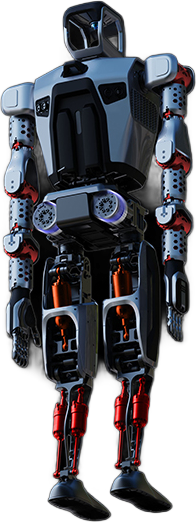
The AgiBot A2 Max (Chinese: 远征A2 Max, Yuanzheng A2 Max) is a heavy-duty bipedal humanoid robot developed by AgiBot (Zhiyuan Robotics) of Shanghai, China, and it is the largest and most powerful variant in the AgiBot A2 series, engineered for high-payload industrial work such as material handling and palletizing. The A2 Max stands 175 cm tall, weighs 85 kg, has 67 degrees of freedom, and can handle objects of up to 40 kg, more than double the standard A2's 15 kg, making it the heaviest-lifting bipedal humanoid AgiBot has announced.[1] First unveiled on August 18, 2024 alongside the standard A2 and the wheeled A2-W, the A2 Max trades the agility and versatility of its siblings for raw strength and payload capacity, positioning it as a purpose-built workhorse for factory floors, warehouses, and logistics operations.[3]
| AgiBot A2 Max | |
|---|---|
 | |
| General information | |
| Manufacturer | AgiBot |
| Country of origin | China |
| Year introduced | August 2024 |
| Status | Coming soon (announced) |
| Type | Bipedal humanoid robot |
| Price | $130,000 - $160,000 USD (estimated) |
| Website | agibot.com/products/A2_Max |
The A2 Max features reinforced joints capable of peak arm torque of 450 N-m and leg thrust of 8,800 N. With 67 total degrees of freedom (53 active), including 19-DOF industrial-grade dexterous hands, it combines brute force with fine manipulation. As of early 2026, the A2 Max is listed as "coming soon" on AgiBot's official website, indicating it remains in a late development or pre-production phase while the rest of the A2 family is already in mass production.[1]
What is the AgiBot A2 Max, and how did it originate?
Development context
AgiBot, legally AGIBOT Innovation (Shanghai) Technology Co., Ltd. and also known as Zhiyuan Robotics, was founded in February 2023 by former Huawei engineers Peng Zhihui (known online as "Zhihui Jun") and Deng Taihua, with Peng serving as chief technology officer and chief innovation officer.[2] The company's first product, the RAISE A1 (Expedition A1), debuted in August 2023 as a 175 cm tall bipedal humanoid with 49 degrees of freedom and proprietary PowerFlow joint motors.[2] The A1 served primarily as a technology demonstration platform for industrial tasks.
Building on the A1's architecture, AgiBot developed the A2 series as a commercially oriented successor. On August 18, 2024, the company unveiled five new robot models at a major product launch event. Three belonged to the Yuanzheng (Expedition) A2 family: the standard A2 for general-purpose service and industrial roles, the heavy-duty A2 Max for high-payload handling, and the wheeled A2-W for flexible factory manufacturing; the other two were the Lingxi X1 and X1-W. The A2 Lite and A2 Ultra variants were introduced subsequently to address cost-sensitive and perception-intensive applications, respectively.[3]
During the 2024 unveiling event, AgiBot demonstrated the A2 Max moving a 40 kg aviation box using its dual-arm system, showcasing the robot's ability to perform heavy lifting tasks that would be beyond the capabilities of the standard A2 or comparable humanoids from competing manufacturers.[4]
What is the production status of the A2 Max?
While the standard A2 and the A2-W entered mass production and contributed to AgiBot's milestone of 5,168 units shipped in 2025, the A2 Max has remained in a pre-production or limited-availability state. As of April 2026, AgiBot's official product page lists the A2 Max as "coming soon," and U.S. distributor listings (such as RobotsUSA) show the product as out of stock with no confirmed availability date.[1][5] This suggests that AgiBot has prioritized scaling up production of the service-oriented A2 variants and the factory-proven A2-W while continuing to refine the A2 Max for its eventual commercial release.
AgiBot reached 10,000 cumulative robot shipments on March 30, 2026, doubling from 5,000 to 10,000 in approximately three months.[6] "Reaching 10,000 units is not simply about producing more robots, it reflects a fundamental shift in our ability to scale," said Peng Zhihui, CTO of AgiBot, on announcing the milestone.[6] The company projects annual shipments in the "tens of thousands" for 2026. Whether the A2 Max will enter this production pipeline in 2026 has not been publicly confirmed.
How is the A2 Max designed and engineered?
Design philosophy
The A2 Max represents a deliberate divergence from the standard A2's design priorities. Where the standard A2 balances mobility, interaction, and manipulation for versatile commercial deployment, the A2 Max shifts heavily toward strength and payload capacity. This trade-off is reflected in its increased weight (85 kg versus 69 kg), reduced walking speed (1 m/s versus up to 3.3 m/s for the standard A2), and reinforced joint modules optimized for sustained heavy-duty operation.
The robot maintains the same 175 cm height as the original A1 platform (compared to the standard A2's 169 cm production height), suggesting that the A2 Max may retain more of the A1's larger frame architecture to accommodate its heavier actuators and structural reinforcements. This taller frame also provides a larger working envelope for overhead tasks such as stacking pallets or loading shelves.[1]
Actuator system
The A2 Max's actuation system represents a significant upgrade over the standard A2. The dual arms are equipped with dual-ratio reduction joint modules, a design that allows each arm joint to switch between two gear ratios depending on the task requirements. In the low-ratio configuration, the joints provide high speed for repositioning. In the high-ratio configuration, they deliver peak torque of up to 450 N-m, enabling the robot to lift and manipulate heavy objects with precision.[1]
For comparison, the standard A2 Ultra features a peak knee torque of 270 N-m. The A2 Max's arm torque of 450 N-m represents a roughly 67% increase over this figure, though the comparison is between arm and leg joints and the specific configurations differ.
The leg joints use linear actuator motors that produce 8,800 N of thrust. This level of force is necessary to support the robot's own 85 kg mass plus the additional load of objects being carried (up to 40 kg), while maintaining stable bipedal locomotion. The combined 125 kg of robot mass plus payload places substantial demands on the locomotion system, particularly during walking, turning, and transitioning between postures.[1]
AgiBot's proprietary PowerFlow joint motor underpins the A2 Max's actuator system. The PowerFlow motor achieves peak torque exceeding 350 N-m while weighing only 1.6 kg, using a liquid cooling circulation system and a proprietary vector control driver to manage heat dissipation during sustained high-torque operations.[7]
Dexterous hands
The A2 Max features 19-DOF industrial-grade dexterous hands with 12 active and 7 passive degrees of freedom. These hands are designed to provide flexibility comparable to human hands while withstanding the stresses of industrial manipulation tasks. The combination of active and passive joints allows the hands to conform to irregularly shaped objects during grasping, a critical capability for handling the diverse range of items encountered in warehouse and factory environments.[1]
The hands can perform both power grasps (for heavy, bulky items) and precision grasps (for smaller components), making the A2 Max suitable for tasks ranging from moving heavy boxes to placing individual parts on assembly lines. The A2 Max can squat and bend to pick items from ground level, extending its effective working range from floor to overhead reach.[1]
What are the technical specifications of the A2 Max?
Physical and mobility specifications
| Specification | Value |
|---|---|
| Height | 175 cm (5 ft 9 in) |
| Weight | 85 kg (187 lb) |
| Total degrees of freedom | 67 (53 active) |
| Arm DOF | 7 per arm (14 total) |
| Hand DOF | 19 per hand (12 active, 7 passive) |
| Leg DOF | 6 per leg (12 total) |
| Waist DOF | 3 |
| Maximum walking speed | 1 m/s (3.6 km/h) |
| Turning radius | 60 cm |
| Maximum payload capacity | 40 kg (across full working range) |
| Peak arm torque | 450 N-m (dual-ratio reduction joint modules) |
| Leg joint thrust | 8,800 N (linear actuator motors) |
| Leg actuator type | Linear actuator motors |
| Ground-level pickup | Yes (squat and bend) |
Power and runtime
| Specification | Value |
|---|---|
| Runtime | ~2 hours |
| Battery swapping | Supported (hot-swappable) |
| Charging time | ~2 hours |
The A2 Max's 2-hour runtime with battery swapping support is designed for shift-aligned battery logistics in factory settings, where batteries can be replaced during breaks or shift changes without powering down the robot.[1]
Sensors and computing
While AgiBot's official A2 Max product page does not provide an exhaustive sensor specification list, the robot is confirmed to include LiDAR and depth sensors for navigation and obstacle avoidance.[1] Based on the A2 platform architecture shared across the series, the A2 Max is expected to incorporate elements of AgiBot's standard perception stack, which on the A2 Ultra includes:
- 360-degree LiDAR for panoramic environmental mapping
- RGB-D cameras for depth perception
- RGB and fisheye cameras for wide-angle visual coverage
- Force/torque sensors for manipulation feedback
- IMU and gyroscope for balance and orientation
The standard A2 series uses 200 TOPS of AI computing power, with an NVIDIA Jetson Orin 64G GPU available as a high-performance option. The A2 Max's computing configuration has not been separately detailed but is expected to be consistent with or exceed this baseline, particularly given the additional computational demands of heavy-payload manipulation planning.[8][9]
How does the A2 Max compare with the other A2 series variants?
The A2 Max is one of five variants in the AgiBot A2 family. Each variant is optimized for a different market segment, from cost-effective entertainment to heavy industrial labor.
| Specification | A2 Lite | A2 (Standard) | A2 Ultra | A2 Max | A2-W |
|---|---|---|---|---|---|
| Height | 169 cm | 169 cm | 169 cm | 175 cm | 163 cm |
| Weight | ~63 kg | ~69 kg | ~69 kg | 85 kg | 230 kg |
| Locomotion | Bipedal | Bipedal | Bipedal | Bipedal | Wheeled (4WD) |
| Active DOF | 40+ | 40+ | 40 | 53 | 22 |
| Max speed | 3.3 m/s | 3.3 m/s | 1.2 m/s | 1 m/s | N/A (wheeled) |
| Payload | 15 kg | 15 kg | ~2 kg/arm | 40 kg | 5 kg/arm |
| Peak arm torque | N/A | N/A | 270 N-m (knee) | 450 N-m | N/A |
| Battery | 700 Wh | 700 Wh | 700 Wh | ~700 Wh | 2,000 Wh |
| Runtime | ~2 hr | ~2 hr | ~1.5-2 hr | ~2 hr | ~5 hr |
| LiDAR | No | Yes | Yes (3D) | Yes | Yes (360-degree) |
| RGB-D camera | No | Yes | Yes | Yes | Yes |
| Dexterous hands | Simplified | Standard (6 DOF) | 6 DOF | 19 DOF (12 active) | 7 DOF bionic arms |
| Primary use | Entertainment, exhibitions | Service, hospitality, retail | Autonomous navigation, mapping | Heavy-duty handling, palletizing | Factory automation, manufacturing |
| Price range | ~$44,500 | $100K-$130K | Quote-based | $130K-$160K | $150K-$190K |
| Status (2026) | In production | In production | In production | Coming soon | In production |
How does the A2 Max differ from the A2 Lite, the A2 Ultra, and the A2-W?
The A2 Max occupies a unique position within the A2 family. It is the only bipedal variant designed for heavy-payload operations, bridging the gap between the lighter, faster bipedal models (A2 Lite, A2, A2 Ultra) and the heavier, wheeled A2-W.
A2 Max vs. A2 Lite: The A2 Lite is AgiBot's most affordable full-size bipedal humanoid, a roughly 63 kg, 23-DOF model aimed at entertainment, performance, and exhibition use; it omits LiDAR and RGB-D perception and uses simplified hands. The A2 Max sits at the opposite end of the lineup: it is far heavier (85 kg), has 67 total DOF with 19-DOF industrial hands, adds a full perception stack, and is built for heavy industrial labor rather than choreography. In short, the A2 Lite is a low-cost crowd-pleaser while the A2 Max is a high-end heavy lifter.
A2 Max vs. A2 (Standard): The A2 Max weighs 16 kg more and is 6 cm taller. It sacrifices walking speed (1 m/s versus 3.3 m/s) in exchange for nearly triple the payload capacity (40 kg versus 15 kg) and significantly higher joint torque. The standard A2 is a generalist suited for service, healthcare, and light industrial roles. The A2 Max is a specialist for logistics and heavy manufacturing.
A2 Max vs. A2-W: Both target factory environments, but with fundamentally different mobility approaches. The A2-W's four-wheel-drive base provides greater stability, a larger battery (2,000 Wh for 5 hours of runtime), and zero-turning-radius maneuverability in tight aisles. However, the A2-W weighs 230 kg, almost three times the A2 Max, and its wheeled base limits it to flat surfaces. The A2 Max's bipedal locomotion allows it to navigate stairs, uneven terrain, and spaces designed for human workers, though with lower stability and shorter runtime. The A2 Max also carries substantially more payload (40 kg versus 5 kg per arm for the A2-W), making it better suited for heavy lifting tasks.[10][11]
A2 Max vs. A2 Ultra: The A2 Ultra emphasizes perception and autonomy, with 3D LiDAR, multiple camera types, and an NVIDIA Jetson Orin GPU for mapping and navigation. Its payload is limited to approximately 2 kg per arm, making it unsuitable for industrial handling. The Ultra and Max represent opposite ends of the A2 spectrum: the Ultra sees and understands its environment in great detail but cannot carry heavy loads, while the Max trades some perception refinement for raw physical capability.[9]
What is the AgiBot A2 Max used for?
Material handling and palletizing
The A2 Max's primary intended application is material handling, the movement of goods between locations within a facility. With a 40 kg payload capacity and the ability to squat, bend, and reach overhead, the robot can perform a range of logistics tasks that would otherwise require either human workers or specialized fixed automation equipment such as conveyor systems and robotic arms.
Palletizing, the process of stacking goods onto pallets for storage or shipment, is specifically highlighted by AgiBot as a target application. This task requires controlled lifting, precise placement, and repeatable motion cycles, all of which align with the A2 Max's combination of high torque, dexterous hands, and stable locomotion at moderate speed. The 60 cm turning radius enables the robot to maneuver in the relatively confined spaces between pallet rows in a typical warehouse layout.[1]
Factory floor integration
As a bipedal humanoid, the A2 Max is designed to operate in environments built for human workers without requiring infrastructure modifications. This contrasts with traditional industrial automation (such as industrial robots on fixed rails or AGVs on magnetic tracks), which often requires significant facility redesign. The A2 Max can navigate doorways, cross between workstations, and access areas that wheeled robots cannot reach.
This flexibility is particularly valuable in mixed-use factories where some processes are automated and others remain manual. The A2 Max can be deployed incrementally, handling specific high-strain tasks while human workers continue to perform adjacent operations. This approach reduces the upfront capital expenditure and facility modification costs associated with traditional automation.
Comparison with fixed industrial automation
The A2 Max addresses a market segment between traditional industrial robots and fully manual labor. A conventional 6-axis industrial arm on a fixed base can lift payloads of 100 kg or more with sub-millimeter precision, but it is bolted to one location and requires safety caging. The A2 Max carries less weight (40 kg) with lower positional precision, but it can walk between tasks, adapt to changing workflows, and operate alongside humans.
For factories that need flexibility rather than raw throughput, particularly in industries with high product mix and frequent line changeovers, the A2 Max's mobility and adaptability offer advantages that fixed automation cannot match.
How does the A2 Max's software and AI work?
The A2 Max runs on AgiBot's integrated software stack, which is shared across the A2 family and other AgiBot products.
WorkGPT
WorkGPT is AgiBot's proprietary multimodal AI engine. It processes text, audio, and visual inputs with 96% accuracy and supports full-duplex conversation for natural human-robot interaction. In industrial contexts, WorkGPT enables the A2 Max to receive verbal instructions, interpret visual cues about object positions and orientations, and communicate status information to human operators.[8]
GO-1 and GO-2 foundation models
AgiBot's Genie Operator-1 (GO-1) embodied AI foundation model, released in March 2025, introduced the Vision-Language-Latent-Action (ViLLA) framework. GO-1 combines a Vision-Language Model (VLM) with a Mixture of Experts (MoE) architecture: a Latent Planner that learns general action understanding from cross-embodiment and human operation data, and an Action Expert that uses over a million real robot demonstrations to generate high-frequency, dexterous manipulation.[12]
The second-generation GO-2 model, released in 2026, introduced an asynchronous dual-system architecture: a low-frequency Semantic Planning Module ("General Commander") for high-level reasoning and a high-frequency Action Following Module ("Agile Executor") for real-time motor refinement. GO-2 achieved a 98.5% average success rate on the LIBERO benchmark, outperforming comparable models from NVIDIA and Physical Intelligence.[13]
These foundation models are particularly relevant for the A2 Max's industrial applications, where the robot must interpret complex manipulation tasks (such as identifying, grasping, and placing objects of varying shapes and weights) without explicit programming for each scenario.
AgiBot World dataset
The A2 Max benefits from AgiBot World, the company's open-source robot manipulation dataset containing over 1 million trajectories across 217 tasks and 87 skills. Launched at the end of 2024 and collected by more than 100 homogeneous robots in a 4,000-square-meter data collection facility, the dataset provides pre-trained models that can be fine-tuned for specific industrial tasks, potentially reducing the time required to deploy the A2 Max in new environments.[14]
AimRT middleware
AimRT is AgiBot's open-source robotics middleware framework, built in C++20 as a lightweight alternative to ROS 2. With a codebase of under 50,000 lines (compared to approximately 200,000 lines for ROS 2), AimRT reduces communication latency by up to 30% in multi-node scenarios while maintaining compatibility with the ROS 2 ecosystem through plugins.[15]
How is the A2 Max priced and positioned in the market?
Pricing and positioning
The A2 Max is estimated to cost between $130,000 and $160,000, placing it in the middle of the A2 series price range. This positions it above the standard A2 ($100,000 to $130,000) but below the industrial A2-W ($150,000 to $190,000). For comparison, the Agility Robotics Digit is priced at approximately $250,000, while Tesla has projected a long-term target price of $20,000 to $30,000 for the Optimus at scale, though Optimus remains in limited factory trials as of early 2026.[4][16]
Competitive landscape for heavy-duty humanoids
The heavy-duty humanoid robot segment is relatively nascent. Most humanoid robots in production or near-production as of 2026 are designed for service, research, or light industrial tasks with payload capacities of 5 kg or less. The A2 Max's 40 kg payload capacity places it in a small group of humanoids designed for physically demanding work.
| Robot | Manufacturer | Payload | Weight | Height | Primary Focus |
|---|---|---|---|---|---|
| AgiBot A2 Max | AgiBot | 40 kg | 85 kg | 175 cm | Material handling, palletizing |
| Digit | Agility Robotics | 16 kg | 65 kg | 175 cm | Warehouse logistics |
| Atlas (Electric) | Boston Dynamics | ~25 kg (est.) | ~89 kg | 150 cm | Research, industrial demos |
| Figure 02 | Figure AI | ~20 kg (est.) | 70 kg | 170 cm | Manufacturing, BMW partnership |
| Optimus Gen 3 | Tesla | ~20 kg (est.) | ~73 kg | 173 cm | Factory automation |
The A2 Max's 40 kg payload significantly exceeds the payload capacity of its closest competitors, establishing it as the heaviest lifter among bipedal humanoids announced as of 2026. However, this advantage comes with trade-offs in speed (1 m/s versus 1.5 to 2 m/s for most competitors) and overall weight (85 kg).
Relationship to the broader A2 production program
AgiBot's A2 series, taken as a whole, is the backbone of the company's commercial success. According to research firm Omdia, AgiBot ranked No. 1 globally in humanoid robot shipments in 2025, shipping 5,168 units for an estimated 38% market share, ahead of Unitree Robotics in second place at roughly 4,200 units (about 32%); Unitree's own IPO prospectus reported approximately 5,500 shipments, leaving the top spot disputed.[6][17][21] AgiBot reached 10,000 cumulative units by March 30, 2026.[6] Together with Unitree, AgiBot helped Chinese manufacturers account for roughly 85 to 90 percent of global humanoid robot shipments in 2025.[21]
The A2 series has been deployed across eight core commercial application areas: customer service and reception, exhibition and marketing, manufacturing, logistics and warehousing, security and inspection, healthcare, education and research, and data collection. The standard A2 and A2-W have driven the bulk of these deployments, while the A2 Max is expected to expand the series' reach into heavier industrial segments once it enters production.[18]
Notable A2 family deployments that demonstrate the industrial pipeline the A2 Max is designed to serve include:
- Fulin Precision Engineering: Nearly 100 A2-W units deployed across automotive parts factories in Mianyang, Sichuan Province, handling raw material delivery across 15 feeding points in powertrain and reducer workshops (August 2025)[19]
- SAIC-GM: An A2-W designated "Nengzai No. 1" deployed on the Buick Electra E7 battery production line for battery cell grasping and loading (early 2026)[20]
- BYD: AgiBot robots deployed for logistics and quality control tasks in welding workshops[6]
- CATL: Testing of humanoid robots at battery production facilities[22]
These factory deployments, currently served by the A2-W, represent the types of environments where the A2 Max's bipedal mobility and higher payload capacity could provide additional value, particularly in facilities where wheeled robots face access limitations.
See also
- AgiBot A2
- AgiBot A2 Lite
- AgiBot A2 Ultra
- AgiBot A2-W
- AgiBot
- Humanoid robot
- Industrial robot
- Embodied AI
- Agility Robotics Digit
References
- ^1 ^2 ^3 ^4 ^5 ^6 ^7 ^8 ^9 ^10 ^11AGIBOT A2-Max official product page
- ^1 ^2AgiBot - Wikipedia
- ^1 ^2AgiBot unveils five humanoid robots, commercialization on the horizon - KrASIA
- ^1 ^2AgiBot A2 Review: Specs and Price (2026) - RoboZaps
- ^AgiBot A2 Max Heavy-Duty Special-Purpose Humanoid Robot - RobotsUSA
- ^1 ^2 ^3 ^4 ^5AGIBOT Reaches 10,000 Units as Real-World Demand for Robots Accelerates - PR Newswire
- ^AgiBot products overview - AgiBot official site
- ^1 ^2AGIBOT A2 official product page
- ^1 ^2AGIBOT A2 Ultra Full-Size Humanoid Robot - AgiBot
- ^AgiBot A2-W Wheeled General-Purpose Robot: Everything You Need to Know - Bikman Tech
- ^AgiBot A2 Lite, Ultra, Max and A2-W: Specs and Uses - Robots Europa
- ^AgiBot GO-1: The Evolution of Generalist Embodied Foundation Model from VLA to ViLLA - GlobeNewsWire
- ^AGIBOT releases GO-2 foundation model for embodied AI - The Robot Report
- ^AgiBot World - GitHub (OpenDriveLab)
- ^AgiBot gains lead in world humanoid robot uptrend - China Daily
- ^AGIBOT Humanoid Robots: Price, Specs and Where to Buy (2026) - BotInfo
- ^Chinese firms outpace US rivals in 2025 humanoid robot shipments, as AgiBot takes lead - South China Morning Post
- ^AGIBOT Makes Its U.S. Market Debut at CES 2026 with Its Full Humanoid Robot Portfolio - PR Newswire
- ^AgiBot Wins Fulin Precision Order Valued at Tens of Millions RMB - Digital Journal
- ^SAIC-GM deploys wheeled humanoid robots on Buick battery assembly line - CnEVPost
- ^1 ^2Humanoid Robots: China Ships 90% of Global Units and Now Leads AI Benchmarks - Tech Times
- ^China's CATL marks trailblazing deployment of humanoid robots at scale on the factory floor - South China Morning Post
Improve this article
Add missing citations, update stale details, or suggest a clearer explanation. Every suggestion is reviewed for sourcing before it goes live.
6 revisions · v6 · 4,002 words · full history
Fact-checks are independent of edits: a reviewer re-verifies the article against its sources and stamps the date. How we verify
Research and drafting on this wiki are AI-assisted, under named human editorial standards. How AI is used here
Cite this page: AI Wiki. "AgiBot A2 Max." aiwiki.ai, updated 24 Jun 2026. CC BY 4.0. https://aiwiki.ai/wiki/agibot_a2_max