

AgiBot A2 Ultra
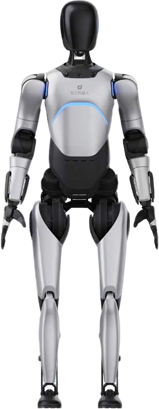
The AgiBot A2 Ultra (Chinese: 远征A2 Ultra, Yuanzheng A2 Ultra) is the perception-enhanced flagship variant of the AgiBot A2 interactive-service humanoid robot, built by AgiBot (legally AGIBOT Innovation (Shanghai) Technology Co., Ltd., Chinese: 智元, Zhiyuan), the Shanghai humanoid startup co-founded by former Huawei "Genius Youth" engineer Peng Zhihui (彭志辉), better known online as Zhihui Jun (稚晖君).[4][19] Standing 169 cm tall and weighing about 69 kg with 40 active degrees of freedom, the A2 Ultra is distinguished from the standard A2 by an expanded sensor suite that adds 3D LiDAR, an RGB-D camera, fisheye cameras, and an NVIDIA Jetson Orin 64G GPU for stronger autonomous navigation, environmental mapping, and obstacle avoidance.
| AgiBot A2 Ultra | |
|---|---|
 | |
| General information | |
| Manufacturer | AgiBot (Zhiyuan Robotics) |
| Country of origin | China |
| Year introduced | 2024 |
| Status | In production |
| Price | ~$109,995 USD (retail); quote-based for enterprise |
| Certifications | CR (China), FCC (US), CE-MD / CE-RED (EU) |
| Website | agibot.com/products/A2_Ultra |
The A2 Ultra is a full-size bipedal humanoid robot that features 6-DOF dexterous hands with fingertip sensors and a 200 TOPS AI computing system powered by AgiBot's proprietary WorkGPT multimodal engine. The robot is designed for complex service environments where high autonomy and rich human-robot interaction are critical, including guided tours in large facilities, interactive exhibitions, commercial marketing, and front desk reception. It supports Wi-Fi and 4G/5G connectivity, over-the-air (OTA) software updates, and swarm control for coordinating multiple units simultaneously.
The A2 family set the Guinness World Record for the longest journey walked by a humanoid robot when a standard, mass-produced AgiBot A2 covered 106.286 km on foot from Suzhou to Shanghai between 10 and 13 November 2025, walking continuously for three days without powering down even during hot-swap battery changes.[20] The A2 Ultra itself gained recognition by winning a gold medal in group dance performance at the World Humanoid Robot Games, demonstrating coordinated multi-robot choreography.[1] It has also appeared on major Chinese television broadcasts, including CCTV and Hunan TV's 2026 New Year's Eve Gala.[2] Along with the rest of the A2 family, the Ultra shares the distinction of being part of the world's first full-size humanoid robot platform certified across all three major global markets (China, United States, and European Union) simultaneously, having received CR, FCC, and CE certifications in May 2025.[3] In 2025 AgiBot shipped 5,168 humanoid robots, the most of any manufacturer worldwide.[8][21]
History
Development background
AgiBot was founded in February 2023 by former Huawei engineers Peng Zhihui (CTO) and Deng Taihua (CEO). Peng, born in 1993 and a graduate of the University of Electronic Science and Technology of China, had joined Huawei's elite "Genius Youth" (Top Minds) program in 2020 before leaving in December 2022 to pursue robotics.[19] The company's first product, the RAISE A1 (Expedition A1), debuted in August 2023 as a 175 cm bipedal humanoid with 49 degrees of freedom and proprietary PowerFlow joint motors.[4] The A1 served as a technology demonstration platform for industrial applications.
In August 2024, AgiBot introduced the A2 series as its commercially oriented successor to the A1. The initial launch included three variants: the standard A2 for general-purpose service, the heavy-duty A2 Max for industrial handling, and the wheeled A2-W for flexible factory manufacturing. The A2 Lite and A2 Ultra were introduced subsequently to address cost-sensitive and perception-intensive applications, respectively.[5] While the A2 Lite stripped down sensors to reduce costs for entertainment roles, the A2 Ultra went in the opposite direction, adding the most comprehensive sensor and computing stack of any bipedal variant in the lineup.
Certifications and safety milestones
In May 2025, the A2 series became the first full-size humanoid robot platform to receive safety and quality certifications from China, the United States, and the European Union simultaneously. At the 2025 Zhangjiang Embodied Intelligence Developers Conference, the Shanghai Robot Industrial Technology Research Institute awarded the CR001 certificate to the A2. The platform also holds FCC certification for the U.S. market and CE marking (both CE-MD for machinery and CE-RED for radio equipment) for the European market. These certifications evaluate mechanical and electrical safety, electromagnetic compatibility, functional safety, and intelligent performance.[3]
The A2 Ultra specifically features PLd-level safety protection (Performance Level d, per ISO 13849) and is certified under ISO/TS 15066 for collaborative robot safety. Its three-layer safety monitoring architecture operates at the business, system, and hardware levels, with redundant computing, a dedicated safety center backup, and a dual-path control architecture.[2][6]
When did AgiBot set the humanoid robot walking world record?
On 13 November 2025, AgiBot Innovation (Shanghai) Technology Co., Ltd. set the official Guinness World Record for the longest journey walked by a humanoid robot, recorded as "106.286 kilometre(s)."[20] An AgiBot A2 walked roughly 100 km from Suzhou's Jinji Lake in Jiangsu Province to Shanghai's Bund over three days (10 to 13 November 2025), crossing asphalt, tiled pavement, and bridges while obeying traffic laws. Equipped with dual GPS modules plus built-in LiDAR and infrared depth cameras, the robot navigated changing light and complex urban conditions, and a hot-swappable battery system let it keep operating without ever powering down. Guinness and AgiBot noted that the record-setting unit was "a standard, mass-produced commercial unit with no customized modifications," identical to robots delivered to clients, after the platform had earlier completed a 24-hour autonomous walk in temperatures near 40 degrees C.[20] The walk was performed by the standard A2; the A2 Ultra is the perception-focused variant of the same platform.
World Humanoid Robot Games
The A2 Ultra achieved notable recognition at the World Humanoid Robot Games, where it won a gold medal in the group dance performance event. During the competition, multiple A2 Ultra units performed coordinated multi-robot choreography, with one robot (designated "GUANGZI," empowered by the AgiBot A2 team) appearing dressed as a Terracotta Warrior. The demonstration showcased breakthroughs in artistic expression, precise motor coordination, and multi-unit synchronization using AgiBot's swarm control software.[1][7]
CES 2026 debut
AgiBot made its U.S. market debut at CES 2026 in January 2026, where the A2 Ultra was displayed alongside the full A2 Series, X2 Series, G2 Series, and D1 quadruped series. The A2 Series received multiple "Best of CES 2026" awards, including a Netzwelt Innovation Award 2026 and recognition from MacStories. AgiBot was ranked the top humanoid robot producer globally based on an estimated 5,168 units shipped in 2025.[7][8]
Television and media appearances
The A2 Ultra has been featured on several prominent Chinese media platforms. Appearances include CCTV, the 2025 CMG (China Media Group) Science and Innovation Gala, and Hunan TV's 2026 New Year's Eve Gala. These broadcasts demonstrated the robot's capacity for scripted performances, audience interaction, and choreographed movement in live entertainment settings.[2]
Corporate restructuring and IPO plans
In late 2025, AgiBot restructured from a limited liability company into a joint stock limited company and was renamed Zhiyuan Innovation (Shanghai) Technology, a standard step for Chinese firms preparing to go public.[22] The company is reported to be targeting an initial public offering in Hong Kong in 2026, with a preliminary prospectus expected in early 2026 and a listing potentially by the third quarter. According to reports, AgiBot is aiming for a valuation of HK$40 billion to HK$50 billion (roughly US$5.1 billion to US$6.4 billion) and plans to sell 15 to 25 percent of its shares, which could raise more than US$1 billion.[22][23]
Technical specifications
The A2 Ultra shares the same physical frame as the standard A2, but adds a significantly enhanced perception and computing stack. The specifications below are based on AgiBot's official product page and confirmed distributor documentation.[2][6][9]
Physical and mobility specifications
| Specification | Value |
|---|---|
| Height | 169 cm (5 ft 7 in) |
| Width | 75 cm |
| Depth | 30 cm |
| Weight | ~69 kg (152 lb) |
| Total active degrees of freedom | 40 |
| Neck DOF | 2 |
| Arm DOF | 7 per arm (14 total) |
| Leg DOF | 6 per leg (12 total) |
| Hand DOF | 6 per hand (12 total) |
| Maximum walking speed | 1.2 m/s (4.3 km/h) |
| Turning radius | 60 cm |
| Peak knee torque | 270 N-m |
| Maximum arm load | ~2 kg per arm |
| Ramp climbing | Up to 10-degree inclines |
| Stair climbing | Yes |
| Operating temperature | 0 to 45 degrees C |
Computing and AI
| Component | Details |
|---|---|
| AI computing power | 200 TOPS |
| Basic board | 16-core high-performance CPU |
| High-performance board | NVIDIA Jetson Orin 64G |
| AI engine | WorkGPT multimodal platform |
| Multimodal accuracy | 96% across text, audio, and visual inputs |
| Face wake-up rate | 99% |
| Navigation | HIMUS 3D-SLAM, L4-level autonomous mobility |
| Locomotion control | RTMOF (Real-Time Robust Motion Framework) with reinforcement learning |
| Connectivity | Wi-Fi (2.4 GHz / 5 GHz), 4G/5G |
| OTA updates | Supported (every 2 to 3 months) |
| API support | Python and C++ via ROS 2 compatibility |
Sensor suite
The A2 Ultra's sensor stack is the most comprehensive of any bipedal A2 variant, combining spatial awareness, visual perception, audio processing, and tactile feedback.
| Sensor | Function |
|---|---|
| 3D LiDAR | 360-degree panoramic environmental mapping and obstacle detection |
| RGB-D camera | Depth perception for object recognition and spatial reasoning |
| RGB camera | High-definition visual capture for face recognition and scene understanding |
| Fisheye camera | Wide-angle peripheral awareness |
| Array microphone | Sound source localization and voice recognition in noisy environments |
| Fingertip sensors | Tactile feedback for manipulation tasks |
| Force/torque sensors | 6D force sensing for collaborative safety and manipulation control |
| IMU / Gyroscope | Balance and orientation |
Power and battery
| Specification | Value |
|---|---|
| Battery capacity | 14.4 Ah (700 Wh) |
| Runtime (standing) | ~3 hours |
| Runtime (walking) | ~1.5 hours |
| Charging time | ~2 hours |
| Input voltage | 110V to 220V |
| Charger output | 54.6V 8A |
| Battery swapping | Hot-swappable (continuous operation without power-off) |
| Battery lifespan | 3 to 5 years |
Interaction and output
| Feature | Details |
|---|---|
| Facial expression display | LED screen capable of customizable expressions |
| Speaker | Built-in for voice output |
| Indicator lights | Status and alert indicators |
| Remote control | Wireless handheld controller included |
| Voice customization | Custom wake words, persona, voice, and greeting via Linksoul platform |
| Dance choreography | Supported via AimMaster development client |
Software platform
The A2 Ultra runs on AgiBot's integrated software stack, which is shared across the A2 family and other AgiBot products. The software ecosystem includes several proprietary components that together enable the robot's interaction, navigation, and task execution capabilities.
WorkGPT
WorkGPT is AgiBot's proprietary multimodal AI engine, serving as the core intelligence layer for all A2 variants. It processes text, audio, and visual inputs simultaneously, achieving 96% accuracy even in noisy environments. WorkGPT supports full-duplex conversation (the robot can listen and speak at the same time), a 99% face wake-up rate for proactive greeting when it detects a human face, and retrieval-augmented generation (RAG) for custom knowledge bases. This allows operators to load domain-specific information (product catalogs, facility maps, company FAQs) so the robot can answer contextual questions relevant to its deployment environment.[6][9]
AimMaster
AimMaster is the A2 Ultra's client-side control application, designed for non-technical operators. AgiBot claims the interface can be learned in approximately five minutes. Through AimMaster, users can customize the robot's facial expressions, walking speed, movement duration, and action sequences. Action blocks can be dragged, reordered, and combined to create choreographed routines for performances, presentations, or guided tours. The software also provides scheduling, status monitoring, and remote diagnostics.[2]
Linksoul
The Linksoul platform handles the A2 Ultra's personality and conversational configuration. Operators can customize the robot's knowledge base, wake words, persona, voice characteristics, and greeting behavior through a web interface. This enables rapid adaptation to different deployment contexts; for example, a hotel lobby deployment might use a welcoming, service-oriented persona, while an exhibition deployment might use a product-focused persona with detailed technical knowledge.[2]
Swarm control
The A2 Ultra supports multi-robot coordination through AgiBot's swarm control software. This capability allows multiple A2 Ultra units to operate as a coordinated fleet, sharing navigation data, synchronizing movements, and executing choreographed routines. The gold medal dance performance at the World Humanoid Robot Games was a direct demonstration of this swarm control capability. In commercial deployments, swarm control enables scenarios such as multiple robots providing coordinated coverage across a large exhibition hall or shopping center.[1][2]
What AI model powers the AgiBot A2? GO-1 and GO-2
The A2 platform is powered by AgiBot's Genie Operator (GO) family of embodied foundation models, trained on the company's AgiBot World dataset. Released on 10 March 2025, the first-generation Genie Operator-1 (GO-1) introduced the Vision-Language-Latent-Action (ViLLA) framework, combining a Vision-Language Model (VLM) with a Mixture of Experts (MoE) architecture. GO-1 consists of a Latent Planner that "learns from cross-embodiment and human operation data to develop general action understanding" and an Action Expert trained on "over a million real robot demonstrations" for high-frequency dexterous manipulation.[10] The underlying AgiBot World dataset, released at the end of 2024, comprises more than 1 million trajectories spanning 217 tasks across five application domains.[10]
The second-generation GO-2 model, released in 2026, uses a dual-system architecture: a low-frequency Semantic Planning Module for high-level reasoning and a high-frequency Action Following Module for real-time motor refinement. GO-2 achieved a 98.5% average success rate on the LIBERO benchmark, outperforming comparable models from NVIDIA and Physical Intelligence.[11]
Genie Sim 3.0
Genie Sim 3.0 is AgiBot's next-generation robot simulation platform, built on NVIDIA Isaac Sim and unveiled at CES 2026. It provides a complete toolchain for environment reconstruction, scene generalization, data collection, and automated evaluation. AgiBot has released over 10,000 hours of open-source synthetic data through the platform, covering more than 200 tasks with multi-sensor modalities including RGB-D, stereo vision, and whole-body kinematics. The platform includes more than 100,000 simulation scenarios for model evaluation.[12]
Lingqu OS and AimRT
Lingqu OS, released in July 2025, is AgiBot's embodied intelligent operating system. It consists of three layers: a real-time middleware layer built on AimRT (a custom C++20 runtime that outperforms ROS 2 in benchmarks), a standardized intelligent agent service layer, and a comprehensive toolchain for simulation, training, and deployment. AimRT's codebase is under 50,000 lines, compared to approximately 200,000 lines for ROS 2, and reduces communication latency by up to 30% in multi-node scenarios.[13]
Dexterous hands
The A2 Ultra is equipped with 6-DOF dexterous hands as standard. For applications requiring greater manipulation capability, AgiBot offers the OmniHand series as an upgrade path. While the standard 6-DOF hands on the A2 Ultra are suitable for basic grasping, gesturing, and light object handling, the OmniHand series provides substantially greater dexterity for precision manipulation tasks.
OmniHand series
The OmniHand 2025 series is AgiBot's standalone dexterous hand product line, available in multiple configurations.
| Specification | OmniHand 2025 (O10) | OmniHand Agile 2025 | OmniHand Pro 2025 |
|---|---|---|---|
| Active DOF | 10 | 16 | 12 (19 total with passive) |
| Total DOF | 16 | 16 | 19 |
| Weight | 500 g or less | ~500 g | ~500 g |
| Dimensions | 180 x 85 x 38.5 mm | ~180 mm length | ~180 mm length |
| Maximum fingertip force | 5 N | 5 N | 15 to 25 N (configuration dependent) |
| Tactile sensing | Optional (400+ tactile points) | Standard | Multi-cell fingertip arrays with slip detection |
| Sensing resolution | 0 to 20 N range | 0.1 N resolution | 0.1 N multi-modal sensing |
| Communication | CANFD / RS485 at 1 kHz | CANFD / RS485 | CANFD / RS485 |
| Operating voltage | 24V | 24V | 24V |
| Min. grasp diameter | 5 mm | ~5 mm | ~5 mm |
| Min. open/close time | 0.7 s | ~0.7 s | ~0.7 s |
| Load capacity (palm up) | 1 kg typical / 2 kg max | 1 to 2 kg | 2+ kg |
| Price | ~9,800 RMB | Higher (quote-based) | |
| Material | PA + Silicone | PA + Silicone | PA + Silicone |
The OmniHand Agile 2025 is notable as the first high-DOF robotic hand priced under 10,000 RMB, breaking the cost barrier for dexterous manipulation in commercial robots. The Pro 2025 variant adds higher fingertip force (up to 25 N versus 5 N), optional 6-axis force/torque sensing, and enhanced tactile resolution, targeting logistics sorting, laboratory automation, and teleoperation workflows. Both models support position/angle mode, torque control, hybrid modes, and velocity operations, with Python and C++ SDKs available for secondary development.[14][15]
AgiBot has demonstrated the OmniHand's capabilities through tasks such as threading a needle, sorting parcels of various sizes and materials on production lines, and performing delicate assembly operations. The hands are designed as modular end-effectors that can be integrated into any robot platform using standard CANFD or RS485 communication protocols.[14]
A2 series variant comparison
The A2 Ultra is one of five variants in the AgiBot A2 family. Each variant is optimized for a different market segment, from cost-effective entertainment to heavy industrial labor. The following table compares all variants across key specifications.
| Specification | A2 Lite | A2 (Standard) | A2 Ultra | A2 Max | A2-W |
|---|---|---|---|---|---|
| Height | 169 cm | 169 cm | 169 cm | 175 cm | 163 cm |
| Weight | ~63 kg | ~69 kg | ~69 kg | 85 kg | 230 kg |
| Locomotion | Bipedal | Bipedal | Bipedal | Bipedal | Wheeled (4WD) |
| Active DOF | 40+ | 40+ | 40 | 53 | 22 |
| Hand DOF | Simplified | 6 per hand | 6 per hand | 19 per hand (12 active) | 7-DOF bionic arms |
| Max speed | 3.3 m/s | 3.3 m/s | 1.2 m/s | 1 m/s | N/A (wheeled) |
| Payload | 15 kg | 15 kg | ~2 kg/arm | 40 kg | 5 kg/arm |
| Battery | 700 Wh | 700 Wh | 700 Wh (14.4 Ah) | ~700 Wh | 2,000 Wh |
| Runtime | ~2 hr | ~2 hr | ~1.5 to 3 hr | ~2 hr | ~5 hr |
| 3D LiDAR | No | Yes (360-degree) | Yes (3D) | Yes | Yes (360-degree) |
| RGB-D camera | No | Yes | Yes | Yes | Yes |
| Fisheye camera | No | No | Yes | No | No |
| GPU | Standard | Standard | NVIDIA Jetson Orin 64G | Standard | Standard |
| AI computing | 200 TOPS | 200 TOPS | 200 TOPS | 200 TOPS | 275 TOPS |
| Swarm control | Yes | Yes | Yes | Yes | Yes |
| OTA updates | Yes | Yes | Yes | Yes | Yes |
| Primary use | Entertainment, exhibitions | Service, hospitality, retail | Autonomous navigation, advanced interaction, mapping | Heavy-duty handling, palletizing | Factory automation, manufacturing |
| Price range | ~$44,500 | $100K to $130K | ~$110K (retail); quote-based | $130K to $160K | $150K to $190K |
| Status (2026) | In production | In production | In production | Coming soon | In production |
Positioning within the A2 family
The A2 Ultra sits between the standard A2 and the A2 Max in terms of technological sophistication, but it occupies a distinct niche focused on perception and autonomy rather than physical strength.
A2 Ultra vs. A2 (Standard): The Ultra adds 3D LiDAR, an RGB-D camera, fisheye cameras, and an NVIDIA Jetson Orin 64G GPU on top of the standard sensor suite. This expanded perception stack enables more capable autonomous navigation, environmental mapping, and obstacle awareness. The trade-off is a lower maximum walking speed (1.2 m/s versus 3.3 m/s for the standard A2) and a lower per-arm payload (~2 kg versus 15 kg). The standard A2 is a generalist for service and retail, while the Ultra targets environments where autonomous operation and environmental understanding are paramount.
A2 Ultra vs. A2 Lite: The A2 Lite strips the LiDAR and RGB-D camera systems entirely, relying on a simplified perception suite to reduce costs (roughly $44,500 versus ~$110,000 for the Ultra). The Lite targets price-sensitive applications like marketing events, exhibition hall performances, and entertainment. The Ultra targets high-value deployments requiring autonomous navigation and advanced AI interaction.
A2 Ultra vs. A2 Max: The A2 Max trades perception for brute force. Standing 175 cm tall and weighing 85 kg, the Max features 53 active DOF, 19-DOF industrial-grade dexterous hands, and a 40 kg payload capacity. The Ultra weighs 16 kg less, walks faster, and has substantially better sensors and computing, but can only carry approximately 2 kg per arm. The Max is a specialist for logistics and heavy manufacturing; the Ultra is a specialist for intelligent interaction and autonomous service.
A2 Ultra vs. A2-W: The A2-W replaces bipedal legs with a four-wheel-drive base, making it a wheeled dual-arm robot weighing 230 kg with a 2,000 Wh battery (5 hours of runtime). The A2-W targets factory floor automation with embodied AI algorithms like UniGrasp and Uni6DPose. The Ultra's bipedal locomotion allows it to navigate stairs, uneven terrain, and human-oriented spaces that wheeled robots cannot access, but with shorter runtime and lower payload.
What is the AgiBot A2 Ultra used for?
The A2 Ultra is designed for environments where rich human-robot interaction and autonomous navigation are central requirements. Its expanded sensor suite and NVIDIA Jetson Orin GPU make it particularly well-suited for complex indoor environments with dynamic obstacles and varied interaction scenarios.
Reception and hospitality
The A2 Ultra serves as an autonomous receptionist in hotel lobbies, corporate offices, and government buildings. Using its 99% face wake-up rate, the robot proactively greets visitors when it detects their presence. WorkGPT enables natural bilingual conversation, allowing the robot to answer questions, provide directions, and handle basic service requests. The Linksoul platform allows operators to load custom knowledge bases tailored to the specific venue.
Exhibition and marketing
At trade shows, museums, and shopping centers, the A2 Ultra provides guided tours and product demonstrations. Its autonomous navigation capability, powered by HIMUS 3D-SLAM algorithms, enables it to follow predefined routes while dynamically avoiding obstacles and pedestrians. The AimMaster software allows marketing teams to create custom choreographed routines and presentations without technical expertise. Multiple units can be coordinated via swarm control to provide coverage across large venues.
Commercial performance
The A2 Ultra's dance choreography support and swarm control make it suitable for staged performances and brand activations. Its gold medal at the World Humanoid Robot Games and appearances on CCTV and Hunan TV demonstrate its performance capabilities. Action sequences can be freely composed in AimMaster by dragging and combining movement blocks.
Research and education
With Python and C++ API support, ROS 2 compatibility via AimRT, and access to the AgiBot World dataset (over 1 million trajectories), the A2 Ultra can serve as a research platform for embodied AI and human-robot interaction studies. The NVIDIA Jetson Orin 64G provides sufficient compute for running custom deep learning models on-board.
Guided facilities and large venues
The combination of 3D LiDAR, RGB-D cameras, and L4-level autonomous mobility makes the A2 Ultra effective in large indoor facilities such as airports, convention centers, and hospitals. It can autonomously navigate complex floor plans, ride elevators (with integration), and provide wayfinding assistance to visitors navigating unfamiliar spaces.
Safety systems
The A2 Ultra features a three-layer safety monitoring architecture designed for deployment in environments shared with humans.
| Layer | Function |
|---|---|
| Hardware level | Dedicated safety center backup; dual-path control architecture; emergency stop button; wireless remote emergency stop |
| System level | Redundant computing; real-time force/torque monitoring; collision detection algorithms |
| Business level | Configurable safety zones; speed limiting near detected humans; PLd-level protection per ISO 13849 |
The 360-degree LiDAR and six HD cameras provide comprehensive obstacle detection and proximity sensing. The robot's force-limiting and collision-detection systems comply with ISO/TS 15066 for collaborative robot safety, enabling it to operate in close proximity to humans without physical barriers. An emergency stop can be triggered via the wireless remote controller or a physical button on the robot.[2][3][6]
Production and availability
The A2 Ultra is in active production as of 2026. AgiBot mass-produced its 1,000th general-purpose embodied robot in January 2025, and its broader production program reached 10,000 cumulative robot shipments by 30 March 2026, doubling from 5,000 to 10,000 in approximately three months.[16][19] In 2025 AgiBot shipped an estimated 5,168 humanoid robots, accounting for roughly 39% of global humanoid shipments and ranking first worldwide in both volume and market share, according to research firm Omdia; Unitree Robotics ranked second with about 4,200 units (32%).[8][21] AgiBot projects annual shipments in the "tens of thousands" for 2026.[16]
The A2 Ultra is available for purchase through AgiBot's direct sales channels and authorized distributors. U.S. retail pricing through distributors such as American Satellite is listed at $109,995 USD.[17] Enterprise deployments are typically quote-based and may include customization, installation, training, and ongoing support services.
The robot is available in China, the United States, Canada, Germany, Japan, and South Korea. Colors include white, silver, and black. AgiBot also offers leasing options through its BotShare platform, a robot rental service covering 50 cities across China with plans to expand to over 200 cities by 2026.[7][18]
How does the AgiBot A2 Ultra compare to other humanoid robots?
The A2 Ultra competes in the service-oriented humanoid robot segment, where interaction quality and autonomous navigation are valued over payload capacity.
| Robot | Manufacturer | Height | Weight | DOF | Payload | Primary Focus | Approx. Price |
|---|---|---|---|---|---|---|---|
| AgiBot A2 Ultra | AgiBot | 169 cm | 69 kg | 40 | ~2 kg/arm | Perception, interaction, autonomous service | ~$110,000 |
| Walker S2 | UBTECH | 170 cm | 77 kg | 42 | ~10 kg | Service, industrial collaboration | N/A |
| Digit | Agility Robotics | 175 cm | 65 kg | 16+ | 16 kg | Warehouse logistics | ~$250,000 |
| Optimus Gen 3 | Tesla | 173 cm | ~73 kg | 50+ | ~20 kg | Factory automation | Target $20K to $30K at scale |
| Figure 02 | Figure AI | 170 cm | 70 kg | 40+ | ~20 kg | Manufacturing, BMW partnership | ~$50,000 (projected) |
| Apollo | Apptronik | 172 cm | 73 kg | 36 | 25 kg | Logistics, manufacturing | N/A |
The A2 Ultra differentiates itself through its comprehensive perception stack (3D LiDAR plus multiple camera types), its mature multimodal AI system (WorkGPT with 96% accuracy), its swarm control capability for multi-robot coordination, and its global safety certifications. While competitors like Digit and Optimus prioritize payload and industrial throughput, the A2 Ultra is optimized for environments where natural human interaction and autonomous navigation are the primary requirements.
AgiBot's competitive advantage also stems from its production scale. With an estimated 5,168 units shipped in 2025, AgiBot has more real-world deployment experience than most Western humanoid robot companies combined. This production volume generates teleoperation data that feeds back into the company's AgiBot World dataset and GO-1/GO-2 foundation models, creating a data flywheel that improves the robots' capabilities over time.[7][16][21]
See also
- AgiBot A2
- AgiBot A2 Lite
- AgiBot A2 Max
- AgiBot A2-W
- AgiBot
- Humanoid robots
- Embodied AI
- LiDAR
- Reinforcement learning
References
- ^1 ^2 ^3AgiBot A2 Review: Specs and Price (2026) - RoboZaps
- ^1 ^2 ^3 ^4 ^5 ^6 ^7 ^8AGIBOT A2 Ultra Full-Size Humanoid Robot - AgiBot official product page
- ^1 ^2 ^3Shanghai firm unveils world's first humanoid robot certified in China, U.S., and EU - ECNS
- ^1 ^2AgiBot - Wikipedia
- ^AgiBot unveils five humanoid robots, commercialization on the horizon - KrASIA
- ^1 ^2 ^3 ^4AgiBot A2 Ultra: Price, Details, Review 2025 - Origin of Bots
- ^1 ^2 ^3 ^4AGIBOT Makes Its U.S. Market Debut at CES 2026 with Its Full Humanoid Robot Portfolio - PR Newswire
- ^1 ^2 ^3AGIBOT's Humanoid Robots Take Home Multiple Best of CES 2026 Awards Following U.S. Debut - PR Newswire
- ^1 ^2AGIBOT A2 Ultra - Service Pro Robotics
- ^1 ^2AgiBot GO-1: The Evolution of Generalist Embodied Foundation Model from VLA to ViLLA - GlobeNewsWire
- ^AGIBOT releases GO-2 foundation model for embodied AI - The Robot Report
- ^AGIBOT Unveils Genie Sim 3.0 at CES 2026 - AgiBot
- ^AgiBot gains lead in world humanoid robot uptrend - China Daily
- ^1 ^2AgiBot OmniHand 2025 (O10) product page - AgiBot
- ^AgiBot OmniHand Series - Robots International
- ^1 ^2 ^3AGIBOT Reaches 10,000 Units as Real-World Demand for Robots Accelerates - PR Newswire
- ^Agibot A2 Ultra: Full-Size Certified Humanoid Robot - American Satellite
- ^China launches first open robot leasing platform BOTSHARE in Shanghai - TechNode
- ^1 ^2 ^3From Huawei 'Genius' to Robotics Entrepreneur: The Rise of Peng Zhihui and AgiBot - Humanoids Daily
- ^1 ^2 ^3Longest journey walked by a humanoid robot - Guinness World Records
- ^1 ^2 ^3Omdia Ranks AGIBOT No.1 Worldwide in Humanoid Robot Shipments in 2025 - PR Newswire
- ^1 ^2Rising China robotics star AgiBot restructures in potential bid to join IPO race - South China Morning Post
- ^Chinese Humanoid Maker AgiBot Reportedly Planning Hong Kong IPO Next Year - Humanoids Daily
Improve this article
Add missing citations, update stale details, or suggest a clearer explanation. Every suggestion is reviewed for sourcing before it goes live.
7 revisions · v7 · 5,000 words · full history
Fact-checks are independent of edits: a reviewer re-verifies the article against its sources and stamps the date. How we verify
Research and drafting on this wiki are AI-assisted, under named human editorial standards. How AI is used here
Cite this page: AI Wiki. "AgiBot A2 Ultra." aiwiki.ai, updated 24 Jun 2026. CC BY 4.0. https://aiwiki.ai/wiki/agibot_a2_ultra