

AgiBot G2 Genie
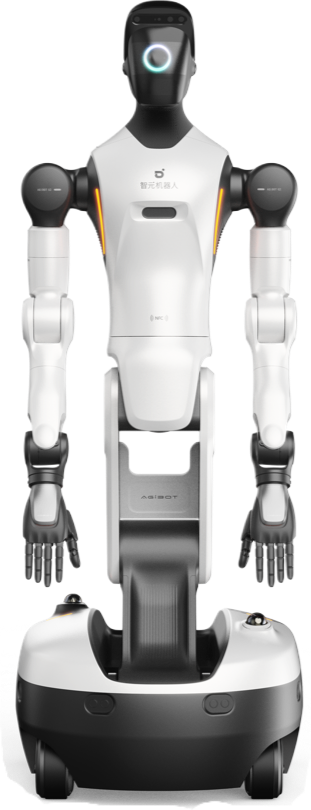
The AgiBot G2 Genie is an industrial-grade wheeled humanoid robot developed by AgiBot (Zhiyuan Robotics), a Chinese company founded in 2023 by former Huawei engineers. Unveiled on October 16, 2025, in Shanghai, it stands an adjustable 1,225 to 1,795 mm tall, weighs 185 kg, has 26 degrees of freedom, and is priced at roughly $138,000 USD.[1][2][13] The G2 pairs force-controlled dual arms (the maker calls them the "world's first cross-shaped wrist force-controlled arm") with an omnidirectional wheeled base and on-device embodied AI to perform precision assembly, logistics handling, and guided interaction in factories, warehouses, and commercial venues.[2][5]
| AgiBot G2 Genie | |
|---|---|
 | |
| General information | |
| Manufacturer | AgiBot |
| Type | Wheeled humanoid robot |
| Launch date | October 16, 2025 |
| Status | In production / commercially deployed |
| Price | ~$138,000 USD (purchase); from EUR 899/day (RaaS rental) |
| Website | agibot.com/products/G2 |
The G2 Genie is AgiBot's flagship commercial and industrial platform, running the company's GO-1 and GO-2 embodied AI foundation models on a dual-processor stack (an Nvidia Jetson Thor T5000 plus AgiBot's own Rhino R1).[2][8] It has attracted some of the largest industrial-humanoid orders in China: AgiBot secured a framework agreement for nearly 1,000 units with Shanghai Longcheer Technology, valued in the hundreds of millions of yuan, and by its U.S. market debut at CES 2026 the company had shipped over 5,000 robots across its full lineup.[3][4] In April 2026, the G2 became, in AgiBot's words, the first embodied-AI humanoid fleet to run at scale on a live consumer-electronics mass-production line, achieving throughput of up to 310 units per hour at a success rate above 99.9%.[14][15]
What is the AgiBot G2 Genie?
The AgiBot G2 Genie (marketed simply as the "Agibot G2" or "Genie G2") is a wheeled humanoid service and manufacturing robot. Rather than walking on legs, it mounts a fully articulated humanoid upper body, with two 7-degree-of-freedom force-controlled arms, a 3-degree-of-freedom anthropomorphic waist, and dexterous hands, on an omnidirectional wheeled base. AgiBot describes it as an "industrial-grade interactive embodied robot" built to bridge human dexterity and robotic precision for repetitive, labor-intensive, and safety-critical work.[2][5]
The G2 is the second generation of AgiBot's wheeled-humanoid line: AgiBot first introduced a wheeled humanoid concept in November 2023, and the October 2025 G2 launch was a substantial upgrade adding the cross-shaped wrist arm, full-arm force sensing, upgraded AI models, and the Nvidia Jetson Thor computing platform.[2][5] It is positioned alongside, not in place of, AgiBot's bipedal A2 series and compact X2 series humanoids; all of them share AgiBot's unified "Genie" software stack.
Who makes the AgiBot G2 Genie?
The G2 Genie is made by AgiBot (formally AGIBOT Innovation (Shanghai) Technology Co., Ltd., known in Chinese as Zhiyuan Robotics).
AgiBot was founded in February 2023 by Deng Taihua (CEO) and Peng Zhihui (CTO), both former Huawei engineers. Peng Zhihui, a graduate of the University of Electronic Science and Technology of China, had gained recognition for posting robotics inventions on social media before joining Huawei's "Top Minds" (Genius Youth) program in 2020. He left Huawei in December 2022 to co-found AgiBot. The company received early funding from HongShan, Hillhouse Investment, and BYD, and according to Reuters reporting from October 2025, AgiBot was planning a Hong Kong IPO.[11]
AgiBot established a manufacturing facility in Shanghai in January 2024 and opened its 3,000-square-meter AIDEA Giga Data Factory in September 2024. By December 2024, the company had begun mass production, manufacturing 962 units by December 15, and the 1,000th general-purpose robot rolled off the production line in January 2025.[11]
At the G2 launch, Dr. Yao Maoqing, Partner at AgiBot, Senior Vice President, and President of the Embodied Business Unit, stated: "We envision Agibot G2 relieving humans from repetitive, labor-intensive, and safety-risk prone work, enabling people to focus on more creative tasks."[2]
How does the G2 fit into AgiBot's product lineup?
AgiBot produces several robot families, each targeting different use cases. The G2 Genie sits within the G-series, which uses a wheeled base optimized for stable, continuous operation on factory floors and in commercial spaces. This contrasts with AgiBot's bipedal platforms:
| Series | Form factor | Key characteristics | Primary use cases |
|---|---|---|---|
| A2 series | Full-size bipedal humanoid | 1.75 m tall, 55 kg, capable of fine motor tasks like threading needles | Presentations, showrooms, advanced manipulation |
| X2 series | Compact bipedal humanoid | Half-size design, open-source (X1) | Entertainment, research, education |
| G2 Genie | Wheeled humanoid | Industrial-grade, force-controlled arms, 24/7 operation | Manufacturing, logistics, hospitality, security |
| D1 series | Quadruped | Four-legged inspection robot | Inspection, patrol |
| RAISE A1 | Full-size bipedal humanoid | 1.75 m, 53 kg, 49 DOF | Industrial tasks |
The G2's wheeled design represents a deliberate engineering choice. While bipedal locomotion offers greater terrain versatility, wheeled platforms provide superior stability, higher payload capacity, longer continuous operation, and more predictable movement on flat indoor surfaces. For the factory floors, logistics centers, and commercial venues that the G2 targets, wheels offer immediate practical advantages over legs.
Background and development
Development history
AgiBot first introduced a wheeled humanoid concept in November 2023, which served as the predecessor to the G2. The October 2025 launch represented a substantial upgrade, incorporating a new cross-shaped wrist arm design, enhanced force sensing across the entire arm, upgraded AI models, and the Nvidia Jetson Thor computing platform.[2][5]
The G2 underwent over 130 component tests and extreme-condition trials, including operation across temperatures from -15 degrees Celsius to 50 degrees Celsius, electrostatic protection assessments, and emergency braking validation, before being approved for commercial deployment.[2]
What are the AgiBot G2 Genie's specifications?
Physical design
The G2 Genie features a humanoid upper body mounted on an omnidirectional wheeled base with four steerable wheels. This configuration allows crab-walking, zero-radius rotation, and smooth navigation through tight industrial corridors. The robot's height is adjustable, ranging from 1,225 mm to 1,795 mm, with a standard standing height of approximately 1,795 mm. It weighs 185 kg including batteries.[10][13] The chassis carries an IP42 ingress protection rating, while the arms achieve IP50, providing dust resistance suitable for factory environments.[2]
The robot is built with 100% automotive-grade components, reflecting AgiBot's emphasis on industrial durability and reliability. Its foldable torso with a 3-degree-of-freedom anthropomorphic waist enables bending, twisting, and side-swaying movements that approximate human body language, which is particularly useful for guided interaction and hospitality applications.[2]
Degrees of freedom
The G2 has 26 degrees of freedom in its upper body:[10]
| Component | Degrees of freedom | Notes |
|---|---|---|
| Right arm | 7 DOF | Force-controlled with full joint torque sensors |
| Left arm | 7 DOF | Force-controlled with full joint torque sensors |
| Waist | 3 DOF | Anthropomorphic design (bend, twist, sway) |
| Lower body | 2 DOF | Height adjustment and base articulation |
| Hands (OmniHand Pro) | 12 DOF per hand | Dexterous manipulation for varied objects |
Some sources cite 49+ total degrees of freedom when including the full hand articulation and additional joints. The 26 DOF figure refers specifically to the upper body structural joints.
Cross-shaped wrist force-controlled arm
The G2's most distinctive hardware feature is what AgiBot calls the "world's first cross-shaped wrist force-controlled arm." Each 7-DOF arm is equipped with high-precision torque sensors distributed along its entire length. These sensors detect external forces in real time, allowing the arm to adjust its motion through impedance control.[2][5] This enables the robot to handle fragile objects (AgiBot demonstrated the arm safely holding a raw egg without cracking it) and perform sub-millimeter precision assembly tasks.
Key arm specifications include:[2][10]
- Force control absolute accuracy better than 0.5 N
- Payload capacity of 5 kg per arm (10 kg total)
- Sub-millimeter positioning accuracy
- Real-time impedance control for compliant interaction with the environment
OmniHand dexterous gripper
The G2 is equipped with AgiBot's OmniHand Pro end effectors, which provide 12 degrees of freedom per hand. These dexterous grippers enable the robot to grasp parcels of different shapes, sizes, and materials during logistics operations, as well as perform delicate manipulation tasks in manufacturing. The hands incorporate fingertip visuo-tactile sensing for feedback during grasping and assembly.
Mobility
The four-steerable-wheel omnidirectional base allows the G2 to move in any direction at up to 1.5 m/s (approximately 5.4 km/h).[10] AgiBot states that the wheeled base is compatible with over 95% of typical factory floor conditions.[2] The omnidirectional capability is essential for navigating cluttered industrial environments where the robot must frequently change direction without turning its entire body.
Perception and sensors
The G2 Genie features a comprehensive multi-modal sensor suite designed for 360-degree situational awareness:[5][10]
| Sensor type | Quantity | Function |
|---|---|---|
| 3D LiDAR | 2 | Long-range spatial mapping and obstacle detection |
| Stereo depth camera | 1 | Close-range depth perception for manipulation |
| Fisheye cameras | 3 | Wide-angle peripheral vision |
| RGB-D camera | 1 | Color and depth data for object detection and scene understanding |
| Microphone array | 8 microphones | Voice interaction, speaker localization, multi-user conversation |
| Speaker | 1 | Audio output for interaction |
| Joint torque sensors | Full-arm coverage | Real-time force feedback during manipulation |
This sensor array enables full-scene omnidirectional obstacle avoidance, allowing the G2 to navigate autonomously in dynamic environments shared with human workers. The dual LiDAR configuration provides redundant spatial data, while the combination of stereo, fisheye, and RGB-D cameras covers both wide-angle navigation and close-range manipulation needs. The 8-microphone array supports multi-user conversation and eye-gaze tracking functionality for natural human-robot interaction.
What AI does the G2 run? (GO-1 and GO-2)
Hardware computing platform
The G2 runs a dual-processor computing architecture:[2][8]
| Processor | Performance | Role |
|---|---|---|
| AgiBot Rhino R1 | 500 TOPS | Basic perception and control |
| Nvidia Jetson Thor T5000 | 2,070 TFLOPS (FP4) | AI inference for foundation models |
This combination delivers real-time decision-making with sub-10-millisecond latency, enabling the robot to process multiple sensor streams simultaneously and execute complex manipulation tasks without cloud connectivity.[2] All AI processing occurs locally on the robot, which is critical for industrial environments where network latency or outages could disrupt operations.
Genie AI software stack
AgiBot has developed an integrated AI software ecosystem, branded under the "Genie" name, that powers the G2's intelligence:
Genie Operator-1 (GO-1): AgiBot's foundational large language model for embodied AI, GO-1 uses a three-layer "brain" architecture:
- A Vision-Language Model (VLM) for perception and scene understanding
- A Latent Planner for task decomposition and planning
- An Action Expert for translating plans into motor commands
This Vision-Language-Latent-Action (VLLA) architecture enables the G2 to perceive its environment through computer vision and natural language processing, plan multi-step tasks, and execute precise physical actions.
Genie Operator-2 (GO-2): Announced in 2026, GO-2 represents AgiBot's next-generation embodied foundation model. It introduces an Asynchronous Dual-System architecture inspired by cognitive science:[8]
- System 2 (Semantic Planning Module) operates at lower frequency as the "General Commander," generating structured action sequences through progressive refinement
- System 1 (Action Following Module) runs at high frequency (1,000 Hz) as the "Agile Executor," compensating for environmental disturbances in real time
GO-2 introduces "Action Chain-of-Thought," where the model generates macro-plans of action intents that serve as mental simulations before execution. This addresses the "Semantic-Actuation Gap" between high-level reasoning and reliable physical action.[8] In benchmarks, GO-2 achieved a 98.5% average success rate on LIBERO tasks (ranking first across the spatial, object, goal, and long suites), 86.6% on zero-shot LIBERO-Plus tasks with disturbances, and 47.4 on VLABench (state of the art for texture and category generalization); trained on simulation data alone, it reached an 82.9% success rate in real-world (sim-to-real) testing.[8][16]
Genie Envisioner (GE-1 and GE-2.0): AgiBot's world model platform allows robots to "rehearse" actions in virtual environments before executing them physically. GE-2.0, announced in 2026, functions as a scalable world simulator for training and evaluating embodied AI agents.
Genie Sim 3.0: Unveiled at CES 2026, Genie Sim 3.0 is an open-source robot simulation platform integrated with Nvidia Isaac Sim on the Omniverse framework. It provides over 10,000 hours of synthetic training data and supports high-frequency (1,000 Hz) physics simulation with decoupled physics and rendering engines.[9] The platform enables complete reinforcement learning pipelines for embodied AI through integration with the RLinf framework.
Genie RL: A rapid deployment tooling system that pairs reinforcement learning policies with teleoperation data, allowing new tasks to be taught quickly on the G-series robots. AgiBot successfully deployed Real-World Reinforcement Learning (RW-RL) on an active manufacturing line with Longcheer Technology, marking one of the first industrial applications of reinforcement learning in production robotics.
Genie Studio: Enables distributed training across thousands of robots simultaneously, reducing task startup times to minutes and improving training efficiency by approximately 10 times.
Lingqu OS
In July 2025, AgiBot released Lingqu OS, described as the world's first embodied intelligent operating system. The layered open-source robotics software stack includes a real-time middleware layer (AimRT), a standardized intelligent agent service layer, and a toolchain for simulation, training, and deployment. Lingqu OS began rolling out in Q4 2025 under an open co-development model and serves as the underlying platform for the G2's software ecosystem.
Technical specifications summary
| Category | Specification | Value |
|---|---|---|
| Physical | Standing height | 1,795 mm (adjustable 1,225 to 1,795 mm) |
| Width | 640 mm | |
| Depth | 760 mm | |
| Weight (with battery) | 185 kg | |
| Mobility | Locomotion type | 4 steerable wheels, omnidirectional |
| Maximum speed | 1.5 m/s (5.4 km/h) | |
| Manipulation | Total DOF (upper body) | 26 |
| Arm DOF | 7 per arm | |
| Hand DOF (OmniHand Pro) | 12 per hand | |
| Waist DOF | 3 | |
| Payload per arm | 5 kg | |
| Force control accuracy | better than 0.5 N | |
| Computing | Primary AI processor | Nvidia Jetson Thor T5000 (2,070 TFLOPS FP4) |
| Secondary processor | AgiBot Rhino R1 (500 TOPS) | |
| Decision latency | less than 10 ms | |
| Sensors | LiDAR | 2 units |
| Stereo camera | 1 | |
| Fisheye cameras | 3 | |
| RGB-D camera | 1 | |
| Microphone array | 8 microphones | |
| Power | Battery configuration | Dual hot-swappable (approximately 1,652 Wh) |
| Runtime per battery set | approximately 240 minutes (4 hours) | |
| Continuous operation | 24/7 via hot-swap | |
| Protection | Chassis IP rating | IP42 |
| Arm IP rating | IP50 | |
| Operating temperature | -15 to 50 degrees Celsius | |
| Connectivity | Wireless | 4G/5G, Wi-Fi |
| Bluetooth | 5.2 | |
| NFC | Yes | |
| Software | Foundation model | GO-1 / GO-2 (VLLA architecture) |
| Autonomy level | Level 2 (task autonomy with minimal human input) |
What is the AgiBot G2 Genie used for?
The G2 Genie is designed for deployment across several industry sectors, reflecting AgiBot's "One Robotic Body, Three Intelligences" framework that integrates motion intelligence, interaction intelligence, and task intelligence into a unified platform.
Manufacturing and assembly
The G2's sub-millimeter precision and force-controlled arms make it suitable for assembly-line tasks that require delicate handling. Demonstrated applications include:
- Seatbelt lock cylinder assembly: Working alongside human operators in automotive parts production, performing both assembly and material handling tasks
- RAM insertion for electronics: Through force-controlled manipulation and AI learning, the G2 mastered precision RAM stick insertion within one hour of training, demonstrating rapid skill acquisition[1]
- Material handling and kitting: Transferring components between workstations, organizing parts for assembly, and feeding production lines
AgiBot has a major deployment partnership with Joyson Electronic, an automotive supplier using G2 units for auto parts manufacturing.
Logistics and sorting
Using its OmniHand dexterous grippers and omnidirectional mobility, the G2 handles parcel sorting across varying sizes, shapes, and materials. The robot's autonomous navigation enables it to operate in dynamic warehouse environments, adapting to over 95% of factory floor conditions.
Commercial services and hospitality
The G2's expressive facial animations, multi-user conversation capability, eye-gaze tracking, and human-like body language (enabled by its 3-DOF waist) make it effective for public-facing roles:
- Guided reception and museum tours
- Commercial entertainment and event hosting
- Beverage and snack distribution (demonstrated at CIIE 2025)
- Security and inspection patrols
Research and education
The G2 platform serves as a research tool for robot learning, reinforcement learning, and human-robot interaction studies. Its integration with the Genie Sim 3.0 open-source simulation platform makes it accessible for academic and institutional research in embodied AI.
Commercial deployment
Shanghai Longcheer Technology deal
In October 2025, AgiBot announced a framework agreement with Shanghai Longcheer Technology, an electronics ODM (Original Design Manufacturer), for nearly 1,000 G2 units. The deal, valued in the hundreds of millions of yuan, was described as one of the largest orders for industrial robots in China.[4] The robots were planned for deployment across Longcheer's factories for manufacturing roles including materials handling and complex assembly operations. This deal was significant in demonstrating the commercial viability of wheeled humanoid robots beyond research and demonstration contexts.
AgiBot also deployed Real-World Reinforcement Learning on an active Longcheer manufacturing line, marking a milestone for reinforcement learning in production environments.
Longcheer mass-production milestone (2026)
On April 15, 2026, AgiBot and Longcheer announced what they described as the world's first deployment of embodied AI in a consumer-electronics precision-manufacturing mass-production line.[14][15] G2 units were placed at Multimedia Integrated Testing (MMIT) stations on Longcheer's tablet assembly lines, where they autonomously pick up devices, navigate the factory layout, place tablets into testing fixtures with millimeter-level accuracy, and sort finished or defective units.
The reported production metrics were:[15]
| Metric | Value |
|---|---|
| Throughput | up to 310 units per hour (UPH) |
| Cycle time | approximately 19 to 20 seconds per operation |
| Success rate | over 99.9% in continuous operation |
| Output per shift | approximately 3,000 units |
| Cumulative continuous operation | over 140 hours, downtime loss below 4% |
| Planned scale-up | 100 robots by Q3 2026 |
Dr. Yao Maoqing said of the deployment: "2026 marks the beginning of large-scale deployment for embodied intelligence. This project demonstrates that embodied AI is no longer experimental."[15] Li Long, General Manager of Longcheer's Robotics Division, added: "In just four months, the AGIBOT G2 was integrated into Longcheer's mass production line, delivering stable, continuous operation."[15] AgiBot said it intends to extend the approach to additional industries including automotive, semiconductors, and energy.
CES 2026 U.S. debut
AgiBot made its official U.S. market debut at CES 2026 in Las Vegas (North Hall, Booth 10715), showcasing its full humanoid robot portfolio. The G2 performed live force-controlled manipulation demonstrations, including real-time precision assembly tasks, drawing large crowds. AgiBot executives highlighted that the company had shipped over 5,000 robots to date and had secured orders totaling hundreds of millions of yuan, including multiple contracts exceeding 100 million yuan each.[3] At CES 2026, AgiBot also unveiled Genie Sim 3.0.[9]
MWC 2026 and Robot-as-a-Service
At Mobile World Congress (MWC) 2026 in Barcelona, AgiBot introduced its Robot-as-a-Service (RaaS) rental platform, offering a flexible leasing model to lower the barrier to entry for humanoid robot deployment. Pricing starts at 899 euros per day, with no upper limit on rental duration and a minimum term of one day. The RaaS service initially covers 17 countries and regions, including major European markets (Spain, Germany, France, Italy, the United Kingdom), North America, and Malaysia.[12] AgiBot announced plans to launch a dedicated U.S. rental platform in March 2026.
How much does the AgiBot G2 cost?
The G2 Genie is listed for purchase at approximately $138,000 USD through authorized distributors.[13] This positions it as a premium industrial platform, with the RaaS rental option (from 899 euros per day) providing a lower-commitment alternative for organizations evaluating humanoid robot integration.[12]
How does the G2 relate to other AgiBot models?
The G2 Genie occupies a distinct niche within AgiBot's product ecosystem. While the AgiBot A2 series (which set a Guinness World Record in November 2025 by walking 106.286 kilometers from Suzhou to Shanghai) emphasizes bipedal locomotion and human-like movement for demonstrations and advanced tasks, the G2 prioritizes industrial reliability, continuous operation, and stable manipulation. The AgiBot X2 series offers a compact bipedal form factor for education and entertainment, while the G2 targets factories and commercial spaces where wheeled mobility is more practical.
All AgiBot robots share the same underlying Genie software stack, including the GO-1 and GO-2 foundation models, Genie Sim simulation platform, and Lingqu OS operating system. This unified software architecture allows skills and training data to transfer across platforms, with the AGIBOT World dataset (claimed by AgiBot to be larger and higher quality than Google's Open X-Embodiment) serving as a shared training resource.
ELI5: AgiBot G2 Genie in simple terms
Think of the G2 Genie as a robot with the top half of a person (a head, a bendable waist, and two careful arms with hand-like grippers) sitting on a set of wheels instead of legs. The wheels let it roll smoothly in any direction around a factory or shop, and the arms can feel how hard they are pushing, so the robot can do delicate jobs like fitting tiny parts together or even holding a raw egg without breaking it. A small computer inside its body acts as its brain, so it can see, listen, and figure out what to do on its own without needing the internet.
See also
- AgiBot
- AgiBot A2
- AgiBot X2
- Humanoid robot
- Embodied AI
- Industrial robot
- Robot learning
- Reinforcement learning
References
- ^1 ^2AgiBot official product page: G2
- ^1 ^2 ^3 ^4 ^5 ^6 ^7 ^8 ^9 ^10 ^11 ^12 ^13 ^14 ^15"Agibot Unveils Next-Gen Industrial-Grade Interactive Embodied Robot Agibot G2" - PR Newswire, October 16, 2025
- ^1 ^2"AGIBOT Makes Its U.S. Market Debut at CES 2026 with Its Full Humanoid Robot Portfolio" - PR Newswire, January 2026
- ^1 ^2"AGIBOT Genie G2 Lands 1,000-Unit Factory Deal" - RoboHorizon, October 2025
- ^1 ^2 ^3 ^4 ^5 ^6"Agibot unveils world-first humanoid robot with cross-shaped wrist arm" - Interesting Engineering
- "Agibot launches advanced G2 humanoid for high-precision manufacturing" - Interesting Engineering
- "AgiBot G2: The Industrial Humanoid with a Force-Control Arm" - Humanoid Press
- ^1 ^2 ^3 ^4 ^5"Bridging the Semantic-Actuation Gap: AGIBOT Unveils the GO-2 Embodied Foundation Model" - Humanoids Daily
- ^1 ^2"AGIBOT Unveils Genie Sim 3.0 at CES 2026" - PR Newswire
- ^1 ^2 ^3 ^4 ^5AgiBot G2 specifications - Aparobot
- ^1 ^2AgiBot - Wikipedia
- ^1 ^2"AgiBot Launches Global Rental Platform at MWC 2026" - Humanoids Daily
- ^1 ^2 ^3AgiBot G2 pricing and availability - Robots International
- ^1 ^2"AGIBOT puts humanoid robots to work in real factory production" - Interesting Engineering, April 2026
- ^1 ^2 ^3 ^4 ^5"AGIBOT and Longcheer Technology Achieve World's First Embodied AI Deployment in Consumer Electronics Precision Manufacturing Mass-Production Line" - PR Newswire, April 15, 2026
- ^"The Unity of Reasoning and Action: AGIBOT Unveils Genie Operator-2 (GO-2) Next-Gen Embodied Foundation Model" - AgiBot
Improve this article
Add missing citations, update stale details, or suggest a clearer explanation. Every suggestion is reviewed for sourcing before it goes live.
4 revisions · v4 · 3,926 words · full history
Fact-checks are independent of edits: a reviewer re-verifies the article against its sources and stamps the date. How we verify
Research and drafting on this wiki are AI-assisted, under named human editorial standards. How AI is used here
Cite this page: AI Wiki. "AgiBot G2 Genie." aiwiki.ai, updated 25 Jun 2026. CC BY 4.0. https://aiwiki.ai/wiki/agibot_g2_genie