

Agile One
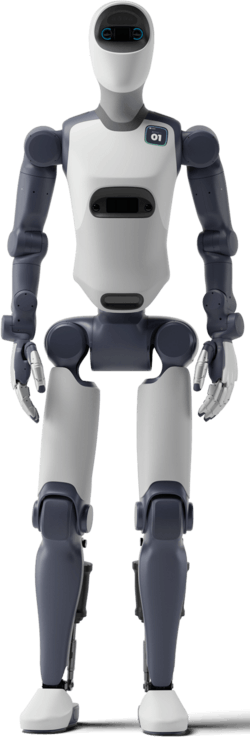
Agile One (stylized as Agile ONE) is an industrial humanoid robot developed by Agile Robots SE, a Munich-based robotics company originally spun off from the German Aerospace Center (DLR). Launched on November 19, 2025, the Agile ONE is designed for collaborative industrial work alongside human operators and existing robotic systems. It features 40 degrees of freedom, highly dexterous five-fingered hands with 21 articulation points each, and force-torque sensors integrated throughout every joint. The robot runs on a layered artificial intelligence architecture powered by Agile Robots' proprietary Robot Foundation Models, which are trained on one of Europe's largest real-world industrial datasets. Full manufacturing is scheduled to begin at the company's own facility in Bavaria in early 2026, marking what the company describes as Europe's largest humanoid production effort.[1][2] Co-founder and CEO Dr. Zhaopeng Chen has described the Agile ONE as a robot that "embodies this revolution" in physical AI.[21]
| Agile One | |
|---|---|
 | |
| General information | |
| Manufacturer | Agile Robots SE |
| Country of origin | Germany |
| Release year | 2025 (announced); 2026 (production) |
| Status | Production-ready prototype |
| Price | ~$100,000 USD (estimated) |
| Availability | Early 2026 (Bavarian factory) |
| Website | agile-robots.com |
Background and company history
Founding and DLR heritage
Agile Robots was founded in 2018 by Dr. Zhaopeng Chen and Peter Meusel, together with eight additional experts from the German Aerospace Center's Institute of Robotics and Mechatronics (DLR/RMC).[3] The DLR institute is widely recognized as the originator of the force-controlled lightweight robot (LWR) series, spanning four generations from LWR I through LWR IV. These robots pioneered concepts such as torque sensing in every joint, a 1:1 load-to-weight ratio, active vibration damping, and compliant control at both joint and Cartesian levels.[4]
Dr. Chen studied engineering in China before completing his doctorate at DLR, where he developed a widely recognized humanoid hand design. He served as deputy director of DLR's Modular Dexterous Robotics Laboratory, conducting research on smart, autonomous robots. Peter Meusel was a senior scientist at DLR with over 30 years of experience in the design of torque sensors and robots. Before founding Agile Robots, the two co-founded Wessling Robotics, an earlier venture drawing on DLR hand and sensor technology.[3][5]
Growth and corporate milestones
Since its founding, Agile Robots has experienced rapid growth, doubling its revenue annually and reaching approximately 200 million euros in 2024. The company employed more than 2,500 people from roughly 60 countries in 2025, a workforce that had grown to more than 3,200 across Germany, China, and India by mid-2026.[6][24] In November 2025, Agile Robots announced the acquisition of thyssenkrupp Automation Engineering, adding roughly 650 engineering experts across ten locations in Europe and North America and strengthening its mechanical engineering and supply chain capabilities.[25] Key milestones in the company's history include:
| Year | Milestone |
|---|---|
| 2018 | Company founded by DLR researchers in Munich |
| 2019 | Introduced Diana 7 collaborative robot; opened first Chinese production facility |
| 2020 | Achieved ISO 9001 quality management certification |
| 2021 | SoftBank Vision Fund 2 led Series C round ($220 million); company became the first robotics unicorn globally with a valuation exceeding $1 billion |
| 2022 | Opened German production facility in Kaufbeuren (2,700 m2) |
| 2023 | Acquired idealworks (BMW Group spin-off for autonomous mobile robots) and BAR Automation; acquired Franka Emika (renamed Franka Robotics GmbH) |
| 2024 | Converted legal entity from Agile Robots AG to Agile Robots SE (Societas Europaea) on March 22; established first Indian production site in Chennai |
| 2025 | Acquired audEERING (AI voice recognition specialist); acquired remaining shares in idealworks for full ownership; launched Agile ONE humanoid; announced acquisition of thyssenkrupp Automation Engineering (November 27; roughly 650 experts across ten locations); opened new global headquarters in Munich's Sendling district |
| 2026 | thyssenkrupp Automation Engineering acquisition closed (Q1); partnership with Google DeepMind announced (March); SoftBank reported in early talks to anchor an approximately $800 million round (June); Agile ONE production begins in Bavaria |
How much funding has Agile Robots raised?
Agile Robots has raised approximately $384 million in total funding. The company's Series C financing, completed in 2021, totaled $220 million and was led by SoftBank Vision Fund 2, making Agile Robots the first intelligent robotics company backed by SoftBank Vision Fund 2 in China and the first German robotics unicorn.[7] Other notable investors include Chimera Investments (under Abu Dhabi's Royal Group), GL Ventures, Sequoia China, Linear Capital, and strategic investors such as Xiaomi Group, Foxconn Industrial Internet, and Midas.[7][8]
In June 2026, Bloomberg reported that Agile Robots was in early talks to raise approximately $800 million (around 700 million euros), with SoftBank in discussions to contribute more than $300 million of the round. The financing would rank among the largest private rounds in European robotics and would deepen SoftBank's involvement following its lead role in the 2021 Series C. Both companies declined to comment, and the reports stressed that the talks were at an early stage, with the final size and terms still open to change.[23][24]
Global presence
Agile Robots operates from its global headquarters in Munich, with production and research facilities across multiple countries:
| Region | Locations |
|---|---|
| Germany | Munich (HQ), Kaufbeuren, Gemmingen |
| United States | Palo Alto |
| China | Beijing, Kunshan, Shenzhen, Zhengzhou, Changsha, Chongqing, Harbin |
| India | Bangalore, Chennai |
The company reports having installed over 20,000 robotics solutions worldwide as of early 2026.[9]
Agile Robots product ecosystem
The Agile ONE humanoid represents the latest addition to a broad product lineup that includes collaborative robot arms, dexterous hands, autonomous mobile robots, and an AI-powered software platform.
Diana 7
The Diana 7 is Agile Robots' flagship seven-axis collaborative robot arm, introduced in 2019. It features torque sensors in all seven axes with a force control accuracy of 0.5 N, a payload capacity of 7 kg, a reach of 923 mm, and repeatability of plus or minus 0.05 mm. The robot has found extensive use in the Chinese consumer electronics market for installing components in smartphones, tablets, and PCs. Diana 7 supports the Franka Control Interface (FCI) and is compatible with C++ and Python programming. It holds IP54 protection and complies with multiple safety standards including EN ISO 10218-1:2011.[10][11]
Thor series
The Thor series provides a range of industrial robot arms with payload options spanning 3 kg, 7 kg, 12 kg, and 20 kg, and reaches from 600 mm to 1,700 mm. The Thor 7 Pro variant includes advanced joint torque sensors for force-controlled operation. The series delivers linear speeds from 1.8 to 3 m/s and joint motion speeds up to 440 degrees per second.[12]
Franka Research 3 (FR3)
Following the 2023 acquisition of Franka Emika (which was renamed Franka Robotics GmbH), Agile Robots inherited the Franka Research 3 platform. The FR3 is a seven-axis force-sensitive robot arm with integrated torque sensors in all joints, a 3 kg payload, 855 mm reach, and a 1 kHz motion control loop. It is widely used in academic robotics research due to its open-source C++ interface (libfranka) and compatibility with ROS 2 and MATLAB/Simulink.[13]
Agile Hand
The Agile Hand is a standalone modular robotic hand that also serves as the basis for the hands used on the Agile ONE. It features five identical, modularly designed fingers with 21 joints and 15 to 16 degrees of freedom, weighing 1.5 kg. The hand provides 10 N of active fingertip force, joint velocities of 360 degrees per second, and a 1 kHz control rate via a proprietary communication protocol. Joint torque and position sensors are integrated in every actuated joint. It supports C++, Python, and ROS interfaces and uses a fast changer adapter conforming to ISO 9409-1-50-4-M6.[14]
idealworks AMRs
Through its acquisition of idealworks, a BMW Group subsidiary, Agile Robots added autonomous mobile robots (AMRs) to its portfolio. The idealworks iw.hub AMR and the AnyFleet fleet management platform have been deployed in over 600 units within BMW Group logistics operations. Agile Robots initially took a majority stake in 2023 and acquired full ownership in September 2025.[15]
AgileCore software platform
AgileCore is the company's AI-powered software platform that serves as the central integration hub for all Agile Robots hardware. It provides hardware abstraction across robots, cameras, grippers, AMRs, and PLCs through a single interface. The platform includes AgileAI, an AI assistant that leverages large language models (LLMs) and vision language models (VLMs) to enable natural-language robot programming. Users can instruct robots using conversational phrases rather than traditional code. AgileCore also incorporates process monitoring dashboards, a software development kit for custom skills, and self-optimization capabilities through continuous machine learning.[16]
Technical specifications of Agile ONE
Physical design
The Agile ONE stands 174 cm tall and weighs 69 kg, proportions chosen to approximate a human adult and facilitate work in environments designed for people. The robot uses an industrial-grade composite shell and features bipedal locomotion with a maximum walking speed of 2 m/s (7.2 km/h). It can carry payloads of up to 20 kg. Motors, actuators, and control systems were designed and engineered entirely in Germany.[1][2]
| Category | Specification | Details |
|---|---|---|
| Physical | Height | 174 cm |
| Physical | Weight | 69 kg |
| Physical | Build | Industrial-grade composite shell |
| Mobility | Total degrees of freedom | 40 |
| Mobility | Locomotion type | Bipedal walking |
| Mobility | Maximum walking speed | 2 m/s (7.2 km/h) |
| Manipulation | Payload capacity | 20 kg |
| Manipulation | Fingers per hand | 5 |
| Manipulation | Articulation points per hand | 21 |
| Manipulation | Active fingertip force | 10 N |
| Power | Estimated battery life | ~3 hours |
| Power | Actuator type | Electric motors |
| Sensors | LiDAR | 360-degree industrial-grade |
| Sensors | Cameras | Four head-mounted RGB cameras with fisheye capability |
| Sensors | Force/torque sensors | Integrated in every joint |
| Sensors | Tactile sensors | Fingertips and palms |
| Sensors | Proximity sensors | Yes |
| Sensors | IMU/gyroscope | Yes |
| Computing | Operating system | Linux/AgileCore |
| Connectivity | Interfaces | WiFi |
| Interface | Chest display | Real-time information display |
| Interface | Eye rings | Responsive indicators for human interaction |
| Interface | Voice | Speech recognition and vocal response |
Dexterous hands
The hands of the Agile ONE are among its most distinguishing features. Building on the Agile Hand platform, each hand incorporates five modular fingers with 21 articulation points, enabling both delicate manipulation (objects as small as individual screws) and firm grasping for heavier payloads. Fingertip force sensors, force-torque sensors in every joint, and tactile sensors in the palms provide comprehensive haptic feedback. This sensor density allows the robot to perform tasks requiring a high degree of precision, stability, and adaptability. The hand design traces its lineage directly to Dr. Zhaopeng Chen's doctoral work at DLR on humanoid hand mechanisms.[1][14]
Layered AI architecture
Rory Sexton, Agile Robots' Senior Vice President of Operations, summarized the design philosophy at launch: "This is our most advanced robotic body, but we also focus on the brain."[21] The Agile ONE uses a three-layer AI architecture, with each layer specialized for a different level of cognition and motor control. Agile Robots frames the top two layers as "slow thinking," which plans a task step by step, and "fast thinking," which handles dynamic actions such as grasping, sitting atop a low-level, high-frequency controller for fine manipulation:[1][2][21]
- Strategic reasoning and task planning ("slow thinking"): The highest layer handles long-horizon decision making, interpreting task instructions, sequencing multi-step workflows, and adapting plans when conditions change.
- Rapid response ("fast thinking"): The middle layer manages reactive behaviors, obstacle avoidance, and real-time adjustments to unexpected events in the workspace.
- Fine motor precision: The lowest layer handles detailed manipulation, controlling individual joint torques and finger movements for delicate assembly tasks.
This architecture is powered by Agile Robots' proprietary Robot Foundation Models, which are pre-trained on multimodal inputs including camera images, voice commands, and tactile measurements. The training data draws from three sources: real-world industrial data collected from production floors where Agile Robots has deployed its 20,000-plus robotic solutions, synthetic data generated through simulation, and human teleoperation data gathered at the company's dedicated data farms.[1][16]
Navigation and perception
The Agile ONE uses a 360-degree industrial-grade LiDAR system for environmental mapping and autonomous navigation, including automatic workstation recognition. Four head-mounted RGB cameras with fisheye capability provide wide-field visual perception for spatial awareness and obstacle detection. An integrated IMU and gyroscope support balance and orientation during bipedal locomotion.[2]
Human-robot interaction
The robot includes several features designed for intuitive collaboration with human workers. Responsive eye rings change color and pattern to confirm that the robot has understood instructions or detected a nearby person. Proximity sensors throughout the body enable the robot to detect human presence and adjust its behavior accordingly. A chest-mounted display shows real-time task status and operational information. Advanced speech recognition (enhanced by technology from the audEERING acquisition) allows voice-based interaction, and the robot can provide vocal responses.[1][17]
What is the Agile ONE used for?
Agile ONE is designed for deployment in industrial environments where it can work collaboratively alongside human operators and integrate with existing automation infrastructure including robot arms, AMRs, and AGVs. Target applications include:[1][2]
- Material gathering and transport: Moving raw materials, parts, and finished goods within factories and warehouses.
- Pick-and-place operations: Sorting, kitting, and placing components with precision using its dexterous hands.
- Machine tending: Loading and unloading CNC machines, injection molding equipment, and other production machinery.
- Tool use and fine manipulation: Performing tasks that require the use of hand tools or the assembly of small components.
- Logistics and warehousing: Sorting goods, managing inventory, and supporting fulfillment workflows.
Dr. Zhaopeng Chen has stated that Agile Robots envisions the Agile ONE not as a standalone unit, but as part of "an entire intelligent production system" where humanoids work cohesively within integrated workflows alongside the company's robot arms, AMRs, and AgileCore software.[1]
When will the Agile ONE enter production?
Full production of the Agile ONE is scheduled to begin in early 2026 at a new facility in Bavaria, Germany. Agile Robots has emphasized that the robot will be manufactured in-house, with all core components (motors, actuators, and control systems) designed in Germany. The company describes this as Europe's largest humanoid production effort and invests over 80 million euros annually in German research and development.[1][2]
The Bavarian manufacturing strategy represents a deliberate choice to keep production in Germany rather than outsourcing to lower-cost regions. This approach aligns with the company's positioning as a European industrial champion and leverages Germany's deep engineering tradition in precision manufacturing and automotive production.
Europe's AI factory and cloud infrastructure
On February 4, 2026, the Agile ONE robot symbolically launched Europe's first Industrial AI Cloud by pressing the activation button at an event in Munich. The Industrial AI Cloud is a joint project between Deutsche Telekom and NVIDIA, with an investment volume of approximately one billion euros. The cloud infrastructure, designed specifically for industrial artificial intelligence, provides a capacity of 10,000 GPUs. German Vice-Chancellor Lars Klingbeil was among those present at the launch event.[18]
Agile Robots is an anchor customer of the Industrial AI Cloud and plans to train its Robot Foundation Models on the new infrastructure. This partnership positions the company to benefit from dedicated European compute resources for its AI development rather than relying solely on cloud infrastructure from American or Asian providers.[18][19]
Google DeepMind partnership
In March 2026, Agile Robots announced a strategic research partnership with Google DeepMind. The collaboration involves integrating Google DeepMind's Gemini Robotics foundation models with Agile Robots' industrial hardware platform. The two companies plan to test, fine-tune, and deploy robots using Gemini models across sectors including electronics manufacturing, automotive, data centers, and logistics. Under this arrangement, edge computing handles real-time inference and safety-critical decisions, while cloud infrastructure provides long-term learning and model refinement capabilities.[9][20]
The partners describe the arrangement as a "scalable AI flywheel," in which, as they put it, "data from real-world operations will improve the models, and the models will then expand robotic capabilities, unlocking broader deployment."[22] Carolina Parada, Senior Director of Robotics at Google DeepMind, called the collaboration "an important step in bringing the impact of AI to the real world."[22] Chen said the "huge opportunity ahead lies in autonomous, intelligent production systems that can transform entire industries."[9]
How does the Agile ONE compare to other humanoid robots?
The Agile ONE enters a rapidly growing global market for humanoid robots, with competitors spanning North America, Asia, and Europe.
| Company | Robot | Headquarters | Notable features |
|---|---|---|---|
| Agile Robots SE | Agile ONE | Munich, Germany | 40 DOF, 21-DOF hands with force sensing, DLR heritage |
| Tesla | Optimus | Austin, USA | Vertically integrated with Tesla manufacturing; still in R&D phase as of Q1 2026 |
| Figure AI | Figure 02 | Sunnyvale, USA | OpenAI integration; deployed at BMW Spartanburg plant |
| Boston Dynamics | Atlas | Waltham, USA | Electric Atlas (2024); focus on commercial viability |
| Unitree | H1/H2 | Hangzhou, China | Low-cost humanoid platforms |
| Apptronik | Apollo | Austin, USA | Partnership with Mercedes-Benz |
| 1X Technologies | NEO | Moss, Norway | European competitor; focus on household and commercial |
The Agile ONE differentiates itself through several factors. Its DLR-derived force-sensing heritage gives it a strong foundation in torque-controlled manipulation, a capability that is especially important for industrial assembly tasks requiring precision. The integration with a mature product ecosystem (Diana 7, Thor series, FR3, Agile Hand, idealworks AMRs, and AgileCore software) means the robot can be deployed as part of a complete automation system rather than as an isolated platform. Agile Robots' existing base of over 20,000 deployed solutions provides a substantial real-world dataset for training foundation models, an advantage not available to companies entering the robotics market without a prior industrial footprint.[1][2]
As a European-headquartered company, Agile Robots is also positioned to benefit from growing interest in European technological sovereignty and industrial policy. The company's emphasis on German engineering, Bavarian manufacturing, and partnerships with European cloud infrastructure represents a strategic bet on the value of localized supply chains in an era of increasing geopolitical complexity.
See also
- Humanoid robot
- Humanoid robots
- Agile Robots SE
- Collaborative robot
- Force-torque sensor
- Physical Intelligence
- Embodied AI
References
- ^1 ^2 ^3 ^4 ^5 ^6 ^7 ^8 ^9 ^10"Agile Robots launches humanoid robot for industry: Agile ONE." Agile Robots SE, November 19, 2025.
- ^1 ^2 ^3 ^4 ^5 ^6 ^7"The next evolution in physical AI: Agile ONE." Agile Robots SE product page.
- ^1 ^2"About Agile Robots: How we transform industries." Agile Robots SE.
- ^"The DLR Lightweight Robot: Design and Control Concepts for Robots in Human Environments." ResearchGate.
- ^"Founder Spotlight: Zhaopeng Chen is Building Smarter, More Agile Robots." HSG Capital.
- ^"Smart Robotics 'Made in Bavaria': Agile Robots opens global headquarters in Munich." Agile Robots SE, June 2025.
- ^1 ^2"AGILE ROBOTS announces the completion of Series C financing led by SoftBank Vision Fund 2." PR Newswire, September 2021.
- ^"SoftBank-backed robotics unicorn Agile Robots receives EUR 27.9M funding from Foxconn Industrial Internet." Silicon Canals.
- ^1 ^2 ^3"Agile Robots becomes the latest robotics company to partner with Google DeepMind." TechCrunch, March 24, 2026.
- ^"Diana 7: the dexterous robot." Agile Robots SE product page.
- ^"Now compatible with FCI: Franka Robotics integrates Diana 7 from Agile Robots into its ecosystem." PR Newswire, 2025.
- ^"Thor series." Agile Robots SE product page.
- ^"Franka Research 3." Franka Robotics (Agile Robots).
- ^1 ^2"Agile Hand: the human-like robotic hand." Agile Robots SE product page.
- ^"Agile Robots completes acquisition of BMW Group spin-off idealworks." Agile Robots SE, September 2025.
- ^1 ^2"AgileCore: the AI-powered software platform." Agile Robots SE product page.
- ^"audEERING, leading specialist for AI supported audio analysis, joins Agile Robots." Agile Robots SE, March 2025.
- ^1 ^2"Agile ONE powers up Europe's largest AI factory." Agile Robots SE, February 2026.
- ^"Agile Robots is an anchor-customer for Europe's first Industrial AI Cloud." Agile Robots SE.
- ^"Agile Robots and Google DeepMind partner to bring intelligence to robotics." Agile Robots SE, March 2026.
- ^1 ^2 ^3"Agile Robots launches Agile ONE industrial humanoid." The Robot Report, November 19, 2025.
- ^1 ^2"Agile Robots to deploy Google DeepMind foundation models on its humanoid." The Robot Report, March 2026.
- ^"SoftBank in Early Talks to Back $800 Million Agile Robots Round." Bloomberg, June 2, 2026.
- ^1 ^2"SoftBank in talks to back Agile Robots' $800m round, reports say." Sifted, June 2026.
- ^"Agile Robots: Acquisition and Humanoid Drive Next Growth Spurt." Munich Startup, November 2025.
Improve this article
Add missing citations, update stale details, or suggest a clearer explanation. Every suggestion is reviewed for sourcing before it goes live.
8 revisions · v8 · 3,503 words · full history
Fact-checks are independent of edits: a reviewer re-verifies the article against its sources and stamps the date. How we verify
Research and drafting on this wiki are AI-assisted, under named human editorial standards. How AI is used here
Cite this page: AI Wiki. "Agile One." aiwiki.ai, updated 7 Jul 2026. CC BY 4.0. https://aiwiki.ai/wiki/agile_robots_se_agile_one