

Cold start (recommender systems)
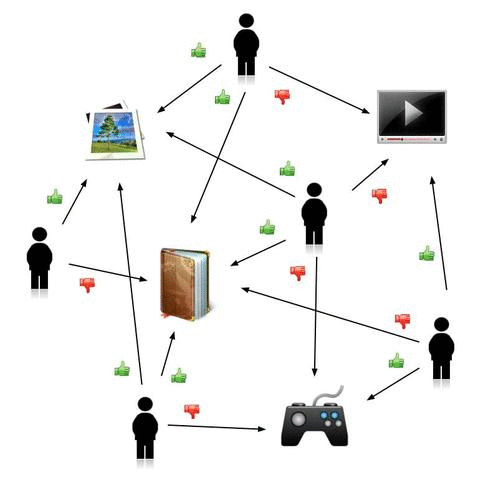
The cold start problem in recommender systems is the difficulty of making useful recommendations for users, items or whole services about which the system has little or no interaction data. A new subscriber has no viewing history, a product added to a catalogue this morning has no clicks or ratings, and a newly launched service has neither. Methods that learn only from past interactions, above all collaborative filtering, have nothing to work with in these cases, so practical systems combine them with content features, explicit preference questions, exploration, transfer from other data, and, more recently, large language models.[1][3] A 2025 survey of the field calls cold-start recommendation one of the long-standing challenges of recommender systems, made more pressing by the volume of new users and items that internet platforms add every day.[3]
Definition
Schein, Popescul, Ungar and Pennock, whose SIGIR 2002 paper "Methods and Metrics for Cold-Start Recommendations" was an early study devoted to the problem, defined the problem as the need to recommend items "that no one in the community has yet rated".[1] In a footnote they noted that the phrase had also been used for a business that knows almost nothing about its customers' preferences, for instance a start-up with little purchase history, and that recommending to new users can be treated as a cold-start problem as well.[1] Later work generally separates three cases.[1][3]
| Case | What is missing | Typical example |
|---|---|---|
| New user (user cold start) | The user's interaction history | A visitor who has just signed up or is not logged in |
| New item (item cold start) | Interactions with the item | A newly uploaded video, a new product, a new advertisement |
| New system (system cold start) | Interactions for most users and items | A platform or recommendation feature at launch |
The survey by Zhang, Bei and colleagues (arXiv, January 2025) proposes a finer split into nine tasks in four groups.[3] "Long-tail" covers users and items with fewer than some threshold $k$ of interactions; "normal" cold start covers new users, new items or both with fewer than $k$ interactions; "strict" cold start covers users or items that appear with no interactions at all; and "system" cold start covers zero-shot settings, with no collaborative information from other users and items, and few-shot settings, where only patterns learned from a small set of users are available.[3] The authors note that papers draw the line between warm and cold entities in different ways, by interaction count, by the date a user or item first appears, or by random sampling.[3]
Why interaction-based models fail
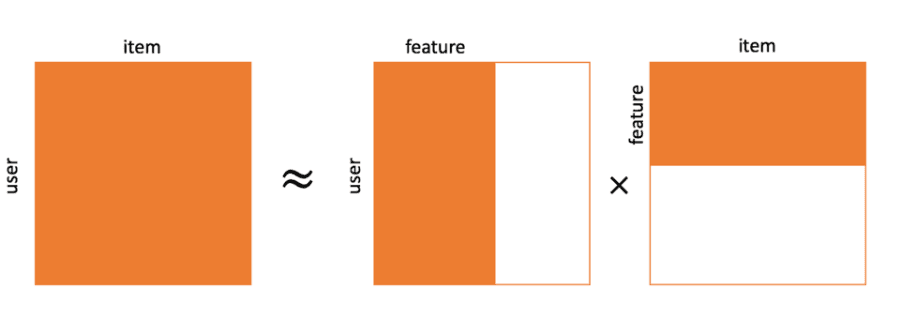
In matrix factorization, the standard collaborative model, a user's predicted preference for an item is the dot product of a learned user vector and a learned item vector (rows of the user matrix and item matrix):
where $\mathbf{p}_u$ and $\mathbf{q}_i$ are $d$-dimensional latent vectors fitted to observed interactions. A user or item that appears in no training interaction has no data from which to estimate its vector, and one with very few interactions gets a poorly estimated one. Kula summarised the consequence in 2015: the standard factorization model performs poorly in cold-start settings because latent factors are hard to estimate when interaction data are sparse.[4] Schein and colleagues made the same point for pure collaborative filtering in 2002, which cannot help with a new item because no preference information about it exists.[1]
Pure content-based methods, which describe items by their metadata, can score a new item immediately, but they have their own gap. Because each user's model is fitted only on that user's history, Kula notes, they do not benefit from other users' data, perform worse than factorization where collaborative data exist, and need a lot of data per user, which makes them unsuitable for user cold start.[4] Many cold-start methods are therefore hybrids that try to keep the accuracy of collaborative signals for warm users and items while falling back on other information for cold ones.[3][4]
History
- 2002, new items. Schein, Popescul, Ungar (University of Pennsylvania) and Pennock (NEC Research Institute) proposed a probabilistic "aspect model" that combined collaborative and content data, using the actors in each film as content. A new film was placed in the model's latent space from its cast, using Hofmann's "folding-in" procedure, which let the model score movies nobody had rated.[1] They tested it on MovieLens ratings joined with actor data from the Internet Movie Database and compared it with a naive Bayes classifier.[1] Fitting used expectation maximization.[1]
- 2002, new users. Rashid and colleagues studied how a collaborative filtering system should choose which items to ask a new user to rate. They compared six strategies, among them choosing items that add the most information, choosing items the user is likely to have an opinion about, and balancing the two, in offline experiments on an existing dataset and in a live study with more than 300 users. The choice of strategy made a large difference both to the effort users had to spend and to the accuracy of the resulting predictions.[2]
- 2010, exploration. Li, Chu, Langford and Schapire framed personalized news recommendation at Yahoo! as a contextual bandit problem, motivated in part by pools of news content that change too quickly for traditional collaborative filtering and by visitors with no consumption history.[15]
- 2013-2019, deep and meta-learned models. Deep networks were used to predict collaborative latent factors from content (for music audio in 2013), to train models that tolerate missing preference data (DropoutNet, 2017), and to cast cold start as a meta-learning problem (Twitter's work in 2017, MeLU in 2019).[9][10][12][13]
- 2023 onward, language models. Research turned to large language models, both as recommenders in their own right and as sources of knowledge about cold users and items.[3][16]
Approaches
Non-personalized fallbacks and onboarding
Two common first responses to a new user are to show popular items and to ask a few questions, and both appear in the onboarding flows that large services describe. Netflix's help pages say that when a member signs up or adds a profile they can choose some titles they like to start their recommendations; members who skip this step start with a varied set of popular titles, and their own viewing then takes precedence over the initial choices.[7] TikTok described a similar flow in 2020: new users are invited to pick categories of interest such as pets or travel, users who skip this get a generalized feed of popular videos, and the first likes, comments and replays trigger an early round of personalized recommendations.[8]
Which items to ask about is itself a research question. Rashid and colleagues found that the item-selection strategy changes both how much effort onboarding demands and how accurate the first recommendations are.[2] MeLU (Lee and colleagues, KDD 2019) combined a meta-learned preference model with a strategy for choosing "evidence candidates", the items a new user is shown at the start, so that they distinguish between users' tastes.[13]
Content and side information
A common fix for new items is to represent them by their content features, which are known in advance, rather than only by what users have done with them.[3][4] Schein's 2002 model used cast lists.[1] Van den Oord, Dieleman and Schrauwen (NIPS 2013) predicted the latent factors of songs from their audio when usage data were missing, comparing a bag-of-words audio representation with deep convolutional neural networks on the Million Song Dataset; the convolutional networks clearly did better.[9]
Kula's LightFM model (CBRecSys workshop, 2015), developed at the online fashion company Lyst, represents each user and item as the sum of the embeddings of its features, so a new item's representation exists as soon as its metadata do:[4]
where $f_u$ and $f_i$ are the sets of features describing user $u$ and item $i$, and $\mathbf{e}^U_j$, $\mathbf{e}^I_j$ are learned feature embeddings. Kula reported that the model beat both collaborative and content-based baselines in cold-start and sparse settings and performed at least as well as pure matrix factorization when interaction data were plentiful.[4] He explained that Lyst aggregated over 8 million fashion items, added tens of thousands of new products each day, and saw a large share of first-time visitors, a combination of user and item cold start.[4] Kula's paper also describes a related model by Saveski and Mantrach (2014), which factorizes the user-item matrix and the item-feature matrix jointly with a shared item factor matrix.[4]
User-side features play the same role for new users. The 2016 paper describing YouTube's deep recommendation system says demographic features give priors so that recommendations behave reasonably for new users; the model's inputs include the user's geographic region, device, gender, logged-in state and age.[6] Netflix says its system does not use demographic information such as age or gender, relying instead on viewing behavior, ratings, similar members' tastes, title information and context such as time of day, language and device.[7]
Training for missing interaction data
Earlier hybrid models typically added content-based terms to the training objective. DropoutNet (Volkovs, Yu and Poutanen, NIPS 2017) instead changes the optimization and trains the network explicitly for cold start: during training it randomly sets the preference inputs of user-item pairs to zero, so the network learns to score from content alone while keeping the accuracy of the underlying latent model when preference data are present.[10][3] It can be added on top of an existing latent model.[10] The 2025 survey places it in a "robust co-training" family that also includes Heater, which randomly feeds in either pre-trained collaborative representations or content-derived ones during training, and MTPR, which trains each item with a second representation whose collaborative embedding is replaced by a zero vector.[3] CLCRec (Wei and colleagues, ACM Multimedia 2021) recasts cold-item representation learning in information-theoretic terms and uses a contrastive learning objective to keep collaborative signal in the content-based representations of both warm and cold items.[11]
Meta-learning
Meta-learning methods pretrain on many users' or items' histories, simulating few-shot cases during training, so that the model can adapt quickly to a new user or item from a handful of interactions; this suits the normal cold-start setting.[3]
| Method | Year and venue | Cold side | Idea |
|---|---|---|---|
| Vartak et al. (Twitter) | 2017, NIPS | Items (Tweets) | Two architectures: a linear classifier whose weights depend on an item's history, and a network whose biases are adjusted; both beat a factorization baseline on Twitter production data[12] |
| MeLU | 2019, KDD | Users | Meta-learned user preference estimator plus selection of evidence candidates; at least 5.92% lower mean absolute error than two comparison models on two benchmarks[13] |
| Meta-Embedding | 2019, SIGIR | Ads | Gradient-based meta-learning of a generator that produces an initial ID embedding for a new ad from its content and attributes, improving both the cold-start and the warm-up phase for six click-through-rate models[14] |
The 2025 survey describes MeLU as one of the foundational works, applying model-agnostic meta-learning (MAML) to estimate a user's preferences from a small number of observed items.[3] Meta-Embedding addresses a common industrial setting: embeddings of advertisement IDs improve click-through rate (CTR) prediction but are data-hungry and work poorly for new ads with little logged data.[14]
Exploration and bandits
A system can also learn about new users and items by showing them content and observing the response, which raises the exploration-exploitation trade-off studied in the multi-armed bandit literature.[15] Li and colleagues' LinUCB algorithm (WWW 2010) chooses, for each visit, the article $a$ that maximises an upper confidence bound on its expected click rate given a feature vector $\mathbf{x}_{t,a}$ for the user and article:[15]
where $\hat{\boldsymbol\theta}_a$ is a ridge-regression estimate fitted to past clicks, $\mathbf{A}_a = \mathbf{D}_a^\top \mathbf{D}_a + \mathbf{I}_d$ is built from the article's past context vectors $\mathbf{D}_a$, and $\alpha$ sets how much weight goes to uncertainty.[15] On a Yahoo! Front Page Today Module dataset of over 33 million events, it gave a 12.5% click lift over a standard context-free bandit, and the advantage grew when data were scarcer.[15] The 2025 survey groups bandit and reinforcement learning methods for cold users and items under "cold exploration", including work that frames user cold start as a multi-armed bandit grounded in active learning principles.[3]
The YouTube paper gives a related practical point: training examples were drawn from all YouTube watches, not only watches of recommended videos, because otherwise new content would struggle to surface and the system would be biased towards exploitation.[6]
Cross-domain transfer
When a user or item is cold in one domain but known in another, knowledge can be transferred. The 2025 survey sorts cross-domain cold-start methods into three classes: domain knowledge transfer (for example, mapping embeddings from a warm source domain to a cold target domain), domain distribution alignment, and domain-invariant representation learning.[3] It also covers graph-based methods that add social, attribute or knowledge graph relations to the user-item interaction graph.[3] Related techniques appear under transfer learning and graph neural networks.
Large language models
Language models bring world knowledge from pre-training and can take preferences stated in words.[3][16] Sanner, Balog, Radlinski, Wedin and Dixon (RecSys 2023) collected a dataset of item-based and language-based preferences and found that prompted LLMs gave recommendation performance competitive with item-based collaborative filtering in the near cold-start case when users described their preferences only in language, with no task-specific training (zero-shot) or only a few labels (few-shot).[16]
The 2025 survey distinguishes two roles.[3] As the recommender, an LLM is prompted or fine-tuned (for example with LoRA in TALLRec and its follow-ups) to recommend directly. As a knowledge enhancer, it improves the representations used by a conventional model: generating richer user and item representations from text, adding relations to knowledge graphs, or simulating interactions between users and cold items so that cold items can be trained alongside warm ones, as in ColdLLM.[3] Generative retrieval with "Semantic IDs", introduced by Rajput and colleagues (NeurIPS 2023), represents each item by a semantically meaningful tuple of codewords and trains a Transformer to predict the Semantic ID of the next item; the authors reported improved retrieval for items with no prior interaction history.[17]
The same survey warns that cold-start methods are mostly developed in offline setups and that LLM-based ones carry training and inference costs that make real-time, industrial-scale deployment difficult; it suggests hybrid designs in which an LLM handles high-level planning while a conventional model makes low-latency item recommendations.[3]
Continuous cold start
Bernardi, Kamps, Kiseleva and Müller (Booking.com, University of Amsterdam and Eindhoven University of Technology, 2015) argued that many e-commerce sites face a recurring version of the problem, which they called continuous cold start (CoCoS).[5] Most cold-start methods bridge the period until a user or item becomes warm and assume it then stays warm, but on a travel site many users book only once or twice a year, so they remain cold for a long time.[5] The paper lists four user-side causes: genuinely new or rare users, interests that change over time, different "personas" (for example business and leisure trips), and failure to match the same user across devices or sessions; items can show similar effects.[5]
Evaluation
Cold-start methods are hard to compare.[3] Schein and colleagues argued in 2002 that results depend on which real-world task a test simulates, and distinguished three modes for their data: predicting whether a user will rate (or buy) an item, predicting whether a user will both rate an item and rate it highly, and imputing the rating of an item the user is known to have seen.[1] They introduced the customer ROC (CROC) curve, which measures performance when the system must recommend the same number of items to every user, and recommended simple "heuristic recommenders" as baselines, which sometimes outperformed more sophisticated methods.[1]
As of the 2025 survey, evaluation remained inconsistent: papers rarely share datasets, only some use datasets with real cold users or items from industrial platforms, cold users and items are defined by different rules (time ranges, interaction counts or random selection), and the general-purpose open-source frameworks RecBole, Elliot and BARS are not designed for cold-start evaluation.[3]
Related issues
Popularity bias. Fleder and Hosanagar (Management Science, 2009) showed analytically and in simulation that common recommenders such as collaborative filters, which rely on sales and ratings, cannot recommend products with limited historical data even if they would be rated favourably; this can produce a rich-get-richer effect for popular products and reduce aggregate sales diversity.[18]
Freshness. The 2016 YouTube paper describes recommending recently uploaded videos as extremely important for the product and notes that models trained on past data tend to be biased towards the past; its fix is to add the age of each training example as a feature and set it to zero or slightly negative at serving time; for an example video, the paper shows that a model with this feature follows the video's upload time and time-dependent popularity, where a model without it predicts roughly the average over the training window.[6]
Privacy. Cold-start methods rely on information beyond interactions, such as profile attributes and data from other domains. The 2025 survey lists dependence on sensitive side information and privacy across domains as open problems, and points to differential privacy, homomorphic encryption and federated learning as possible mitigations.[3]
Continue reading
- Collaborative filteringCollaborative filtering (CF) is a family of techniques used in recommendation systems that predicts a user's preferences by collecting and analyzing preference signals from many other users.Mentioned 5 times above
- Recommender SystemA recommender system (also called a recommendation system or recommendation engine) is an information filtering system that predicts the preference a user would give to an item and uses those predictions to…Mentioned twice above
- Matrix factorizationMatrix factorization is a family of mathematical techniques that decompose a matrix into a product of two or more smaller matrices.Mentioned twice above
- Two-Tower ModelThe two-tower model, also known as the dual encoder, bi-encoder, or Siamese network for retrieval, is a neural network architecture that encodes a query and a candidate item with two separate sub-networks…Listed in See also
- Few-Shot LearningFew-shot learning is a branch of machine learning in which a model learns to recognize new classes or perform new tasks from only a very small number of labeled examples, typically one to five per class.Listed in See also
- Candidate GenerationCandidate generation is the first stage in a multi-stage recommendation system or information retrieval pipeline.Listed in See also
More to read
References
- ^1 ^2 ^3 ^4 ^5 ^6 ^7 ^8 ^9 ^10 ^11Andrew I. Schein, Alexandrin Popescul, Lyle H. Ungar, David M. Pennock. "Methods and Metrics for Cold-Start Recommendations". Proceedings of the 25th Annual International ACM SIGIR Conference on Research and Development in Information Retrieval (SIGIR 2002), pp. 253-260, August 2002. doi.org/...564376.564421
- ^1 ^2Al Mamunur Rashid, Istvan Albert, Dan Cosley, Shyong K. Lam, Sean M. McNee, Joseph A. Konstan, John Riedl. "Getting to know you: Learning new user preferences in recommender systems". 2002 International Conference on Intelligent User Interfaces (IUI 02), pp. 127-134, 2002. experts.umn.edu/...ser-preferences-in-recommender-
- ^1 ^2 ^3 ^4 ^5 ^6 ^7 ^8 ^9 ^10 ^11 ^12 ^13 ^14 ^15 ^16 ^17 ^18 ^19 ^20 ^21 ^22 ^23Weizhi Zhang, Yuanchen Bei, Liangwei Yang, et al. "Cold-Start Recommendation towards the Era of Large Language Models (LLMs): A Comprehensive Survey and Roadmap". arXiv:2501.01945, January 2025. arxiv.org/...2501.01945
- ^1 ^2 ^3 ^4 ^5 ^6 ^7 ^8Maciej Kula. "Metadata Embeddings for User and Item Cold-start Recommendations". CBRecSys 2015 workshop, Vienna; arXiv:1507.08439, July 2015. arxiv.org/...1507.08439
- ^1 ^2 ^3Lucas Bernardi, Jaap Kamps, Julia Kiseleva, Melanie J. I. Müller. "The Continuous Cold Start Problem in e-Commerce Recommender Systems". 2nd Workshop on New Trends in Content-Based Recommender Systems, RecSys 2015; arXiv:1508.01177, August 2015. arxiv.org/...1508.01177
- ^1 ^2 ^3Paul Covington, Jay Adams, Emre Sargin. "Deep Neural Networks for YouTube Recommendations". RecSys '16, Boston, September 2016. static.googleusercontent.com/...45530.pdf
- ^1 ^2Netflix Help Center. "How Netflix's Recommendations System Works". Netflix, accessed November 2026. help.netflix.com/...100639
- ^TikTok. "How TikTok recommends videos #ForYou". TikTok Newsroom, June 18, 2020. newsroom.tiktok.com/...k-recommends-videos-for-you
- ^1 ^2Aaron van den Oord, Sander Dieleman, Benjamin Schrauwen. "Deep content-based music recommendation". Advances in Neural Information Processing Systems 26 (NIPS 2013), 2013. papers.nips.cc/...e1238a2f37603d90b58898d-Abstract
- ^1 ^2 ^3Maksims Volkovs, Guangwei Yu, Tomi Poutanen. "DropoutNet: Addressing Cold Start in Recommender Systems". Advances in Neural Information Processing Systems 30 (NIPS 2017), 2017. papers.nips.cc/...d0df8f385bdac3e9f8be207-Abstract
- ^Yinwei Wei, Xiang Wang, Qi Li, Liqiang Nie, Yan Li, Xuanping Li, Tat-Seng Chua. "Contrastive Learning for Cold-Start Recommendation". ACM Multimedia 2021; arXiv:2107.05315, July 2021. arxiv.org/...2107.05315
- ^1 ^2Manasi Vartak, Arvind Thiagarajan, Conrado Miranda, Jeshua Bratman, Hugo Larochelle. "A Meta-Learning Perspective on Cold-Start Recommendations for Items". Advances in Neural Information Processing Systems 30 (NIPS 2017), 2017. papers.nips.cc/...9953c6311757004d8cbbba9-Abstract
- ^1 ^2 ^3Hoyeop Lee, Jinbae Im, Seongwon Jang, Hyunsouk Cho, Sehee Chung. "MeLU: Meta-Learned User Preference Estimator for Cold-Start Recommendation". Proceedings of the 25th ACM SIGKDD International Conference on Knowledge Discovery and Data Mining (KDD 2019); arXiv:1908.00413, July 2019. arxiv.org/...1908.00413
- ^1 ^2Feiyang Pan, Shuokai Li, Xiang Ao, Pingzhong Tang, Qing He. "Warm Up Cold-start Advertisements: Improving CTR Predictions via Learning to Learn ID Embeddings". SIGIR 2019; arXiv:1904.11547, April 2019. arxiv.org/...1904.11547
- ^1 ^2 ^3 ^4 ^5Lihong Li, Wei Chu, John Langford, Robert E. Schapire. "A Contextual-Bandit Approach to Personalized News Article Recommendation". Nineteenth International Conference on World Wide Web (WWW 2010), Raleigh, NC; arXiv:1003.0146. arxiv.org/...1003.0146
- ^1 ^2 ^3Scott Sanner, Krisztian Balog, Filip Radlinski, Ben Wedin, Lucas Dixon. "Large Language Models are Competitive Near Cold-start Recommenders for Language- and Item-based Preferences". RecSys 2023; arXiv:2307.14225, July 2023. arxiv.org/...2307.14225
- ^Shashank Rajput, Nikhil Mehta, Anima Singh, et al. "Recommender Systems with Generative Retrieval". NeurIPS 2023; arXiv:2305.05065, May 2023. arxiv.org/...2305.05065
- ^Daniel M. Fleder, Kartik Hosanagar. "Blockbuster Culture's Next Rise or Fall: The Impact of Recommender Systems on Sales Diversity". Management Science 55(5), pp. 697-712, May 2009. repository.upenn.edu/...42056
Improve this article
Add missing citations, update stale details, or write a clearer explanation. Anyone can edit: changes go live when you publish, and every edit is checked by an editor.
2 revisions · v2 · 3,450 words · full history
Fact-checks are independent of edits: a reviewer re-verifies the article against its sources and stamps the date. How we verify
Research and drafting on this wiki are AI-assisted, under named human editorial standards. How AI is used here
Reviewer note: Independent fact-check before publication on November 18, 2026: 72 claims checked against 18 cited and independent sources; 1 material and 4 minor corrections applied before publication.
Cite this page: AI Wiki. "Cold start (recommender systems)." aiwiki.ai, updated 18 Nov 2026, fact-checked 18 Nov 2026. CC BY 4.0. https://aiwiki.ai/wiki/cold_start