

DARwIn-OP
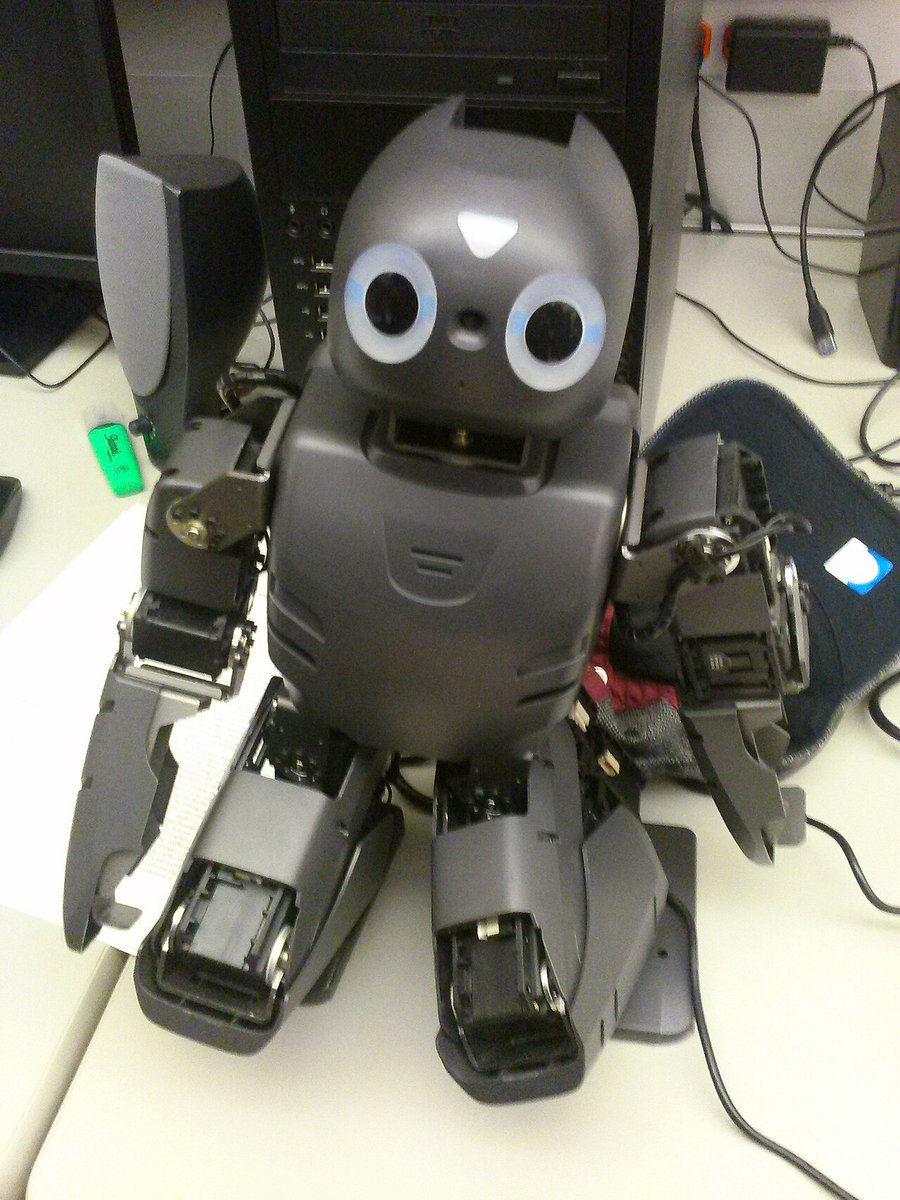
DARwIn-OP (Dynamic Anthropomorphic Robot with Intelligence, Open Platform), later sold as ROBOTIS OP, is a kid-size humanoid robot about 45.5 cm tall with 20 degrees of freedom, developed by Dennis Hong's Robotics and Mechanisms Laboratory (RoMeLa) at Virginia Tech together with the University of Pennsylvania, Purdue University and the South Korean company ROBOTIS, with funding from the US National Science Foundation (NSF).[1][3][6] It was shown publicly at the IEEE Humanoids 2010 conference in Nashville in December 2010, and its designers published its software, circuit diagrams and mechanical CAD files so that research groups could build, repair and modify the robot themselves or buy it assembled from ROBOTIS.[1][6][7] Team DARwIn, a joint Virginia Tech and University of Pennsylvania team, won the KidSize division of the RoboCup Humanoid League with DARwIn-OP robots in 2011 and 2012, and a Penn-only Team DARwIn won again in 2013.[8][9][11][12][13][15] ROBOTIS continued the line with the ROBOTIS OP2 and ROBOTIS OP3; the OP3 is the robot Google DeepMind used to train soccer-playing agents with deep reinforcement learning.[18][19][27]
History
The DARwIn series
Hong started project DARwIn at Virginia Tech in 2003 to study human locomotion and humanoid robot design, and the first robot in the series, DARwIn 1, was introduced in 2004.[8][9] Team DARwIn's RoboCup team description papers picture the family as DARwIn I through DARwIn IV followed by DARwIn-OP, and state that the DARwIn platform was the base of Virginia Tech's first entry into the RoboCup humanoid division in 2007.[14] The same papers describe the DARwIn family as the first US entry in that division.[14]
NSF funding
In February 2010 the NSF's Division of Computer and Network Systems made collaborative awards titled "CI-ADDO-NEW: Collaborative Research: Development of DARwIn Humanoid Robots for Research, Education and Outreach" to Virginia Tech and Purdue, both starting on 1 March 2010.[3][4] The Virginia Tech award, led by Hong, had an intended total of $600,000; the Purdue award, led by Cheng-Kok Koh with Yung-Hsiang Lu, had an intended total of $400,000.[3][4] After Hong moved from Virginia Tech to UCLA, a $125,114 award under the same title began at UCLA in May 2015.[5] Make magazine later put the NSF support for DARwIn-OP at $1.2 million.[24]
The award abstract set out a plan to build two models, a high-performance DARwIn-HP and a low-cost DARwIn-LC, for 11 partner universities, including research universities, a women's college and two local high schools, and to grow a humanoid-robotics community through workshops, a website and public demonstrations.[3] The robot that came out of this work as a commercial product was DARwIn-OP, built and sold by ROBOTIS, while a DARwIn-HP design was still being refined in 2014.[5][6]
Unveiling and commercial release
IEEE Spectrum reported on 9 December 2010 that Hong was demonstrating DARwIn-OP at that week's IEEE Humanoids 2010 conference in Nashville, describing it as designed by RoMeLa with the University of Pennsylvania's GRASP Lab, Purdue and ROBOTIS, with both hardware and software open source.[6] Popular Science reported that about 10 units were shown at the conference and would then go to the partner universities.[7] Spectrum first gave a price of around $8,000 for an assembled robot and then updated it: ROBOTIS announced a list price of $12,000 and an educational price of $9,600.[6]
ROBOTIS opened a SourceForge project for the software, named "ROBOTIS-OP (a.k.a. DARWIN-OP) project", on 17 November 2010.[20] The release history in the ROBOTIS e-Manual starts with framework version 1.0.0 on 1 February 2011 and runs to version 1.6.0 on 11 April 2013.[16] Hong and his co-authors described the design formally at the SICE Annual Conference in Tokyo in September 2011, and a longer version appeared in the journal Advanced Robotics in February 2013.[1][2] By June 2012 Hong said about 400 units were in use around the world for research and education.[9]
The robot was later marketed under the ROBOTIS name. ROBOTIS documentation calls it "ROBOTIS OP" and notes that it is also known as DARwIn-OP, and the SourceForge project carries both names.[17][18][20]
Design
Design goals
The 2011 SICE paper argued that many research groups spend time building their own humanoid when what they need is a common platform, and it set five requirements for such a platform: an expandable and modifiable structure, high performance, simple maintenance, a familiar development environment and an affordable price.[1] The authors' answer was a "network based modular structure" combined with a standard PC architecture.[1] Every device on the robot, including actuators, sensors, LEDs, buttons and external I/O, hangs off a serial bus that uses the DYNAMIXEL protocol and connects to a sub-controller; the sub-controller talks to the main computer over USB, so the main computer sees the whole robot as USB devices and can be programmed like an ordinary PC.[1]
Mechanics and actuators
DARwIn-OP has 20 joints: six in each leg, three in each arm and two in the neck for camera pan and tilt.[1][22] The frames are hollow, which keeps the weight down and leaves room for extra sensors and wiring, and the center of mass sits in the middle of the pelvis.[1] Optional frames let users fit grippers.[1] Ohio University's kinematic analysis of the robot describes each leg as a three-axis hip, a one-axis knee and a two-axis ankle, and each arm as a two-axis shoulder and a one-axis elbow.[22]
Each joint is driven by a DYNAMIXEL MX-28 servo motor, which the SICE paper says was designed for DARwIn-OP as an improvement on the older RX-28.[1] The RX-28 measured position with a contact potentiometer that wears out over time; the MX-28 uses a contactless magnetic encoder with 12-bit resolution (0.072 degrees) over a full 360 degrees and lets the user adjust its PID gains in real time.[1] The e-Manual lists a stall torque of 24 kgf·cm at 12 V and a 193:1 reduction ratio.[16] The Team DARwIn team description papers for 2012 and 2013 name the joint motors "Dynamixel RX-28M", the actuator's earlier model name: the ROBOTIS framework release notes record the change of model name from RX-28M to MX-28 in version 1.2.0 of June 2011.[14][15][16]
Electronics and sensing
The main computer uses an Intel Atom Z530 processor at 1.6 GHz, the kind of chip then used in netbooks, with 1 GB of DDR2 memory and about 4 GB of flash storage.[1][16] Team DARwIn's 2012 description identifies the computer as a fit-PC2i that draws 8 W at full CPU load.[14] The sub-controller, the CM-730, is built around an STM32F103RE ARM Cortex-M3 at 72 MHz and carries the 3-axis gyroscope and 3-axis accelerometer used for balance and posture estimation.[1][16]
The head holds a USB camera and microphones, and the eyes and forehead carry programmable RGB LEDs.[1] The SICE paper argued that one high-definition USB camera was enough for the basic configuration and that the USB interface let users add other cameras, including a second one for stereo vision.[1] Optional force-sensing resistor modules put four sensors under each foot to measure ground reaction forces; they share the actuators' daisy-chained power and data line.[1] An 11.1 V, 1,000 mAh lithium polymer pack powers the robot, which Team DARwIn put at about 30 minutes of run time.[14][16]
| Specification | DARwIn-OP (ROBOTIS OP) |
|---|---|
| Height | 454.5 mm |
| Weight | 2.9 kg (2.8 kg in the 2011 paper) |
| Degrees of freedom | 20 (legs 2 x 6, arms 2 x 3, head 2) |
| Actuators | DYNAMIXEL MX-28 (24 kgf·cm stall torque at 12 V) |
| Main computer | Intel Atom Z530, 1.6 GHz; 1 GB DDR2 |
| Storage | 3.6 GB NAND flash SSD (listed as 4 GB in the 2011 paper) |
| Sub-controller | CM-730, STM32F103RE ARM Cortex-M3, 72 MHz |
| Inertial sensors | 3-axis gyroscope, 3-axis accelerometer |
| Camera | Logitech C905 (2 MP native, USB 2.0) |
| Optional sensors | 4 force-sensing resistors per foot |
| Battery | 11.1 V, 1,000 mAh LiPo |
Sources: ROBOTIS e-Manual and the 2011 SICE paper.[1][16]
Software
The original control software, which the designers called the open-DARwIn SDK, is a C++ framework split into modules for device communication, motion, walking, sensing, behavior, vision and diagnostics.[1] The authors wrote it to be independent of the operating system so it could be ported to other systems, naming the Robot Operating System (ROS) as one target, and the robot shipped running Linux.[1][16] In the demonstration program described in the paper, the motion loop ran every 8 ms and the vision loop every 30 ms, with color-based ball tracking, a gait generator and a walk stabilizer.[1]
ROBOTIS distributed the framework source through SourceForge and supplied tools for building and tuning motions, including an Action Editor, a Walking Tuner, an Offset Tuner, a DYNAMIXEL monitor and a firmware installer; the e-Manual also documents support for the Webots simulator, with controllers cross-compiled to run on the robot.[16] Not everything was open: the e-Manual states that the firmware of the MX-28 actuators and of the foot sensors is not open-source software.[16] Out of the box, the robot offers demonstration modes for autonomous soccer, interactive motion and vision processing.[17]
Groups were free to replace the stack. Team DARwIn's RoboCup software used Lua as the common development language, with C routines for hardware access underneath and modules for vision, world modeling, game, head and body state machines, keyframe motions and omnidirectional walking; the team said Lua let students without strong programming backgrounds take part.[14]
Open platform and derivatives
The designers' stated aim was to release all of DARwIn-OP's resources, including source code, circuit diagrams, mechanical CAD files and parts information.[1] Virginia Tech described both the hardware and the software as open source, with detailed plans, drawings and manuals for fabrication and assembly to be shared online for free.[9] The NSF project report for the UCLA award said the mechanical design used modular parts that could be machined, made by rapid prototyping or bought from vendors, and that all fabrication, assembly and software manuals were available online.[5]
That openness was used. Hobbyist Michael Overstreet downloaded the published part models and 3D-printed more than 70 parts from 33 models on a home printer; Make reported in April 2013 that his clone cost a little over $6,000, about half the price of a commercial unit.[24] The University of Bonn's NimbRo team said its larger NimbRo-OP TeenSize prototype, presented in November 2012, was inspired by DARwIn-OP, used the same Logitech C905 camera and took the DARwIn-OP software framework as its starting point.[23] The Bold Hearts team entered RoboCup 2018 with BoldBot, a robot based on DARwIn-OP with mostly self-printed parts.[25]
RoboCup
DARwIn-OP was built with robot soccer in mind, and the RoboCup Humanoid League's KidSize division was where it became best known. In the 2011 tournament in Istanbul, Team DARwIn beat CIT Brains 8-1 in the KidSize final, and RoMeLa's adult-size robot CHARLI-2 won the AdultSize division and the Louis Vuitton Best Humanoid award, in which Team DARwIn placed third.[8][11] In Mexico City in 2012, Team DARwIn beat CIT Brains Kid 8-2 in the final on 23 June, and Virginia Tech reported that eight teams in the competition used DARwIn-OP robots.[9][12]
For 2013, Team DARwIn's team description paper said the team would be made up only of University of Pennsylvania members and described its robot as the DARwIn-OP; the team won the 2013 KidSize final in Eindhoven 7-4 against AUTMan.[13][15][30] The year before DARwIn-OP's debut, at RoboCup 2010, Team DARwIn had lost its semi-final 1-9 to the Darmstadt Dribblers and the third-place game 3-4 to CIT Brains Kid; the Darmstadt Dribblers won that year's KidSize title.[10]
| Year | Host city | KidSize champion | Final | Runner-up |
|---|---|---|---|---|
| 2011 | Istanbul | Team DARwIn | 8-1 | CIT Brains |
| 2012 | Mexico City | Team DARwIn | 8-2 | CIT Brains Kid |
| 2013 | Eindhoven | Team DARwIn | 7-4 | AUTMan |
Sources: RoboCup Humanoid League results, RoboCup 2013 results and Virginia Tech news releases.[8][9][11][12][13][30]
Research and education use
The NSF awards paid for robots at partner institutions. Purdue's final project report says four humanoid robots were used there for research and teaching, with work on understanding human-human interaction from 3D point clouds and outreach to middle and high school students through programs such as Purdue's Women in Engineering Program; an undergraduate there also taught a DARwIn-OP to dance.[4] Ohio University received two units through the NSF program and published a full Denavit-Hartenberg kinematic model of the robot in 2012, saying it could not find one elsewhere.[22] In August 2014 the project held a workshop titled "Humanoid Robots for Research, Education, and Outreach" at the ASME IDETC/CIE conference in Buffalo, New York, inviting thirteen partner universities that used DARwIn robots; the UCLA report notes that Penn presented software libraries for DARwIn-OP and that Purdue and Georgia Tech described interaction studies.[5]
The robot has continued to appear in research well after its release. One example is a 2022 IEEE Humanoids paper that turned a DARwIn-OP into "Avatar-DARwIn", a telepresence robot that retargets an operator's motions using a scaling approach the authors called the "Marionette Method".[26]
Successors
ROBOTIS kept the platform's layout through two later generations. The ROBOTIS OP2, which ROBOTIS says is also called DARWIN-OP2, kept the mechanical design and mainly upgraded the computer: a dual-core Intel Atom N2600, up to 4 GB of replaceable DDR3 memory, a 32 GB mSATA drive, gigabit Ethernet and the ability to run Windows as well as Linux, plus a new CM-740 sub-controller.[18]
The ROBOTIS OP3 changed more. It replaced the MX-28 actuators with DYNAMIXEL XM430-W350 units that support current-based control and DYNAMIXEL Protocol 2.0, swapped the Atom board for an Intel NUC with a Core i3 processor, used the OpenCR board as sub-controller and a Logitech C920 camera, and grew to about 51 cm and 3.5 kg.[19] ROBOTIS publishes ROS packages for the OP3 on GitHub under the Apache 2.0 license, in a repository created in May 2016, and its documentation describes a 2025 re-release built for ROS 2.[19][21]
| Model | Main computer | Actuators | Sub-controller | Height and weight |
|---|---|---|---|---|
| ROBOTIS OP (DARwIn-OP) | Intel Atom Z530 | MX-28 | CM-730 | 454.5 mm, 2.9 kg |
| ROBOTIS OP2 | Intel Atom N2600 (dual core) | MX-28 | CM-740 | not listed |
| ROBOTIS OP3 | Intel NUC, Core i3 | XM430-W350-R | OpenCR | about 510 mm, about 3.5 kg |
Sources: ROBOTIS documentation.[16][18][19]
OP3 in deep reinforcement learning research
The OP3 became a test platform for learned control at Google DeepMind. A 2022 DeepMind paper trained walking and ball-dribbling policies for the OP3 (and for the ANYmal quadruped) using a skill module learned from human and animal motion capture data, and deployed them on the hardware through zero-shot sim-to-real transfer.[28] In "Learning agile soccer skills for a bipedal robot with deep reinforcement learning", published in Science Robotics in April 2024, DeepMind researchers trained a policy in a MuJoCo soccer simulation and transferred it zero-shot to real OP3 robots for one-versus-one games.[27] They reported that, compared with scripted baseline controllers, the learned agent walked 181% faster, turned 302% faster, took 63% less time to get up and kicked the ball 34% faster.[27] That system relied on motion capture for the game state; a 2024 follow-up trained multi-agent soccer policies that run on the OP3 using only onboard sensing (an IMU, joint encoders and the head-mounted RGB camera), rendering realistic camera images in simulation with neural radiance fields.[27][29]
Continue reading
- ROBOTISROBOTIS (ROBOTIS Co., Ltd.) is a South Korean robotics company, founded in 1999 by Kim Byoung-Soo, that designs and manufactures the DYNAMIXEL brand of all-in-one smart servo actuators, the standard motion…Mentioned 28 times above
- RoboCupRoboCup (short for Robot World Cup) is an international scientific initiative and annual competition, founded in 1997, that uses the game of soccer as a standard problem to drive research in artificial…Mentioned 10 times above
- Humanoid Robot"Humanoid" redirects here. For the London-based robotics company, see Humanoid (company).Mentioned 5 times above
- HUBOHUBO is a series of bipedal humanoid robots developed at the Korea Advanced Institute of Science and Technology (KAIST) in Daejeon, South KoreaListed in See also
- Westwood RoboticsWestwood Robotics (officially Westwood Robotics Corporation) is a private American robotics company headquartered in Los Angeles, California, that specializes in proprioceptive actuators and humanoid robots.Listed in See also
- TurtleBotTurtleBot is an open source, low cost mobile robot platform built around the Robot Operating System (ROS) and intended primarily for robotics education and research.Listed in See also


More from See also
More to read
References
- ^1 ^2 ^3 ^4 ^5 ^6 ^7 ^8 ^9 ^10 ^11 ^12 ^13 ^14 ^15 ^16 ^17 ^18 ^19 ^20 ^21Inyong Ha, Yusuke Tamura, Hajime Asama, Jeakweon Han and Dennis W. Hong. "Development of Open Humanoid Platform DARwIn-OP". SICE Annual Conference 2011, Waseda University, Tokyo, September 13-18, 2011, pp. 2178-2181. robot.t.u-tokyo.ac.jp/...581.pdf
- ^Inyong Ha, Yusuke Tamura and Hajime Asama. "Development of open platform humanoid robot DARwIn-OP". Advanced Robotics, vol. 27, no. 3, pp. 223-232, February 2013. doi.org/...01691864.2012.754079
- ^1 ^2 ^3 ^4National Science Foundation. "CI-ADDO-NEW: Collaborative Research: Development of DARwIn Humanoid Robots for Research, Education and Outreach" (Award 0958406, Virginia Polytechnic Institute and State University). NSF Award Search, 2010. nsf.gov/...showAward
- ^1 ^2 ^3National Science Foundation. "CI-ADDO-NEW: Collaborative Research: Development of DARwIn Humanoid Robots for Research, Education and Outreach" (Award 0958487, Purdue University), with project outcomes report. NSF Award Search, 2010-2016. nsf.gov/...showAward
- ^1 ^2 ^3 ^4National Science Foundation. "CI-ADDO-NEW: Collaborative Research: Development of DARwIn Humanoid Robots for Research, Education and Outreach" (Award 1564417, University of California-Los Angeles), with project outcomes report. NSF Award Search, 2015. nsf.gov/...showAward
- ^1 ^2 ^3 ^4 ^5Erico Guizzo. "DARwIn-OP Humanoid Robot Demo". IEEE Spectrum, 9 December 2010. spectrum.ieee.org/darwin-op-humanoid-robot-demo
- ^1 ^2Rebecca Boyle. "Build Your Own DARwIn-OP, the Open-Source Humanoid Robot". Popular Science, 11 December 2010. popsci.com/...in-op-americas-newest-humanoid-robot
- ^1 ^2 ^3 ^4Virginia Polytechnic Institute and State University. "Virginia Tech robotics team dominates international RoboCup competition". Phys.org, 12 July 2011. phys.org/...-virginia-tech-robotics-team-dominates
- ^1 ^2 ^3 ^4 ^5 ^6Virginia Tech News. "Virginia Tech repeats RoboCup soccer win in Adult- and Kid-sized divisions". Virginia Tech, 28 June 2012. news.vt.edu/...062812-engineering-robocup
- ^RoboCup Humanoid League. "Results for RoboCup 2010". humanoid.robocup.org. humanoid.robocup.org/...results
- ^1 ^2 ^3RoboCup Humanoid League. "Results for RoboCup 2011". humanoid.robocup.org. humanoid.robocup.org/...results
- ^1 ^2 ^3RoboCup Humanoid League. "Results for RoboCup 2012". humanoid.robocup.org. humanoid.robocup.org/...results
- ^1 ^2 ^3RoboCup Humanoid League. "Results for RoboCup 2013". humanoid.robocup.org. humanoid.robocup.org/...results
- ^1 ^2 ^3 ^4 ^5 ^6Stephen McGill, Seung Joon Yi, Taylor Pesek, Bryce Lee and Daniel Lee. "Team DARwIn: Team Description for Humanoid KidSize League of RoboCup 2012". RoboCup Humanoid League qualification, 2012. humanoid.robocup.org/...%20DARwIn%20TDP%202012.pdf
- ^1 ^2 ^3Stephen McGill, Seung Joon Yi, Yida Zhang, Aditya Sreekumar and Daniel Lee. "Team DARwIn: Team Description for Humanoid KidSize League of RoboCup 2013". RoboCup 2013 Symposium team description papers, 2013. staff.fnwi.uva.nl/...2013_qual.pdf
- ^1 ^2 ^3 ^4 ^5 ^6 ^7 ^8 ^9 ^10 ^11ROBOTIS. "ROBOTIS OP (DARwIn-OP): References" (specifications, software and release history). ROBOTIS e-Manual. emanual.robotis.com/...references
- ^1 ^2ROBOTIS. "ROBOTIS OP: Getting Started". ROBOTIS e-Manual. emanual.robotis.com/...getting_started
- ^1 ^2 ^3 ^4ROBOTIS. "ROBOTIS OP2: Getting Started". ROBOTIS e-Manual. emanual.robotis.com/...getting_started
- ^1 ^2 ^3 ^4ROBOTIS. "ROBOTIS OP3: Introduction". ROBOTIS Docs. docs.robotis.com/...introduction
- ^1 ^2ROBOTIS. "ROBOTIS-OP (a.k.a. DARWIN-OP) project". SourceForge, created 17 November 2010. sourceforge.net/...darwinop
- ^ROBOTIS. "ROBOTIS-OP3: ROS packages for the ROBOTIS OP3". GitHub repository, created 9 May 2016. github.com/...ROBOTIS-OP3
- ^1 ^2 ^3Robert L. Williams II. "DARwIn-OP Humanoid Robot Kinematics". Proceedings of the ASME 2012 International Design Engineering Technical Conferences and Computers and Information in Engineering Conference (IDETC/CIE 2012), Chicago, August 12-15, 2012, DETC2012-70265. doi.org/...DETC2012-70265
- ^Max Schwarz, Michael Schreiber, Sebastian Schueller, Marcell Missura and Sven Behnke. "NimbRo-OP Humanoid TeenSize Open Platform". Proceedings of the 7th Workshop on Humanoid Soccer Robots, IEEE-RAS International Conference on Humanoid Robots, Osaka, November 2012. ais.uni-bonn.de/...HSR12_NimbRo-OP.pdf
- ^1 ^2Sean Michael Ragan. "Cloning the DARwin-OP". Make:, 26 April 2013. makezine.com/...cloning-the-darwin-op
- ^Marcus M. Scheunemann, Sander G. van Dijk, Rebecca Miko, Daniel Barry, George M. Evans, Alessandra Rossi and Daniel Polani. "Bold Hearts Team Description for RoboCup 2019 (Humanoid Kid Size League)". arXiv:1904.10066, April 2019. arxiv.org/...1904.10066
- ^Akshay Dave, Jean Chagas Vaz, Jeongeun Kim, Nicolas Kosanovic, Nathan Kassai and Paul Y. Oh. "Avatar-Darwin a Social Humanoid with Telepresence Abilities Aimed at Embodied Avatar Systems". 2022 IEEE-RAS 21st International Conference on Humanoid Robots (Humanoids), Ginowan, Japan, pp. 47-52, November 2022. doi.org/...Humanoids53995.2022.10000176
- ^1 ^2 ^3 ^4Tuomas Haarnoja, Ben Moran, Guy Lever, Sandy H. Huang, Dhruva Tirumala, Jan Humplik, Markus Wulfmeier, et al. "Learning agile soccer skills for a bipedal robot with deep reinforcement learning". Science Robotics, vol. 9, no. 89, eadi8022, 10 April 2024 (arXiv:2304.13653). arxiv.org/...2304.13653
- ^Steven Bohez, Saran Tunyasuvunakool, Philemon Brakel, Fereshteh Sadeghi, Leonard Hasenclever, Yuval Tassa, et al. "Imitate and Repurpose: Learning Reusable Robot Movement Skills From Human and Animal Behaviors". arXiv:2203.17138, March 2022. arxiv.org/...2203.17138
- ^Dhruva Tirumala, Markus Wulfmeier, Ben Moran, Sandy Huang, Jan Humplik, Guy Lever, Tuomas Haarnoja, et al. "Learning Robot Soccer from Egocentric Vision with Deep Reinforcement Learning". arXiv:2405.02425, May 2024. arxiv.org/...2405.02425
- ^1 ^2RoboCup 2013 Organisation. "Humanoid - Kid Size - Results". RoboCup 2013 Eindhoven, 30 June 2013. 2013.robocup.org/index.html%3Fp=3711
Improve this article
Add missing citations, update stale details, or write a clearer explanation. Anyone can edit: changes go live when you publish, and every edit is checked by an editor.
2 revisions · v2 · 3,374 words · full history
Fact-checks are independent of edits: a reviewer re-verifies the article against its sources and stamps the date. How we verify
Research and drafting on this wiki are AI-assisted, under named human editorial standards. How AI is used here
Reviewer note: Independent fact-check before publication on November 18, 2026: 96 claims checked against 32 cited and independent sources; 1 material and 3 minor corrections applied before publication.
Cite this page: AI Wiki. "DARwIn-OP." aiwiki.ai, updated 18 Nov 2026, fact-checked 18 Nov 2026. CC BY 4.0. https://aiwiki.ai/wiki/darwin_op