

HUBO
HUBO is a series of bipedal humanoid robots developed at the Korea Advanced Institute of Science and Technology (KAIST) in Daejeon, South Korea, by a team led by mechanical engineering professor Oh Jun-ho (also written Jun-Ho Oh). The first robot to carry the name, the KHR-3, was shown to reporters in December 2004, and the Chosun Ilbo called it the first humanoid robot developed by a Korean research team. Later generations included the Einstein-faced Albert HUBO (2005), the lighter HUBO 2 (2009) and DRC-HUBO, whose upgraded version won the 2015 DARPA Robotics Challenge Finals and its US$2 million prize.[5][35][1][3][10][21] The lab's spin-off company, Rainbow Robotics, was founded in 2011 to commercialize the HUBO platform and became a subsidiary of Samsung Electronics in December 2024.[15][17]
HUBO robots were exported to universities, research institutes and companies in the United States, China and Singapore, and a US National Science Foundation grant in 2010 funded six identical HUBO units as a shared research platform for eight American universities.[16][13] A US Department of Defense news report on the 2015 win said the name comes from the words "humanoid robot."[24]
Development history
Origins and the KHR prototypes
Oh earned his doctorate in mechanical engineering at the University of California, Berkeley in 1985, joined the KAIST faculty the same year, and served as KAIST's vice president from 2013 to 2014.[32] His lab worked on machine control before it worked on humanoids. In an interview published by Asian Scientist Magazine in January 2017, Oh said he decided to build a humanoid after Honda revealed ASIMO, reasoning that "the humanoid robot is also a machine"; the magazine reported that he built the first prototype in 2002 with US$50,000.[17] (The Korea Times reported in 2004 that it had been completed in mid-2003.)[4] That prototype, the KHR-1 (KAIST Humanoid Robot 1), was built to study biped walking. It had no head or hands and had 21 degrees of freedom: 12 in the legs, 1 in the torso and 8 in the arms.[1]
The KHR-2, under development from 2003, was a complete humanoid with 41 degrees of freedom, including five-fingered hands, movable eyes and a one-axis trunk.[2] Its joints were driven by servo motors under distributed control: small sub-controllers handled each axis and talked to a main computer on the robot's back over a CAN bus, and the main computer ran Windows XP with the RTX real-time extension. Sensors included three-axis force/torque sensors at the feet and wrists, an inertial sensor system and a CCD camera.[2] The Korea Times reported in November 2004 that neither KHR-1 nor KHR-2 had been officially unveiled, and quoted a project manager at the Ministry of Information and Communication who said Korea trailed Japan by two to three years in the mechanics of walking robots but was "almost on par" in intelligence.[4]
HUBO (KHR-3), 2004 to 2005
KAIST demonstrated the third robot, KHR-3, renamed HUBO, at its Daejeon lab in December 2004, with an official unveiling set for 6 January 2005.[5] Accounts of the schedule differ: a January 2005 New Atlas report said work on KHR-3 began in January 2004, while the lab's website gave September 2004 as the start of design.[6][7] New Atlas reported a development cost of less than 1 billion won (about US$1 million), and contrasted that with the more than US$300 million it said Honda had spent on ASIMO over nearly two decades.[6]
HUBO kept the KHR-2's 41 degrees of freedom but had a stiffer frame, redesigned joints and links, and an exterior design developed at the mechanical design stage. The journal paper describing it gives a height of 125 cm and a mass of 55 kg; the lab's web page listed 56 kg.[1][7] KAIST's industrial design department helped with the robot's appearance.[7] The lab's specification page listed these capabilities:[8]
| Feature | HUBO (KHR-3) specification |
|---|---|
| Height | 125 cm |
| Degrees of freedom | 41 |
| Maximum walking speed | 1.25 km/h |
| Stride | 0 to 32 cm |
| Walking modes | Forward, backward, sideways, turning |
| Hands | Five independently moving fingers on each hand |
| Vision | Two eyes that move independently |
| Control | Distributed control over CAN; Windows XP with RTX |
| Power | 300 W NiMH battery |
| Other | Wrist force/torque sensing; remote control over a wireless network |
When Chosun Ilbo reported the December 2004 demonstration, Oh described HUBO's voice recognition and speech synthesis and its independently moving eyes.[5] New Atlas wrote that HUBO's on-board computing was supplemented by a wireless link to an external server.[6]
Albert HUBO, 2005
Albert HUBO paired a HUBO body with an android head modeled on Albert Einstein. KAIST's HUBO team and Hanson Robotics built it to mark the 100th anniversary of Einstein's special theory of relativity; KAIST designed the body, modified from the KHR-3, and Hanson Robotics designed the head.[3] According to the team's 2006 IROS paper, the robot stood 137 cm tall, weighed 57 kg and had 66 degrees of freedom: 31 for the head and 35 for the body. The face used 28 servo motors under a soft artificial skin and the neck used 3 more, enough to produce expressions such as laughing, sadness, anger and surprise. The authors wrote that it "may be the world's first expressive human face on a walking biped robot."[3]
Hanson Robotics says Albert HUBO debuted in November 2005 at the APEC summit hosted by South Korea, and that David Hanson demonstrated its ability to recognize and imitate facial expressions in a 2009 TED talk.[9]
HUBO 2, 2009
HUBO 2 (also written HUBO II) was completed in 2009. The lab said its main design goal was to make the lightest human-sized humanoid in the world.[10] It introduced more compact seven-degree-of-freedom arms and a walking algorithm that kept the legs straight instead of bent at the knee, and the lab gave its top running speed as 3.6 km/h.[10] IEEE Spectrum, which covered the robot in March 2010, reported a mass of 45 kg and walking twice as fast as the original HUBO, and quoted Oh as saying straight-leg walking used less energy and allowed faster walking.[11]
| Feature | HUBO 2 specification |
|---|---|
| Completed | 2009 |
| Degrees of freedom | 38 (40) |
| Mass | About 43 kg with exterior case (lab); 45 kg (IEEE Spectrum) |
| Actuators | BLDC and DC motors with harmonic reduction gears |
| Sensors | Three-axis force/torque sensors in the ankles and wrists; inertial sensor in the pelvis; CCD camera in the head |
| Battery | Lithium polymer, 480 Wh; up to 2 hours with movement |
| Computers | Two PC104 embedded computers |
| Hands | 380 g each, five motors and a torque sensor |
Sources: lab specification page[10] and IEEE Spectrum[11].
In the design IEEE Spectrum described, one PC104 computer controlled the whole robot, including walking and balance, and the second was left free so researchers could load their own speech, vision and navigation software.[11]
HUBO as a research platform
KAIST and US universities used HUBO in several National Science Foundation programs. A five-year Partnerships for International Research and Education (PIRE) grant awarded to Drexel University in 2007, with an estimated US$2.5 million budget, joined Drexel, the University of Pennsylvania, Virginia Tech, Swarthmore College and Bryn Mawr College with KAIST, Seoul National University and Korea University. It planned three tools built on HUBO: a free emulator (virtual-HUBO), a 20-inch-tall low-cost version (mini-HUBO) and a full-size HUBO that researchers could operate over the internet (online-HUBO).[12]
In 2010, an NSF Major Research Instrumentation award to Drexel, with an estimated budget of US$5,999,997, funded the development of HUBO+ as a common humanoid platform. The award abstract named eight participating universities (Drexel, Carnegie Mellon, MIT, Ohio State, Penn, Purdue, the University of Southern California and Virginia Tech) and called for six identical units, described as the first homogeneous, full-sized humanoid team for research.[13] A further NSF grant in 2013 funded at least 12 American students to spend six months each at KAIST's Hubo Lab.[14]
Rainbow Robotics' corporate history lists an NSF-supported export of HUBO II robots to MIT and other institutions in December 2011 and an export of HUBO II to Google in September 2013.[15] KAIST said in July 2013 that 12 HUBOs had been exported to universities, research institutes and private companies in the United States, China and Singapore, and Asian Scientist Magazine reported in January 2017 that about 20 HUBO robots of different versions were in use worldwide.[16][17]
Rainbow Robotics
Oh and fellow KAIST researchers founded Rainbow Robotics in February 2011 to commercialize the HUBO platform; the company was originally named Rainbow Co.[15][17][35] The company says it designed many core HUBO components in-house, including actuators, motor drives, real-time controllers, battery management systems and fingers, and that this habit of building its own parts shaped its later product strategy.[15] Rainbow engineers built the hardware for the robot that won the 2015 DARPA Robotics Challenge.[24]
Rainbow listed on the KOSDAQ market in February 2021, and in October 2021 Oh donated his 20 percent founding stake, worth about 5 billion won, to KAIST. KAIST said at the time that Oh had retired from its mechanical engineering department the previous year and was serving as Rainbow's chief technology officer.[33] Samsung Electronics bought a 14.7 percent stake in 2023 and, by exercising a call option to raise it to 35 percent, made Rainbow a subsidiary in December 2024; Oh retired from Rainbow to become an advisor to Samsung and head of its new Future Robotics Office, a post he still held in February 2026.[15][40][35] The Rainbow Robotics article covers the company's later products, including the RB-Y1 mobile manipulator.
DARPA Robotics Challenge
DRC-HUBO and the 2013 Trials
KAIST's Hubo Lab and Rainbow unveiled DRC-HUBO in July 2013 for the DARPA Robotics Challenge, a competition launched in October 2012 to develop robots for disaster response. The robot was entered at the December 2013 Trials by Team DRC-HUBO, a team led by Drexel University with KAIST and nine US institutions.[16] KAIST gave its specifications as 34 degrees of freedom, a height of 4.7 feet and a weight of 120 pounds. Its arms were longer than earlier HUBOs' and could be swung forward to act as extra legs, so the robot could switch between two-legged and four-legged walking on rough ground. The right hand had four fingers, one of them a trigger finger that moved independently, and the left hand had three; each hand could hold 15 pounds.[16] The lab's page for the robot lists brushless DC motors with harmonic reduction gears, air cooling in the legs, force/torque sensors at the wrists and ankles, a stereo vision system and a hard real-time Linux system.[18]
Two HUBO-based teams competed at the Trials in Homestead, Florida. Team KAIST, entered under Rainbow Co., scored 8 points and Team DRC-Hubo from Drexel scored 3, against 27 for the winner, SCHAFT.[19] Researchers at the University of Illinois, part of the Drexel-led team, developed DRC-Hubo's ladder- and stair-climbing planners. They reported that DRC-Hubo climbed 8 of 9 ladder rungs before falling, that Team KAIST climbed the whole ladder the next day using the same strategy, and that the Drexel-led team's overall score did not pass DARPA's cutoff for further funding.[20]
DRC-HUBO+ and the 2015 Finals
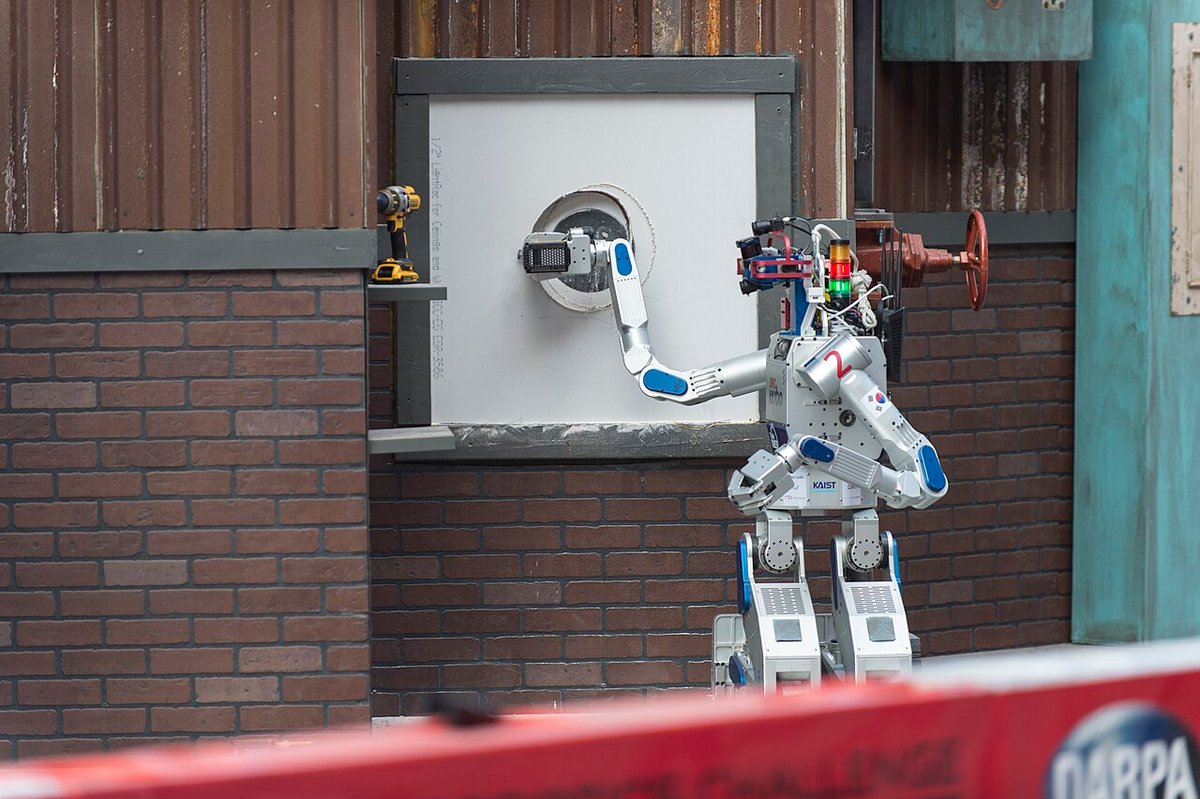
For the Finals, KAIST built an upgraded robot that its papers call DRC-HUBO+, though the Department of Defense and press coverage of the event called it DRC-HUBO.[21][27][24][22] The KAIST College of Engineering said DRC-HUBO+ was developed in 2014 from HUBO 2's basic layout, with 3 to 4 times the maximum joint power thanks to air cooling, longer arms and legs, 32 degrees of freedom driven by 36 brushless DC motors, a height of 173 cm and a mass of 82 kg.[21] IEEE Spectrum, writing after the event, counted 33 motors and 31 degrees of freedom.[22]
The robot's main departure from other humanoids was its ability to kneel and roll. It had motorized wheels on its knees and casters on its feet, and while rolling it used optical flow sensors on its shins for odometry.[22] Oh told IEEE Spectrum he wanted a design that kept the advantages of a human shape but reduced the risk of falling: "I thought about different things, and the simplest was wheels on the knees."[22] Other features described by IEEE Spectrum included:[22]
- an upper body that could rotate up to 180 degrees, standing or kneeling, so the robot could face one way while moving another;
- seven-degree-of-freedom arms that could each hold up to 15 kg, with cables routed inside to avoid snagging;
- six-axis force/torque sensors in the ankles;
- a lidar on a servo that scanned only when needed, while operators relied mostly on an ordinary camera;
- custom motor drivers with fans and fins for cooling, and compliance implemented in the motor driver instead of a force-feedback controller;
- a supercapacitor system that kept computers, communications and gyros powered if the main supply sagged;
- software built on the Xenomai real-time extension for Linux and a KAIST motion framework called PODO, with the Gazebo simulator.
The Hubo Lab's page for the robot described the control approach as a balance between supervision and autonomy: operators indicated where to go or which object to handle in a 2D camera view, and the robot found objects in lidar point clouds and executed scripted behaviors.[23] KAIST built four DRC-HUBOs and practiced without safety cables for more than a month, outdoors on rough ground. Oh estimated the cost of each robot at US$500,000 to US$1 million.[22]
The Finals took place on 5 and 6 June 2015 at the Fairplex in Pomona, California. Team KAIST, led by Oh and electrical engineering professor In-So Kweon with researchers from Rainbow, completed all eight tasks in 44 minutes and 28 seconds. IHMC Robotics and Tartan Rescue also scored eight points but took 50:26 and 55:15, so KAIST won the US$2 million first prize.[21][24] The Department of Defense counted 23 teams in the Finals; KAIST's own accounts say 24.[24][21] DARPA program manager Gill Pratt, commenting on the mix of designs, said "Flexibility may be the most important thing."[22]
IEEE Spectrum's task-by-task account of the winning run:[22]
| Task | What DRC-HUBO did | Approximate time |
|---|---|---|
| Drive | Pressed a lever linked by cable to the accelerator; did not stop at the barriers | A little over 1 minute |
| Egress | Held the vehicle frame and pulled with 100 N on each arm in a controlled "dynamic" exit | Under 4 minutes |
| Door | Opened the door while kneeling and rolled through | Under 2 minutes |
| Valve | Rotated its torso 180 degrees and turned the valve twice, though one turn was required | About 3 minutes |
| Wall | Operators marked the cut; the robot cut the circle on its own while pressing 20 N against the wall | About 11 minutes |
| Surprise (plug) | Moved a plug to another socket | 13 minutes 30 seconds |
| Rubble | Turned its torso and pushed through debris with its feet as a blade | Under 5 minutes |
| Stairs | Climbed backwards so its knees would not block the view of its feet | Under 7 minutes |
Oh told MIT Technology Review that the robot could walk as a biped or roll on its knees, using whichever mode suited the moment.[25] At the DARPA press conference he said the win did not make DRC-HUBO the best robot in the world, but that he valued it as a demonstration of Korea's technical capability.[24] A post-event analysis by C. G. Atkeson and colleagues, hosted at Carnegie Mellon University and based on teams' self-reports, grouped KAIST and a team from the University of Nevada, Las Vegas (UNLV) with other leg-wheel hybrids that did well on flat floors and light debris, noted that the HUBO teams chose the debris task over the rough-terrain walk, and listed KAIST's robot among the wheeled and tracked machines that almost fell. It also said the Finals winner (KAIST) and the Trials winner (SCHAFT) both put heavy emphasis on heat dissipation.[26] KAIST researchers later described the robot and their strategy in the Journal of Field Robotics and analyzed the walking-wheeling mode in a 2016 IROS paper.[27][28]
Later appearances
DRC-HUBO appeared at the World Economic Forum's annual meeting in Davos, Switzerland, in January 2016, where KAIST used it to demonstrate robotics to forum participants.[29][17] Rainbow's history lists the export of a DRC-HUBO+ to the US Naval Research Laboratory in December 2015.[15] In 2016 Oh received the Ho-Am Prize in engineering and the Changjo Medal of the Korean Order of Science and Technology Merit.[15]
On 11 December 2017, during the torch relay for the 2018 Winter Olympics in PyeongChang, HUBO carried the Olympic flame on the KAIST campus. It received the torch from Dennis Hong of UCLA, drilled through a wall to reach the next runner, and handed the flame to Oh. Oh passed it to the last runner of the Daejeon leg, Jung Jae Lee, a member of a winning team in the Samsung Junior Software Cup, who rode and controlled FX-2, a rideable robot Oh developed for the relay.[30] The Hubo Lab says it also showed an FX robot at the 2018 Games, and Rainbow lists a February 2018 contract to run a humanoid robot experience service at PyeongChang.[34][15]
On 14 May 2020, HUBO 2 served as a special co-anchor on the prime-time news of TJB, a local broadcaster celebrating its 25th anniversary, presenting two reports on contactless services using robots after the COVID-19 outbreak.[31] As of October 2021, KAIST said professors Hae-Won Park and Je Min Hwangbo were responsible for the Hubo Lab.[33]
Related Hubo Lab robots
The lab also built several non-humanoid machines, most of them carrying the HUBO name:
| Robot | Type | Details |
|---|---|---|
| HUBO FX-1 | Rideable biped | 12 degrees of freedom, 2 m tall, 150 kg; built to walk while carrying a person or a 100 kg load, steered by a joystick[36] |
| Huboway | Two-wheeled vehicle | Self-balancing transporter that could carry a person or a HUBO; top speed 20 km/h[37] |
| HuboQ | Delivery robot | Developed from 2009; carried objects up to 9 kg at up to 20 km/h; switched between four-wheel and two-wheel balancing modes[38] |
| FX-2 | Rideable robot | Ridden and controlled by the final Daejeon runner in the December 2017 Olympic torch relay[30] |
Significance
IEEE Spectrum described the original HUBO as one of the first advanced full-body humanoid robots developed outside Japan.[11] Coverage at its unveiling compared it with ASIMO and presented it as evidence that Korea was catching up with Japan in walking robots.[4][5][6] Rainbow Robotics describes HUBO as having been ranked alongside ASIMO and Atlas as a global biped platform, which is the company's own assessment.[15]
The 2015 DARPA win is the series' best-known result. IEEE Spectrum and MIT Technology Review both attributed it largely to the robot's ability to switch between walking and rolling, at an event where many robots lost their balance and fell.[22][25] The series also has a place in the wider history of humanoid robots as South Korea's first full-size walking humanoid program.[35] The lab's own account of the series was published as a chapter, "History of HUBO: Korean Humanoid Robot," in Springer's Humanoid Robotics: A Reference.[39] Oh, called the "Father of HUBO" in an International Federation of Robotics announcement, became president of the Korea AI & Robot Industry Association in February 2026.[35]
Continue reading
- Rainbow RoboticsRainbow Robotics (Korean: 레인보우로보틱스) is a South Korean robotics company that spun out of the Korea Advanced Institute of Science and Technology (KAIST) in 2011, descends from the DRC-HUBO team that won the 2015…Mentioned 7 times above
- DARPA Robotics ChallengeThe DARPA Robotics Challenge (commonly abbreviated DRC) was a prize competition organised by the United States Defense Advanced Research Projects Agency (DARPA) that ran from October 2012 through June 2015Mentioned 5 times above
- ASIMOASIMO (Advanced Step in Innovative Mobility), often called Honda ASIMO, was a bipedal humanoid robot developed by Honda Motor Co.Mentioned 4 times above
- History of humanoid robotsThe history of humanoid robots runs from pre-modern automata, such as the programmable musicians described by the Muslim engineer Al-Jazari around 1206 and Leonardo da Vinci's mechanical knight of about 1495…Listed in See also
- K-Humanoid AllianceThe K-Humanoid Alliance (Korean: 케이-휴머노이드 연합) is a South Korean industry-academia-government consortium for developing humanoid robots and the artificial intelligence that controls them.Listed in See also
- List of humanoid robotsThis is a list of humanoid robots: robots built with a human-like body plan that have been publicly shown as working machines.Listed in See also

More to read
References
- ^1 ^2 ^3Park, I.-W., Kim, J.-Y., Lee, J., and Oh, J.-H. "Mechanical design of the humanoid robot platform, HUBO". Advanced Robotics, vol. 21, no. 11, pp. 1305-1322, 2007. pure.seoultech.ac.kr/...manoid-robot-platform-hubo
- ^1 ^2Park, I.-W., Kim, J.-Y., Park, S.-W., and Oh, J.-H. "Development of humanoid robot platform KHR-2 (KAIST humanoid robot-2)". International Journal of Humanoid Robotics, vol. 2, no. 4, pp. 519-536, 2005. pure.seoultech.ac.kr/...r-2-kaist-humanoid-robot-2
- ^1 ^2 ^3Oh, J.-H., Hanson, D., Kim, W.-S., Han, I.-Y., Kim, J.-Y., and Park, I.-W. "Design of Android type Humanoid Robot Albert HUBO". Proceedings of the IEEE/RSJ International Conference on Intelligent Robots and Systems (IROS), pp. 1428-1433, October 2006. ri.cmu.edu/...roid-type-humanoid-robot-albert-hubo
- ^1 ^2 ^3Kim Tae-gyu. "KAIST to Unveil Self-Regulated 2-Legged Robot This Year". The Korea Times, 2004-11-23. web.archive.org/...kt2004112316265112350
- ^1 ^2 ^3 ^4Yeo Shi-dong. "Birth of Korean Humanoid Robot Marks Brilliance Advance in Korea Robotics". The Chosun Ilbo (English edition), 2004-12-22. web.archive.org/...200412220012
- ^1 ^2 ^3 ^4Hanlon, Mike. "Korea shows its robotics prowess with a rival for Asimo". New Atlas, 2005-01-25. newatlas.com/...3638
- ^1 ^2 ^3KAIST Humanoid Robot Research Center (HUBO Lab). "Introduction of HUBO". HUBO Lab website, archived 2008-01-07. web.archive.org/...KHR-3
- ^KAIST Humanoid Robot Research Center (HUBO Lab). "Specification of KHR-3(HUBO)". HUBO Lab website, archived 2011-02-22. web.archive.org/...SpecificationofHUBO
- ^Hanson Robotics. "Albert Einstein HUBO". Hanson Robotics website, archived 2017-04-01. web.archive.org/...albert-einstein-hubo
- ^1 ^2 ^3 ^4Hubo Lab @KAIST. "Hubo2". Hubo Lab website, archived 2020-01-28. web.archive.org/...hubo2
- ^1 ^2 ^3 ^4Guizzo, Erico. "Hubo II Humanoid Robot Is Lighter and Faster, Makes His Creator Proud". IEEE Spectrum, 2010-03-30. spectrum.ieee.org/...d-robot-is-lighter-and-faster
- ^National Science Foundation. "PIRE: Humanoids - Universally Accessible Infrastructures to Advance Capabilities" (Award 0730206, Drexel University). NSF Award Search, 2007. nsf.gov/...showAward
- ^1 ^2National Science Foundation. "MRI-R2: Development of Common Platform for Unifying Humanoids Research" (Award 0960061, Drexel University). NSF Award Search, 2010. nsf.gov/...showAward
- ^National Science Foundation. "IRES: US-Korea Collaborative Software- and Hardware-Design of Humanoids for Real-World tasks in Human-Centered Environments" (Award 1261170, Drexel University). NSF Award Search, 2013. nsf.gov/...showAward
- ^1 ^2 ^3 ^4 ^5 ^6 ^7 ^8 ^9Rainbow Robotics. "헤리티지 스토리" (Heritage story). Rainbow Robotics website, accessed 2026-11-18. rainbow-robotics.com
- ^1 ^2 ^3 ^4KAIST. "KAIST's HUBO Ready for DARPA's Robotics Challenge Trials". KAIST News, 2013-07-25. news.kaist.ac.kr/...news
- ^1 ^2 ^3 ^4 ^5Chua, Grace. "HUBO To The Rescue". Asian Scientist Magazine, 2017-01-03. asianscientist.com/...kaist-drc-hubo-darpa-challenge
- ^Hubo Lab @KAIST. "DRC-Hubo". Hubo Lab website, archived 2020-01-28. web.archive.org/...drc-hubo
- ^Chow, Denise. "Japanese Humanoid Robot Dominates DARPA Challenge". Live Science, 2013-12-22. livescience.com/...darpa-robotics-challenge-winner
- ^Luo, Jingru, Zhang, Yajia, and Hauser, Kris. "DRC-Hubo: a ladder-climbing humanoid robot for the DARPA Robotics Challenge". Intelligent Motion Laboratory, University of Illinois at Urbana-Champaign. motion.cs.illinois.edu/drc
- ^1 ^2 ^3 ^4 ^5KAIST College of Engineering. "Team-KAIST won in the DARPA Robotics Challenge 2015 Finals". Breakthroughs (Fall 2015 issue). breakthroughs.kaist.ac.kr/...289
- ^1 ^2 ^3 ^4 ^5 ^6 ^7 ^8 ^9Guizzo, Erico, and Ackerman, Evan. "How South Korea's DRC-HUBO Robot Won the DARPA Robotics Challenge". IEEE Spectrum, 2015-06-09. spectrum.ieee.org/...-won-darpa-robotics-challenge
- ^Hubo Lab @KAIST. "DRC-HUBO+". Hubo Lab website, archived 2018-10-05. web.archive.org/...p_drchuboplus
- ^1 ^2 ^3 ^4 ^5 ^6Pellerin, Cheryl. "Robots from South Korea, U.S. Win DARPA Finals". DoD News (via DVIDS), 2015-06-06. dvidshub.net/...503827
- ^1 ^2Knight, Will. "A Transformer Wins DARPA's $2 Million Robotics Challenge". MIT Technology Review, 2015-06-05. technologyreview.com/...million-robotics-challenge
- ^Atkeson, C. G., Babu, B. P. W., Banerjee, N., Berenson, D., Bove, C. P., Cui, X., DeDonato, M., Du, R., Feng, S., Franklin, P., Gennert, M., Graff, J. P., He, P., Jaeger, A., Kim, J., Knoedler, K., Li, L., Liu, C., Long, X., Padir, T., Polido, F., Tighe, G. G., and Xinjilefu, X. "What Happened at the DARPA Robotics Challenge, and Why?". Carnegie Mellon University (author-hosted manuscript), 2015. cs.cmu.edu/...jfr-what.pdf
- ^1 ^2Lim, J., Lee, I., Shim, I., Jung, H., Joe, H. M., Bae, H., Sim, O., Oh, J., Jung, T., Shin, S., Joo, K., Kim, M., Lee, K., Bok, Y., Choi, D.-G., Cho, B., Kim, S., Heo, J., Kim, I., Lee, J., Kwon, I. S., and Oh, J.-H. "Robot System of DRC-HUBO+ and Control Strategy of Team KAIST in DARPA Robotics Challenge Finals". Journal of Field Robotics, vol. 34, no. 4, pp. 802-829, 2017. doi.org/...rob.21673
- ^Bae, H., Lee, I., Jung, T., and Oh, J.-H. "Walking-wheeling dual mode strategy for humanoid robot, DRC-HUBO+". 2016 IEEE/RSJ International Conference on Intelligent Robots and Systems (IROS), pp. 1342-1348, October 2016. doi.org/...IROS.2016.7759221
- ^KAIST. "HUBO to Present at the 2016 World Economic Forum". KAIST News, 2015-11-18. news.kaist.ac.kr/...news
- ^1 ^2KAIST. "Hubo Completes New Mission at the Winter Olympic Torch Relay". KAIST News, 2017-12-12. news.kaist.ac.kr/...news
- ^KAIST. "Hubo Debuts as a News Anchor". KAIST News, 2020-05-14. news.kaist.ac.kr/...news
- ^Hubo Lab @KAIST. "About Us". Hubo Lab website, archived 2018-10-07. web.archive.org/...c_about
- ^1 ^2KAIST. "Professor Jun-Ho Oh Donates Startup Shares Worth 5 Billion KRW". KAIST News, 2021-10-26. news.kaist.ac.kr/...news
- ^KAIST Humanoid Robot Research Center (Hubo Lab). "About Us". Hubo Lab website, archived 2021-03-07. web.archive.org/...introduce
- ^1 ^2 ^3 ^4 ^5International Federation of Robotics. "Dr. Junho Oh elected as new President of KAR". IFR press release, 2026-02-25. ifr.org/...unho-oh-elected-as-new-president-of-kar
- ^KAIST Humanoid Robot Research Center (HUBO Lab). "Introduction of HUBO FX-1". HUBO Lab website, archived 2009-03-06. web.archive.org/...HUBOFX-1
- ^KAIST Humanoid Robot Research Center (HUBO Lab). "Introduction of HUBOway". HUBO Lab website, archived 2009-03-21. web.archive.org/...huboway
- ^Hubo Lab @KAIST. "HuboQ (Quick Delivery Robot)". Hubo Lab website, archived 2018-07-25. web.archive.org/...p_huboq
- ^Heo, J., Lee, J., Lee, I., Lim, J., and Oh, J.-H. "History of HUBO: Korean Humanoid Robot". In Humanoid Robotics: A Reference, Springer, 2018, pp. 117-129. doi.org/...978-94-007-6046-2_12
- ^Rainbow Robotics. "Samsung Electronics To Become Largest Shareholder in Rainbow Robotics Accelerating Future Robot Development". A3 Robotics News, posted 2025-03-07. automate.org/...t-development-rainbow-robotics-inc
Improve this article
Add missing citations, update stale details, or write a clearer explanation. Anyone can edit: changes go live when you publish, and every edit is checked by an editor.
2 revisions · v2 · 4,255 words · full history
Fact-checks are independent of edits: a reviewer re-verifies the article against its sources and stamps the date. How we verify
Research and drafting on this wiki are AI-assisted, under named human editorial standards. How AI is used here
Reviewer note: Independent fact-check before publication on November 18, 2026: 118 claims checked against 41 cited and independent sources; 1 material and 7 minor corrections applied before publication.
Cite this page: AI Wiki. "HUBO." aiwiki.ai, updated 18 Nov 2026, fact-checked 18 Nov 2026. CC BY 4.0. https://aiwiki.ai/wiki/hubo