

GENE.01
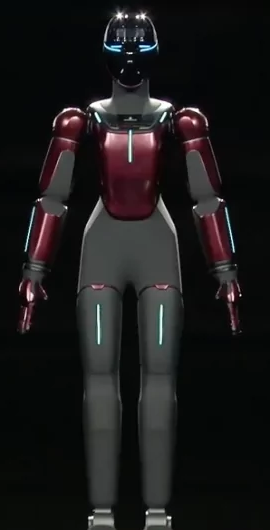
GENE.01 is a humanoid robot concept developed by Generative Bionics, an Italian robotics company headquartered in Genoa. Unveiled on January 6, 2026 during AMD's opening keynote at CES 2026 in Las Vegas, GENE.01 introduced a novel approach to humanoid design in which intelligence is distributed throughout the robot's body rather than concentrated in a single central processor. The robot's defining innovation is a full-body tactile skin, a network of touch and force sensors covering its entire surface, that treats physical contact as a primary channel of machine intelligence. Powered by an AMD-based computing stack that combines CPUs, GPUs, and FPGA-based edge processors, GENE.01 is designed to operate safely alongside humans in demanding industrial, logistics, and healthcare environments.
| GENE.01 | |
|---|---|
 | |
| General information | |
| Manufacturer | Generative Bionics |
| Country of origin | Italy |
| Year unveiled | 2026 |
| Status | Concept / Prototype |
| Estimated price | ~$50,000 USD |
| Commercial launch | Q4 2026 (planned) |
| Website | gbionics.ai |
Generative Bionics is a spinoff of the Italian Institute of Technology (IIT), building on more than two decades of humanoid research that produced the iCub cognitive research platform, the ergoCub industrial support humanoid, and the iRonCub jet-powered flying humanoid. The company raised 70 million euros (approximately $81 million USD) in one of the largest early-stage robotics funding rounds in European history, with investors including CDP Venture Capital, AMD Ventures, Duferco, Eni Next, RoboIT, and Tether. GENE.01 is the first model in a planned lineage of task-specific humanoid variants, with a commercial launch targeted for late 2026.
Company background
Italian Institute of Technology origins
Generative Bionics traces its roots to the Italian Institute of Technology (IIT), a scientific research center established in Genoa, Italy. IIT launched the iCub project in 2004 as its flagship humanoid robotics platform. The iCub, a child-sized open-source humanoid standing 104 cm tall with 53 degrees of freedom, became one of the most widely used research platforms for embodied artificial intelligence in the world, training hundreds of researchers over two decades and generating numerous patents.[1][2]
Building on the iCub foundation, IIT developed two additional humanoid programs that directly informed GENE.01's technology. The ergoCub humanoid, co-developed with INAIL (Italy's National Institute for Insurance against Accidents at Work), was designed to support workers in industrial settings and contributed the Physical AI architecture that allows humanoids to learn from real-world environments. The iRonCub, conceived around 2016 under the leadership of Daniele Pucci, became the world's first jet-powered flying humanoid robot and contributed advanced AI methods for adaptation in extreme operational conditions.[3][4]
Founding and leadership
Generative Bionics was founded in July 2024 as a spinoff of IIT. The founding team consisted of four senior IIT researchers and two business co-founders:[5][6]
| Role | Name | Background |
|---|---|---|
| CEO and Co-Founder | Daniele Pucci | Former Principal Investigator at IIT; head of the Dynamic Interaction Control lab; led the iRonCub flying humanoid project |
| Chief AI Officer and Co-Founder | Alessio Del Bue | Former IIT researcher specializing in artificial intelligence |
| Chief Technology Officer and Co-Founder | Marco Maggiali | Former IIT researcher in humanoid mechatronics |
| Chief Business Officer and Co-Founder | Andrea Pagnin | Former IIT business development |
| Executive Chairman and Co-Founder | Davide Rota | Entrepreneurial advisor |
| Co-Founder | Jeffrey Libshutz | Entrepreneurial advisor |
Approximately 70 engineers from IIT's technical division joined the company, bringing a combined team experience of over 600 years in Physical AI and robotics. IIT granted Generative Bionics exclusive licenses to key humanoid technologies, including those developed in collaboration with INAIL.[7]
Funding
In December 2025, Generative Bionics announced the closing of a 70 million euro funding round, equivalent to approximately $81 million USD. The round was led by the Artificial Intelligence Fund of CDP Venture Capital, Italy's state-backed venture capital arm. Additional investors included AMD Ventures, Duferco, Eni Next, RoboIT, and Tether. This round was reported as one of the largest early-stage investments in the European humanoid robotics deep-tech sector.[5][8]
CDP Venture Capital's involvement began earlier, with an initial investment during the prototyping phase through RoboIT, its Technology Transfer Hub. The Artificial Intelligence Fund subsequently led the larger expansion round.[6] AMD Ventures participated not only as a financial investor but as a strategic technology partner, providing the computing hardware that forms the core of GENE.01's architecture.[9]
Tether, the company behind the USDt stablecoin, invested as part of its strategy to expand into physical infrastructure and edge AI solutions. Tether CEO Paolo Ardoino stated: "Humanoid robotics and Physical AI represent a powerful evolution in how intelligence and capability operate in the real world."[7]
The capital was allocated to accelerate product development, train Physical AI systems, conduct industrial validation, and construct Generative Bionics' first production plant in Italy.[5]
Design philosophy
Physical AI and "body as compute"
GENE.01 is built around what Generative Bionics calls "Physical AI," the fusion of robotics and artificial intelligence where the physical body itself becomes an integral part of the computational system. CEO Daniele Pucci described the approach: "Our aim with GENE.01 is to create a humanoid that is as efficient as it is intelligent. AMD technologies allow us to treat the robot's body as part of the compute, where mechatronics and AI work as a single system."[9][10]
This stands in contrast to conventional robotics architectures where a central processor handles all computation and sends commands to passive actuators. In GENE.01's architecture, processing occurs near sensors throughout the body, enabling split-second reaction times and smoother movement. The approach draws inspiration from biological systems, where human intelligence emerges not only from the brain but also from distributed processes like proprioception, reflexes, and spinal cord circuits.[11]
Human-centric Italian design
The robot's aesthetic and ergonomic design reflects what the company describes as a distinctively Italian approach where "form, function and human experience converge." Rather than treating industrial design as a cosmetic layer applied after engineering, Generative Bionics integrated design considerations into the robot's core architecture. The robot's proportions, posture, and movement patterns are engineered specifically to encourage human acceptance and facilitate comfortable human-robot collaboration.[9][10]
This philosophy extends to the tactile skin system, which is not merely a sensor array but an active component of the robot's intelligence and safety infrastructure. By enabling the robot to perceive and respond to physical contact across its entire surface, the design ensures that interactions between GENE.01 and human workers feel natural and predictable rather than mechanical and unpredictable.[10]
Naming convention
The name "GENE" was chosen to represent the fundamental unit of identity and inheritance in biology. Just as a gene carries the blueprint for biological traits across generations, GENE.01 serves as the foundational template from which all future Generative Bionics humanoids will evolve. The ".01" suffix indicates that this is the first variant in what the company envisions as a modular nomenclature system, where subsequent models and task-specific variants receive their own designations.[9][10]
Technical architecture
Full-body tactile skin
The most distinctive technical feature of GENE.01 is its full-body tactile skin: a distributed network of touch and force sensors spanning the robot's entire external surface. This technology, which evolved from iCub's pioneering tactile sensor networks developed at IIT, enables GENE.01 to perceive contact, pressure, and micro-interactions at any point on its body.[9][10]
Unlike robots that use touch sensing only at the fingertips or palms for grasping tasks, GENE.01 treats touch as a "primary channel of intelligence." The tactile data streams feed directly into the robot's decision-making processes, enabling continuous adaptation to physical interactions. When a human touches the robot's arm, for example, the system can instantly determine the nature, intensity, and direction of the contact and adjust its behavior accordingly. This capability is critical for safe operation in environments where humans and robots share workspace.[10][11]
The distributed sensing system also functions as a safety mechanism. By detecting unexpected contact across any body surface, the robot can immediately halt or redirect its motion to prevent injury, going beyond the capabilities of robots that rely solely on force-torque sensors at the joints or external camera systems for collision avoidance.[11]
Computing architecture
GENE.01's computing infrastructure is organized around three foundational pillars, all built on AMD hardware:[9][10]
| Pillar | Description | AMD Technology |
|---|---|---|
| Body as Compute | Near-sensor processing fuses physical dynamics with digital intelligence in real time, turning the body into a distributed computational asset | AMD CPUs, embedded processors |
| Interaction Intelligence | Low-latency edge computing integrates tactile, visual, and force data at high frequency for responsive and safe physical interactions | FPGA-based embedded platforms |
| Open Architecture | Open-source toolchains and platforms enable the Physical AI stack to be shared and extended across the robotics ecosystem | AMD-supported development tools |
The combination of CPUs, GPUs, FPGAs, and embedded processors allows the robot to handle multiple data streams simultaneously. FPGAs are particularly important for the tactile skin system because they can process sensor data with extremely low latency, which is essential for real-time touch-based decision-making. The GPU handles computationally intensive tasks like computer vision and machine learning inference, while the CPUs manage high-level planning and coordination.[11]
AMD's Salil Raje commented on the partnership: "Physical AI...becomes possible when supported by a comprehensive computing portfolio."[10]
Reported specifications
As of early 2026, Generative Bionics has not published a comprehensive official specification sheet for GENE.01, which remains a concept platform advancing toward production. Third-party robotics databases have compiled the following reported specifications, though some figures may be estimates pending official confirmation:[12]
| Category | Specification | Reported value |
|---|---|---|
| Physical | Height | 170 cm (5 ft 7 in) |
| Physical | Weight | 70 kg (154 lb) |
| Physical | Primary materials | Aluminum and composites |
| Mobility | Total degrees of freedom | 50 |
| Mobility | DOF per hand | 5 |
| Mobility | Maximum walking speed | 1.1 m/s (4.0 km/h) |
| Manipulation | Arm payload capacity | 6.5 kg (14.3 lb) |
| Manipulation | Fingers per hand | 5 |
| Power | Estimated battery life | 4 hours |
| Computing | Processor architecture | AMD CPUs, GPUs, FPGAs |
| Computing | Operating system | Custom robotics OS |
| Actuators | Type | High-torque electric actuators |
| Actuators | Transmission | Precision gear reducers |
| Connectivity | Interfaces | 5G, Ethernet, Wi-Fi |
The human-like proportions (170 cm height, 70 kg weight) are consistent with the company's stated design goal of creating a humanoid that matches a typical adult human form factor for ergonomic compatibility in workspaces designed for people.
IIT research heritage
GENE.01's technology stack draws directly from three flagship IIT humanoid programs, each contributing a distinct technological pillar:[3][5]
iCub
Launched in 2004 as part of the EU-funded RobotCub project, iCub is a child-sized (104 cm) open-source humanoid with 53 degrees of freedom designed for cognitive AI research. Over twenty years, iCub became one of the most widely adopted humanoid research platforms globally. Its key contribution to GENE.01 is the distributed tactile and force sensor network technology. iCub pioneered the concept of covering a humanoid robot's body with capacitive touch sensors, and this technology was refined over two decades before being licensed exclusively to Generative Bionics.[1][2]
ergoCub
The ergoCub was co-developed by IIT and INAIL to create a humanoid capable of supporting human workers in industrial environments. This program refined the Physical AI architecture that enables humanoid robots to be designed for specific applications and to learn directly from real-world operational data. The ergoCub research produced insights into safe human-robot collaboration, force control, and task adaptation that are central to GENE.01's design for industrial deployment.[3][5]
iRonCub
Conceived around 2016 under the leadership of Daniele Pucci, iRonCub is the world's only jet-powered flying humanoid robot. In 2025, the iRonCub3 variant achieved its first flight, with four jet engines lifting it 50 cm off the ground in a milestone demonstration. While GENE.01 is not designed to fly, the iRonCub program contributed advanced AI methods for adaptation to extreme and unpredictable environments, including techniques for dealing with high temperatures, unstructured terrain, and complex outdoor conditions.[4][13]
Industrial applications and partnerships
Target sectors
Generative Bionics positions GENE.01 for deployment in sectors characterized by repetitive, hazardous, or high-intensity operational tasks. The company's primary target markets include:[5][9]
- Manufacturing: Assembly, welding, quality inspection, and material handling in factories
- Logistics: Warehouse operations, picking and packing, and goods transportation
- Healthcare: Patient assistance, rehabilitation support, and hospital logistics
- Retail: Inventory management and customer-facing service roles
The company emphasizes that its humanoids are designed to support human work rather than replace it, with the tactile sensing and human-centric design enabling side-by-side collaboration between robots and workers.
Fincantieri shipyard partnership
On February 11, 2026, Fincantieri, one of the world's largest shipbuilding companies, announced a four-year industrial partnership with Generative Bionics to develop and deploy humanoid welding robots in European shipyards. This represented one of the first major industrial deployment agreements for a European humanoid robot company.[14][15]
The partnership designates a specialized variant called GENE.01/W (with the "W" standing for welding), marking the first use of Generative Bionics' modular nomenclature system where letter suffixes identify task-specific variants. The GENE.01/W will feature:[14][15]
| Feature | Description |
|---|---|
| Welding AI | Specialized artificial intelligence for monitoring welding seams and ensuring weld quality |
| Adapted locomotion | Optimized movement systems for navigating the complex, non-uniform terrain of shipyard environments |
| AMD-powered vision | High-performance computing and FPGA-based vision systems for real-time environmental awareness |
| Collaborative safety | Systems enabling the robot to work alongside human shipbuilders safely |
The partnership follows a phased timeline:[14]
| Phase | Period | Objectives |
|---|---|---|
| Phase 1 | Late 2026 | Initial on-site testing at Fincantieri's Sestri Ponente shipyard |
| Phase 2 | 2027-2028 | Operational functionalities become available; real-world deployment |
| Phase 3 | 2028-2030 | Refinement, expansion, and industrial certification |
Fincantieri CEO Pierroberto Folgiero described the initiative: "Advanced robotics and artificial intelligence...represent a strategic lever for shipbuilding competitiveness." Daniele Pucci added: "This project enables humanoid robots designed around human work, capable of operating side by side with people."[14]
The Sestri Ponente shipyard in Genoa serves as the reference testing environment, functioning as what the companies call an "industrial laboratory" for technology development and validation. The choice of a Genoa-based shipyard reflects the geographic connection to Generative Bionics' and IIT's home city.[14]
Competitive context
European humanoid robotics landscape
GENE.01 enters a growing European humanoid robotics sector. Italy is the second-largest European market for industrial robots after Germany, with over 12,000 new industrial robots installed in 2023 alone.[16] Notable European humanoid robot developers include:
| Company | Country | Robot | Focus area |
|---|---|---|---|
| Generative Bionics | Italy | GENE.01 | Industrial Physical AI with tactile intelligence |
| Oversonic Robotics | Italy | RoBee | Cognitive humanoid for Industry 5.0 |
| PAL Robotics | Spain | TALOS, Kangaroo | Research and industrial humanoids |
| Pollen Robotics | France | Reachy 2 | Open-source manipulation platform |
| Engineered Arts | United Kingdom | Ameca | Social interaction and entertainment |
| Agile Robots | Germany | Agile One | Industrial manipulation |
Global competition
On the global stage, GENE.01 competes with well-funded humanoid robot programs from the United States, China, and other regions. Companies like Tesla (Optimus), Figure (Figure 02), Apptronik (Apollo), Unitree (H1, G1), and Agility Robotics (Digit) have attracted significant investment and media attention.[16]
Generative Bionics differentiates GENE.01 through several strategic choices:
- Tactile-first intelligence: While most competitors emphasize visual perception and language models, GENE.01 prioritizes distributed touch sensing as a core intelligence modality
- Body-as-compute architecture: The distributed processing approach contrasts with the centralized computing architectures used by most competing platforms
- IIT research lineage: Over two decades of continuous humanoid research, including 60+ prototypes, provides a depth of institutional knowledge that newer startups lack[7]
- European sovereignty: The company explicitly positions itself within a European technology sovereignty framework, using domestic supply chains and research institutions
Market projections
The humanoid robotics market is projected to exceed 200 billion euros by 2035 and could potentially surpass $5 trillion by 2050, according to international industry analyses cited by Generative Bionics.[5] These projections have attracted substantial venture capital to the sector globally, with Generative Bionics' 70 million euro round reflecting the broader trend of large investments flowing into humanoid robotics companies.
CES 2026 unveiling
GENE.01 made its public debut on January 6, 2026 during AMD Chair and CEO Dr. Lisa Su's opening keynote at CES 2026 in Las Vegas. During the keynote, Dr. Su hosted Daniele Pucci on stage to introduce Generative Bionics' vision and demonstrate the technologies behind GENE.01. The presentation emphasized the deep integration between AMD's computing hardware and the robot's Physical AI capabilities.[9][10]
The CES appearance positioned GENE.01 alongside numerous other humanoid robots that dominated the 2026 show. Media coverage noted that humanoid robots were a major theme at CES 2026, with multiple companies showcasing prototypes and production models.[17] For Generative Bionics, the AMD keynote slot represented significant visibility for a company that had been operating largely in stealth since its founding in mid-2024.
Following the CES unveiling, Generative Bionics announced a demo-based industrial roadmap for 2026, with demonstrations and testing programs planned throughout the year in preparation for the commercial launch in Q4 2026.[9]
Roadmap and future development
Generative Bionics has outlined several near-term milestones for the GENE.01 program:[9][14]
- 2026 (H1): Industrial demonstrations and testing programs with partner companies
- 2026 (Q4): Planned commercial launch of the GENE.01 production model
- Late 2026: Initial on-site welding tests at Fincantieri's Sestri Ponente shipyard with GENE.01/W
- 2027-2028: Operational deployment of GENE.01/W in shipyard environments
- Ongoing: Construction of the company's first production plant in Italy
The GENE.01 platform is designed as a modular foundation that will give rise to specialized variants optimized for different industrial applications. The GENE.01/W welding variant is the first announced specialization, but the company has indicated plans for additional configurations tailored to the specific demands of logistics, healthcare, and other sectors.[9][14]
See also
- Humanoid robots
- Generative Bionics
- iCub
- Physical AI
- Oversonic Robotics RoBee
- PAL Robotics TALOS
- Fincantieri
References
- ^1 ^2iCub - Wikipedia
- ^1 ^210 Years with the iCub - International Foundation of Robotics Research
- ^1 ^2 ^3Born from IIT, Generative Bionics raises 70 million euros - EurekAlert!
- ^1 ^2iRonCub: A Humanoid Robot Designed to Fly Like Iron Man - IEEE Spectrum
- ^1 ^2 ^3 ^4 ^5 ^6 ^7Generative Bionics raises 70 million euros - CDP Venture Capital
- ^1 ^2Born from IIT, Generative Bionics raises 70 million - IIT Open Talk
- ^1 ^2 ^3Tether Invests in Generative Bionics - Tether.io
- ^From iCub to humanoids: Generative Bionics raises $81M - The Robot Report
- ^1 ^2 ^3 ^4 ^5 ^6 ^7 ^8 ^9 ^10 ^11Generative Bionics Unveils GENE.01 at CES 2026 - Humanoid Robotics Technology
- ^1 ^2 ^3 ^4 ^5 ^6 ^7 ^8 ^9GENE.01, the first humanoid robot from Generative Bionics - Startupbusiness.it
- ^1 ^2 ^3 ^4AMD hardware-powered humanoid robot uses body as computing system - Interesting Engineering
- ^HumanoidSpecs.com - GENE.01
- ^IIT demonstrates that a humanoid robot can fly - EurekAlert!
- ^1 ^2 ^3 ^4 ^5 ^6 ^7Fincantieri and Generative Bionics launch industrial partnership - Fincantieri Press Release
- ^1 ^2Fincantieri and Generative Bionics Partner to Bring Humanoid Welders to Italian Shipyards - Humanoids Daily
- ^1 ^2The Robotics Market in Italy: A Growing Ecosystem - Robot Magazine
- ^Humanoid robots take over CES in Las Vegas - CNBC
Improve this article
Add missing citations, update stale details, or suggest a clearer explanation. Every suggestion is reviewed for sourcing before it goes live.
6 revisions · v6 · 3,269 words · full history
Fact-checks are independent of edits: a reviewer re-verifies the article against its sources and stamps the date. How we verify
Research and drafting on this wiki are AI-assisted, under named human editorial standards. How AI is used here
Cite this page: AI Wiki. "GENE.01." aiwiki.ai, updated 12 Apr 2026. CC BY 4.0. https://aiwiki.ai/wiki/generative_bionics_gene_01