

RoBee
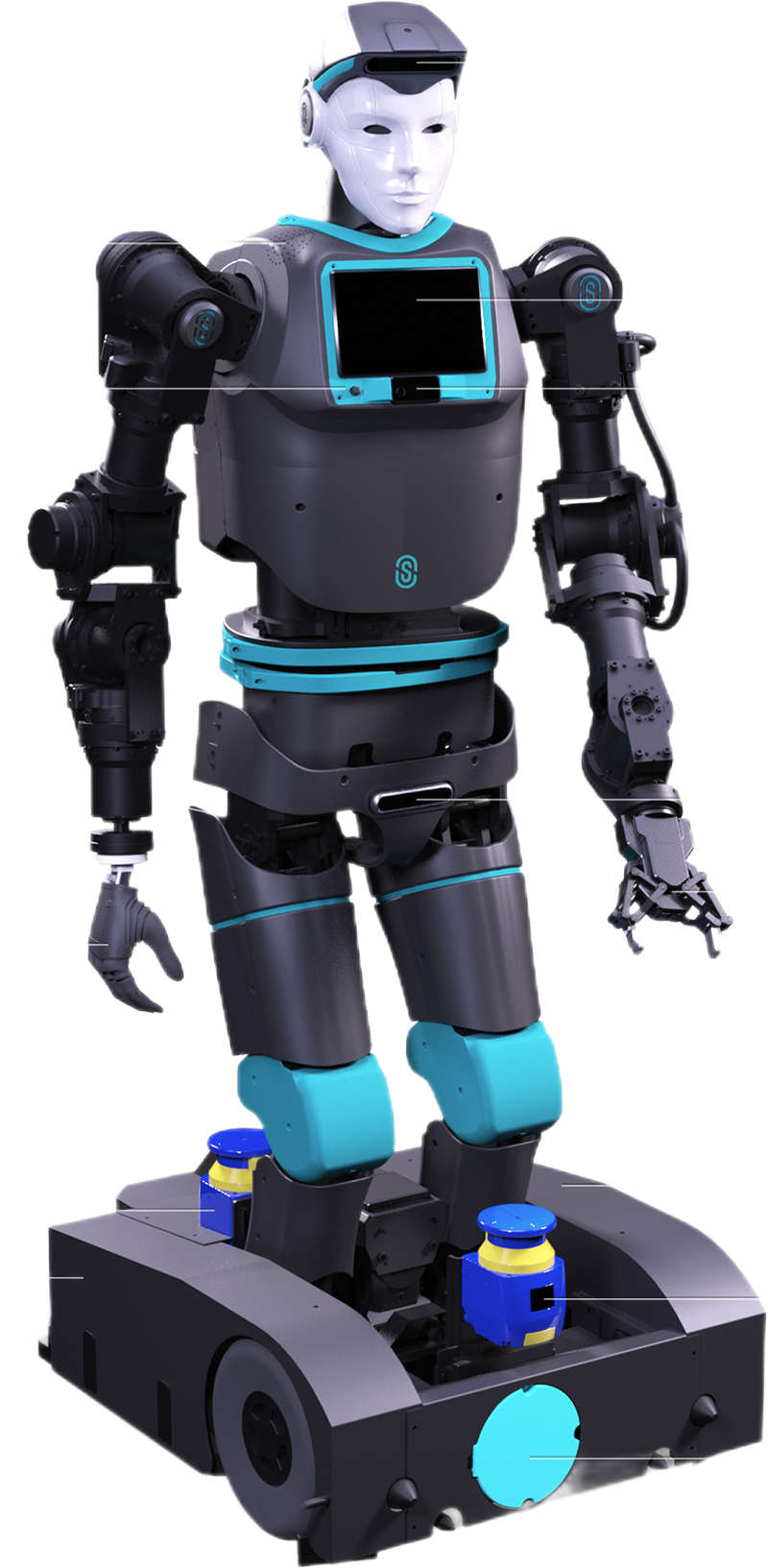
RoBee is a cognitive humanoid robot developed by Oversonic Robotics, an Italian company headquartered in Carate Brianza, Lombardy. It is the only humanoid robot certified for operation in both industrial and healthcare environments, carrying CE marking for industrial machinery and a Class 1 Medical Device certification in Europe.[2][3] In December 2025, RoBee became the first cognitive humanoid robot operationally integrated into semiconductor manufacturing when STMicroelectronics deployed the first unit at its advanced packaging and test facility in Malta.[3]
| RoBee | |
|---|---|
 | |
| General information | |
| Manufacturer | Oversonic Robotics |
| Country of origin | Italy |
| Year introduced | 2022 |
| Status | In production |
| Height | 154 to 200 cm (varies by series) |
| Weight | 80 to 180 kg (varies by series) |
| Degrees of freedom | 40 |
| Battery life | Up to 8 hours |
| Price | Approximately $140,000 USD |
| Website | oversonicrobotics.com |
RoBee combines a humanoid form factor with artificial intelligence-based perception, real-time decision-making, and multimodal interaction. Oversonic describes RoBee as a "cognitive humanoid robot" to emphasize its onboard AI processing and its ability to perceive, reason about, and respond to complex environments without constant human supervision.[1] The robot stands between 154 and 200 cm tall (depending on the series), has 40 degrees of freedom, carries up to 5 kg per arm, and runs for up to 8 hours on a single charge.[8] Each unit is priced at approximately 140,000 euros (roughly $140,000 USD).[14]
RoBee is produced in three variants: the Series R for industrial manufacturing, the Series M for healthcare and rehabilitation, and the Series F for intralogistics and heavy-payload applications.[8][9][10] At CES 2026 in Las Vegas, Oversonic showcased RoBee in partnership with both STMicroelectronics and Intel, demonstrating its capabilities powered by Intel Core Ultra Series 3 edge processors.[4]
What is RoBee?
RoBee is a full-size cognitive humanoid robot designed to work alongside people in environments built for humans, such as factory floors, hospitals, and warehouses. Unlike traditional industrial robots that are fixed in place and pre-programmed for a single repetitive task, RoBee is mobile, autonomous, and able to perceive its surroundings, reason about them, and adapt its behavior in real time.[1] Oversonic positions it as part of the Industry 5.0 paradigm, in which robots collaborate with human workers rather than replacing entire production lines.[11]
The defining characteristic is its "cognitive" platform: RoBee processes speech recognition, speech generation, reasoning, and select computer vision tasks directly onboard, rather than depending on a cloud connection.[4] This combination of a humanoid body with edge AI lets RoBee handle machine tending, packaging, quality inspection, patient assistance, and material handling, switching between tasks without being re-engineered for each one.[8]
Who makes RoBee?
RoBee is made by Oversonic Robotics, an Italian robotics company founded in 2020 by Fabio Puglia and Paolo Denti. Puglia, who serves as President, holds a degree in Physics and Mathematics with a specialization in Astrophysics from the University of Milan. His background spans robotics, automation, and international technology partnerships, including projects in Tel Aviv involving European and Israeli partners in water management (2013), technology partnership agreements in Abu Dhabi (2014), and participation in an ICT congress in Pasadena organized by NASA (2017).[5]
Paolo Denti, the company's CEO, is originally from Venice and graduated in Economic Statistics from the University of Padua, later earning a Master's in International Marketing and Sales in Scotland. Before co-founding Oversonic, Denti held executive positions at Benetton Sportsystem (as Executive Vice President of Sales and Marketing in the United States), served as General Manager of Nordica and board member of the Tecnica Group across China, Japan, and the United States, and was CEO of Thun SpA from 2008 to 2018.[5]
The company was originally established in Besana Brianza (Province of Monza and Brianza, Lombardy) as a software company specializing in cognitive computing systems for robotics. In 2022, Oversonic adopted the legal status of a Benefit Company ("Societa Benefit" under Italian law), committing to operate responsibly and sustainably toward individuals, communities, and the environment.[6] As of 2026, the company employs 65 professionals, including approximately 30 engineers specialized in computer science, mechanical engineering, and electronic engineering.[3]
Oversonic operates from multiple locations: its technology and production center in Carate Brianza, a representative office in Milan, an operational site in Rovereto (Trento, Trentino-Alto Adige), and offices in the United States including a 5,000-square-foot facility on Mariposa Avenue in El Segundo, California (Los Angeles area), opened in January 2026.[7]
When was RoBee developed? Development timeline
| Year | Milestone |
|---|---|
| 2020 | Oversonic Robotics founded in Besana Brianza by Fabio Puglia and Paolo Denti |
| 2021 | Raised 4.5 million euros from Fintel and other investors |
| 2022 | Adopted Benefit Company status; began CE certification process |
| 2023 (July) | Cysero venture capital fund invests 5 million euros |
| 2023 (December) | Datalogic acquires minority stake; partnership for Industry 5.0 |
| 2024 | Named among 13 leading players in humanoid robotics by CB Insights; LinkedIn Top Startups recognition |
| 2025 | Total funding surpasses 30 million euros; mass production facility established at former Maserati plant in Grugliasco |
| 2025 (December) | Supply agreement signed with STMicroelectronics; first RoBee deployed in Malta semiconductor fab |
| 2026 (January) | Debut at CES 2026; US market launch; NantWorks partnership and Los Angeles office opened |
What are RoBee's product variants?
RoBee is available in three product series, each designed for specific operational environments. All three share the same cognitive AI platform but differ in physical dimensions, payload capacity, and application-specific features.
RoBee Series R (Industrial)
The Series R is the flagship industrial variant, designed to operate safely in manufacturing environments built for human workers. It can move autonomously through factory floors, manipulate objects with precision, and interact naturally with human operators. Typical tasks include machine loading and unloading, product packaging, pick-and-place operations for objects of varying shapes and sizes, and quality inspection.[8]
The Series R stands 162 to 190 cm tall with a robust structure weighing up to 180 kg. It is rated for environments with temperatures between 5 and 50 degrees Celsius. The robot carries CE marking under the Machine Directive 2006/42/CE and complies with EMC-EMI standards, ISO 27001:2013 for information security, and GDPR requirements for data protection.[8]
RoBee Series M (Healthcare)
The Series M is built specifically for clinical environments including hospitals, rehabilitation centers, and elderly care facilities. Standing 175 cm tall and weighing 80 kg, it features a smaller footprint (45 x 45 cm versus the R series' 69 x 78 cm) for navigating hospital corridors and patient rooms. The M variant can remind patients of therapies and appointments, accompany patients during transfers between departments, offer companionship, and support healthcare workers during cognitive rehabilitation sessions.[9]
The Series M is certified as a Class 1 Medical Device in Europe. It integrates with electronic health records and hospital IT systems, enabling data-driven workflows in clinical settings. Its inductive charging system allows autonomous recharging without manual cable connections.[9]
RoBee Series F (Intralogistics)
The Series F is the largest and most powerful variant, designed for warehouse and intralogistics applications. At 200 cm tall and 850 kg, it features a significantly larger frame with an omnidirectional base and 7-axis articulated arms. The F series can carry up to 10 kg per arm (20 kg combined) and transport up to 500 kg of cargo on its rear axle using a pneumatic lift system. It includes eight integrated cameras and moves at a maximum speed of 0.6 m/s.[10]
What are RoBee's specifications?
Physical and Mechanical Specifications
| Parameter | Series R (Industrial) | Series M (Healthcare) | Series F (Intralogistics) |
|---|---|---|---|
| Height | 162 to 190 cm | 154 to 175 cm | 200 cm |
| Weight | Up to 180 kg | Up to 80 kg | 850 kg |
| Footprint | 69 x 78 cm | 45 x 45 cm | 80 x 120 cm |
| Arm reach | 90 cm per arm | 80 cm | 120 cm |
| Single arm payload | 5 kg | 3 kg | 10 kg |
| Dual arm payload | 10 kg | 6 kg | 20 kg |
| Rear axle transport | N/A | N/A | 500 kg |
| Arm configuration | Articulated | Articulated | 7-axis articulated |
| Degrees of freedom | 40 | 40 | 40+ |
| Repeatability | +/- 0.8 mm | +/- 0.5 mm | +/- 0.5 mm |
| Deterministic accuracy | +/- 1 mm | +/- 2 mm | +/- 1 mm |
| Cognitive accuracy | +/- 3 mm | +/- 5 mm | +/- 5 mm |
Mobility and Navigation
| Parameter | Series R | Series M | Series F |
|---|---|---|---|
| Drive type | Differential (optional omnidirectional) | Differential (2 front traction wheels) | Omnidirectional base |
| Maximum speed | 1.2 m/s | 1.2 m/s | 0.6 m/s |
| Maximum slope | 8% | 8% | N/A |
| Navigation sensors | LiDAR and cameras | LiDAR and cameras | LiDAR and cameras |
| Obstacle detection | SIL 3 rated | Safety-rated | SIL 3 rated |
| Ground flatness requirement | N/A | Less than 5 mm/m squared | N/A |
All three series navigate using a combination of LiDAR sensors and depth cameras. The obstacle detection system on the R and F series is rated to Safety Integrity Level 3 (SIL 3), a standard used in safety-critical systems to ensure reliable hazard detection. Datasensing's Safety Laser Scanner is integrated into RoBee's navigation system, continuously monitoring the environment to ensure the robot's assigned path is clear of obstacles.[11]
Power and Battery
| Parameter | Series R | Series M | Series F |
|---|---|---|---|
| Battery type | Lithium-ion | Lithium-ion | Lithium-ion |
| Number of batteries | 2 | 2 | 6 |
| Autonomy | Up to 8 hours | Up to 8 hours | Up to 8 hours |
| Charging method | Inductive auto-recharge | Inductive fast recharge | Inductive auto-recharge |
| Supply voltage | AC 230 V | AC 230 V | AC 230 V |
| Quick battery swap | Yes | N/A | N/A |
Sensors, Connectivity, and Communication
| Parameter | Details |
|---|---|
| Vision | Depth cameras for 3D perception and object recognition |
| Thermal imaging | Available on request (Series R) |
| Audio output | 60 W speakers |
| Microphone | Cardioid microphone with integrated voicebot |
| Wireless connectivity | WiFi 6, 5G ready |
| Motor controls | Integrated with power/force feedback |
| Cameras (Series F) | 8 integrated units |
How does RoBee's cognitive platform work?
RoBee's cognitive platform processes speech recognition, speech generation, reasoning, and select computer vision tasks directly onboard the robot. At CES 2026, Intel showcased RoBee running on Intel Core Ultra Series 3 edge processors, enabling all critical AI workloads to run locally without cloud connectivity. According to Intel, "nothing is sent to the cloud, which reduces reliance on large, power-hungry GPUs and reduces the risk of latency."[4]
The software platform supports autonomous navigation, multimodal reasoning, custom model training, and predictive analytics. RoBee integrates with existing industrial automation systems and can cooperate with agentic software platforms, enabling it to function as part of larger automated workflows rather than as an isolated machine.[3]
What certifications does RoBee hold?
| Certification | Applicable Series | Details |
|---|---|---|
| CE marking (Machine Directive 2006/42/CE) | Series R, Series F | European industrial machinery safety |
| CE Medical Device Class 1 | Series M | European medical device regulation |
| ISO 27001:2013 | Series R | Information security management |
| ISO 9001 | Series F | Quality management systems |
| EMC-EMI compliance | Series R, Series F | Electromagnetic compatibility |
| IPX4 protection | Series R, Series F | Splash-proof water resistance |
| GDPR compliance | All series | European data protection regulation |
RoBee's dual certification, holding both CE marking for industrial machinery and Class 1 Medical Device status in Europe, is what makes it, in Oversonic's description, the only humanoid robot certified for use in both industrial and healthcare sectors.[2][3]
Where is RoBee deployed?
STMicroelectronics (Semiconductor Manufacturing)
The most prominent deployment of RoBee is at STMicroelectronics, a major European semiconductor manufacturer. Announced on December 22, 2025, the supply agreement calls for customized RoBee robots to be integrated into production and logistics processes at several ST plants globally, spanning facilities in Europe, Asia, and North Africa.[3]
The first unit was deployed at ST's advanced packaging and test facility in Malta, where RoBee intervenes in the final stages of chip production: the assembly of chips into their protective cases and verification before shipping.[3] Fabio Puglia stated that "being the first to introduce cognitive humanoid robots in a sophisticated production context such as semiconductors means measuring ourselves against the highest standards in terms of reliability, safety, and operational continuity."[3] Fabio Gualandris, ST's President of Quality, Manufacturing and Technology, said that "a key parameter of the long-term competitiveness of our global advanced manufacturing infrastructure is our ability to deploy automation and robotics solutions at scale."[3]
This partnership marked the first time a semiconductor company operationally integrated cognitive humanoid robots into its manufacturing processes. The collaboration was publicly demonstrated at CES 2026, with two industrial RoBee units performing tasks in the STMicroelectronics exhibition area.[12]
Fondazione Santa Lucia (Neurorehabilitation)
RoBee Series M is deployed at the Fondazione Santa Lucia IRCCS in Rome, a center of excellence in hospital neurorehabilitation. The robot works alongside neuropsychologists, physiotherapists, and speech therapists in cognitive rehabilitation programs for stroke patients. Rehabilitation exercises target memory, attention, language, and executive functions.[13]
The project involves a multidisciplinary team of 24 professionals, with 12 from Fondazione Santa Lucia and 12 engineers from Oversonic, working together in a phased research program. RoBee has also been included in an implementation program for home care of Alzheimer's patients through the KCS Consortium, providing accompaniment, monitoring, and assistance.[13]
Additional Industrial Deployments
Beyond the STMicroelectronics partnership, RoBee is operational in several Italian industrial companies, though Oversonic has not publicly named all customers. The robot's industrial applications include handling repetitive, physically demanding, or hazardous tasks, freeing human workers for higher-value activities. Specific use cases demonstrated by Oversonic include machine tending (loading and unloading), product packaging, quality inspection, and material handling.[8]
How is RoBee manufactured?
Oversonic established its mass production facility at the former Maserati industrial complex in Grugliasco, on the outskirts of Turin, in the Piedmont region of Italy. The choice of location was strategic: Turin hosts AI4Industry, Italy's national hub for artificial intelligence in industrial applications (headquartered at OGR Torino), and the broader Piedmont region offers a deep-rooted manufacturing ecosystem with available industrial sites including the former Fiat plant in Venaria and the Mirafiori TNE complex.[14]
The company targets an annual production capacity of 5,000 robots per year. Each unit is priced at approximately 140,000 euros (roughly $140,000 USD). With total funding surpassing 30 million euros, Oversonic has the capital to scale production to meet demand from its growing roster of industrial and healthcare clients.[14]
How is RoBee funded?
Oversonic has raised approximately $16.2 million (over 30 million euros total) across multiple funding rounds.
| Round | Date | Amount | Investor(s) | Details |
|---|---|---|---|---|
| Series A | August 2021 | 4.5 million euros | Fintel, others | Fintel acquired approximately 33% of the company at a 14 million euro post-money valuation |
| Venture capital | July 2023 | 5 million euros | Cysero VC | Cysero acquired a qualified minority interest |
| Strategic investment | December 2023 | Undisclosed | Datalogic | Datalogic acquired minority stake through subsidiary Datalogic S.r.l.; joint sales, R&D, and marketing partnership |
| Additional rounds | Various | Various | COMAT, AVM Gestioni, Giancarlo Locatelli | Early and follow-on investments |
The Datalogic investment is particularly noteworthy because it brought a strategic technology partnership. Datalogic, through its subsidiary Datasensing, supplies Safety Laser Scanners and machine vision systems that are integrated into RoBee's navigation and safety infrastructure. The partnership supports Oversonic's goal of providing cognitive humanoid robots for Industry 5.0 applications.[11][15]
What is RoBee's US market strategy?
Oversonic entered the United States market in January 2026, coinciding with its debut at CES 2026. The company announced a strategic partnership with NantWorks, a technology conglomerate founded by Patrick Soon-Shiong, to accelerate deployment in the medical and aerospace sectors.[7]
The NantWorks partnership focuses on two areas: healthcare delivery, where RoBee's cognitive capabilities can support clinical workflows, and aerospace applications, with a particular emphasis on space environments. Oversonic has indicated that initial aerospace targets include projects related to lunar exploration and infrastructure development, particularly in support of activities at the lunar South Pole and the Lunar Gateway orbital space station.[7]
Oversonic opened a 5,000-square-foot office on Mariposa Avenue in El Segundo, California, to serve as a hub for technology development of medical machines and coordination of US expansion. The facility supports research and development in both medical and aerospace sectors.[7]
At CES 2026, RoBee was demonstrated in two separate exhibition areas. The medical version was showcased in the Intel pavilion at The Venetian (4th floor), running on Intel Core Ultra Series 3 edge processors, while two industrial units demonstrated manufacturing capabilities in the STMicroelectronics area.[4][12]
How does RoBee compare to other humanoid robots?
European Humanoid Robotics
RoBee occupies a distinctive position in the European humanoid robotics landscape. While Europe has historically been strong in industrial robotics through companies like ABB, KUKA, and Comau, the humanoid robotics sector has been dominated by American and Asian companies. Oversonic represents one of the few European companies developing full-size humanoid robots for commercial deployment rather than research purposes.
Key European competitors and peers include:
| Company | Country | Robot | Primary Focus |
|---|---|---|---|
| Oversonic Robotics | Italy | RoBee | Industrial manufacturing, healthcare |
| PAL Robotics | Spain | TALOS, Kangaroo | Research, bipedal locomotion |
| Pollen Robotics / Hugging Face | France | Reachy 2 | Research, open-source, embodied AI |
| Agile Robots | Germany | Agile One | Dexterous manipulation, surgery |
| Neura Robotics | Germany | 4NE-1 | Cognitive industrial robotics |
| Engineered Arts | United Kingdom | Ameca | Entertainment, human-robot interaction |
Global Competition
In the broader global market, RoBee competes against well-funded American and Asian humanoid programs. Tesla's Optimus, Figure AI's Figure 02, and Boston Dynamics' Atlas represent major American efforts, while Chinese companies such as Unitree Robotics, UBTECH, and Agibot are rapidly scaling production. The global humanoid robotics market is estimated to reach $160 billion by 2035.[14]
Oversonic differentiates RoBee through several factors: its dual certification for industrial and healthcare use, its cognitive AI platform that enables edge computing without cloud dependency, and its established record of actual commercial deployments (as opposed to demonstrations or pilot programs). CB Insights' 2024 "Tech Trends" report named Oversonic among the 13 leading public players in humanoid robotics worldwide for the industrial sector, and LinkedIn included the company in its Top Startups list the same year.[3]
Industry Recognition
- CB Insights 2024 Tech Trends Report: Named among 13 leading players in humanoid robotics for the industrial sector worldwide.[3]
- LinkedIn Top Startups 2024: Recognized as one of Italy's most prominent innovative companies.[3]
- CES 2026: Featured demonstrations in both Intel and STMicroelectronics exhibition areas.[4][12]
- First semiconductor deployment: The STMicroelectronics partnership represents the first operational integration of cognitive humanoid robots in semiconductor manufacturing globally.[3]
ELI5: RoBee explained simply
Imagine a robot that looks roughly like a person, can roll around a factory or a hospital on its own, see what is around it with cameras and lasers, listen and talk, and figure out what to do next without someone controlling it by remote. That is RoBee. A company in Italy called Oversonic Robotics builds it. Instead of doing just one job over and over like an old factory arm, RoBee can switch between jobs: it can help put computer chips into their cases at a chip factory, or it can help a nurse by reminding a patient to take medicine. It is special because it is allowed to work in both factories and hospitals, and it does its thinking on a small computer inside its own body instead of sending everything to the internet.
See Also
- Oversonic Robotics
- Humanoid robots
- Humanoid robot market
- CE marking
- STMicroelectronics
- Intel
- Industry 5.0
- Cognitive robotics
- PAL Robotics
- Neura Robotics
References
- ^1 ^2"RoBee: Cognitive Humanoid Robot." Oversonic Robotics official website. oversonicrobotics.com
- ^1 ^2"RoBee R: Industrial Humanoid Robot with Cognitive AI." Oversonic Robotics. oversonicrobotics.com/robee-r
- ^1 ^2 ^3 ^4 ^5 ^6 ^7 ^8 ^9 ^10 ^11 ^12 ^13"Oversonic Robotics signs humanoid robots supply agreement with STMicroelectronics." PR Newswire, December 22, 2025. prnewswire.com/...ith-stmicroelectronics-302647593
- ^1 ^2 ^3 ^4 ^5"Postcard from CES 2026: RoBee Steals the Spotlight with Intel Core Ultra Series 3 edge processors." Intel Newsroom, January 2026. newsroom.intel.com/...tra-series-3-edge-processors
- ^1 ^2"Who We Are: Vision and Identity." Oversonic Robotics. oversonicrobotics.com/who-we-are
- ^"Oversonic Robotics." Wikitia. wikitia.com/...Oversonic_Robotics
- ^1 ^2 ^3 ^4"Oversonic Robotics agrees strategic partnership with NantWorks and opens new LA office." Robotics and Automation News, January 30, 2026. roboticsandautomationnews.com/...98430
- ^1 ^2 ^3 ^4 ^5 ^6"RoBee R: Industrial Humanoid Robot with Cognitive AI." Oversonic Robotics. oversonicrobotics.com/robee-r
- ^1 ^2 ^3"RoBee M: Medical Humanoid Robot with Cognitive AI." Oversonic Robotics. oversonicrobotics.com/robee-m
- ^1 ^2"RoBee F: Humanoid Robot for Intralogistics and Cognitive Automation." Oversonic Robotics. oversonicrobotics.com/robee-f
- ^1 ^2 ^3"Datalogic, Datasensing and Oversonic, the leading edge of technology for Industry 5.0." Datalogic, May 2023. datalogic.com/...chnology-for-industry-5.0-nd-8339
- ^1 ^2 ^3"CES 2026: Oversonic Robotics' RoBee, the cognitive humanoid robot that works in factories and hospitals, debuts." FIRSTonline, January 2026. firstonline.info/...vora-in-fabbrica-e-in-ospedale
- ^1 ^2"Humanoid Robots for Hospital Neurorehabilitation." Oversonic Robotics. oversonicrobotics.com/collaboration-fsl
- ^1 ^2 ^3 ^4"The factory of RoBee, the Italian worker robot for the cognitive industry, is born in Turin." ToTeM (Torino Tech Map). torinotechmap.it/...tive-industry-is-born-in-turin
- ^"Datalogic invests in Oversonic Robotics, continuing its commitment to Artificial Intelligence." Datalogic, December 2023. datalogic.com/...o-artificial-intelligence-nd-8389
Improve this article
Add missing citations, update stale details, or suggest a clearer explanation. Every suggestion is reviewed for sourcing before it goes live.
6 revisions · v6 · 3,701 words · full history
Fact-checks are independent of edits: a reviewer re-verifies the article against its sources and stamps the date. How we verify
Research and drafting on this wiki are AI-assisted, under named human editorial standards. How AI is used here
Cite this page: AI Wiki. "RoBee." aiwiki.ai, updated 28 Jun 2026. CC BY 4.0. https://aiwiki.ai/wiki/oversonic_robotics_robee