

High-performance computing
High-performance computing (HPC) is the use of aggregated computing power, usually many networked computers working together, to tackle large problems in science, engineering and business that a single desktop computer or workstation cannot handle in reasonable time. [1] Its flagship machines are supercomputers, a relative label: the Computer History Museum notes that every era has had supercomputers and that the definition shifts as technology advances. [2] HPC has historically been applied to the most calculation-intensive problems, such as weather prediction, codebreaking and the design of nuclear weapons. [2]
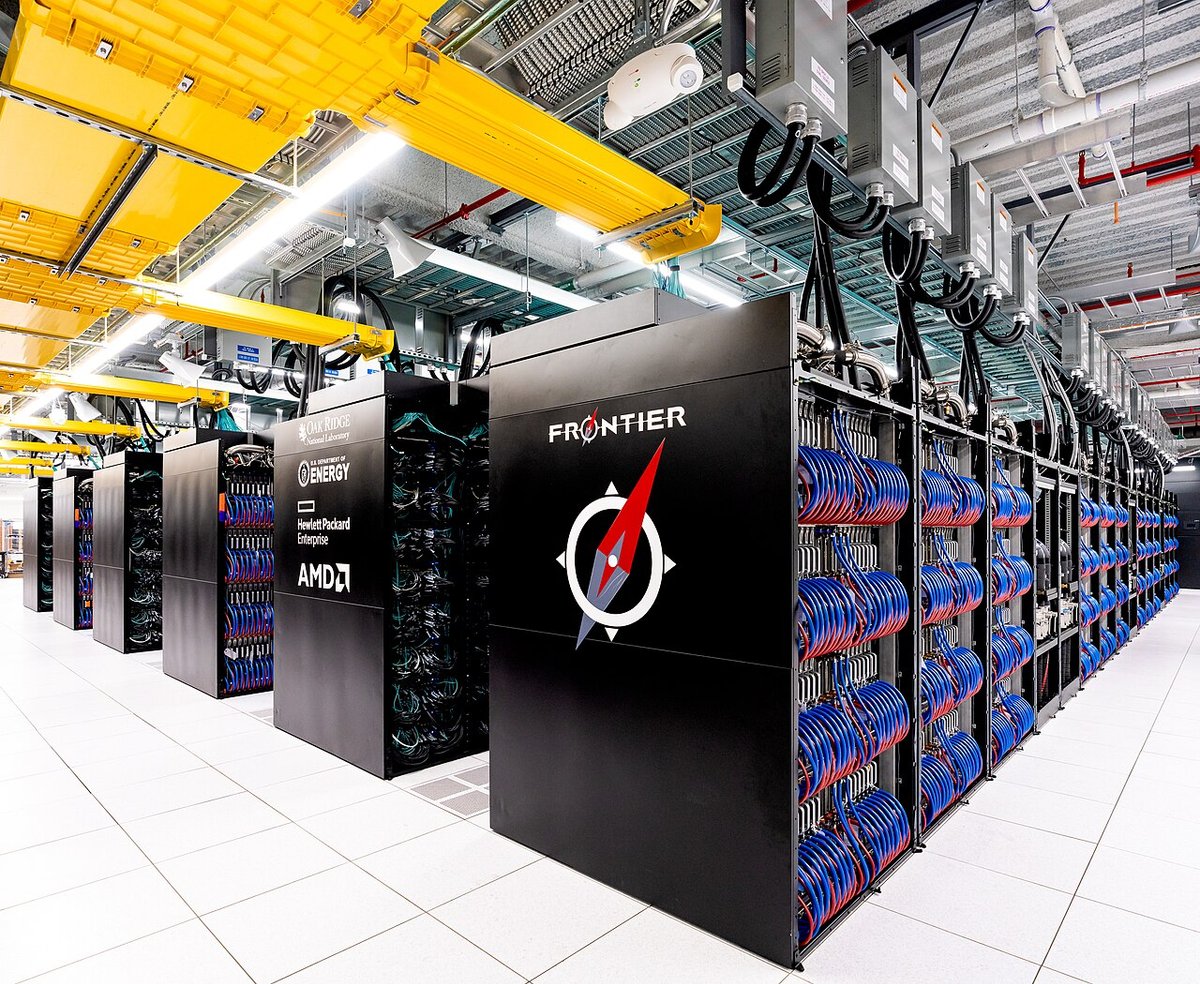
Since 1993 the TOP500 project has ranked the world's most powerful systems twice a year by their results on the Linpack benchmark. [3] In June 2022 the Frontier system at Oak Ridge National Laboratory became the first machine to pass one exaflop/s on that benchmark, [4] and on the November 2026 list five systems were in the exascale class, led by LineShine in Shenzhen, China, at 2.198 exaflop/s. [5] HPC and artificial intelligence computing have converged over the same period. GPU-accelerated supercomputers have been used to train large language models, [7] a mixed-precision benchmark measures AI-style low-precision arithmetic on them, [8] and the TOP500 organizers suggested in November 2026 that, while few new HPC systems were reaching the list, growth in computing hardware had shifted toward the large AI clusters known as AI factories, with five major U.S. hyperscalers owning an estimated 71 percent of global AI compute. [5]
Definition and scope
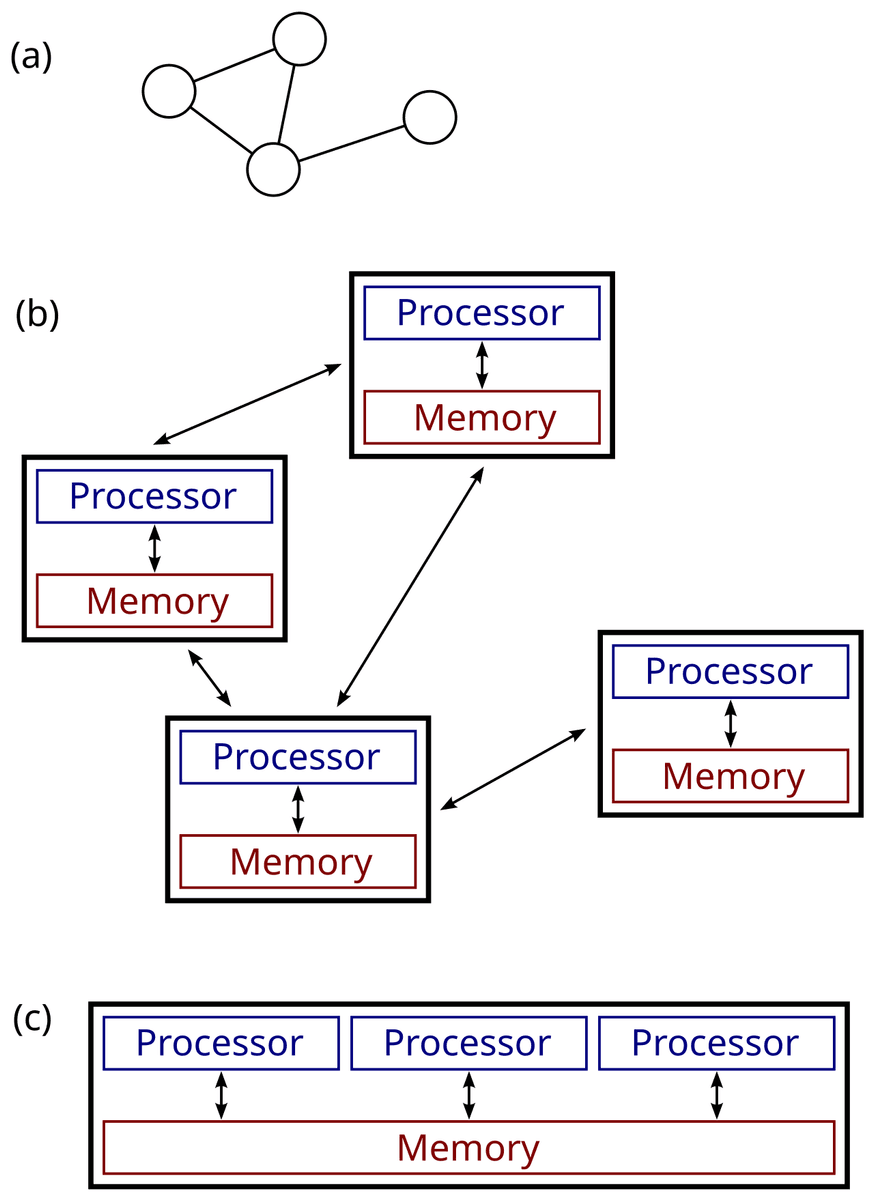
The U.S. Geological Survey describes a supercomputer as one large computer made up of many smaller computers, each called a node. Each node has its own processors or cores, and the nodes talk to each other through a communications network such as InfiniBand. [1] According to the USGS, scientists turn to HPC when a desktop or single server can no longer handle the work, for example when a study area grows from regional to global scale, when new data must be integrated, or when a model's resolution is increased. [1]
HPC overlaps with distributed computing, cloud computing and the GPU clusters built for AI training. The categories are not exclusive: the Eagle system, a Microsoft NDv5 cluster of NVIDIA H100 GPUs installed in the Azure cloud, debuted at No. 3 on the TOP500 in November 2023 and was described in June 2024 as the highest-ranked cloud system on the list, with 561.2 petaflop/s on the benchmark. [6]
History
Early supercomputers
The CDC 6600, designed by Seymour Cray at Control Data, set speed records in 1964. It executed about 3,000,000 instructions per second and was not surpassed until the CDC 7600 of 1969, another Cray design. Control Data sold about 100 of them, which took supercomputers beyond their usual government and military customers. [9] Cray's later Cray-1 was the world's fastest computer from 1976 to 1982. Its vector-processing design suited problems such as cryptography, bomb simulation and aircraft design; it sold for up to $10 million and drew 115 kW of power. [10]
Parallel designs developed alongside these machines. Daniel Slotnik's 1966 design for the ILLIAC IV called for 256 processors executing the same instruction on different data, but only 64 were completed and the cost grew from $8 million to $31 million. [11] The museum notes that coordinating hundreds or thousands of processors is hard to program, but that by 2000 parallel machines had started to excel and made less expensive supercomputers possible. [11] From 1994 the Beowulf project, named and first built by Thomas Sterling and Donald Becker, assembled supercomputers from clusters of ordinary PCs running open-source software such as Linux, and often matched the performance of far costlier systems. [12] IBM's Roadrunner broke the petaflop/s barrier in June 2008. [13]
Accelerators and the race to exascale
China's Tianhe-1A, which used NVIDIA GPUs to accelerate computation, was No. 1 on the TOP500 in November 2010. [17][14] Two years later, in November 2012, Titan, a Cray XK7 at Oak Ridge with NVIDIA K20x accelerators, took No. 1 at 17.59 petaflop/s; 62 systems on that list used accelerator or co-processor technology. [14] Summit, which took No. 1 in June 2018, paired two IBM Power9 CPUs with six NVIDIA Tesla V100 GPUs in each of its 4,356 nodes. [15] In June 2020 Japan's Fugaku, built on Fujitsu's 48-core A64FX chip, became the first No. 1 system powered by Arm processors. [16] It held the top spot until November 2021. [6]
| Date | System | Designer or site | Milestone |
|---|---|---|---|
| 1964 | CDC 6600 | Control Data | Set speed records; about 3 million instructions per second [9] |
| 1976 | Cray-1 | Seymour Cray | World's fastest computer until 1982 [10] |
| June 1993 | CM-5 | Los Alamos National Laboratory | No. 1 on the first TOP500 list [3][17] |
| June 2008 | Roadrunner | Los Alamos National Laboratory | First to break the petaflop/s barrier [13] |
| November 2012 | Titan | Oak Ridge National Laboratory | GPU-accelerated No. 1, 17.59 petaflop/s [14] |
| June 2018 | Summit | Oak Ridge National Laboratory | No. 1 at 122.3 petaflop/s with NVIDIA V100 GPUs [15] |
| June 2020 | Fugaku | RIKEN Center for Computational Science | First Arm-based No. 1, 415.5 petaflop/s [16] |
| June 2022 | Frontier | Oak Ridge National Laboratory | First exascale result, 1.102 exaflop/s [4] |
| November 2024 | El Capitan | Lawrence Livermore National Laboratory | No. 1 at 1.742 exaflop/s [18] |
| June 2026 | LineShine | National Supercomputing Centre in Shenzhen | No. 1 at 2.198 exaflop/s, CPU-only [19] |
How HPC systems are built
Processors, accelerators and interconnects
A majority of TOP500 systems now pair general-purpose CPUs with accelerators: on the November 2026 list, 291 of the 500 systems (58.2 percent) were accelerator-based. [5] The leading designs differ considerably. El Capitan combines AMD 4th Gen EPYC processors with AMD Instinct MI300A accelerators; JUPITER Booster in Germany uses NVIDIA GH200 Grace Hopper Superchips in Eviden's direct liquid-cooled BullSequana XH3000 architecture; Fugaku and LineShine use CPUs only. [19]
The network linking the nodes is as important as the processors. El Capitan, Frontier and Aurora use Cray's Slingshot-11 interconnect, JUPITER Booster uses quad-rail NVIDIA InfiniBand NDR200, Fugaku uses Fujitsu's Tofu interconnect D, and LineShine uses a proprietary interconnect called LingQi. [19] Power draw at this scale is measured in tens of megawatts: the June 2026 list reports 42,220 kW for LineShine and 29,685 kW for El Capitan. [19]
Storage and scheduling
Supercomputers share storage through parallel file systems. Lustre, for example, describes itself as an open-source parallel file system that supports many requirements of leadership-class HPC simulation environments. [20] Access to the machine is managed by a batch scheduler. Slurm, an open-source cluster management and job scheduling system for Linux clusters, allocates exclusive or shared access to compute nodes for a set time, starts and monitors the (usually parallel) jobs on those nodes, and resolves contention for resources by managing a queue of pending work. [21]
Programming models
Communication between the processes of a parallel program is commonly handled through the Message Passing Interface (MPI), whose standardization body is the MPI Forum. [22][23] The Forum approved MPI-3.0 on September 21, 2012, MPI-4.0 on June 9, 2021, and MPI-5.0 on June 5, 2025. [23] Within a node, the OpenMP API gives shared-memory parallel programmers a portable, scalable interface for developing parallel applications on platforms ranging from embedded systems and accelerator devices to multicore and shared-memory systems. Its specification is overseen by the OpenMP Architecture Review Board, a non-profit corporation whose permanent members are vendors with a long-term interest in OpenMP products. [24]
Limits of parallel speedup
A recurring question in HPC is how much faster a program can run when more processors are added. In 1967 Gene Amdahl argued that even a small serial fraction of a program caps the attainable speedup. [25] If $N$ is the number of processors, $s$ the time a serial processor spends on the serial part of the program and $p$ the time it spends on the parallelizable part, with $s + p = 1$, Amdahl's law gives
which can never exceed $1/s$ however many processors are used. [25]
In a 1988 paper, John Gustafson of Sandia National Laboratories reported speedups of 1,021, 1,020 and 1,016 for three applications on a 1,024-processor hypercube, even though their serial fractions were 0.4 to 0.8 percent. He argued that Amdahl's formula assumes a fixed problem size, whereas in practice users scale the problem with the machine, so that the parallel work grows with $N$. With $s'$ and $p'$ the serial and parallel times measured on the parallel system ($s' + p' = 1$), the alternative he presented, which he credited to E. Barsis at Sandia, gives a scaled speedup of
a straight line with a much gentler slope. [25]
Measuring performance
TOP500 and the Linpack benchmark
The TOP500 grew out of annual counts of vector computer manufacturers' systems that Hans Meuer had published since 1986, based mainly on the Mannheim Supercomputer Seminar; the first list appeared in 1993 and the list has been published every June and November since. [3][5] Systems are ranked by the High Performance Linpack (HPL) benchmark, which solves a dense system of linear equations. To keep results comparable, the solver must use LU factorization with partial pivoting, with an operation count of $\tfrac{2}{3}n^3 + O(n^2)$ double-precision floating-point operations. The rules exclude fast matrix multiplication algorithms such as Strassen's method, methods that compute in lower than 64-bit precision and then refine the answer iteratively, and methods that emulate floating-point arithmetic in software with integer arithmetic. [26]
Each entry reports Rmax, the best performance achieved, and Rpeak, the theoretical peak. [26] The gap can be large: El Capitan's Rmax was 1,809.00 petaflop/s against an Rpeak of 2,821.10 petaflop/s in June 2026. [19] The TOP500 itself cautions that the benchmark "does not reflect the overall performance of a given system, as no single number ever can", because it measures a dedicated machine solving one very regular problem. [26]
Complementary benchmarks
Several companion rankings measure other aspects of a system:
| Benchmark | What it measures | Leader, November 2026 |
|---|---|---|
| HPL | 64-bit dense linear algebra | LineShine, 2.198 exaflop/s [5] |
| HPCG | Data-intensive application behavior | LineShine, 22.00 petaflop/s [5] |
| HPL-MxP | Mixed-precision solve refined to 64-bit accuracy | El Capitan, 16.7 exaflop/s [5] |
| Green500 | Energy efficiency | KAIROS (France), 73.28 gigaflop/s per watt [5] |
HPL-MxP was designed for this convergence: machine learning methods reach useful results at 32-bit and lower precision, and new hardware offers high performance and energy savings at those formats. It factors the matrix in low precision (likely 16-bit), then uses an iterative method, the generalized minimal residual method (GMRES) with the LU factors as a preconditioner, to recover 64-bit accuracy. [8] The difference in scale is visible in the results: El Capitan's HPL-MxP score of 16.7 exaflop/s is about nine times its HPL result. [5] LineShine, a CPU-only system, achieved a more modest 3.6x speedup on HPL-MxP, which the TOP500 described as consistent with its CPU-only design. [19]
Exascale computing
Exascale computing means performing $10^{18}$ operations per second, about 1,000 times the petascale speed of earlier leading systems. [27] In the United States the Exascale Computing Project (ECP), a joint project of the Department of Energy (DOE) Office of Science and the National Nuclear Security Administration, ran from 2016 to 2024 to deliver not only the machines but a software and application ecosystem for them. Twenty-four application development teams took part and seventy software technology products were actively developed for next-generation architectures. Fifteen of DOE's 17 national laboratories participated, and the project comprised about 1,000 researchers, scientists, U.S. HPC companies and project management experts. [27]
Peak performance alone did not settle the question of who reached exascale first. In June 2022 the TOP500 noted that Fugaku's theoretical peak was above one exaflop/s, but that Frontier was the only system to demonstrate it on HPL. [4]
| TOP500 rank (Nov. 2026) | System | Site | Country | HPL (exaflop/s) | First exascale list | Processors |
|---|---|---|---|---|---|---|
| 1 | LineShine | National Supercomputing Centre in Shenzhen | China | 2.198 | June 2026 | 304-core LX2 CPUs [19] |
| 2 | El Capitan | Lawrence Livermore National Laboratory | United States | 1.809 | November 2024 | AMD EPYC and Instinct MI300A [18][19] |
| 3 | Frontier | Oak Ridge National Laboratory | United States | 1.353 | June 2022 | AMD EPYC and Instinct MI250X [4][19] |
| 4 | Aurora | Argonne National Laboratory | United States | 1.012 | June 2024 | Intel Xeon CPU Max and Data Center GPU Max [6][19] |
| 5 | JUPITER Booster | Jülich Supercomputing Centre | Germany | 1.000 | November 2025 | NVIDIA GH200 [19][28] |
El Capitan debuted at 1.742 exaflop/s in November 2024 and was later remeasured at 1.809 exaflop/s. [18][28] JUPITER Booster, fully installed by November 2025, was the first exascale system outside the United States and is the first in Europe. [28] LineShine, built by the Shenzhen Cloud Computing Center on a custom "LingKun" platform and running Kylin OS, debuted in June 2026 more than 20 percent ahead of the No. 2 system and became the first China-based No. 1 since Sunway TaihuLight in 2017. [19]
Convergence with AI
Shared hardware and benchmarks
When Fugaku took first place in 2020, the TOP500 noted that its peak performance in single or further reduced precision, the formats often used in machine learning, was over one exaflop/s, more than double its 64-bit HPL result. [16] HPL-MxP was designed to connect the two worlds by letting AI-oriented low-precision hardware count toward a 64-bit-accurate answer. [8]
AI workloads on supercomputers
Supercomputers are also used to train AI models directly. A 2023 study by Oak Ridge researchers explored how to train large language models on Frontier, combining tensor parallelism, pipeline parallelism and sharded data parallelism. For 22-billion, 175-billion and 1-trillion-parameter models they reached GPU throughputs of 38.38, 36.14 and 31.96 percent respectively. For the two largest models they reported 100 percent weak scaling efficiency on 1,024 and 3,072 MI250X GPUs, and strong scaling efficiencies of 89 and 87 percent. [7] The authors described Frontier as the world's first exascale supercomputer dedicated to open science. [7]
National laboratories have begun ordering systems built mainly for AI. On October 28, 2025, DOE announced a partnership with NVIDIA and Oracle for Solstice, a system of 100,000 NVIDIA Blackwell GPUs that it called the largest AI supercomputer in its laboratory complex, and Equinox, a 10,000-GPU Blackwell system expected to be delivered in 2026, both at Argonne National Laboratory. DOE described the arrangement as a public-private partnership model with shared investment and shared computing power. [29][30] A day earlier AMD announced two systems for Oak Ridge. Lux, co-developed with Oracle Cloud Infrastructure and HPE and built on AMD Instinct MI355X GPUs, was scheduled for early 2026, and AMD called it the first dedicated AI factory for science, energy and national security in the United States. [31] Lux appeared on the November 2026 TOP500 list at No. 14, with 220.79 petaflop/s on HPL. [37] Discovery, built with HPE on AMD "Venice" CPUs and Instinct MI430X GPUs, was expected to be delivered to Oak Ridge in 2028, with user operations in 2029. AMD put the combined investment at $1 billion in public and private funding. [31] The Register counted nine new machines across Argonne, Oak Ridge and Los Alamos, including the Los Alamos systems Mission, for nuclear stockpile stewardship, and Vision, for open science. [30] Doudna, also known as NERSC-10, was announced at Lawrence Berkeley National Laboratory in May 2025 as a Dell system on NVIDIA's Vera Rubin platform. At the announcement NVIDIA said the system was set to launch in 2026 and presented it as a single platform for simulation, data and AI, expected to deliver more than ten times the scientific output of its predecessor, Perlmutter, while using two to three times the power. [32]
The policy framing changed at the same time. The executive order launching the Genesis Mission, signed on November 24, 2025, directs DOE to build a platform providing "high-performance computing resources, including DOE national laboratory supercomputers and secure cloud-based AI computing environments, capable of supporting large-scale model training, simulation, and inference". [33]
AI supercomputers outside the TOP500
A 2025 study by Konstantin Pilz, James Sanders, Robi Rahman and Lennart Heim assembled a dataset of 500 AI supercomputers from 2019 to 2025 and found that their computational performance had doubled every nine months, while hardware cost and power needs each doubled every year. The leading system in March 2025, xAI's Colossus, used 200,000 AI chips, had a hardware cost of $7 billion and needed 300 MW of power. The authors also found that companies' share of AI supercomputer performance had risen quickly while the share held by governments and academia had fallen. [34]
The TOP500 organizers drew a similar conclusion in November 2026. That list contained only 27 new systems (5.4 percent), the lowest turnover in its history, even as the market for advanced computing hardware boomed. Citing Epoch AI, they noted that cumulative global AI compute had passed the equivalent of 15 million NVIDIA H100 GPUs and that five large U.S. hyperscalers owned an estimated 71 percent of it as of the fourth quarter of 2025, and suggested that growth had shifted toward AI factories, "from capability systems to capacity systems". [5]
The double-precision question
The HPL ranking and many traditional HPC workloads depend on 64-bit (FP64) arithmetic, whereas machine learning methods reach useful results at 32-bit and lower precision. [26][8][35] One response is to emulate FP64 arithmetic on the low-precision units of AI hardware. In a 2026 preprint, Satoshi Matsuoka argued that on AI-optimized GPUs of the NVIDIA B300 generation and later, FP8 tensor-core operations combined through the Ozaki Scheme II can serve as the main matrix-multiplication substrate for the FP64 kernel classes he surveyed, at FP64-grade accuracy. He presented the claim as conditional, and his model estimates that the method lifts the emulated FP64 ceiling from about 1.3 to about 135 teraflop/s on a B300 GPU. [36] Another 2026 study emulated FP64 matrix multiplications with INT8 arithmetic in LSMS, an ab initio electronic-structure application in the MuST suite, without changing its code, and found that accuracy depended on both the arithmetic precision and the properties of the operator. [35] Under the TOP500's rules, however, HPL results may not use methods that emulate floating-point arithmetic with integer arithmetic, so such techniques do not count toward the main ranking. [26]
Continue reading
- AI computeAI compute is the processing capacity used to train and run artificial intelligence models, together with the chips, memory, networks, data centers, electricity and capital that supply it.Mentioned twice above
- GPU ClusterA GPU cluster is a group of servers containing graphics processing units that are connected by high-bandwidth, low-latency networks and operated as one computational pool.Listed in See also
- Distributed computingDistributed computing is the field of computer science concerned with systems in which many computers, often in different locations and connected by a local or wide-area networkListed in See also
- FLOPSFLOPS (floating-point operations per second, also written FLOP/s) is a measure of computing speed: the number of arithmetic operations on floating-point numbers that a processor, accelerator or supercomputer…Listed in See also
- AI for ScienceAI for science is the use of artificial intelligence, particularly deep learning and large language models, to accelerate scientific discovery across biology, chemistry, physics, materials science…Listed in See also
- Mixed-Precision TrainingMixed-precision training is a technique for training deep learning models using lower-precision floating-point formats for most computations while maintaining a higher-precision copy of the model weights for…Listed in See also
More to read
Topics:AI ComputeAI HardwareAI InfrastructureComputer Science
References
- ^1 ^2 ^3U.S. Geological Survey, Advanced Research Computing. "What is High Performance Computing?". USGS. usgs.gov/...what-high-performance-computing
- ^1 ^2Computer History Museum. "The Fastest Brains for the Biggest Problems" (Supercomputers). Revolution: The First 2000 Years of Computing. computerhistory.org/...10
- ^1 ^2 ^3TOP500. "Introduction and Objectives". top500.org. top500.org/...introduction
- ^1 ^2 ^3 ^4TOP500. "June 2022". top500.org, June 2022. top500.org/...06
- ^1 ^2 ^3 ^4 ^5 ^6 ^7 ^8 ^9 ^10TOP500. "TOP500 Leadership Holds Steady as New System Turnover Falls to a Historic Low". top500.org, November 16, 2026. top500.org/...w-system-turnover-falls-historic-low
- ^1 ^2 ^3TOP500. "June 2024". top500.org, June 2024. top500.org/...06
- ^1 ^2 ^3Dash, Sajal; Lyngaas, Isaac; Yin, Junqi; Wang, Xiao; Egele, Romain; Cong, Guojing; Wang, Feiyi; Balaprakash, Prasanna. "Optimizing Distributed Training on Frontier for Large Language Models". arXiv:2312.12705, December 20, 2023. arxiv.org/...2312.12705
- ^1 ^2 ^3 ^4HPL-MxP. "HPL-MxP Mixed-Precision Benchmark". hpl-mxp.org. hpl-mxp.org
- ^1 ^2Computer History Museum. "CDC 6600's Five Year Reign". Revolution: The First 2000 Years of Computing. computerhistory.org/...33
- ^1 ^2Computer History Museum. "The Cray-1 Supercomputer". Revolution: The First 2000 Years of Computing. computerhistory.org/...10
- ^1 ^2Computer History Museum. "Parallel Processing". Revolution: The First 2000 Years of Computing. computerhistory.org/...160
- ^Computer History Museum. "Broadening the Supercomputer Market". Revolution: The First 2000 Years of Computing. computerhistory.org/...71
- ^1 ^2Computer History Museum. "Entering the Race". Revolution: The First 2000 Years of Computing. computerhistory.org/...76
- ^1 ^2 ^3TOP500. "November 2012". top500.org, November 12, 2012. top500.org/...11
- ^1 ^2TOP500. "June 2018". top500.org, June 2018. top500.org/...06
- ^1 ^2 ^3TOP500. "June 2020". top500.org, June 2020. top500.org/...06
- ^1 ^2TOP500. "Top #1 Systems". top500.org. top500.org/...top-systems
- ^1 ^2 ^3TOP500. "November 2024". top500.org, November 2024. top500.org/...11
- ^1 ^2 ^3 ^4 ^5 ^6 ^7 ^8 ^9 ^10 ^11 ^12TOP500. "June 2026". top500.org, June 2026. top500.org/...06
- ^Lustre.org. "Lustre". lustre.org. lustre.org
- ^SchedMD. "Slurm Workload Manager - Overview". slurm.schedmd.com. slurm.schedmd.com/overview
- ^MPI Forum. "MPI Forum" (home page). mpi-forum.org. mpi-forum.org
- ^1 ^2MPI Forum. "MPI Documents". mpi-forum.org. mpi-forum.org/docs
- ^OpenMP Architecture Review Board. "About Us". openmp.org. openmp.org/...about-us
- ^1 ^2 ^3Gustafson, John L. "Reevaluating Amdahl's Law". Communications of the ACM 31(5): 532-533, May 1988. doi.org/...42411.42415
- ^1 ^2 ^3 ^4 ^5TOP500. "The Linpack Benchmark". top500.org. top500.org/...linpack
- ^1 ^2Exascale Computing Project. "About - Exascale Computing Project". exascaleproject.org. exascaleproject.org/about
- ^1 ^2 ^3TOP500. "November 2025". top500.org, November 2025. top500.org/...11
- ^U.S. Department of Energy. "Energy Department Announces New Partnership with NVIDIA and Oracle to Build Largest DOE AI Supercomputer". energy.gov, October 28, 2025. energy.gov/...idia-and-oracle-build-largest-doe-ai
- ^1 ^2Jadhav, Abhishek. "The exascale offensive: America's race to rule AI HPC". The Register, November 26, 2025. theregister.com/...the_exascale_offensive
- ^1 ^2AMD. "AMD Powers US Sovereign AI Factory Supercomputers, Accelerating an Open American AI Stack". AMD Newsroom, October 27, 2025. newsroom.amd.com/...reign-ai-factory-supercomputer
- ^Harris, Dion. "The Supercomputer Designed to Accelerate Nobel-Worthy Science". NVIDIA Blog, May 29, 2025. blogs.nvidia.com/...dell-nvidia-berkeley-doudna
- ^The White House. "Launching the Genesis Mission". whitehouse.gov, November 24, 2025. whitehouse.gov/...launching-the-genesis-mission
- ^Pilz, Konstantin F.; Sanders, James; Rahman, Robi; Heim, Lennart. "Trends in AI Supercomputers". arXiv:2504.16026, April 22, 2025. arxiv.org/...2504.16026
- ^1 ^2Liu, Hang; Li, Junjie; Wang, Yinzhi; Nepal, Niraj K.; Wang, Yang. "A Precision Emulation Approach to the GPU Acceleration of Ab Initio Electronic Structure Calculations". arXiv:2603.29975, March 31, 2026. arxiv.org/...2603.29975
- ^Matsuoka, Satoshi. "FP8 is All You Need (Part 1): Debunking Hardware FP64 as the HPC Holy Grail". arXiv:2606.06510, May 28, 2026 (revised September 8, 2026). arxiv.org/...2606.06510
- ^TOP500. "TOP500 List - November 2026". top500.org, November 2026. top500.org/...11
Improve this article
Add missing citations, update stale details, or write a clearer explanation. Anyone can edit: changes go live when you publish, and every edit is checked by an editor.
2 revisions · v2 · 3,773 words · full history
Fact-checks are independent of edits: a reviewer re-verifies the article against its sources and stamps the date. How we verify
Research and drafting on this wiki are AI-assisted, under named human editorial standards. How AI is used here
Reviewer note: Independent fact-check before publication on November 18, 2026: 118 claims checked against 41 cited and independent sources; 2 material and 6 minor corrections applied before publication.
Cite this page: AI Wiki. "High-performance computing." aiwiki.ai, updated 18 Nov 2026, fact-checked 18 Nov 2026. CC BY 4.0. https://aiwiki.ai/wiki/high_performance_computing