

Kinisi 01
| Kinisi 01 | |
|---|---|
 | |
| General information | |
| Manufacturer | Kinisi Robotics |
| Parent company | Bear Robotics (acquisition announced June 2026) |
| Also known as | KR1 |
| Type | Wheeled humanoid robot |
| Unveiled | July 2025 |
| Country of origin | United States / United Kingdom |
| Status | In production; pilot deployments |
| Price | ~$75,000 USD (or ~$4,000/month rental) |
| Website | kinisi.com |
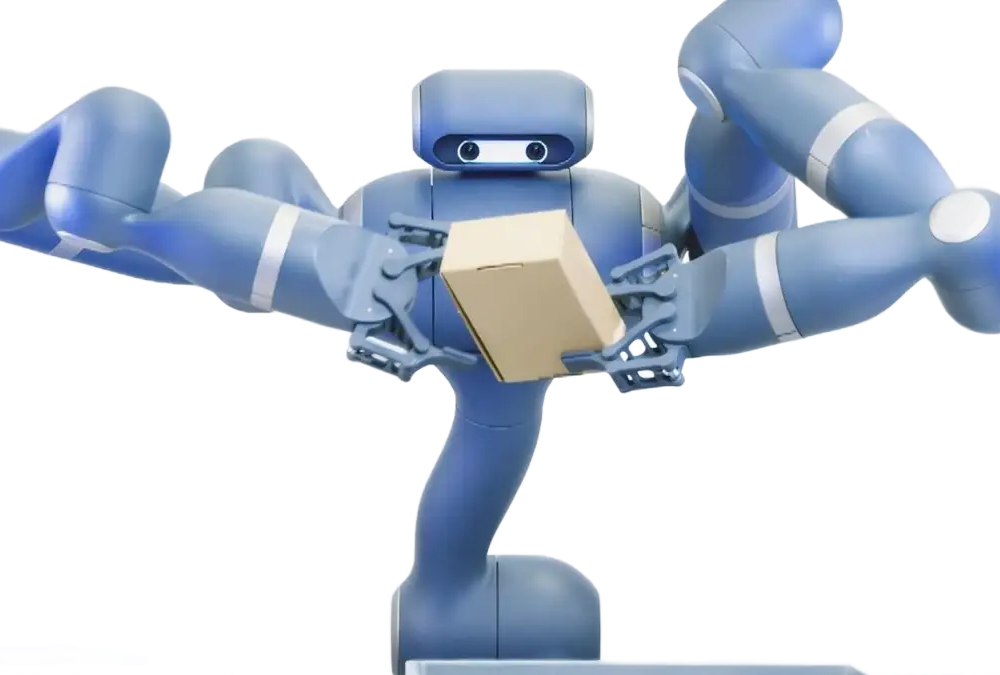
The Kinisi 01, also designated the KR1, is a wheeled humanoid robot developed by Kinisi Robotics for warehouse automation, logistics, and light manufacturing.[1][4] Unlike most humanoid robots that rely on bipedal locomotion, the Kinisi 01 uses an omnidirectional wheeled base to prioritize speed, stability, and practicality over human-like walking.[7] Standing 162 cm tall and weighing 100 kg, it carries dual arms with modular grippers, an IP65-rated aluminum chassis, and on-board artificial intelligence running on an NVIDIA Jetson module.[1][12] Kinisi Robotics positions the robot as an affordable, deployment-ready alternative to more expensive bipedal humanoids, with a list price of about $75,000 and a rental option of roughly $4,000 per month.[1]
The Kinisi 01 was first publicly unveiled in July 2025 after roughly 18 months of development.[4] It won the Automate Start-up Challenge in May 2025, and by November 2025 it had entered its first commercial deployment, sorting glass at a recycling facility in the United Kingdom.[8][6] Kinisi has also signed a pilot agreement with a major global automotive manufacturer for intra-logistics tasks.[10]
In June 2026, Bear Robotics, the LG-owned service-robot company that Kinisi founder Bren Pierce had co-founded years earlier, signed a definitive agreement to acquire Kinisi Robotics and fold the KR1 and its manipulation AI into Bear's product line.[19][20] Pierce is set to rejoin Bear as its Chief Robotics Officer once the deal closes.[19]
Why is the Kinisi 01 also called the KR1?
"Kinisi 01" is the full product name, while "KR1" serves as the abbreviated designation used in technical and media contexts. Both names refer to the same platform. The official product page on the Kinisi Robotics website uses "Kinisi 01,"[1] while press coverage and industry databases frequently use "KR1" or "Kinisi KR1" interchangeably.[4][13] The existing wiki article on Kinisi KR1 covers the same robot under its alternate designation.
Who makes the Kinisi 01?
Company background
Kinisi Robotics is a robotics startup with offices in New York City (140 Broadway, New York, NY 10005) and Bristol, United Kingdom (Beacon Tower, Colston Street, Bristol BS1 5AQ).[2] The company was founded in late 2023 and formally established in January 2024 by Brennand "Bren" Pierce, a roboticist with roughly two decades of experience across academia and robotics startups.[2][9][18] Pierce previously co-founded Robotise GmbH, a Munich-based startup that built autonomous mobile delivery robots for hotels, and Bear Robotics, the Silicon Valley company behind the Penny and Servi restaurant delivery robots, which raised a $32 million Series A led by SoftBank.[9][17] Bear grew to around 200 employees and, by 2026, had shipped more than 16,000 service robots worldwide since its 2017 founding.[19] In January 2025, LG Electronics took a majority (51%) stake in Bear Robotics, a deal reportedly valuing the company at about $600 million.[22] Across his ventures, Pierce has raised more than $180 million from investors.[7]
Pierce holds a PhD from the Technical University of Munich (TUM), where his doctoral research focused on low-cost humanoid robots.[9][17] During his academic career he built a full-size compliant humanoid robot called "Herbert" and developed a new generation of FPGA-based robotic controllers.[17] He also worked on a project with Samsung at Carnegie Mellon University.[9][17] His professional philosophy centers on building robots that are economically viable for real-world commercial applications rather than research demonstrations.[9] Pierce spent roughly his first decade in academia working on humanoid robotics and locomotion, then a second decade founding robotics companies.[9]
The name "Kinisi" derives from the Greek word for movement, reflecting the company's focus on creating technology that makes physical work more efficient.[2]
Leadership team
As of early 2026, the Kinisi Robotics leadership team includes:
| Name | Role | Background |
|---|---|---|
| Brennand Pierce | Founder and CEO | PhD in humanoid robotics (TUM); co-founded Robotise and Bear Robotics [9] |
| Aaron Colfer | Head of Product | Former Senior Manager of Industrial Design at Dyson (2021 to 2024); Senior Design Lead at Matter [2] |
| Mitch Leibowitz | Head of Business Development | Business development and partnerships [2] |
| Mark Finean | Head of Robotics | Robotics engineering lead [2] |
Funding and milestones
Kinisi Robotics has raised approximately $2 million in seed funding as of early 2026.[18] The company has been recruiting partners in fulfillment, retail replenishment, and light manufacturing ahead of a planned production ramp in 2026. Its development has followed a rapid timeline:
| Date | Milestone |
|---|---|
| January 2024 | Company founded; initial customer conversations begin [2] |
| May 2024 | KR1 prototype completed with agentic AI capabilities [9] |
| September 2024 | First employees hired; Bristol office established [2] |
| October 2024 | First customer visit [9] |
| April 2025 | V2 hardware completed [9] |
| May 2025 | First on-site customer demonstration in Europe; won Automate Start-up Challenge ($10,000 prize) [8] |
| July 2025 | Public unveiling of the Kinisi 01 platform [4] |
| September 2025 | V3 hardware launched [9] |
| November 2025 | First commercial deployment (glass recycling in UK) [6] |
| June 2026 | Bear Robotics signs definitive agreement to acquire Kinisi Robotics [19] |
Who acquired Kinisi Robotics?
On June 22, 2026, Bear Robotics announced that it had signed a definitive agreement to acquire Kinisi Robotics, bringing the KR1 platform and its manipulation AI under Bear's roof.[19][20] The transaction was expected to close within days of the announcement, subject to customary closing conditions, and the deal terms were not disclosed.[19][20]
The acquisition reunites Kinisi founder Bren Pierce with the company he helped start. Pierce co-founded Bear Robotics before leaving to found Kinisi, and he is set to return as Bear's Chief Robotics Officer once the deal closes, leading the combined robotics engineering organization.[19][20] Kinisi's Bristol engineering team is to continue as Bear's European engineering hub.[20]
For Bear Robotics, a company known for its Servi restaurant-service robots and majority-owned by LG Electronics, the deal adds physical manipulation to a fleet built mainly for navigation and delivery. Bear has shipped more than 16,000 service robots worldwide since 2017.[19] The assets Bear is acquiring include the KR1 hardware, Kinisi's vision-language-action (VLA) model and robot foundation model, in-house gripper and end-effector designs, and a low-cost glove system for capturing manipulation demonstrations.[20]
John Ha, Bear Robotics founder and CEO, said Kinisi's "manipulation AI is the layer that lets our robots move from navigating and delivering to actually handling the work in front of them."[21] Pierce framed the combination in similar terms: "Manipulation is the missing layer, and that's what Kinisi brings. Together we're not building one humanoid in isolation; we're completing an integrated, multi-robot automation platform."[21]
Why does the Kinisi 01 use wheels instead of legs?
The Kinisi 01's most distinctive design choice is its wheeled base rather than bipedal legs. Founder Bren Pierce argues that legs are unnecessary complexity for the vast majority of industrial applications. "80% of the tasks that humanoids aim for, you don't need legs," he told The Robot Report.[9] In an interview with Tech.eu he put the engineering trade-off bluntly: "Why spend on 14 motors when two will do?"[7] Pierce has said customers "see humanoids with legs and hands as cool toys, not industrial tools," and Kinisi says the wheeled base lets the robot move about twice as fast as a legged humanoid.[7][1]
The company's strategy is to build its AI software on top of proven, reliable hardware rather than trying to reinvent both hardware and AI at once.[9] Pierce points to past failures in consumer robotics as cautionary tales, citing Anki (which raised $182.5 million), Jibo ($72 million), and Mayfield Robotics' Kuri ($73 million) as products that over-engineered hardware without reaching commercial viability.[7] SoftBank's Pepper robot, discontinued after about 27,000 units, is another example he has referenced.[7] "At Kinisi, we don't sell science fiction," Pierce has said. "We build robots that actually get work done."[11]
Pierce is skeptical of the polished demonstration videos common in the industry, which he says are "usually staged demos in ideal environments" featuring "spotless kitchens, brightly coloured single objects" that bear little resemblance to messy, unpredictable warehouses and factories.[7] As he put it, "no warehouse is asking for a robot that can do backflips. They're asking for one that shows up to work."[7]
The Kinisi 01 targets what Kinisi calls the roughly 70% of warehouses that are "small, irregular spaces with mixed inventory" and cannot justify large fixed-automation budgets.[7] Because the robot is built to work alongside people, it does not require the safety cages that conventional industrial automation needs, and it is designed to slot into existing workflows without new conveyor systems or facility redesigns. Kinisi frames the pitch around uptime, describing a machine that can work full shifts without breaks or sick days.[16] "Our north star is running an entire eight-hour shift and fully replacing a human in that role," Pierce has said.[11]
What are the Kinisi 01's specifications?
Physical structure
The Kinisi 01 stands 162 cm (approximately 5 feet 4 inches) tall and weighs 100 kg (220 lb).[1][12] The frame is constructed from aluminum and carries an IP65 ingress protection rating, meaning it is fully protected against dust and low-pressure water jets from any direction.[1] This level of protection allows the robot to operate in industrial environments where dust, debris, and occasional liquid splashes are common. The chassis is precision-engineered with gaps no larger than 0.5 mm, and joints are protected with polyurethane bands to prevent contaminant ingress.[1]
Detailed specifications
| Category | Specification | Value |
|---|---|---|
| Physical | Height | 162 cm (5 ft 4 in) [1] |
| Physical | Weight | 100 kg (220 lb) [1] |
| Physical | Frame material | Aluminum [1] |
| Physical | IP rating | IP65 [1] |
| Physical | Chassis gap tolerance | 0.5 mm or less [1] |
| Mobility | Base type | Omnidirectional wheeled [1] |
| Mobility | Turning radius | Zero-turn capable [1] |
| Mobility | Top speed | 2.4 m/s (8.6 km/h / 5.4 mph) [1] |
| Mobility | Max speed (third-party listing) | Up to 14.4 km/h [12] |
| Mobility | Degrees of freedom (total) | 21 [12] |
| Mobility | DOF per hand | 2 [12] |
| Manipulation | Dynamic payload | 25 kg (55 lb) [1] |
| Manipulation | Static payload | 40 kg (88 lb) [1] |
| Manipulation | Gripper type | Dual-end gripper with quick-swap interface [1] |
| Manipulation | End-effector options | Mechanical fingers, vacuum tools [1] |
| Actuators | Motor type | Brushless DC (BLDC) [1] |
| Actuators | Gear technology | Strain wave (harmonic drive) [1] |
| Actuators | Arm modules | Compact wave gear with integrated encoders [1] |
| Power | Battery voltage | 48V [1] |
| Power | Battery type | Lithium-ion (20 Ah modular pack) [1] |
| Power | Runtime | 6 to 8 hours (typical industrial duty cycle) [1] |
| Power | Charging | 80% in 90 minutes (CC/CV smart charger) [1] |
| Power | Battery swap | Hot-swappable with auto-docking [1] |
| Power | Battery management | Integrated BMS with thermal and current protection [1] |
| Perception | Cameras | Stereo depth cameras [1] |
| Perception | LiDAR | 180-degree array with SLAM integration [1] |
| Perception | Depth accuracy | Plus or minus 2 mm at 2 meters [1] |
| Perception | Perception-to-action latency | Sub-100 ms [1] |
| Computing | Processor | NVIDIA Jetson (CPU/GPU) [1] |
| Computing | AI inference | Real-time transformer models [1] |
| Computing | Operating system | Linux [1] |
| Connectivity | Cloud telemetry | Encrypted, via Kinisi Mission Control [1] |
| Connectivity | Updates | Over-the-air (OTA) firmware [1] |
| Connectivity | API | Available [1] |
| Connectivity | ROS compatible | Yes [1] |
| Safety | Controllers | Dual redundant with watchdogs [1] |
| Safety | Emergency stop | Hardware and software linked [1] |
| Safety | Diagnostics | Continuous thermal and current monitoring [1] |
| Safety | Fail-safe | Automatic deceleration and posture lock on critical alerts [1] |
Mobility system
The omnidirectional wheeled base provides zero-turn capability, allowing the Kinisi 01 to rotate in place and navigate tight aisles and confined warehouse spaces.[1] The base includes an active damping suspension system that compensates for terrain variation and load shifting, helping maintain stability when the robot is carrying heavy objects.[1] At a top speed of 2.4 m/s (approximately 8.6 km/h), the Kinisi 01 moves significantly faster than most bipedal humanoid robots, which typically walk at 1.0 to 1.5 m/s.[1] Some third-party spec databases list higher maximum figures, up to 14.4 km/h, that Kinisi's own materials do not confirm.[12] The wheeled platform also eliminates the risk of falls that bipedal systems face on smooth warehouse floors.
The wheeled design does impose limitations. The Kinisi 01 is restricted to relatively flat, smooth surfaces and cannot climb stairs, step over obstacles, or work on uneven terrain. Kinisi Robotics argues that this trade-off is acceptable because the vast majority of warehouse and factory floors are flat, and the speed, stability, and cost advantages of wheels outweigh the loss of terrain versatility.[7]
Manipulation system
The Kinisi 01 features dual human-scale arms with 21 total degrees of freedom distributed across the body, including 2 DOF per hand.[12] The arms use compact wave gear modules with integrated encoders, driven by brushless DC motors through strain wave (harmonic drive) gearing for precise, low-backlash motion.[1]
The gripper system uses a dual-end design with a quick-swap interface that allows operators to change end-effectors depending on the task.[1] Available options include mechanical finger grippers for grasping items like bottles and boxes, and vacuum end-effectors for handling flat or smooth-surfaced objects such as cartons and poly-bags.[1] The robot can handle dynamic payloads of up to 25 kg (55 lb) and static loads of up to 40 kg (88 lb), according to Kinisi's product specifications.[1] Some 2025 press coverage from the unveiling reported a lower payload figure of around 10 kg.[4] Kinisi describes the system as combining "human-level strength and dexterity" for both heavy lifting and delicate manipulation.[1]
Perception and sensing
The Kinisi 01's sensor suite combines stereo depth cameras with a 180-degree LiDAR array.[1] The stereo cameras provide depth perception with an accuracy of plus or minus 2 mm at a range of 2 meters, which is sufficient for precise picking and placement operations.[1] The LiDAR array feeds into a SLAM (Simultaneous Localization and Mapping) system that builds and continuously updates a map of the robot's environment, enabling autonomous navigation without pre-programmed paths.[1]
All sensor data is fused in real time to create a 3D representation of the workspace. The perception-to-action latency is under 100 milliseconds, meaning the robot can detect an obstacle or identify an object and begin responding in less than a tenth of a second.[1] The company describes the fused perception system as enabling the robot to "detect motion, anticipate intent, and navigate with precision."[1]
Power system
The Kinisi 01 runs on a 48V lithium-ion battery with a 20 Ah modular pack.[1] Under typical industrial duty cycles, the battery provides 6 to 8 hours of continuous operation.[1] Kinisi designed the battery to be hot-swappable, meaning operators can replace a depleted battery pack with a charged one without shutting down the robot.[1] The system also supports auto-docking, where the robot autonomously returns to its charging station when battery levels drop below a threshold.[1]
Rapid charging reaches 80% capacity in approximately 90 minutes using a CC/CV (constant current / constant voltage) smart charger.[1] An integrated battery management system (BMS) provides thermal and current protection, monitoring cell temperatures and preventing overcharge or deep discharge conditions.[1]
Software and intelligence
On-board AI
All of the Kinisi 01's artificial intelligence processing runs locally on the NVIDIA Jetson module.[1] This edge computing approach means the robot does not depend on a cloud connection for real-time decision-making, which improves response times and ensures reliability in environments with poor or unstable internet connectivity. It also addresses data privacy concerns, as sensitive warehouse inventory data and operational patterns stay on the robot rather than being transmitted to external servers.
The AI system runs real-time transformer inference models for both navigation and manipulation tasks.[1] The robot uses a reinforcement learning controller that processes fused sensor data (LiDAR and stereo vision) to plan paths, avoid obstacles, and adjust arm trajectories dynamically. Kinisi has stated that modern large language model reasoning underpins the system's task generalization capabilities, allowing operators to demonstrate new workflows without coding.[5]
Imitation learning
One of the Kinisi 01's key features is its use of demonstration-based imitation learning. Rather than requiring traditional programming or coded task sequences, operators can teach the robot new tasks by physically demonstrating them.[5] The robot observes the demonstration and learns to replicate the task independently. Kinisi calls this approach part of its broader goal of making robots accessible to warehouse workers who may not have programming expertise. The company has emphasized that the system is "easy to deploy, with quick training and minimal setup."[1]
Pierce has highlighted the practical impact of AI on deployment timelines: tasks that previously required 5 to 10 engineers working over months can now be trained and deployed in days with 1 to 2 engineers using simulation and imitation learning.[9] "With AI and imitation learning, you can train in simulation and deploy in days with one or two engineers," he told Tech.eu.[7]
Shadow Play teleoperation
The system also supports what Kinisi calls "Shadow Play," a teleoperation mode where a human operator can remotely control the robot's movements in real time.[1] Data collected during teleoperation and demonstrations feeds into the robot's machine learning pipeline, allowing it to progressively improve its autonomous performance on trained tasks. This mode is particularly useful for teaching the robot to handle new object types or for managing unusual scenarios that the autonomous system has not yet been trained on.
Data flywheel and fleet intelligence
A central element of Kinisi's software strategy is its "data flywheel" architecture. Every deployed Kinisi 01 unit contributes operational data to a shared knowledge base. When one robot learns to handle a new object type, navigate a new obstacle pattern, or optimize a picking sequence, that knowledge can be distributed to the entire fleet. This means that as Kinisi deploys more robots, each individual unit benefits from the collective experience of all deployed systems.
Fleet management is handled through Kinisi Mission Control, a cloud-based telemetry and management platform.[1] Mission Control provides real-time monitoring of robot status, task progress, and fleet-wide analytics.[1] It supports remote task updates, over-the-air firmware updates, and encrypted data transmission.[1] Operators can switch individual robots between operating modes through the platform.
Operating modes
The Kinisi 01 supports three operating modes:
| Mode | Description |
|---|---|
| Autonomous | The robot operates independently using its onboard AI, navigating, picking, and placing without human intervention |
| Semi-autonomous | The robot handles routine operations autonomously but requests human guidance for edge cases or unfamiliar situations |
| Teleoperated (Shadow Play) | A human operator remotely controls the robot's movements in real time; useful for teaching new tasks or handling unusual scenarios |
Safety systems
The Kinisi 01 incorporates multiple layers of safety features designed for collaborative operation alongside human workers. The safety architecture includes dual redundant controllers with watchdog systems that independently monitor the robot's behavior and can trigger shutdowns if anomalies are detected.[1] Hardware and software-linked emergency stops provide immediate halting capability.[1]
The robot performs continuous thermal and current diagnostics during operation, monitoring actuator temperatures and power draw for signs of malfunction.[1] If critical alerts are triggered, the system initiates automatic deceleration and posture lock, bringing the robot to a controlled stop rather than allowing uncontrolled movements.[1] Kinisi positions the robot as certified for co-existence in shared human-robot workspaces, though specific compliance certifications (such as ISO 10218 or ISO/TS 15066) have not been publicly detailed.
What is the Kinisi 01 used for?
Target industries
Kinisi Robotics has identified several primary application domains for the Kinisi 01:
| Application | Description |
|---|---|
| Pick and place | Retrieving items from shelves or bins and placing them into totes, boxes, or onto conveyors |
| Tote and material handling | Moving loaded totes, boxes, and pallets between stations within a facility |
| Palletizing and depalletizing | Stacking and unstacking items on pallets for shipping or storage |
| Inspection and quality control | Using stereo cameras and depth sensing to visually inspect items for defects |
| Replenishment | Restocking shelves and inventory locations |
| Assembly support | Handling components in light manufacturing and assembly operations |
Where was the Kinisi 01 first deployed?
The Kinisi 01's first commercial deployment took place in November 2025 at a glass recycling facility in the United Kingdom.[6] This deployment marked the first time the platform performed live production work at a customer site.[6] The robot was tasked with autonomous glass bottle sorting for reuse, a process that requires delicate handling to prevent breakage while maintaining throughput.[6]
During the deployment, the Kinisi 01 used its stereo depth cameras and onboard AI to autonomously determine grasp points and classify bottles by shape, size, and material.[6] Because bottles arrived randomly oriented, the robot had to work out grasp points from geometry and stability on its own.[6] It was positioned at the sortation stage rather than near the crushing machinery, protecting it from the harsh environment of the glass recycling plant.[6] The robot had to balance speed against careful handling, as broken glass creates both product loss and safety hazards.
Aaron Colfer, Kinisi's Head of Product, acknowledged that the system's throughput was initially below human-operator levels: "The process is still slower than a human operator at this stage. Our plan now is to gradually increase speed, with the ambition of surpassing human throughput over the next couple of months."[6] This transparency about early performance limitations reflected Kinisi's approach of deploying real systems in production environments and iterating, rather than waiting for laboratory-perfect performance.
Automotive pilot
Kinisi has also secured a pilot agreement with an unnamed major global automotive manufacturer.[10] The initial focus of this pilot is on intra-logistics tasks, specifically moving totes, handling parts, and unloading components, rather than complex assembly operations.[10] This approach aligns with the industry pattern seen in other humanoid robot deployments, where companies like BMW and Mercedes-Benz have started with material handling before exploring more complex applications.
Future applications
Beyond warehouse logistics, Pierce has indicated interest in deploying the Kinisi 01 platform in hospitality and service environments.[10] Given his background co-founding Bear Robotics, which developed restaurant delivery robots, Pierce has envisioned future applications where the robot could serve food and bus tables in restaurants.[10] The platform's wheeled design and manipulation capabilities make it potentially suitable for service environments that share characteristics with warehouse settings: flat floors, structured layouts, and repetitive physical tasks. That direction became more concrete with the June 2026 agreement for Bear Robotics, a restaurant-service robot maker, to acquire Kinisi.[19]
Automate Start-up Challenge
In May 2025, Kinisi Robotics won the Automate Start-up Challenge, a pitch competition held as part of the Automate trade show organized by the Association for Advancing Automation (A3).[8] The event took place during Automate's four-day run from May 12 to 15, 2025 in Detroit, Michigan, where 45,000 people from around the world registered to visit the sold-out show floor featuring more than 900 exhibitors.[14] Kinisi won the $10,000 prize.[8]
The challenge is a competition where early-stage robotics and automation companies present their technology and business models to a panel of judges. Kinisi's win was notable because the company was competing against other innovative startups, including 3Laws Robotics (a CalTech spinout developing a dynamic universal safety layer for robots) and Sonair (which develops ultrasonic sensor technology).[15] The Automate Start-up Challenge provided Kinisi with industry visibility and credibility at a time when the company was preparing for broader pilot deployments. The event took place shortly before ICRA 2025 (the IEEE International Conference on Robotics and Automation) in Atlanta, Georgia.
Hardware iterations
The Kinisi 01 has gone through multiple hardware revisions in its relatively short development history:
| Version | Date | Notes |
|---|---|---|
| V1 (Prototype) | May 2024 | Initial prototype with agentic AI capabilities; completed roughly six months after company founding [9] |
| V2 | April 2025 | Second-generation hardware; used for first customer demonstrations in Europe [9] |
| V3 | September 2025 | Third-generation hardware; deployed in glass recycling pilot [9] |
This rapid iteration cycle (three hardware versions in roughly 16 months) reflects both Kinisi's agile development approach and the engineering focus on getting functional hardware into real-world environments as quickly as possible. Each iteration has incorporated feedback from customer visits and pilot deployments.
Research and development
Kinisi's R&D division concentrates on three core disciplines.[3] Mechanical engineering focuses on developing lightweight composite frames and precision actuator systems.[3] Software engineering creates integrated software stacks bridging perception, planning, and control, including the Mission Control fleet management interface.[3] The artificial intelligence team implements real-time AI systems that fuse multi-modal sensor data from vision, LiDAR, and inertial inputs.[3]
The company emphasizes vertical integration, combining mechanics, software, and AI from project inception.[3] Its development methodology flows from simulation through physical prototyping to field deployment, with digital twins modeling systems before manufacturing.[3] The company frames the evolution of robotics as trending toward "general-purpose" systems rather than single-task machines, though current focus remains on refining the Kinisi 01 platform for warehouse automation tasks.
How does the Kinisi 01 compare to other humanoid robots?
The Kinisi 01 occupies a distinctive niche in the humanoid robotics market. While companies like Figure AI, Tesla, Boston Dynamics, and Apptronik are developing bipedal humanoid robots with general-purpose ambitions, Kinisi has deliberately narrowed its focus to wheeled humanoids for industrial logistics.[7]
| Company | Robot | Locomotion | Key Focus | Price Range |
|---|---|---|---|---|
| Kinisi Robotics | Kinisi 01 (KR1) | Wheeled (omnidirectional) | Warehouse logistics, pick and place | ~$75,000 [1] |
| Figure AI | Figure 02 / Figure 03 | Bipedal | General-purpose manufacturing | ~$100,000 (estimated) |
| Apptronik | Apollo | Bipedal | Factory and warehouse automation | Undisclosed |
| Agility Robotics | Digit | Bipedal | Logistics and material handling | Undisclosed |
| Tesla | Optimus | Bipedal | Factory automation, consumer | $20,000 to $30,000 (target) |
| Unitree Robotics | G1 / H1 | Bipedal | General-purpose, research | ~$16,000 to $90,000 |
Kinisi's competitive advantages center on cost, speed, and reliability. The $75,000 price point (or $4,000/month rental) undercuts most bipedal humanoids.[1][7] The wheeled base provides faster movement, greater stability, and lower maintenance costs compared to legged systems with their complex joint assemblies and balancing algorithms.[7] However, the wheeled design also limits the Kinisi 01 to relatively flat, smooth surfaces, meaning it cannot climb stairs, step over obstacles, or work on uneven terrain.
How much does the Kinisi 01 cost?
Kinisi Robotics offers the Kinisi 01 through two commercial channels:
The rental model allows companies to avoid upfront capital expenditure and evaluate the technology before committing to a purchase. Kinisi targets its sales efforts at logistics operators, third-party logistics (3PL) providers, warehouse operators, light manufacturers, and retail fulfillment centers.
Market context and future outlook
As of mid-2026, Kinisi Robotics is moving from initial pilot deployments toward broader commercial rollout, a transition set to accelerate through its acquisition by Bear Robotics.[19] The company's immediate priorities include increasing the Kinisi 01's operational speed to match and eventually exceed human throughput in deployed applications, scaling production to meet demand from pilot customers, and continuing to develop the software stack that enables fleet-wide learning.
The broader market context is favorable for Kinisi's approach. The global warehouse automation market continues to grow as e-commerce expansion, labor shortages, and rising wages drive demand for robotic solutions. Kinisi's focus on affordable, practical automation for small and mid-sized warehouses positions it to serve a segment that has historically been underserved by traditional fixed automation systems. The company raised approximately $2 million in seed funding and had been recruiting partners ahead of a planned 2026 production ramp before the Bear Robotics deal.[18][19]
Pierce has been clear about his long-term vision: building commercially viable robots that solve real problems rather than pursuing spectacle. As he told Tech.eu, "Flashy demos might raise funding, but lasting value comes from tools that work reliably in the field."[7]
See also
- Kinisi Robotics
- Kinisi KR1
- Bear Robotics
- Humanoid robot
- Humanoid robots
- Warehouse automation
- Mobile manipulation
- Imitation learning
- NVIDIA Jetson
- Apptronik Apollo
- Figure 02
- Agility Robotics Digit
- Tesla Optimus
References
- ^1 ^2 ^3 ^4 ^5 ^6 ^7 ^8 ^9 ^10 ^11 ^12 ^13 ^14 ^15 ^16 ^17 ^18 ^19 ^20 ^21 ^22 ^23 ^24 ^25 ^26 ^27 ^28 ^29 ^30 ^31 ^32 ^33 ^34 ^35 ^36 ^37 ^38 ^39 ^40 ^41 ^42 ^43 ^44 ^45 ^46 ^47 ^48 ^49 ^50 ^51 ^52 ^53 ^54 ^55 ^56 ^57 ^58 ^59 ^60 ^61 ^62 ^63 ^64 ^65 ^66 ^67 ^68 ^69 ^70 ^71 ^72 ^73 ^74 ^75 ^76 ^77 ^78"Kinisi 01 Product Page." Kinisi Robotics. kinisi.com/kinisi-01
- ^1 ^2 ^3 ^4 ^5 ^6 ^7 ^8"Kinisi Robotics About Page." Kinisi Robotics. kinisi.com/about
- ^1 ^2 ^3 ^4 ^5 ^6"R&D Labs." Kinisi Robotics. kinisi.com/rd-labs
- ^1 ^2 ^3 ^4 ^5"KR1 humanoid robot handles fragile, heavy loads safely in factories." Interesting Engineering, July 2025. interestingengineering.com/...oid-robot-kr1-kinisi
- ^1 ^2"New humanoid robot handles pick-and-place tasks with accuracy, speed." Interesting Engineering, July 2025. interestingengineering.com/...ot-kr1-warehouse-ops
- ^1 ^2 ^3 ^4 ^5 ^6 ^7 ^8 ^9"Kinisi Robotics Deploys Wheeled Humanoid for Glass Sorting." Humanoids Daily, November 2025. humanoidsdaily.com/...d-humanoid-for-glass-sorting
- ^1 ^2 ^3 ^4 ^5 ^6 ^7 ^8 ^9 ^10 ^11 ^12 ^13 ^14 ^15"Kinisi bets on simplicity over spectacle in the robotics race." Tech.eu, August 2025. tech.eu/...autionary-tale-for-todays-humanoid-hype
- ^1 ^2 ^3 ^4"Kinisi wins Automate Start-Up Challenge." Robots & Startups, May 2025. robotsandstartups.substack.com/...art-up-challenge
- ^1 ^2 ^3 ^4 ^5 ^6 ^7 ^8 ^9 ^10 ^11 ^12 ^13 ^14 ^15 ^16 ^17"5 questions with Kinisi Robotics founder Brennand Pierce." The Robot Report, 2025. therobotreport.com/...robotics-founder-bren-pierce
- ^1 ^2 ^3 ^4 ^5"From warehouses to restaurants: Kinisi Robotics on the potential of wheeled humanoids." The Robot Report, 2025. therobotreport.com/...tential-of-wheeled-humanoids
- ^1 ^2"Kinisi Robotics Focuses on Wheeled Humanoids for Industry." NextTech Today, 2025. nexttechtoday.com/...-focuses-on-wheeled-humanoids
- ^1 ^2 ^3 ^4 ^5 ^6 ^7"Kinisi 01." HumanoidSpecs. humanoidspecs.com/...kinisi-01
- ^"Kinisi KR1." Humanoid.guide. humanoid.guide/...kinisi-kr1
- ^"Automate 2025 Celebrates Record-Breaking Success Amid Rising Demand for Robotics and Automation." Automate Show, May 2025. automateshow.com/...nd-for-robotics-and-automation
- ^"Automations Rising Stars: Meet the 2025 Startup Challenge Finalists." Automate Show. automateshow.com/...25-startup-challenge-finalists
- ^"Autonomous robot with muscles, smarts and zero sick days." Fox News, 2025. foxnews.com/...robot-muscles-smarts-zero-sick-days
- ^1 ^2 ^3 ^4"Brennand Pierce Portfolio." brenpierce.com
- ^1 ^2 ^3"Kinisi Robotics." Crunchbase. crunchbase.com/...kinisi-robotics
- ^1 ^2 ^3 ^4 ^5 ^6 ^7 ^8 ^9 ^10 ^11"Bear Robotics acquires Kinisi Robotics to boost its physical AI capabilities." The Robot Report, June 2026. therobotreport.com/...its-physical-ai-capabilities
- ^1 ^2 ^3 ^4 ^5 ^6"Bear Robotics to Acquire Kinisi Robotics." Bear Robotics, June 22, 2026. bearrobotics.ai/...tics-to-acquire-kinisi-robotics
- ^1 ^2"Bear Robotics Acquires Kinisi Robotics to Add Manipulation AI and Humanoid Technology." The AI Insider, June 24, 2026. theaiinsider.tech/...on-ai-and-humanoid-technology
- ^"LG Electronics takes majority stake in Bear Robotics, reportedly valuing startup at $600M." TechCrunch, January 24, 2025. techcrunch.com/...portedly-valuing-startup-at-600m
Improve this article
Add missing citations, update stale details, or suggest a clearer explanation. Every suggestion is reviewed for sourcing before it goes live.
6 revisions · v7 · 5,232 words · full history
Fact-checks are independent of edits: a reviewer re-verifies the article against its sources and stamps the date. How we verify
Research and drafting on this wiki are AI-assisted, under named human editorial standards. How AI is used here
Cite this page: AI Wiki. "Kinisi 01." aiwiki.ai, updated 13 Jul 2026. CC BY 4.0. https://aiwiki.ai/wiki/kinisi_01