

Macsyma
Macsyma (Project MAC's SYmbolic MAnipulator) is a computer algebra system that was developed at the Massachusetts Institute of Technology from 1968 to 1982 as part of Project MAC, and one of the major early systems for manipulating mathematical expressions symbolically rather than numerically.[1][2] It grew out of research on symbolic integration and algebraic manipulation in the MIT artificial intelligence group of the 1960s, was written in the MacLisp dialect of Lisp, and was offered to users over the ARPANET from a dedicated PDP-10 computer.[1][3] After 1982 the system split into a commercial line, sold first by Symbolics and then by Macsyma Inc., and a government copy known as DOE Macsyma, which William Schelter maintained and which was released under the GNU General Public License in 1998 as the basis of Maxima, the open-source system still developed today.[2][4][5]
Macsyma matters to the history of artificial intelligence for two reasons. Its founders came out of Marvin Minsky's AI group, and Joel Moses, who led it for about a dozen years, later described his work on SIN, the integration program he wrote before Macsyma, as an early statement of the knowledge-based approach to AI. Its size also pressed against the memory limits of the PDP-10, and its needs drove Lisp compiler and implementation work at MIT.[1][3]
Background: symbolic mathematics in the MIT AI group
Symbolic mathematics was an early test problem for AI programs. In 1961 James Slagle, supervised by Minsky, wrote SAINT (Symbolic Automatic INTegrator), a Lisp program that solved integration problems from freshman calculus.[1] Joel Moses entered MIT as a doctoral student in mathematics in 1963 with the aim of redesigning Slagle's program. His program SIN (a deliberate pun on SAINT) was completed in 1967.[1]
SIN worked in three stages. The first applied a cheap "derivative divides" heuristic followed by a table lookup, which Moses estimated solved about 80% of the problems posed in practice. The second stage held about a dozen methods specialised to particular kinds of integrand. The third stage was originally a guessing method Moses called EDGE (EDucated GuEss), which he later replaced with Robert Risch's decision procedure for integration in finite terms after receiving Risch's paper.[1] Moses wrote that a key contribution of the thesis was to argue, at about the same time as Edward Feigenbaum at Stanford, that programs should be given knowledge of their problem domain so that large tree searches could be avoided, an idea that later became known as the knowledge-based systems approach. He contrasted his preference for highly structured knowledge with Feigenbaum's rule-based expert systems.[1]
Two other strands fed into Macsyma. William A. Martin, another of Minsky's students, wrote a 1967 thesis on an interactive "symbolic mathematical laboratory" that let an engineer solve a symbolic problem step by step and displayed formulas in two dimensions on a bitmap screen.[1] Carl Engelman of the MITRE Corporation created MATHLAB, a Lisp program from the 1960s for interactive symbolic manipulation, whose rational-function integration Moses used inside SIN.[1][6]
Development at MIT (1968 to 1982)
Design
After both men finished their theses, Martin began planning a new system that would combine his own work, Engelman's and Moses's with the newest algorithms presented at the 1966 symposium on symbolic and algebraic manipulation organised by Jean Sammet of IBM. Moses gave it the name Macsyma, and design meetings began in earnest in 1968.[1] The central design decision was to use several internal representations. A general representation, modeled on IBM's FORMAC but built from Lisp list structures, could hold any expression. A separate rational-function representation, in the style of Bell Labs' ALPAK, held ratios of multivariate polynomials with integer coefficients and relied on a greatest common divisor (GCD) algorithm to keep them in lowest terms. Other forms, such as one for power series, were added over time.[1] Richard Fateman's 1979 description of the general simplifier, "the heart of MACSYMA", notes that it was written in MacLisp and that special-purpose simplifiers existed for rational functions, Taylor series, trigonometric forms and factorial forms.[3]
ARPA funding and the Mathlab machine
The project received research support from ARPA (the predecessor of DARPA) beginning in July 1969, when it hired its first staff member, Jeff Golden.[1] The growing system put a heavy load on the AI Laboratory's PDP-10, and ARPA agreed to let the group buy an additional quarter of a million words of memory, which Moses recalled cost $400,000 in 1968. Project MAC director J. C. R. Licklider then persuaded ARPA to fund a PDP-10 for the group alone, the "Mathlab machine", which was connected to the ARPANET. Moses wrote that during some months it was one of the most popular nodes on the network.[1]
The 1971 symposium and the algorithms
Macsyma's public debut came at the second ACM Symposium on Symbolic and Algebraic Manipulation in 1971, where the MIT group presented seven papers, including Martin and Fateman's system description "The MACSYMA System".[1][7] Moses also presented his survey "Algebraic Simplification: A Guide for the Perplexed", which distinguished zero-equivalence, canonical and regular simplification algorithms.[1][8]
The group returned from the symposium eager to adopt the newly presented modular algorithms for polynomial GCDs. Moses recalled that on the day the modular GCD became the default, the system "ground to a halt" and users complained. His analysis was that the modular method took about as long on sparse multivariate polynomials as on dense ones, while most Macsyma users worked with sparse problems, so the group reverted to its previous algorithms and began research on sparse methods.[1] Soon after the symposium Martin left the project, and Moses ran the group for roughly the next dozen years.[1]
Several algorithms associated with Macsyma came from that research program:
| Work | Authors | Year | Contribution |
|---|---|---|---|
| Integration in finite terms | Robert Risch | 1969 | Decision procedure that replaced the last stage of SIN [1] |
| Definite integrals and limits | Paul Wang | 1971 | MIT doctoral thesis on evaluating definite integrals symbolically [1] |
| Multivariate factorization | Paul Wang, Linda Preiss Rothschild | 1975 | Factorization over the integers using Berlekamp's algorithm and Hensel lifting [1][9] |
| EZ GCD algorithm | Joel Moses, David Y. Y. Yun | 1973 | GCD of sparse multivariate polynomials by the same lifting idea [1][10] |
| Indefinite hypergeometric summation | R. William Gosper | 1977 to 1978 | Closed-form summation, presented at the first Macsyma Users' Conference [1][11] |
| Sparse polynomial algorithms | Richard Zippel | 1979 | Probabilistic methods for cases where EZ GCD substitutions fail [1] |
| Integration of algebraic functions | Barry Trager | 1984 | MIT doctoral thesis by one of the group's students [1] |
The Macsyma Consortium and the move off the PDP-10
By 1974 ARPA judged that five years of support was enough and asked MIT to turn further funding over to the user community. As a parting contribution it paid for a newer, faster PDP-10, known as the Macsyma Consortium computer and also reachable over the ARPANET. The consortium, whose members included the Department of Energy, NASA, the US Navy and Schlumberger, funded the group for the next seven or eight years.[1] Moses summarised the state of the system that year in "MACSYMA: The Fifth Year".[12] The Maxima project's history file lists support from NASA, the Office of Naval Research, the Department of Energy and the US Air Force.[13]
The program kept growing until the core system had great difficulty fitting in the PDP-10's 256K-word address limit. The MIT laboratories hoped for a PDP-10 with a larger address space, and Digital Equipment Corporation vice president Gordon Bell promised a cheaper one by 1978, but DEC instead unveiled the VAX architecture, and the group began writing a Lisp for the VAX called NIL (New Implementation of Lisp).[1] At Berkeley, Fateman, by then a faculty member there, organised the first Macsyma Users' Conference in 1977.[1] His group adapted Macsyma to run under UNIX on DEC VAX computers and Sun workstations; that version became known as VAXIMA, and it was described at the 1981 SYMSAC conference in "Characterization of VAX Macsyma".[13][14]
Commercialization (1982 to 1999)
Licensing to Symbolics
In 1981 Moses began discussions within MIT about forming a company to distribute and develop Macsyma for VAX-class and smaller computers. The Bayh-Dole Act had recently allowed universities to license government-funded work, but MIT's administration worried about the conflict of interest in letting faculty and staff profit from government-sponsored research. It asked the consulting firm Arthur D. Little to choose a licensee, and Arthur D. Little selected Symbolics, the Lisp machine company founded by former MIT staff.[1] Moses opposed the choice because he expected Symbolics to be reluctant to sell VAX versions that competed with its own Lisp machines, and he noted that an Arthur D. Little employee fund was a major Symbolics investor. The MIT group ended its activities in 1982, and some staff, including Jeff and Ellen Golden, moved to Symbolics.[1]
At the same time, some users and developers asked the Department of Energy, a consortium sponsor, to require that the software be freely available. Moses opposed this on the grounds that maintaining the system required significant funds, but MIT eventually gave DOE a copy for a public database.[1] The Maxima manual dates the handover to 1982 and says that copy became known as DOE Macsyma.[2]
Symbolics years
Richard Petti, who joined Symbolics in July 1986 to work on Macsyma and later co-founded Macsyma Inc., gave a first-hand account of the years after 1986 on the Maxima mailing list in 2003. In his telling, Symbolics held an exclusive licence from 1982 but underfunded Macsyma and at first impeded contractually required ports to other workstations, the group lacked business leadership, and the Department of Energy and the national laboratories declined to buy from Symbolics and put resources into DOE Macsyma instead.[15] He wrote that after he joined in July 1986 sales doubled over 18 months, that a 1987 to 1988 attempt to build a PC version on Gold Hill Lisp failed because that Lisp was too unstable, and that when Mathematica was released in the summer of 1988, Macsyma's answer was a PC product in August 1989 that lacked notebooks and was slow at numerical work.[15] Moses likewise wrote that the late arrival of Macsyma on personal computers became a serious competitive disadvantage during the 1980s.[1]
The competing systems had links to Macsyma's own community. Moses identified Stephen Wolfram, the main developer of the early 1980s system SMP, as a former Macsyma user from Caltech, and recalled that Maple was presented at the 1984 Macsyma Users' Conference with an emphasis on small memory needs and fast basic algorithms.[1]
Macsyma Inc. and after
According to Petti, he and Russell Noftsker founded Macsyma Inc. in April 1992 and acquired the Macsyma business from Symbolics; by his figures Macsyma's share of the symbolic mathematics software market had fallen from 70% in 1987 to 1% in 1992.[15] He wrote that Macsyma 2.0.5, released in early 1995, scored better than Maple and Mathematica on Michael Wester's large test suite, that LAPACK was added in 1996 to address slow numerical linear algebra, and that by 1993 the market had already standardised on Mathematica and Maple. In 1999 the company was acquired by Tenedos LLC, a small holding company, and Petti reported in 2003 that the product lay dormant.[15] Moses's own short account says that Macsyma Inc. failed "in the early 90's", which does not match Petti's dates.[1] A page on the Symbolics-DKS website (symbolics-dks.com), last edited in 2017, offered Macsyma 2.4 for Windows, together with the Numkit and PDEase packages, for $500, and said it ran on Windows 95, 98, 2000 and XP but not on later versions.[16]
Maxima
William F. Schelter of the University of Texas maintained a copy of DOE Macsyma from 1982 until his death in 2001. In 1998 he obtained permission from the Department of Energy to release its source code under the GNU General Public License, and in 2000 he started the Maxima project at SourceForge.[2] The project describes Maxima as the only system based on the original MIT effort that is still publicly available with an active user community, and says that later systems such as Maple and Mathematica were inspired by Macsyma.[4] Moses noted in 2008 that it did not contain the improvements made at Symbolics.[1]
Maxima is written in Common Lisp. Its project site lists SBCL, CLISP, CCL, GCL, CMUCL, ECL, Scieneer Common Lisp, Allegro Common Lisp and ABCL as implementations it can be compiled with.[17] The command-line program is accompanied by the wxMaxima and XMaxima front ends, which provide a notebook interface with formatted mathematical output. It handles differentiation, integration, Taylor series, Laplace transforms, ordinary differential equations, systems of linear equations, polynomials, sets, lists, vectors, matrices and tensors, and it produces high-precision numerical results and two- and three-dimensional plots.[4] As of November 2026 the latest source release on SourceForge is Maxima 5.50.0, dated 17 August 2026, following 5.49.0 on 18 December 2025.[5]
Place in AI history
Macsyma sits at the boundary between early AI and computer algebra. Moses's abstract describes the system as arising from research on mathematical software in the MIT AI group, and the methods it inherited began as heuristic AI programs (SAINT and SIN) before being replaced by exact algorithms such as Risch's procedure.[1] Moses later argued that SIN's use of domain knowledge to avoid search introduced the knowledge-based systems approach at about the same time as Feigenbaum's work on DENDRAL, and he linked the later collapse of rule-based expert systems to the "AI winter" that, in his words, "eventually led to the demise of Symbolics as a hardware manufacturer".[1] See AI winter.
The system also illustrates the close tie between symbolic AI and Lisp. Moses wrote that his group and others spent two decades improving Lisp's speed and memory use until, with declarations, it rivalled popular languages, and that some of Macsyma's effort went into a better Lisp compiler.[1] Fateman's account of the simplifier describes a program that deliberately avoided checking for bad input early, so that an input its original authors had not anticipated could pass down to a routine added later that knew how to handle it.[3] Petti, writing from the commercial side, blamed Macsyma's slow numerics partly on Lisp systems whose developers, focused on AI, treated numerical analysis as unimportant.[15]
Timeline
| Date | Event |
|---|---|
| 1961 | James Slagle's SAINT integration program [1] |
| 1967 | Moses completes SIN; Martin completes his symbolic mathematical laboratory thesis [1] |
| 1968 | Macsyma design meetings begin at MIT Project MAC [1] |
| July 1969 | ARPA research funding begins; first staff hire [1] |
| 1971 | Macsyma presented at the second Symposium on Symbolic and Algebraic Manipulation [1][7] |
| 1974 | ARPA support ends; Macsyma Consortium takes over [1] |
| 1977 | First Macsyma Users' Conference, Berkeley [1] |
| 1982 | Licence to Symbolics; MIT group ends; DOE receives a copy [1][2][15] |
| July 1986 | Richard Petti joins the Symbolics Macsyma business [15] |
| August 1989 | First PC version released by Symbolics [15] |
| April 1992 | Macsyma Inc. founded and acquires the business [15] |
| Early 1995 | Macsyma 2.0.5 [15] |
| 1998 | DOE Macsyma source released under the GPL [2] |
| 1999 | Macsyma Inc. acquired by Tenedos LLC [15] |
| 2000 | Schelter starts the Maxima project at SourceForge [2] |
| 2026-08-17 | Maxima 5.50.0 released [5] |
Continue reading
- LispLisp (historically LISP, an acronym for "LISt Processor") is a family of programming languages, specified in 1958 by John McCarthy at the Massachusetts Institute of TechnologyMentioned 18 times above
- Common LispCommon Lisp is the ANSI-standardized dialect of the Lisp family and was, from the late 1980s through the early 1990s, the dominant programming language of symbolic AI research.Mentioned 3 times above
- Symbolic AISymbolic AI is the approach to artificial intelligence that models intelligence as the rule-governed manipulation of human-readable symbols, formal logic, and explicit knowledge representations rather than…Listed in See also
- HomoiconicityHomoiconicity is a property of a programming language in which the program itself is represented as an ordinary data structure of the language, so that code can be read, generated, and transformed at runtime…Listed in See also
- Automated Theorem ProvingAutomated theorem proving (ATP) is the use of computer programs to find or check mathematical proofs, expressing both the statement and the proof in a formal_logic so that correctness can be decided…Listed in See also
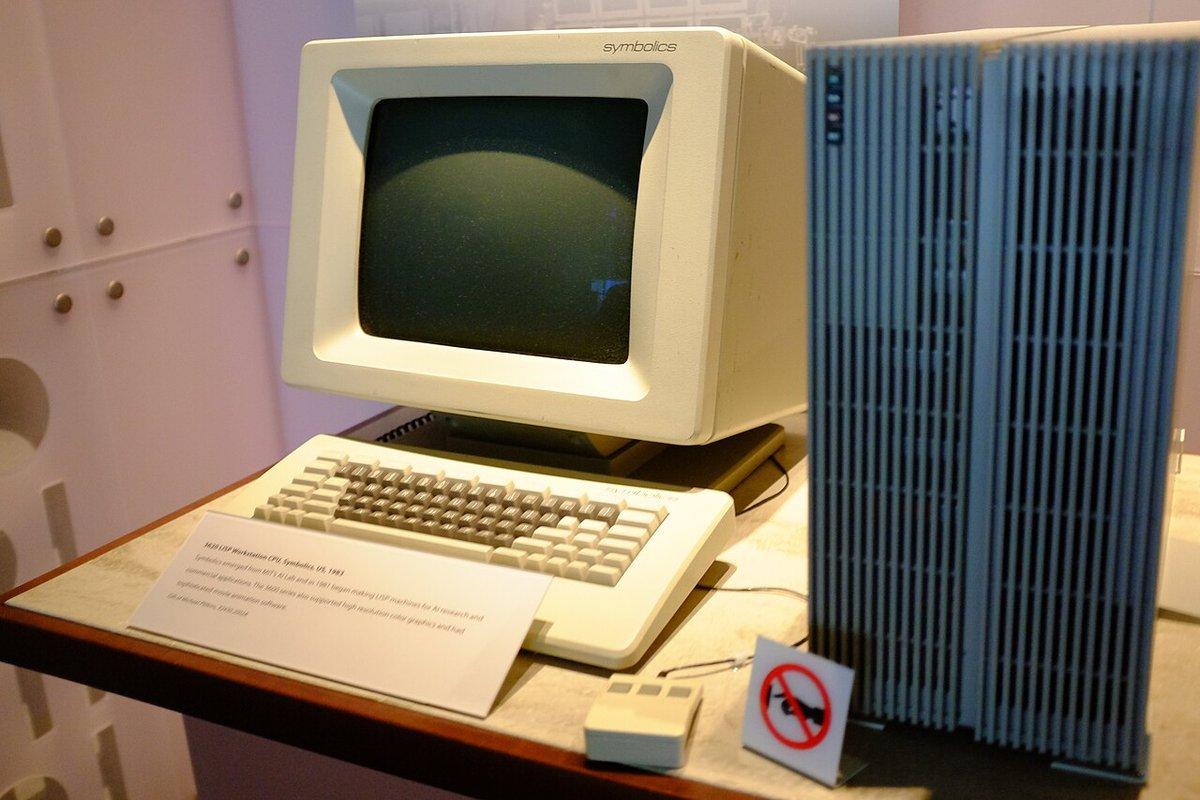
- SymbolicsSymbolics, Inc. was an American computer company, formed in 1980, that designed, manufactured and sold Lisp machines: single-user workstations whose hardware and software were built to run the Lisp programming…Mentioned 18 times above

More to read
References
- ^1 ^2 ^3 ^4 ^5 ^6 ^7 ^8 ^9 ^10 ^11 ^12 ^13 ^14 ^15 ^16 ^17 ^18 ^19 ^20 ^21 ^22 ^23 ^24 ^25 ^26 ^27 ^28 ^29 ^30 ^31 ^32 ^33 ^34 ^35 ^36 ^37 ^38 ^39 ^40 ^41 ^42 ^43 ^44 ^45Moses, Joel. "Macsyma: A Personal History". Invited presentation, Milestones in Computer Algebra, Tobago, May 2008; later published in Journal of Symbolic Computation 47(2): 123-130, February 2012, doi:10.1016/j.jsc.2010.08.018. web.archive.org/...Macsyma.pdf
- ^1 ^2 ^3 ^4 ^5 ^6 ^7Maxima project. "Maxima 5.49.0 Manual". maxima.sourceforge.io. maxima.sourceforge.io/...maxima_singlepage
- ^1 ^2 ^3 ^4Fateman, Richard J. "MACSYMA's General Simplifier: Philosophy and Operation". Macsyma Users' Conference, 1979. people.eecs.berkeley.edu/...simplifier.txt
- ^1 ^2 ^3Maxima project. "Maxima, a Computer Algebra System". maxima.sourceforge.io, accessed November 2026. maxima.sourceforge.io
- ^1 ^2 ^3Maxima project. "Maxima-source" release files. SourceForge, accessed November 2026. sourceforge.net/...Maxima-source
- ^"Carl Engelman Memorial Fund". The FINITE STRING Newsletter, American Journal of Computational Linguistics 9(3-4), July-December 1983. aclanthology.org/J83-3008.pdf
- ^1 ^2Martin, W. A.; Fateman, R. J. "The MACSYMA system". Proceedings of the second ACM symposium on Symbolic and algebraic manipulation (SYMSAC '71), pp. 59-75, 1971. doi.org/...800204.806267
- ^Moses, Joel. "Algebraic simplification: a guide for the perplexed". Proceedings of the second ACM symposium on Symbolic and algebraic manipulation (SYMSAC '71), pp. 282-304, 1971; also published in Communications of the ACM 14(8): 527-537, August 1971. doi.org/...800204.806298
- ^Wang, Paul S.; Rothschild, Linda Preiss. "Factoring Multivariate Polynomials Over the Integers". Mathematics of Computation 29(131): 935-950, 1975. doi.org/...s0025-5718-1975-0396471-3
- ^Moses, Joel; Yun, David Y. Y. "The EZ GCD algorithm". Proceedings of the ACM annual conference (ACM '73), pp. 159-166, 1973. doi.org/...800192.805698
- ^Gosper, R. William. "Decision procedure for indefinite hypergeometric summation". Proceedings of the National Academy of Sciences 75(1): 40-42, January 1978. doi.org/...pnas.75.1.40
- ^Moses, Joel. "MACSYMA - the fifth year". ACM SIGSAM Bulletin 8(3): 105-110, August 1974. doi.org/...1086837.1086857
- ^1 ^2Maxima project. "AUTHORS" file. Maxima source repository, SourceForge, accessed November 2026. sourceforge.net/...AUTHORS
- ^Foderaro, John K.; Fateman, Richard J. "Characterization of VAX Macsyma". Proceedings of the fourth ACM symposium on Symbolic and algebraic computation (SYMSAC '81), pp. 14-19, 1981. doi.org/...800206.806364
- ^1 ^2 ^3 ^4 ^5 ^6 ^7 ^8 ^9 ^10 ^11Petti, Richard. "Macsyma Saga" (posted as "XML, why Mma is popular, was...Re: [Maxima] Lunch with George Carrette"). Maxima mailing list, 30 October 2003. maxima.sourceforge.io/...msg02334
- ^Symbolics-DKS. "Macsyma". symbolics-dks.com, page last edited July 2017. symbolics-dks.com/Macsyma-1
- ^Maxima project. "Maxima and Lisp". maxima.sourceforge.io. maxima.sourceforge.io/lisp
Improve this article
Add missing citations, update stale details, or write a clearer explanation. Anyone can edit: changes go live when you publish, and every edit is checked by an editor.
1 revision · v1 · 2,949 words · full history
Fact-checks are independent of edits: a reviewer re-verifies the article against its sources and stamps the date. How we verify
Research and drafting on this wiki are AI-assisted, under named human editorial standards. How AI is used here
Reviewer note: Independent fact-check before publication on November 18, 2026: 96 claims checked against 21 cited and independent sources; 0 material and 9 minor corrections applied before publication.
Cite this page: AI Wiki. "Macsyma." aiwiki.ai, updated 18 Nov 2026, fact-checked 18 Nov 2026. CC BY 4.0. https://aiwiki.ai/wiki/macsyma