

MenteeBot V3
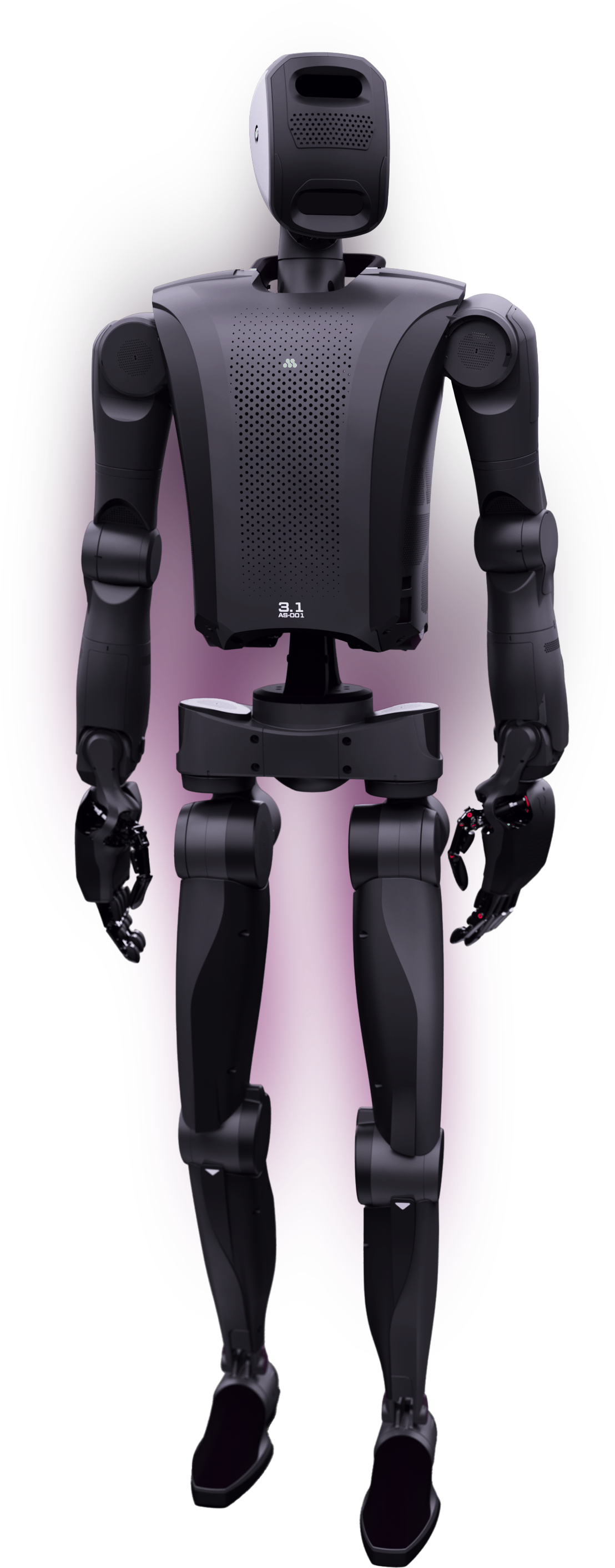
MenteeBot V3 (also referred to as MenteeBot V3.0) is a third-generation humanoid robot developed by Mentee Robotics, an Israeli AI robotics company headquartered in Herzliya, near Tel Aviv. Unveiled in February 2025, the MenteeBot V3 features 360-degree vision, a hot-swappable battery system, redesigned hands with 30 N finger pinch force, and custom-built actuators delivering three times the power of comparable commercial alternatives. The robot is built around a vertically integrated, AI-first architecture that combines large language models for task planning, neural radiance field (NeRF) algorithms for real-time 3D mapping, and simulator-to-reality (Sim2Real) reinforcement learning for locomotion and manipulation.
| MenteeBot V3 | |
|---|---|
 | |
| General information | |
| Manufacturer | Mentee Robotics |
| Country of origin | Israel |
| Release year | 2025 |
| Status | Prototype / Pre-production |
| Website | menteebot.com |
Mentee Robotics was co-founded in 2022 by Professor Amnon Shashua (chairman of Mentee and president/CEO of Mobileye), Professor Lior Wolf (CEO of Mentee and former director at Facebook AI Research), and Professor Shai Shalev-Shwartz (chief scientist of Mentee and CTO of Mobileye). In January 2026, Mobileye announced a definitive agreement to acquire Mentee Robotics for approximately $900 million, a transaction that closed in the first quarter of 2026. Mobileye plans first customer proof-of-concept deployments in 2026, an initial manufacturing batch built with partner Aumovio in 2027, and commercial production by 2028.[1][2][22]
Background and company history
Founding and stealth development (2022 to 2024)
Mentee Robotics was founded in late 2022 in Herzliya, Israel, by three prominent figures from Israel's artificial intelligence and computer vision research community. Professor Amnon Shashua, best known as the co-founder of Mobileye (the autonomous driving technology company acquired by Intel for $15.3 billion in 2017 and re-listed on NASDAQ in 2022), served as chairman. Professor Lior Wolf, a full professor at Tel Aviv University's School of Computer Science and AI who had previously served as a research scientist and director at Facebook AI Research, took on the role of CEO. Professor Shai Shalev-Shwartz, a professor at the Hebrew University of Jerusalem and Mobileye's CTO (where he leads development of Responsibility-Sensitive Safety and Road Experience Management technologies), joined as chief scientist.[3][4]
The company attracted initial media attention at the tail end of 2022, shortly after Tesla announced its own humanoid robotics program with Optimus. However, Mentee Robotics had little to show publicly at that stage and entered a stealth development period lasting roughly two years. During this time, the company assembled a team that grew to fewer than 100 employees and developed its AI-first humanoid robot platform from the ground up, designing proprietary actuators, motor drivers, and robotic hands in-house rather than relying on off-the-shelf components.[5][6][18]
The company raised funding from a group of investors including Ahren Innovation Capital (lead investor), Cisco Investments, and others. The total amount raised before acquisition has been reported variously as $17 million (per Tracxn) or as approximately $38 million across two rounds (per Calcalist), with the most recent round valuing the company at slightly over $100 million.[7][8][18]
Original MenteeBot unveiling (April 2024)
Mentee Robotics emerged from stealth on April 17, 2024, with the public unveiling of its first-generation MenteeBot prototype. The announcement, distributed via BusinessWire, described the MenteeBot as "a humanoid robot that integrates AI across all operational layers." Demonstration videos showed the robot performing a multi-step task: receiving a verbal command, navigating to a table, identifying and picking up persimmons, placing them in a box, and carrying the box to a shelf, all within approximately 90 seconds.[9][10]
The original MenteeBot stood 175 cm tall, weighed 70 kg, and could carry payloads up to 25 kg. It featured 40 degrees of freedom and a battery life of roughly 3 hours. The robot's AI system operated across three layers: transformer-based LLMs for interpreting natural language commands and planning task sequences; NeRF-based algorithms for building cognitive 3D maps of the environment in real time; and a Sim2Real machine learning approach for locomotion, where reinforcement learning occurred first on a simulated version of the robot before being adapted to the physical hardware.[9]
At the time, the company targeted both household applications (table setting, laundry management, cleaning) and warehouse/industrial tasks (item retrieval, transportation, organization). The MenteeBot was designed to learn new tasks through verbal instructions and visual imitation, with the company working toward "few-shot generalization" that would allow the robot to acquire new skills from only a small number of human demonstrations.[9][10]
CES 2025 appearance
In January 2025, a design resembling the MenteeBot V3.0 appeared on stage during NVIDIA founder Jensen Huang's keynote address at CES 2025 in Las Vegas. Huang presented 14 humanoid robots alongside his declaration that "the ChatGPT moment for general robotics is just around the corner." The lineup included robots from Boston Dynamics, Agility Robotics, Figure AI, Apptronik, Unitree, 1X Technologies, Sanctuary AI, and others. MenteeBot was the sole representative from Israel.[11][12]
The CES appearance underscored Mentee Robotics' use of NVIDIA's simulation and training ecosystem, including NVIDIA Isaac Sim for physics-accurate simulation and synthetic data generation, NVIDIA Isaac Lab for reinforcement and imitation learning, and NVIDIA Cosmos for augmenting synthetic training data with generative AI capabilities.[13]
MenteeBot V3.0
Announcement and design philosophy
Mentee Robotics officially unveiled the MenteeBot V3.0 in February 2025, describing it as the third iteration of its flagship humanoid platform. Company chairman Amnon Shashua shared a teaser of the updated design on February 11, 2025. The V3.0 represented a significant step forward from the original 2024 prototype, with a more humanoid appearance, upgraded manipulation capabilities, improved power systems, and enhanced sensor coverage.[14][15]
The design philosophy behind V3.0 reflects a shift in market focus. While the original MenteeBot had been pitched for both domestic and industrial applications, the V3.0 was positioned squarely for industrial and organizational environments: manufacturing floors, logistics centers, warehouses, and hazardous work settings. Mentee Robotics described the V3.0 as "a teaser for the official launch," though the company did not confirm at the time whether V3.0 would be the final pre-production model.[14]
What are the MenteeBot V3 specifications?
| Category | Specification | Value |
|---|---|---|
| Physical | Height | 175 cm (5 ft 9 in) |
| Physical | Weight | 70 kg (154 lb) |
| Mobility | Degrees of freedom | 40 |
| Mobility | Maximum walking speed | 1.5 m/s (5.4 km/h, 3.4 mph) |
| Manipulation | Payload capacity | 25 kg (55 lb) |
| Manipulation | Finger pinch force | 30 N per finger |
| Power | Battery type | Hot-swappable lithium battery |
| Power | Battery life per module | 3 to 4+ hours continuous operation |
| Power | Operational availability | 24/7 (via battery cycling) |
| Computing | Compute platform | Dual NVIDIA Jetson AGX Orin |
| Computing | Onboard AI | Yes (LLM integration, NeRF mapping) |
| Sensors | Vision system | 360-degree (fisheye side cameras + rear camera + head-mounted sensors) |
| Sensors | Tactile sensing | Motor-based tactile sensing in hands |
| Hardware | Actuators | Custom proprietary (3x power density vs. commercial alternatives) |
| Hardware | Motor drivers | Proprietary precision motor drivers |
360-degree vision system
The MenteeBot V3.0 introduces a comprehensive 360-degree vision system. Fisheye cameras are mounted on the sides and rear of the robot's body, while sophisticated head-mounted sensors provide enhanced awareness of the forward environment. This configuration gives the robot full surround perception, enabling it to navigate safely through cluttered warehouse aisles and crowded factory floors without blind spots. The camera-only sensing approach (the robot does not use LiDAR) mirrors the vision-centric philosophy employed by Mobileye in its autonomous driving systems.[14][15]
Redesigned hands and manipulation
The V3.0 features completely redesigned hands with a pinch force of 30 Newtons per finger. This provides a firm and precise grip suitable for handling a wide range of objects encountered in industrial settings, from small components to heavy packages. The hands also incorporate motor-based tactile sensing, which simplifies the overall sensor system while preserving reliable grip detection and manipulation capabilities. The redesigned hands are notably more impact-resistant than those on earlier prototypes.[14][16]
However, some observers have noted that unlike certain competitors (such as Tesla Optimus with its multi-jointed fingers), the MenteeBot's hands use a simpler gripper-style design optimized for industrial reliability rather than human-like finger articulation.[6]
Custom actuators and vertical integration
A defining feature of the MenteeBot platform is its deep vertical integration. Rather than purchasing off-the-shelf actuators and components, Mentee Robotics designs and manufactures its own actuators, motor drivers, and robotic hands. The custom actuators in V3.0 deliver approximately three times the power of comparable commercial alternatives while maintaining a compact form factor. The proprietary precision motor drivers provide transparent, stable, and highly predictable joint behavior, which is critical for both safety and for minimizing the gap between simulated and real-world robot performance (the "Sim2Real gap").[2][14][17]
This vertically integrated approach offers several advantages: it enables tighter integration between hardware and the AI software stack, supports cost-effective volume manufacturing, and provides the company with full control over component performance. According to Mobileye's acquisition announcement, this integration "minimizes the Sim2Real gap, enables 24/7 operational availability, provides versatility for a wide range of applications, and supports cost-effective volume manufacturing."[2]
Hot-swappable battery system
The V3.0 is equipped with a hot-swappable battery architecture that allows operators to replace depleted battery modules without powering down the robot. Each battery module provides roughly 3 to 4 hours of continuous operation. Through battery cycling (swapping fresh modules as needed), the robot can operate around the clock without scheduled downtime for recharging. This feature is particularly important for industrial deployments where 24/7 uptime is required across multiple work shifts.[14][15]
Dual NVIDIA Jetson AGX Orin computing
The MenteeBot V3.0 is powered by two NVIDIA Jetson AGX Orin processors, providing the onboard computational power needed for real-time AI inference, 3D environment mapping, natural language processing, and autonomous decision-making. The dual-processor configuration follows NVIDIA's three-computer architecture for robotics, where training occurs on NVIDIA DGX systems, simulation and validation run in NVIDIA Isaac Sim, and edge deployment uses Jetson hardware on the physical robot.[13]
AI architecture and software
AI-first design philosophy
Mentee Robotics describes its approach as "AI-first," distinguishing it from companies that started with mechanical engineering and later added AI capabilities. The MenteeBot was conceived from the outset as a platform where AI is integrated across all operational layers, from high-level task planning down to low-level motor control. This philosophy was informed by the founders' decades of experience at Mobileye, where they had built one of the world's most advanced perception and decision-making stacks for autonomous vehicles.[9][10]
Large language model integration
At the highest level of the AI stack, the MenteeBot uses transformer-based large language models to interpret natural language commands, engage in conversation, and plan complex task sequences. When a human operator gives a verbal instruction (for example, "pick up the boxes from aisle three and move them to the loading dock"), the LLM breaks this down into a sequence of subtasks: navigate to aisle three, locate the relevant boxes, grasp them, transport them to the loading dock, and place them appropriately. This capability enables workers without technical training to direct the robot using plain spoken language.[9][14]
NeRF-based 3D mapping
The robot builds a detailed three-dimensional map of its environment in real time using NeRF-based algorithms. These neural radiance field models, originally developed in the computer vision research community for representing 3D scenes from 2D images, are adapted in the MenteeBot to create cognitive maps that store both geometric and semantic information. The robot can identify the locations of specific objects, understand spatial relationships, and dynamically plan paths that avoid obstacles. The maps update continuously as the robot moves through its environment, allowing it to handle changes such as moved inventory or new obstacles.[9][14]
Sim2Real reinforcement learning
Locomotion and manipulation skills are trained using a simulator-to-reality (Sim2Real) approach. The robot first learns behaviors in a simulated environment built in NVIDIA Isaac Sim, where reinforcement learning can draw on effectively unlimited synthetic training data. Domain randomization techniques (randomizing object positions, textures, lighting, and physical properties) ensure that policies learned in simulation are robust enough to transfer to the real world with minimal fine-tuning. This dramatically reduces the need for expensive and time-consuming real-world data collection and teleoperation.[9][13]
Mentee Robotics also leverages NVIDIA GR00T-Mimic for imitation learning, efficiently scaling expert trajectories collected during teleoperation demonstrations. The combined use of reinforcement learning and imitation learning allows the robot to acquire new manipulation skills from a small number of human demonstrations, a capability the company refers to as "few-shot learning" or "mentorable" behavior.[2][13]
Foundation model approach
The company describes its training methodology as a "Foundation Model" approach, combining two complementary learning strategies: "learning from experience" (reinforcement learning for action management and motor control) and "learning from data" (processing language, vision, and speech inputs through large pretrained models). This dual strategy is designed to produce a robot that can both follow explicit instructions and adapt autonomously to novel situations encountered in dynamic work environments.[15]
MenteeBot V3.1 update
In 2025, Mentee Robotics announced the MenteeBot V3.1, an incremental update to the V3.0 platform. The V3.1 retains the same core physical specifications (175 cm height, 70 kg weight, 25 kg payload, 40 degrees of freedom, 1.5 m/s walking speed) but refines the software stack and control systems. Key improvements include enhanced motor-based tactile sensing in the hands, improved reinforcement learning workflows for specific industrial tasks (such as coordinated picking, transport, and placement of boxes across varying rack heights), and further refinement of the Sim2Real transfer pipeline. The V3.1 advances the company's vision of a "personalized, mentorable AI-driven robot that learns directly from human instruction" rather than requiring continuous remote teleoperation.[16]
Why did Mobileye acquire Mentee Robotics?
Deal announcement
On January 6, 2026, during CES 2026 in Las Vegas, Mobileye announced a definitive agreement to acquire Mentee Robotics for approximately $900 million. The deal comprised roughly $612 million in cash and up to 26,229,714 shares of Mobileye Class A common stock (subject to adjustment based on vesting of Mentee options prior to closing). The transaction closed in the first quarter of 2026; Mobileye's subsequent filings reported that the acquisition reduced its cash balance by approximately $591 million net of cash acquired, with total transaction costs of about $75 million including cash paid for accelerated options.[1][2][24]
Amnon Shashua, who held a 37.8% stake in Mentee Robotics, framed the acquisition as "the beginning of Mobileye 3.0." "By combining Mentee's breakthroughs in humanoid robotics with Mobileye's expertise in automotive autonomy and its proven ability to productize advanced AI, we have a unique opportunity to lead the evolution of physical AI across robotics and autonomous vehicles on a global scale," Shashua said.[1][2] Mentee CEO Lior Wolf said, "I am immensely proud of what Mentee's multidisciplinary team has accomplished in just four years. We set out to build a platform that combines cutting-edge AI with deeply integrated hardware to make humanoid robots truly useful in real-world environments."[2]
Strategic rationale and technology synergies
Mobileye identified three primary technology synergies driving the acquisition:
- Enhanced autonomy: Mentee's vision-language-action models and advanced simulation techniques would strengthen Mobileye's autonomous driving systems through improved generalization and faster environmental adaptation.
- Safety integration: Mobileye's Responsibility-Sensitive Safety (RSS) framework, a mathematically grounded formal model for safe autonomous vehicle behavior originally published by Shashua and Shalev-Shwartz in 2017, would be adapted to define, verify, and enforce safe behavior for humanoid robots operating near humans.
- Accelerated commercialization: Mobileye's deep relationships with high-volume precision manufacturers and its experience scaling advanced AI technologies from prototype to mass production would speed Mentee's path to market.[1][2]
Mobileye framed the move as an extension of a business whose automotive design-win pipeline it valued at $24.5 billion over eight years, up roughly 40% from January 2023, and said the acquisition would raise its 2026 operating expenses by only a low-single-digit percentage.[2][22] The combined entity would position Mobileye as a leader in "physical AI" across two transformative markets: autonomous driving and humanoid robotics.
When will MenteeBot V3 be commercially available?
Following the acquisition, Mobileye outlined a phased commercialization plan that leads with industrial deployment and expands to consumer use later:
| Phase | Year | Milestone |
|---|---|---|
| Proof of concept | 2026 | First on-site customer deployments in fulfillment centers and assembly environments |
| Pilot manufacturing | 2027 | First experimental production batch built with manufacturing partner Aumovio |
| Commercial deployment | 2028 | Series production and commercial sales in structured industrial environments |
| Household expansion | ~2030 | Expansion toward in-home consumer applications |
Aumovio, the automotive-electronics supplier spun off from Germany's Continental AG in September 2025 and listed on the Frankfurt Stock Exchange under the ticker AMV0, signed on to manufacture the first experimental batch of MenteeBot robots beginning in 2027, integrating humanoid production into the automotive supply chain. Mobileye indicated that initial deployments would focus on industrial applications such as logistics centers and manufacturing lines rather than consumer use cases.[1][2][22][23]
Governance questions
The acquisition drew scrutiny due to Shashua's role on both sides of the transaction. As both the CEO of Mobileye (the acquirer) and the chairman and largest shareholder of Mentee Robotics (the target), the deal raised governance questions. Shashua's 37.8% stake was worth roughly $341 million at the deal price, and his Mobileye holding rose from about 1% to about 2% through the share consideration. Mobileye's board established a strategy committee to evaluate robotics targets and engaged McKinsey for external valuation advice and Goldman Sachs as deal adviser, with Shashua formally recused from the decision-making process. Critics noted that Mentee had been valued at slightly over $100 million in its most recent funding round yet sold for $900 million, that it had generated no revenue at the time of acquisition (having raised about $38 million in total and employing fewer than 100 people), and that the deal set aside roughly $50 million in employee retention bonuses. Others pointed out that the humanoid robotics market remains nascent, with no company yet selling humanoid robots at scale.[18]
Technology transfer from Mobileye
Autonomous driving heritage
The relationship between Mentee Robotics and Mobileye extends beyond shared founders. Mobileye, founded in 1999, pioneered the use of camera-based computer vision for advanced driver-assistance systems (ADAS) and later fully autonomous driving. The company's technology relies on interpreting visual data from cameras (rather than expensive LiDAR arrays) to perceive the driving environment, make decisions, and control vehicle behavior. This camera-first, vision-centric approach directly influenced Mentee Robotics' design of the MenteeBot, which similarly relies on cameras rather than LiDAR for perception.[2][19]
Responsibility-Sensitive Safety for robotics
Mobileye's RSS framework provides a formal mathematical model that defines safe behavior for autonomous systems operating in dynamic environments alongside humans. Originally developed for self-driving cars, RSS encodes five core safety rules covering safe following distances, lateral spacing, right-of-way priority, visibility handling, and crash avoidance obligations. Adapting RSS for humanoid robotics would provide a rigorous safety foundation for robots working in close proximity to human workers in factories and warehouses, building the regulatory readiness and trust required for large-scale commercial deployment.[2][20]
How does MenteeBot V3 compare to competitors?
The MenteeBot V3 enters a rapidly growing and intensely competitive humanoid robotics market. Major competitors include:
| Company | Robot | Country | Key differentiators |
|---|---|---|---|
| Tesla | Optimus Gen 3 | United States | Autopilot AI, projected $20,000-$30,000 price, 10-12 hour battery life |
| Figure AI | Figure 02 / Figure 03 | United States | 16 DOF per hand, OpenAI partnership for reasoning |
| Agility Robotics | Digit | United States | Already deployed in Amazon warehouses |
| Apptronik | Apollo | United States | Mercedes-Benz partnership, modular design |
| 1X Technologies | NEO | Norway | Consumer-focused, lightweight design |
| Sanctuary AI | Phoenix | Canada | Carbon AI control system, dexterous hands |
| Unitree Robotics | H1 / H2 | China | Aggressive pricing, open ecosystem |
| UBTECH | Walker S2 | China | Factory deployments with NIO, mature platform |
The MenteeBot V3 differentiates itself through its AI-first architecture, deep vertical integration of proprietary hardware, the founders' track record in bringing autonomous vehicle technology to market at scale, and the backing of Mobileye's global manufacturing relationships. However, the robot faces the same fundamental challenge confronting the entire industry: no company has yet achieved large-scale commercial sales of general-purpose humanoid robots, and the timeline for doing so remains uncertain.[6][18]
Israel's AI and robotics ecosystem
Mentee Robotics is a product of Israel's broader technology ecosystem, which has earned the country its "Startup Nation" reputation. Israel is home to approximately 170 robotics companies spanning industrial technology, agricultural technology, health technology, and defense. The country's innovation culture fosters close collaboration between universities, research institutions, and startups, supported by a deep talent pool in AI, computer vision, and machine learning.
The nation's autonomous driving sector is particularly strong, anchored by Mobileye and supported by companies like OrCam (co-founded by Shashua for assistive vision devices) and numerous defense-related autonomy firms. Israeli tech startups raised approximately $9.58 billion in 2024 (a 38% increase over 2023), with robotics representing a growing share of investment. The Mobileye-Mentee acquisition at $900 million was one of the largest Israeli startup acquisitions of early 2026.[8][21]
Applications
The MenteeBot V3 is designed primarily for industrial and logistics applications:
- Warehouse automation: Autonomously locating items on shelves, lifting and carrying packages (up to 25 kg), and palletizing goods for shipment.
- Manufacturing: Assembly tasks, loading and unloading operations, and material handling on production lines.
- Logistics: Sorting, transporting, and organizing inventory across distribution centers.
- Hazardous environments: Performing tasks in settings that are dangerous for human workers, such as environments with chemical exposure or extreme temperatures.
By handling repetitive and physically demanding tasks, the robot is intended to reduce workplace injury risks and free human workers for higher-value activities that require complex judgment.[14][15][16]
See also
- Humanoid robots
- Mentee Robotics
- MenteeBot
- Mobileye
- Amnon Shashua
- Tesla Optimus
- Figure 02
- NVIDIA Isaac Sim
- Humanoid robot market
References
- ^1 ^2 ^3 ^4 ^5Mobileye acquires humanoid robot startup Mentee Robotics for $900M - TechCrunch (January 6, 2026)
- ^1 ^2 ^3 ^4 ^5 ^6 ^7 ^8 ^9 ^10 ^11 ^12Mobileye To Acquire Mentee Robotics to Accelerate Physical AI Leadership - Mobileye News (January 6, 2026)
- ^Prof. Amnon Shashua - Mobileye official biography
- ^Prof. Shai Shalev-Shwartz, Chief Technology Officer - Mobileye
- ^A humanoid robot is on its way from Mobileye founder - TechCrunch (April 17, 2024)
- ^1 ^2 ^3How does Amnon Shashua's MenteeBot stack up against the competition? - Calcalist Tech (2024)
- ^Mentee Robotics raised $17 million for their Humanoid Robot, MenteeBot - StartupHub.ai
- ^1 ^2Mentee Robotics funding rounds and list of investors - Tracxn
- ^1 ^2 ^3 ^4 ^5 ^6 ^7Mentee Robotics Unveils MenteeBot: A Humanoid Robot That Integrates AI Across All Operational Layers - BusinessWire (April 17, 2024)
- ^1 ^2 ^3Watch out, Boston Dynamics! Mentee Robotics unveils AI-first robot - VentureBeat (2024)
- ^CES 2025: AI Advancing at Incredible Pace, NVIDIA CEO Says - NVIDIA Blog (January 2025)
- ^HMND-01, MenteeBot V3.0, ENGINEAI S2 Original IP Service Robot - Mike Kalil (2025)
- ^1 ^2 ^3 ^4Mentee Robotics uses the NVIDIA Isaac Platform and NVIDIA Jetson - NVIDIA Case Study
- ^1 ^2 ^3 ^4 ^5 ^6 ^7 ^8 ^9Robotics jumps ahead: Mentee unveils 3rd version of its robot - Ynet News (February 2025)
- ^1 ^2 ^3 ^4 ^5Menteebot V3.0: Humanoid robot with human-like features, strong grip - Interesting Engineering (February 2025)
- ^1 ^2 ^3Mentee Bot V3.1 brings human-like touch to 24/7 factory floors - Interesting Engineering (2025)
- ^Mentee Robotics Unveils MenteeBot - Ahren Innovation Capital
- ^1 ^2 ^3 ^4The question marks behind Mobileye's $900 million bet on Mentee - Calcalist Tech (January 2026)
- ^Amnon Shashua - Wikipedia
- ^Mobileye RSS: Responsibility-Sensitive Safety - Mobileye
- ^2024 Israeli Robotics Tech Companies - Startup Nation Central
- ^1 ^2 ^3Mobileye to acquire Mentee Robotics for $900M in bid to dominate physical AI - The Robot Report (January 6, 2026)
- ^Continental spinoff Aumovio starts IPO in Frankfurt - Automotive News (September 18, 2025)
- ^Mobileye Global Inc. Form 8-K, FY2026 - U.S. Securities and Exchange Commission
Improve this article
Add missing citations, update stale details, or suggest a clearer explanation. Every suggestion is reviewed for sourcing before it goes live.
9 revisions · v9 · 4,041 words · full history
Fact-checks are independent of edits: a reviewer re-verifies the article against its sources and stamps the date. How we verify
Research and drafting on this wiki are AI-assisted, under named human editorial standards. How AI is used here
Cite this page: AI Wiki. "MenteeBot V3." aiwiki.ai, updated 7 Jul 2026. CC BY 4.0. https://aiwiki.ai/wiki/mentee_robotics_menteebot_v3