

Microduck
Microduck is a small biped robot developed by Pollen Robotics, the robotics team within Hugging Face. Announced on August 27, 2026, it is intended as a platform for learning and experimenting with robot movement through reinforcement learning. Pollen opened preorders at an introductory price of $399 before tax and shipping, with first deliveries targeted before Christmas 2026.[1][2]
As of August 28, 2026, Microduck was a preorder product rather than a robot in general customer use. Its public software and simulation repositories were available, while its hardware specifications and launch behaviors came mainly from Pollen's prototypes and product materials. No independent hardware review or controlled performance evaluation had been published.[2][3]
Design and hardware
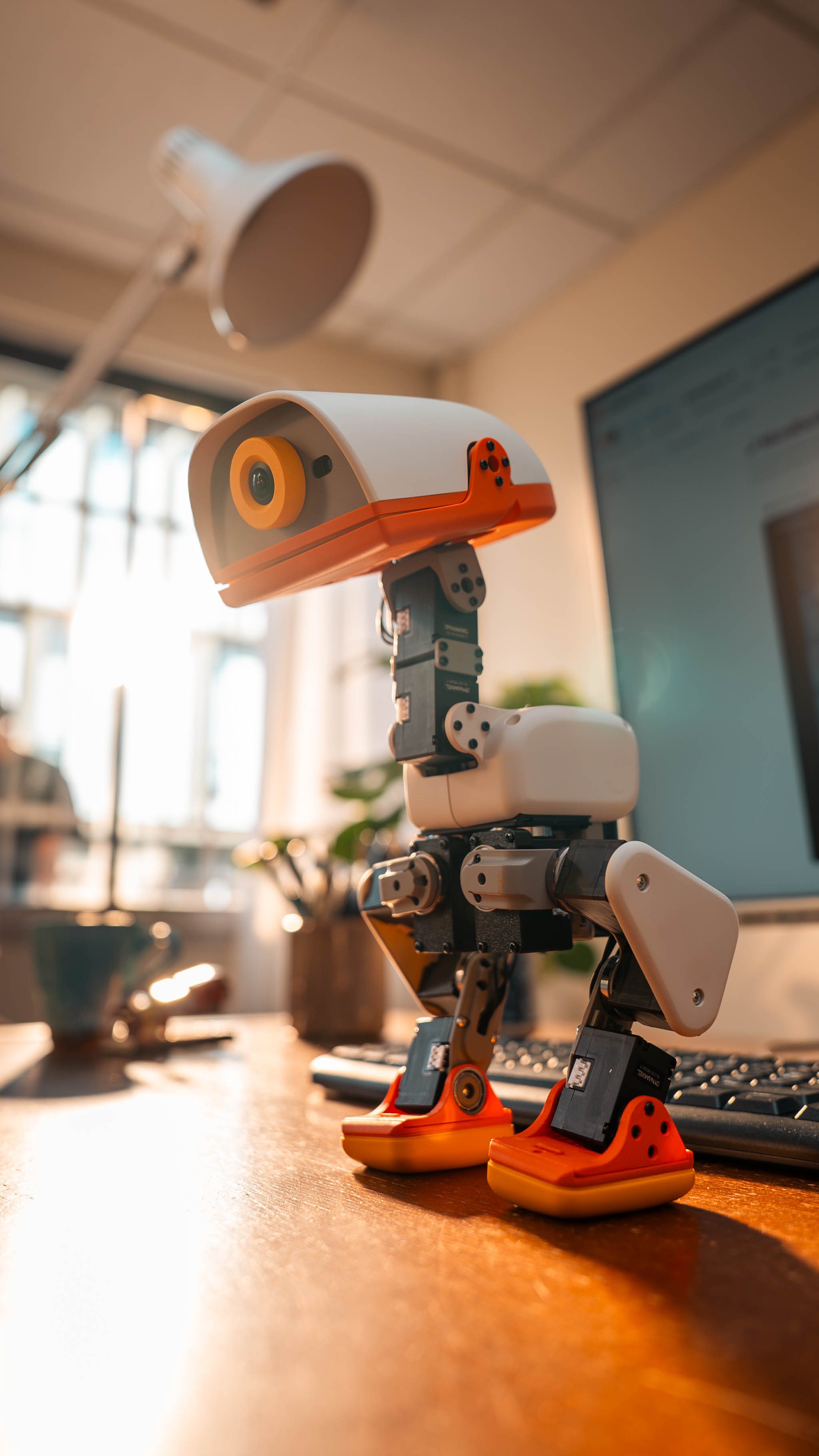
Microduck is 25 cm tall, 14 cm wide, and weighs under 800 g. Its duck-like design has two articulated legs, a movable head and neck, and an articulated beak that can grasp small objects. Pollen describes 15 degrees of freedom distributed across the legs, head, and neck.[2]
| Component | Launch specification |
|---|---|
| Onboard computer | Rockchip RK3566 with an AI accelerator |
| Memory and storage | 1 GB RAM and 32 GB storage |
| Actuation | 15 degrees of freedom |
| Vision | Front camera with a camera-use indicator |
| Range sensing | 8 by 8 time-of-flight matrix described as compact LiDAR |
| Motion sensing | Two IMUs, one in the body and one in the head |
| Interaction | Articulated beak, microphones, speaker, and two NFC antennas |
| Connectivity | Wi-Fi and Bluetooth |
| Battery | Removable 2,600 mAh NP-F550 battery |
| Control rate | 50 Hz neural-policy loop |
Pollen estimated about one hour of operation per battery, depending on use. That figure was a vendor estimate rather than an independently measured runtime. The company also marked several details as unfinished: camera resolution and field of view, LiDAR range, radio versions, SDK languages, and any age recommendation remained provisional at launch.[2]
The standard package was listed with the robot, one battery, a USB-C cable, and a game controller. Pollen offered separate charger, developer, and accessory packs. The accessory pack included passive rollers, a ball, NFC tags, and a laser pointer.[1]
Behaviors and control
Pollen's launch materials showed policies for walking, sitting and standing, crouching, kicking a ball, lowering the beak to grasp an object, moving on passive rollers, and recovering from several fall positions. The included controller was intended to make these behaviors usable without programming. Pollen also said autonomous behaviors would be included at launch.[1][2][3]
These demonstrations established what Pollen intended to ship, not how reliably the behaviors would work across surfaces, objects, and customer units. Axios independently confirmed that launch demonstrations showed the robot grasping an object, moving on rollers, and recovering after being pushed, but it did not conduct a technical review. The publication noted that Microduck's small size limits its usefulness for household work.[10]
In an informal August 27 demonstration, Hugging Face co-founder Thomas Wolf said he had programmed an image detector that made a prototype follow a laser pointer.[9] The post showed one development example. It did not report accuracy, latency, robustness, or a controlled comparison, so it should not be treated as a benchmark of the robot's perception system.
Reinforcement-learning workflow
Microduck's software is organized around policies trained in simulation and transferred to the physical robot. The public microduck_rl repository uses MuJoCo through the mjlab framework and trains policies with proximal policy optimization. The repository documents a 50 Hz training rate, ONNX export for deployment, actuator modeling, backlash simulation, and domain randomization.[5][6]
Domain randomization varies aspects of a simulated environment so that a learned model is exposed to a range of conditions before it encounters physical hardware. The technique is used to reduce the simulation-to-reality gap, although success remains dependent on the task, simulator, hardware model, and evaluation protocol.[11] Pollen describes its own workflow as tested, but no peer-reviewed study or independent evaluation of Microduck's transfer reliability was available at launch.[2][6]
The launch repository listed environments for velocity-controlled walking, combined walking and fall recovery, sitting and standing, ground contact with the beak, ball kicking, forward rolling, and several roller configurations. Users could train on a CUDA-capable computer or invoke Hugging Face Jobs, then export a policy to ONNX.[6]
Pollen also published a browser simulator. It runs selected ONNX policies at 50 Hz using MuJoCo compiled to WebAssembly, with separate leg and roller models.[8] The simulator makes the robot model and example policies inspectable before hardware delivery. It does not by itself demonstrate that a policy will behave identically on a physical robot.
Software architecture and openness
The main Microduck repository contains the Rust-based robot runtime and is licensed under Apache License 2.0. Its README describes a 50 Hz control loop for fifteen servos on the RK3566, plus software for input, sensing, media, configuration, and updates. The separate reinforcement-learning repository uses Apache License 2.0 for its code, while its README assigns the bundled 3D model files a Creative Commons BY-SA-NC license.[5][6]
Microduck is not open-source hardware. Pollen explicitly limits its open-source statement to the software stack; it has not released the mechanical or electronic design files.[2] The distinction means developers can inspect, modify, and redistribute covered software under its license, but cannot infer equivalent rights over the physical design.
Some repository documents describe targets rather than completed product behavior. The architecture document is labeled a draft for the first shipped version, not a description of the current prototype.[7] A separate roadmap said policies still shipped inside the robot daemon artifact and described independent policy installation from the Hugging Face Hub as future work. Claims that users could already browse and install arbitrary community policies directly on a robot would therefore have been premature.[5][7][12]
Availability
Preorders opened on August 27, 2026. Pollen listed Cream, Graphite, Lavender, and Sky color options and targeted first deliveries before Christmas 2026. Its store identified the United States, Canada, the European Union, the United Kingdom, Norway, Switzerland, Japan, and South Korea as initial markets.[2][4]
The $399 amount was an introductory US-dollar price before taxes and shipping. Local store prices and final import costs varied by market. Because the delivery date was a target, it did not establish that production units had shipped by the August 28 cutoff.[2][4]
On August 28, Hugging Face co-founder Thomas Wolf reported that more than $2.6 million in Microduck orders had been placed during the first 24 hours. The statement gave an order-value total, not a unit count or completed deliveries.[13][14] Pollen later added a store notice saying it could no longer promise Christmas delivery for new orders and estimated a four-to-six-month wait, with earlier orders shipping first.[4][14] The notice applied to new orders and did not establish which earlier preorders would meet the original Christmas target.
Limitations
Most available evidence at launch came from Pollen Robotics and Hugging Face. Independent reporting confirmed the announcement, price, form factor, sensors, and demonstrations, but did not test durability, battery life, locomotion reliability, sim-to-real performance, perception quality, or safety.[10]
Several hardware and SDK specifications were still being finalized. The public codebase was also evolving, with draft architecture documents and roadmap items that should not be read as guarantees about the first retail release. Microduck's practical capabilities therefore remained subject to production hardware, final software, and real-world evaluation after delivery.[2][7][12]
References
- ^1 ^2 ^3Pollen Robotics. "Microduck." Accessed August 28, 2026. pollen-robotics.com/microduck
- ^1 ^2 ^3 ^4 ^5 ^6 ^7 ^8 ^9 ^10 ^11Pollen Robotics. "Microduck press kit." Accessed August 28, 2026. pollen-robotics.com/...press-kit
- ^1 ^2Matthieu Lapeyre, Thomas Wolf, Antoine Pirrone, Augustin Crampette, Coralie Deplane, and Anne Charlotte Passanisi. "Meet Microduck." Pollen Robotics. August 27, 2026. pollen-robotics.com/...introducing-microduck
- ^1 ^2 ^3Pollen Robotics. "Microduck" store listing. Accessed August 29, 2026. store.pollen-robotics.com/...microduck
- ^1 ^2 ^3Pollen Robotics. "pollen-robotics/microduck." GitHub. Accessed August 28, 2026. github.com/...microduck
- ^1 ^2 ^3 ^4Pollen Robotics. "pollen-robotics/microduck_rl." GitHub. Accessed August 28, 2026. github.com/...microduck_rl
- ^1 ^2 ^3Pollen Robotics. "Robot Daemon Overall Architecture." Draft dated July 22, 2026. Accessed August 28, 2026. github.com/...architecture.md
- ^Pollen Robotics. "Microduck RL playground." Hugging Face Spaces. Accessed August 28, 2026. huggingface.co/...README.md
- ^Thomas Wolf. X post demonstrating laser-pointer following. August 27, 2026. x.com/...2092959363992326236
- ^1 ^2Ina Fried. "Hugging Face debuts 'Microduck,' a $399 robot." Axios. August 27, 2026. axios.com/...ing-face-debuts-microduck-a-399-robot
- ^Josh Tobin, Rachel Fong, Alex Ray, Jonas Schneider, Wojciech Zaremba, and Pieter Abbeel. "Domain Randomization for Transferring Deep Neural Networks from Simulation to the Real World." arXiv:1703.06907. March 20, 2017. arxiv.org/...1703.06907
- ^1 ^2Pollen Robotics. "Roadmap." Revised August 26, 2026. Accessed August 28, 2026. github.com/...roadmap.md
- ^Thomas Wolf. X post reporting the first 24 hours of Microduck orders. August 28, 2026. x.com/...2093295950605279501
- ^1 ^2Ben Shimkus. "Hugging Face says sales for its robot ducks topped $2.6 million in 24 hours. Now there's a backlog." Business Insider. August 28, 2026. Syndicated by Yahoo. tech.yahoo.com/...ce-says-roller-skating-164314293
Improve this article
Add missing citations, update stale details, or suggest a clearer explanation. Every suggestion is reviewed for sourcing before it goes live.
2 revisions · v3 · 1,476 words · full history
Fact-checks are independent of edits: a reviewer re-verifies the article against its sources and stamps the date. How we verify
Research and drafting on this wiki are AI-assisted, under named human editorial standards. How AI is used here
Reviewer note: Independent source audit passed on August 29, 2026.
Cite this page: AI Wiki. "Microduck." aiwiki.ai, updated 29 Aug 2026, fact-checked 29 Aug 2026. CC BY 4.0. https://aiwiki.ai/wiki/microduck