

MiniMax M3.1 Flash
MiniMax M3.1 Flash is a large language model released by MiniMax on October 19, 2026, for software development, tool-using agents and computer use.[1] Its hosted API accepts text, images and video, and supports a one-million-token context window with adjustable reasoning effort.[2] On October 23, 2026, MiniMax published the model's weights on Hugging Face and ModelScope under its own MiniMax Community License. The model card describes a natively multimodal mixture-of-experts model with about 428 billion total parameters, of which 23 billion are activated per token.[12][16][17]
Compare, price, and deploy MiniMax M3.1 Flash
These sourced facts are shared with the comparison and planning tools. Each field retains its own review date.
MiniMax M3.1 Flash
Article updated after the pricing / specification review. Inspect the sources before relying on these fields; a newer edit does not necessarily change the model facts.
- Provider API lifecycle
- ActiveSource · checked 2026-10-25
- Context tokens
- 1MSource · checked 2026-10-25
- Input / output per 1M tokens
- $0.15 / $0.6Source · checked 2026-10-25
Rates as listed on October 25, 2026; the provider does not say when they took effect.
Always thinks (thinking depth low to max, default max). MiniMax publishes no maximum output limit.
Release and model identity
MiniMax identified the anonymous model Space Bunny as an early version of M3.1 Flash and said it had processed over 200 trillion tokens. That is a company-reported usage total, not a training-data count. The launch made the model available through the API, M Plan and MiniMax Code.[1]
At launch, MiniMax said downloadable weights would follow later; its official social announcement scheduled them for October 23.[1][11] On October 20 the model was available only as a hosted service, although MiniMax's invocation guide already described it as "an ultra-efficient open-weight model for everyday work".[2] The weights arrived on the announced date, so that description has matched a downloadable release since October 23.[17]
MiniMax's product guide describes M3.1 Flash as the generally available successor to M3.1-Flash-Preview. The released API identifier omits the Preview suffix. The guide's examples concern coding, financial workbooks, visual comparisons and interactive graphics. It describes image and video work as tool-assisted processing rather than native image or video generation.[9]
Open-weight release
MiniMax's official account announced at 01:06 UTC on October 23, 2026, that the weights were public, giving 428 billion total parameters and 23 billion activated per token.[17] The announcement linked two repositories, MiniMaxAI/MiniMax-M3.1-Flash on Hugging Face and MiniMax/MiniMax-M3.1-Flash on ModelScope.[17][18] The Hugging Face repository is not gated, so downloading it does not require an access request.[15]
| Item | Detail (as of October 25, 2026) |
|---|---|
| Announcement | October 23, 2026, by @MiniMax_AI |
| Repositories | Hugging Face MiniMaxAI/MiniMax-M3.1-Flash; ModelScope MiniMax/MiniMax-M3.1-Flash |
| License | MiniMax Community License (Hugging Face license field "other", name minimax-community) |
| Main weights | 48 safetensors shards, about 250.1 GB |
| Speculative-decoding draft | DSpark draft in the dspark/ folder, about 2.3 GB |
| Repository total | About 252.4 GB |
| Stored precision | MXFP8 for projections and dense layers; NVFP4 for the routed experts |
The file sizes are sums of the per-file sizes that the Hugging Face API reports.[15] The configuration file declares MXFP8 as the quantization method, sets moe_quant_algo to NVFP4 with a group size of 16, and leaves the router gates, token embeddings, output head, vision tower and multimodal projector out of quantization.[13] vLLM's deployment recipe summarizes the same layout as "MXFP8 dense layers and NVFP4 experts".[26] The FlagOS documentation in the repository calls these the model's "original QAT NVFP4 weights", referring to quantization-aware training.[28]
The low-precision storage makes the download much smaller than its predecessor's. MiniMax's card for MiniMax M3 gives the same rounded sizes (about 428 billion parameters, about 23 billion activated), but the M3 repository stores BF16 weights and totals about 854.2 GB.[19] Hugging Face's automatic safetensors summary lists about 220.5 billion stored elements for M3.1 Flash, 206.6 billion of them as 8-bit unsigned integers, the container for the packed 4-bit NVFP4 expert weights.[13][15] That figure counts stored values, not parameters, and is not a substitute for the card's parameter count.
License terms
The MiniMax Community License grants free use of the software for non-commercial purposes. Commercial use carries two conditions. The product must prominently display "Built with MiniMax M3.1-Flash", and the user must contact MiniMax: products or services with more than US$20 million in yearly revenue need prior written authorization, while smaller ones send a one-time notice to the company.[16] The license defines commercial use broadly, covering paid products or services that rely on the model, commercial use of APIs serving it, and commercial deployment of post-trained or fine-tuned versions.[16] An appendix lists prohibited uses, among them any military purpose and generating false or misleading information intended to cause harm.[16]
Independent coverage stressed that public weights under these terms are not the same as unrestricted commercial access.[30] The M3 weights use a license of the same name with the same US$20 million authorization threshold.[31]
Architecture
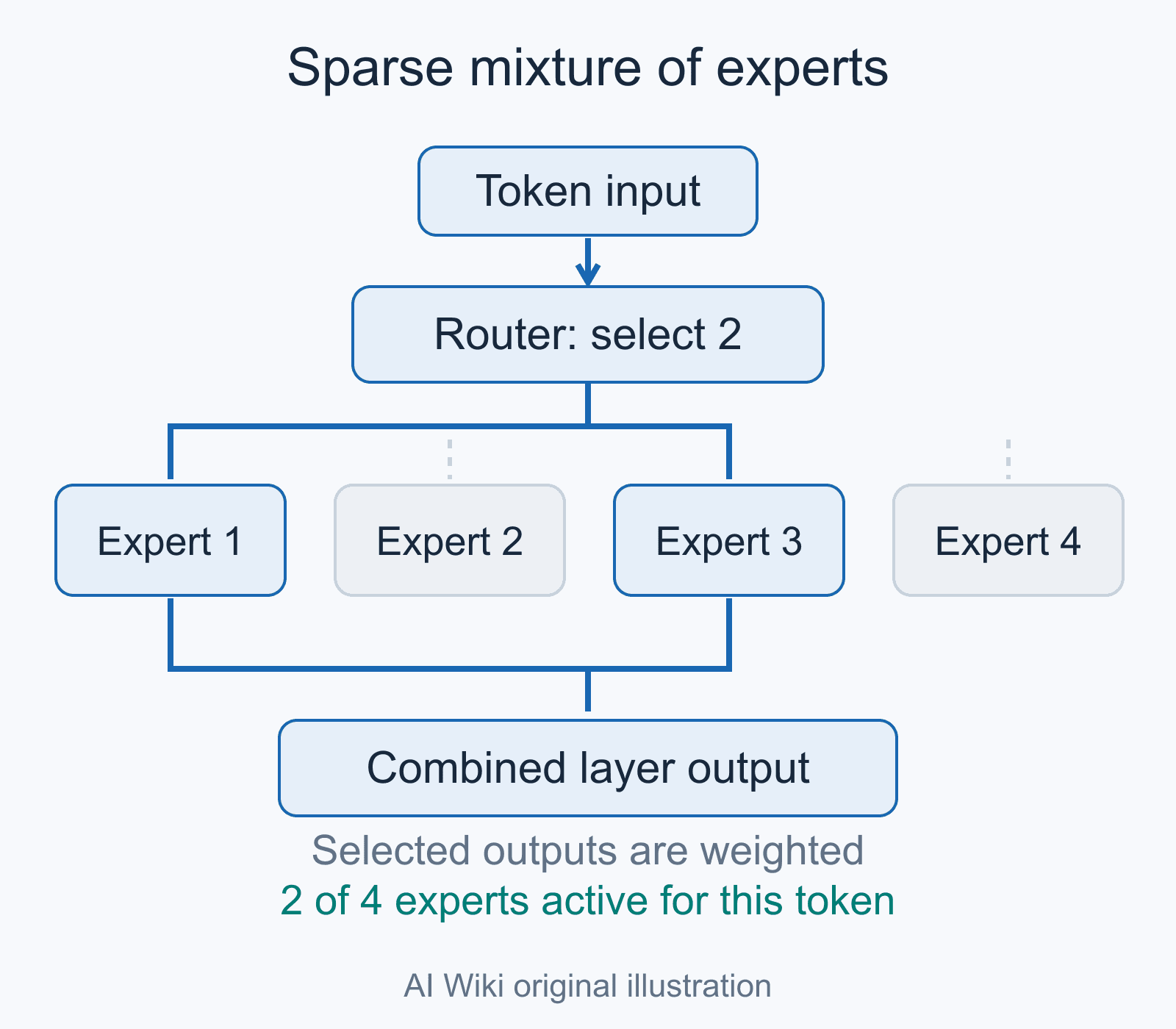
The model card lists a native multimodal mixture-of-experts architecture with text, image and video inputs and text output, a context window of up to 1,000,000 tokens, MiniMax Sparse Attention (MSA) throughout the model, and an included DSpark draft head for speculative decoding.[12] It says M3.1 Flash keeps M3's core mixture-of-experts architecture with three changes:[12]
- Sparse attention throughout. M3's first three full-attention layers are replaced with sparse attention.
- Quantization-aware training. The routed experts and the attention paths are quantized during training, which MiniMax says reduces memory footprint and improves serving efficiency.
- DSpark speculative decoding. DSpark replaces the earlier EAGLE-like MTP approach, and the release includes the draft head.
The SGLang team's day-0 post adds that the model keeps M3's backbone and vision encoder. By its figures, the KV cache per token across all 60 layers, including the indexer key cache, falls from 134 KB in BF16 on M3 to 38 KB in NVFP4 on M3.1 Flash.[22]
The published configuration gives the following values.[13][14]
| Component | Value in the released configuration |
|---|---|
| Language-model layers | 60 |
| Hidden size | 6,144 |
| Attention heads / key-value heads | 64 / 4 (grouped-query attention) |
| Head dimension | 128 |
| Experts | 128 routed experts, 4 selected per token, plus 1 shared expert |
| Dense layers | The first 3 layers use a dense feed-forward block; the other 57 use experts |
| Router | Sigmoid scoring with a routing bias |
| Vocabulary | 200,064 tokens |
| Maximum positions | 1,048,576 |
| Sparse attention | Enabled in all 60 layers; 128-token blocks, top 16 blocks selected, 4 index heads |
| Vision encoder | 32 layers, hidden size 1,280, 14-pixel patches |
| DSpark draft | 5 layers with a 4,096-token sliding window, a 7-token block size and a confidence head |
MiniMax Sparse Attention
MSA is described in a June 2026 arXiv paper by Xunhao Lai and 16 co-authors. It is a blockwise sparse attention method built on grouped-query attention: a lightweight index branch scores key-value blocks and selects a top-k subset for each query group, and a main branch then computes exact attention over only the selected blocks.[20] The authors report that on a 109-billion-parameter natively multimodal model, MSA performed on par with grouped-query attention while cutting per-token attention compute by 28.4 times at one-million-token context, and that their kernel achieved 14.2 times faster prefill and 7.6 times faster decoding on H800 GPUs.[20] Those figures come from the paper's test model, not from M3.1 Flash.
DSpark
The SGLang team describes DSpark as speculative decoding that pairs a semi-autoregressive drafter, which proposes a whole block of tokens per forward pass, with a per-request verification length set by the draft model's own confidence, so the target model stops verifying draft tokens that are unlikely to be accepted.[21] In the M3.1 Flash release the draft conditions on hidden states from five layers of the target model, according to its configuration file.[14]
API behavior
| Property | Documented behavior |
|---|---|
| Hosted model identifier | MiniMax-M3.1-Flash |
| Context capacity | 1,000,000 tokens |
| Accepted inputs | Text, images and video |
| Generated output | Text |
| Reasoning settings | low, medium, high, xhigh, max |
| Default effort | max |
| Disabling reasoning | Unsupported |
The invocation guide documents the context, input and effort settings; Artificial Analysis lists text output.[2][7] Higher effort increases reasoning-token use and latency. The API rejects requests that disable thinking or select none rather than treating those settings as ordinary low-effort requests.[2]
MiniMax supports two client conventions. These are compatibility interfaces operated by MiniMax, not requests served by Anthropic or OpenAI.[4][5]
| Interface | Client base URL | Effort field |
|---|---|---|
| Anthropic-compatible | https://api.minimax.io/anthropic | output_config.effort |
| OpenAI-compatible Chat Completions | https://api.minimax.io/v1 | reasoning_effort |
In the Anthropic-compatible interface, reasoning and answers arrive in separate content blocks. Applications continuing a tool-use conversation must retain the complete assistant content, including reasoning and tool-use blocks. The API also provides a token-counting endpoint that estimates input usage without generating a reply.[5]
Integration limits
The OpenAI-compatible interface returns reasoning through reasoning_content and final text through content. Reasoning consumes the generation budget, so a low output limit can end a request before any final answer appears. The documentation recommends max_completion_tokens for new integrations.[4]
The OpenAI-compatible documentation excludes audio input. It accepts JPEG, PNG, GIF and WEBP images, plus MP4, AVI, MOV and MKV videos. Limits are 10 MB per image, 50 MB for URL or base64 video, and 64 MB per request body; Files API uploads allow videos up to 512 MB.[4]
Sampling remains fixed at temperature 1 and top_p 0.95; sending different values does not change it. service_tier is unsupported.[4] The Anthropic-compatible interface also ignores several otherwise familiar fields, including stop_sequences, mcp_servers, context_management and container; accepting that protocol does not supply the services those fields might represent elsewhere.[5] For self-hosted use, the model card recommends the same values, temperature=1.0 and top_p=0.95, and sets reasoning effort through a reasoning_effort field in the chat template with the same five levels.[12]
API pricing and caching
MiniMax's public price table listed the following pay-as-you-go rates on October 20, 2026. All amounts are US dollars per one million tokens, not per request or per million words.[3]
| Billing item | Price per 1 million tokens |
|---|---|
| Uncached input | $0.15 |
| Output | $0.60 |
| Cached input read | $0.015 |
For example, one million uncached input tokens and one million output tokens total $0.75 at these rates, before separately charged tools. This is arithmetic from the published rates, not a fixed price for completing a task. The same pricing page lists server-side web search at $0.01 per request.[3] The rates were unchanged when the page was checked on October 25, 2026.[3]
Prompt caching automatically recognizes reused context without a separate caching call. Repeated system instructions, tool definitions and conversation history are examples MiniMax gives of reusable material. Usage fields report the tokens read from cache, so the discounted rate applies to actual cache hits rather than to every input token in a long conversation.[6]
Self-hosting and inference support
The model card recommends three serving frameworks, SGLang, vLLM and TokenSpeed, each with its own deployment guide, and lists Transformers, KTransformers, unsloth and ATOM as integrations in progress.[12] It notes that usable context length and throughput depend on GPU memory and serving configuration, and that its results are for the official weights, so third-party quantizations may differ.[12] Together AI said on October 23 that it was a day-0 launch partner offering the model as a hosted service.[29]
vLLM
vLLM's recipe, updated October 23, 2026, requires vLLM 0.33.0 or later and a mandatory KV-cache block size of 128 to match MSA's sparse block size.[26]
| Hardware | Recipe configuration |
|---|---|
| NVIDIA Blackwell (GB200, GB300, B200, B300) | Tensor parallelism across 4 GPUs; NVFP4 experts run natively on FP4 tensor cores; DSpark used in the example commands |
| AMD Instinct MI355X | 4-GPU tensor parallelism on ROCm 7.2 or later; NVFP4 experts re-quantized to MXFP8 at load; DSpark used in the example commands |
| NVIDIA Hopper (H100, H200) | 8-GPU tensor parallelism with FP8 KV cache and the Marlin MoE kernel; DSpark not enabled; the example caps context at 262,144 tokens and turns off video input |
The recipe also gives prefill/decode disaggregated setups for MI355X and for GB200 and GB300 systems.[26]
SGLang and Miles
The SGLang team announced day-0 SGLang inference and Miles reinforcement-learning support in a post dated October 22, 2026. Its post on X called the integration a joint effort by MiniMax, NVIDIA, AMD and RadixArk.[22][24] The post lists NVIDIA GB300, B300 and B200, NVIDIA H200, and AMD Instinct MI355X and MI350X as supported hardware, with tool calling, multimodal input, the HiCache hierarchical KV cache (including a Mooncake storage tier) and prefill/decode disaggregation.[22] As of October 25, 2026, the model-support pull request (#45925) had not been merged into SGLang's main branch, and the cookbook told users to install from the unmerged model-support pull request (its instructions still left the PR number as "TBD") or use dedicated Docker images.[23][25]
SGLang supports two speculative-decoding drafts: the DSpark draft shipped in the checkpoint, and a DFlash2 draft trained by RadixArk and published separately as RadixArk/Minimax-M3.1-Flash-Dflash2. The cookbook restricts the DFlash2 draft to Blackwell GPUs.[22][23] The cookbook also lists a Quark-quantized MXFP4 checkpoint, amd/MiniMax-M3.1-Flash-Quark-MXFP4, for MI350X and MI355X.[23]
The SGLang team reported the following measurements of its own deployments.[22][23]
| Test (SGLang-reported) | Setup | Result |
|---|---|---|
| Single-request decode with MegaKernels | 4x B300, tensor parallelism 4, acceptance length fixed at 5 | 1,028 tokens/s at 1K context (2.15 times the standard path's 479); 919 vs 465 at 256K |
| Same test at 1M context | 4x B300 | 723 tokens/s vs 408 on the standard path |
| AgentX coding-agent trace | One 4x B300 replica, DSpark acceptance length fixed at 3.07, HiCache from 48 sessions | 5.4K tokens/s per GPU at 1 session to 101.5K at 96 sessions; per-user speed 353 to 44 tokens/s |
| AgentX coding-agent trace | One 4x MI350X replica, up to 64 sessions | About 5K to about 81K tokens/s per GPU; per-user speed about 318 to 61 tokens/s |
AgentX replays 393 recorded coding-agent sessions. Its throughput figure counts input and output tokens per GPU, including cached prompt tokens, and per-user speed is the inverse of the 90th-percentile inter-token latency.[22] The AgentX numbers therefore measure total token processing under a fixed acceptance length, not output speed seen by API users. The single-request MegaKernel path runs only at batch size 1, and the cookbook says throughput under concurrency is lower than its balanced recipe.[23]
For Miles, the post reports a validated GRPO run on the DAPO-Math-17K dataset on 32 GB300 GPUs, training with Megatron and generating rollouts with SGLang. Over steps 0 to 65, the five-step mean reward rose from 0.64 to 0.77.[22]
Other serving paths
TokenSpeed's recipe automatically selects a combined MXFP8 and NVFP4 path for the checkpoint and states that this quantization requires Blackwell GPUs.[27] For multi-chip deployment, including non-NVIDIA accelerators, the repository links FlagOS, an open-source system-software stack whose community was jointly established by the Beijing Academy of Artificial Intelligence and partners. FlagOS converts the QAT NVFP4 weights into W8A8 versions for platforms from nine chip vendors: T-Head, NVIDIA, MetaX, Hygon, Huawei Ascend, Moore Threads, Iluvatar, Kunlunxin and Tsingmicro.[28]
Community quantizations
On November 2, 2026, MiniMax acknowledged community efforts to run M3.1 Flash on additional hardware. Its announcement credited GGUF, SAGE-EXL3, EXL3-EAQ, MLX and AMD Quark conversions, as well as expert-offloading implementations. This was recognition of separate community recipes, rather than a single interchangeable runtime or configuration.[32]
Unsloth publishes Dynamic GGUF conversions, including the following download sizes. Its guide distinguishes decimal GB from binary GiB.[33]
| Quantization | Download size | Weight size |
|---|---|---|
UD-IQ1_M | 129.4 GB | 120.5 GiB |
UD-Q2_K_XL | 143.9 GB | 134.0 GiB |
UD-Q4_K_XL | 249.4 GB | 232.3 GiB |
These are weight sizes, not complete inference-memory requirements. The guide calls for additional memory for the KV cache, runtime and operating system; longer contexts, vision and DSpark increase requirements. Its ordinary CPU-offloading recipe keeps the full quantized weights across system RAM and VRAM, despite the smaller number of parameters activated per token.[33]
Other formats target different runtimes. AMD's Quark checkpoint converts routed-expert weights and activations to MXFP4 for MI350/MI355 hardware, with vLLM and SGLang recipes. Its other layers retain the source model's precision.[34] The MLX community's MiniMax-M3.1-Flash-oQ4e-mtp combines several precisions, retains a vision encoder and includes the DSpark draft for oMLX Lightning MTP.[35] Project Maya supplies another serving path with expert placement and offloading. Its GPU, host-memory and storage requirements depend on the chosen engine and quantization.[36]
Reported evaluations
MiniMax's launch scores are vendor reports. The launch announcement's prose does not disclose a complete harness and budget for each result.[1]
| Evaluation | Reported result |
|---|---|
| BankerToolBench | 76.2 |
| DeepSWE v1.1 | 73.7% |
| OSWorld V2 | 61.7 |
| Agents' Last Exam | 29.6 |
| CyberGym | 82% |
The CyberGym paper describes a benchmark built from 1,507 vulnerabilities across 188 software projects. Its principal task asks an agent to reproduce a vulnerability with a proof-of-concept test, given a description and codebase.[10] Consequently, a CyberGym score concerns success under a vulnerability-reproduction evaluation. It is not evidence that the model makes arbitrary software secure, or a measurement of every cybersecurity activity.
Model card results
The Hugging Face model card published with the weights gives a fuller table of 15 benchmarks, with evaluation notes that give the agent harness and version for about half the entries and a context setting for several. MiniMax compiled the whole table, including the figures for competing models; most M3.1 Flash results are MiniMax's own runs, but the card says the GDP.pdf AA score is taken from Artificial Analysis and the Agents' Last Exam scores come from the official leaderboard.[12] The card gives CyberGym as 82.2 (the launch post rounded it to 82%) and names the computer-use test "OSWorld 2.0" in its table, using its 0808 full release, while its highlights and the launch post call it "OSWorld V2".[1][12]
| Benchmark | M3.1 Flash (MiniMax-reported) | Setup stated on the card |
|---|---|---|
| AutomationBench v1.0.6 | 62.8 | 600 publicly released tasks |
| BankerToolBench | 76.2 | OpenCode 1.17.18; MiniMax-M2.7 judge |
| GDP.pdf AA | 20.8 | Taken from Artificial Analysis |
| Terminal-Bench 4.0 | 38.1 | Codex 0.149.1 |
| LOCA-Bench 256K | 60.3 | Official implementation |
| Agents' Last Exam | 29.6 | Official overall setting, leaderboard results |
| OSWorld 2.0 | 61.7 | 0808 full release |
| PostTrain Bench v1.1 | 39.3 | Claude Code 2.1.251, 512K context |
| DeepSWE v1.1 | 73.7 | mini-SWE-agent 2.4.5, 512K context |
| NL2Repo-Bench | 61.2 | Claude Code 2.1.233, 512K context |
| SWE Refactor Bench | 23.0 | Claude Code 2.1.220, 200K context |
| CyberGym | 82.2 | Claude Code 2.1.263, 1M context |
| BabyVision (with tools) | 91.0 | Claude Code 2.1.285; minimum image side 1,500 px |
| HLE (without tools) | 43.4 | Text-only subset, 2,158 questions |
| CharXiv RQ | 82.5 | GPT-5.5 judge |
The card compares M3.1 Flash with two DeepSeek V4.1 Flash versions, Kimi K3, GLM-5.3, GPT-5.6 Sol and Opus 5, with gaps where no result was available.[12] In MiniMax's own table, M3.1 Flash has the highest listed score on Automation-Bench and LOCA-Bench 256K and ties Opus 5 on BankerToolBench; Opus 5 has the highest listed score on eight of the other rows, GPT-5.6 Sol on GDP.pdf AA and CharXiv RQ, GLM-5.3 on CyberGym (84.5), and DeepSeek V4.1 Flash-1017 on DeepSWE v1.1 (77.0).[12]
Independent measurement
When accessed on October 20, 2026, Artificial Analysis listed an Intelligence Index score of 43 for MiniMax-M3.1-Flash, output throughput of 93.1 tokens per second and average evaluation cost of $0.22 per Intelligence Index task. These are measurements on its evaluation service, not guaranteed latency or billing for every provider and workload.[7]
On the same page, AA-Omniscience accuracy was 56% and the non-hallucination metric, defined as 1 minus hallucination rate, was 7%.[7][8] Those are separate benchmark measures; they do not establish an error rate across all uses of the model.
The evaluator's v4.3.2 methodology combines ten evaluations, grouped into agents, coding, scientific reasoning and general tasks. It describes the suite as primarily text-based and English-language, and evaluates images, speech and multilingual performance separately.[8] The aggregate therefore should not be read as a direct test of the model's entire multimodal API or as a universal measure of reliability.
Continue reading
- MiniMaxMiniMax (稀宇科技; listed as MiniMax Group Inc.) is a publicly traded artificial intelligence (AI) company headquartered in Shanghai, China that develops large language models, multimodal AI systems, and…Mentioned 48 times above
- Hugging FaceHugging Face is an artificial intelligence company and collaboration platform for machine learning.Mentioned 8 times above
- ModelScopeModelScope is an open-source Model-as-a-Service (MaaS) platform developed by Alibaba Cloud and DAMO Academy and launched on November 3, 2022, that functions as China's largest AI model and dataset hub…Mentioned 3 times above
- Mixture of Experts (MoE)A mixture of experts (MoE) is a machine-learning architecture that contains multiple component functions called experts and a gating or routing mechanism that determines how their outputs contribute to a…Mentioned 3 times above
- Context windowA context window is the finite token sequence that a language model can process for one invocation.Mentioned twice above
- Large Language ModelA large language model (LLM) is an artificial intelligence system built on a transformer neural network with billions to trillions of parameters, trained on massive text corpora to predict the next token in a…Linked in the introduction

More to read
Topics:AI AgentsChinese AILarge Language ModelsMixture of Experts
References
- ^1 ^2 ^3 ^4 ^5MiniMax. "MiniMax M3.1 Flash: Redefining Agent Performance and Cost." October 19, 2026. Official release announcement.
- ^1 ^2 ^3 ^4MiniMax API Docs. "Model Invocation." Accessed October 20, 2026. Model overview and reasoning controls.
- ^1 ^2 ^3MiniMax API Docs. "Pricing Overview." Accessed October 20, 2026. Token and server-tool prices.
- ^1 ^2 ^3 ^4MiniMax API Docs. "OpenAI SDK." Accessed October 20, 2026. Compatibility, media limits and parameters.
- ^1 ^2 ^3MiniMax API Docs. "Anthropic SDK." Accessed October 20, 2026. Compatibility, content blocks and token counting.
- ^MiniMax API Docs. "Prompt Caching." Accessed October 20, 2026. Caching behavior and usage accounting.
- ^1 ^2 ^3Artificial Analysis. "MiniMax-M3.1-Flash: Intelligence, Performance & Price Analysis." Accessed October 20, 2026. Independent model measurements.
- ^1 ^2Artificial Analysis. "Intelligence Benchmarking." Accessed October 20, 2026. Intelligence Index methodology.
- ^MiniMax Code. "MiniMax M3.1 Flash is Now Generally Available." Accessed October 20, 2026. Model workflow guide and preview distinction.
- ^Wang, Zhun, et al. "CyberGym: Evaluating AI Agents' Real-World Cybersecurity Capabilities at Scale." arXiv:2506.02548, June 3, 2025, revised March 24, 2026. Research paper.
- ^MiniMax (@MiniMax_AI). M3.1 Flash launch announcement, October 19, 2026. Official post.
- ^1 ^2 ^3 ^4 ^5 ^6 ^7 ^8 ^9 ^10MiniMax. "MiniMax-M3.1-Flash" model card. Hugging Face. Accessed October 25, 2026. Model card.
- ^1 ^2 ^3MiniMax. `config.json` for MiniMax-M3.1-Flash. Hugging Face. Accessed October 25, 2026. Model configuration.
- ^1 ^2MiniMax. `dspark/config.json` for MiniMax-M3.1-Flash. Hugging Face. Accessed October 25, 2026. DSpark draft configuration.
- ^1 ^2 ^3Hugging Face. Model metadata API for MiniMaxAI/MiniMax-M3.1-Flash. Accessed October 25, 2026. Repository metadata and file sizes.
- ^1 ^2 ^3 ^4MiniMax. "MiniMax Community License" for MiniMax M3.1-Flash. Hugging Face. Accessed October 25, 2026. License text.
- ^1 ^2 ^3 ^4MiniMax (@MiniMax_AI). "MiniMax M3.1 Flash weights are now public." October 23, 2026. Official post.
- ^ModelScope. "MiniMax-M3.1-Flash." Accessed October 25, 2026. ModelScope repository.
- ^Hugging Face. Model metadata API for MiniMaxAI/MiniMax-M3. Accessed October 25, 2026. Repository metadata and file sizes.
- ^1 ^2Lai, Xunhao, et al. "MiniMax Sparse Attention." arXiv:2606.13392, June 11, 2026, revised June 12, 2026. Research paper.
- ^SGLang Team. "DSpark in SGLang: Speculative Decoding with Confidence-Driven, Variable-Length Verification." LMSYS Org, July 6, 2026. Blog post.
- ^1 ^2 ^3 ^4 ^5 ^6 ^7SGLang Team. "SGLang and Miles Add Day-0 Support for MiniMax M3.1 Flash." October 22, 2026. Blog post.
- ^1 ^2 ^3 ^4 ^5SGLang Documentation. "MiniMax-M3.1." Accessed October 25, 2026. SGLang cookbook.
- ^SGLang (@sgl_project). MiniMax M3.1 Flash day-0 support announcement, October 23, 2026 (UTC). Official post.
- ^sgl-project/sglang. "[Feat] minimax: Support MiniMax-M3.1-Flash." Pull request #45925, opened October 23, 2026. GitHub pull request.
- ^1 ^2 ^3vLLM Recipes. "MiniMaxAI/MiniMax-M3.1-Flash." Updated October 23, 2026. vLLM recipe.
- ^LightSeek. TokenSpeed model recipes, "MiniMax M3.1" section. Accessed October 25, 2026. TokenSpeed recipe.
- ^1 ^2FlagOS. "Multi-Chip Deployment with FlagOS." MiniMax-M3.1-Flash repository documentation. Accessed October 25, 2026. FlagOS guide.
- ^Together AI (@togethercompute). M3.1 Flash availability announcement, October 23, 2026. Official post.
- ^Superpower Daily. "MiniMax publishes M3.1 Flash weights, with conditions for commercial use." October 23, 2026. News article.
- ^MiniMax. "MiniMax Community License" for MiniMax M3. Hugging Face. Accessed October 25, 2026. License text.
- ^MiniMax (@MiniMax_AI). "MiniMax M3.1 Flash, on more of your hardware." November 2, 2026. Official community quantization announcement.
- ^1 ^2Unsloth. "MiniMax-M3.1-Flash: Run Locally." Accessed November 4, 2026. GGUF sizes, memory planning and local inference.
- ^AMD. "MiniMax-M3.1-Flash-Quark-MXFP4." Hugging Face. Accessed November 4, 2026. Checkpoint, quantization scope and serving recipes.
- ^MLX Community. "MiniMax-M3.1-Flash-oQ4e-mtp." Hugging Face. Accessed November 4, 2026. Mixed-precision checkpoint and DSpark support.
- ^Project Maya. Repository documentation. Accessed November 4, 2026. Supported models, engines and deployment requirements.
Improve this article
Add missing citations, update stale details, or write a clearer explanation. Anyone can edit: changes go live when you publish, and every edit is checked by an editor.
5 revisions · v5 · 3,987 words · full history
Fact-checks are independent of edits: a reviewer re-verifies the article against its sources and stamps the date. How we verify
Research and drafting on this wiki are AI-assisted, under named human editorial standards. How AI is used here
Reviewer note: xg21 V2 independent verification (140 claims, 28 sources); 5 minor fixes applied
Cite this page: AI Wiki. "MiniMax M3.1 Flash." aiwiki.ai, updated 4 Nov 2026, fact-checked 25 Oct 2026. CC BY 4.0. https://aiwiki.ai/wiki/minimax_m3_1_flash