

PL Universe ProWhite
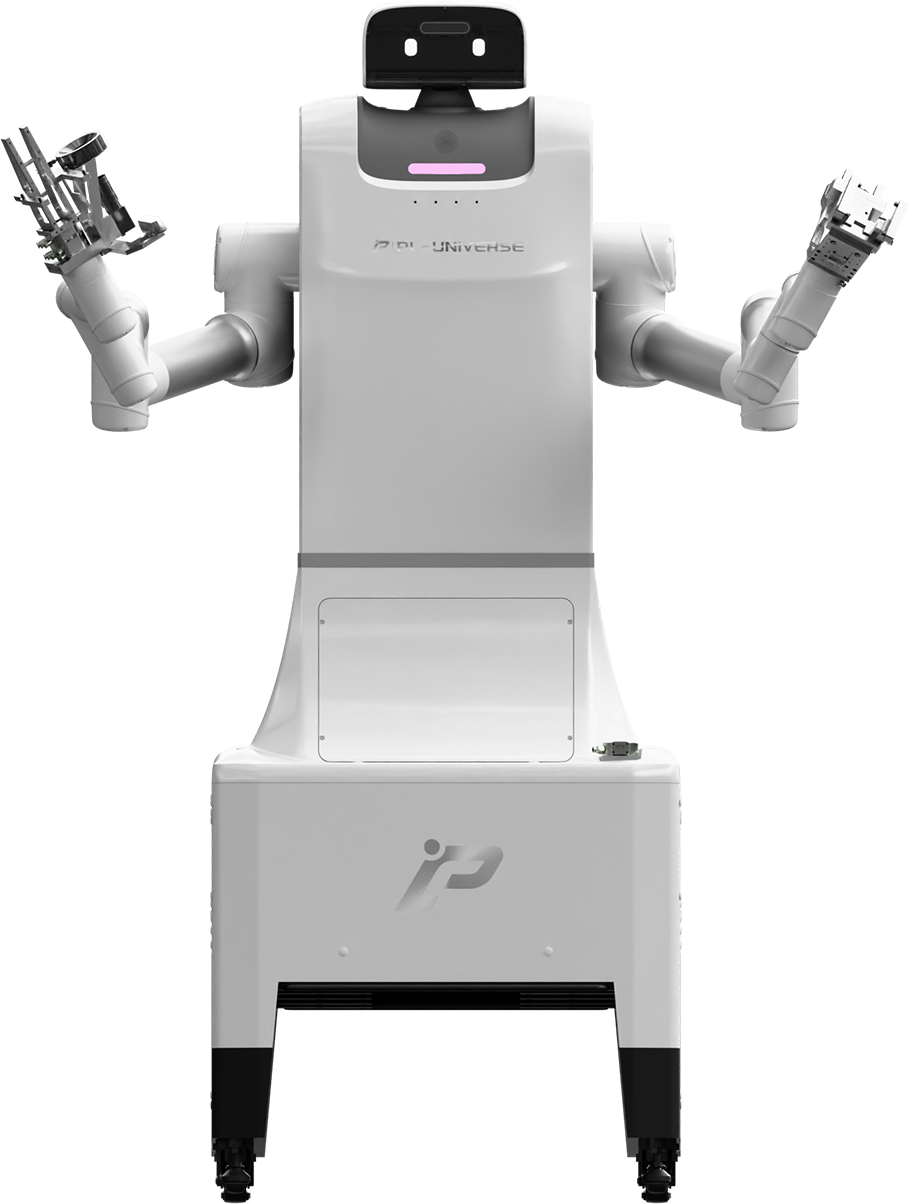
The PL Universe ProWhite (Chinese: 大白, literally "Big White") is a series of industrial-grade wheeled humanoid robots developed by PL-Universe Robotics Technology (Suzhou) Limited Co. (Chinese: 普罗宇宙机器人科技(苏州)有限公司), a Chinese robotics startup headquartered in Suzhou Industrial Park, Jiangsu Province. The ProWhite platform serves as PL-Universe's flagship product line, combining a humanoid upper body with a wheeled omnidirectional mobile base to perform precision manufacturing tasks on production lines at sub-millimeter accuracy (±0.05 mm repeatable positioning).
| PL Universe ProWhite | |
|---|---|
 | |
| General information | |
| Manufacturer | PL-Universe Robotics |
| Country of origin | China |
| Year unveiled | 2025 |
| Status | Production |
| Availability | Available (via JD.com) |
| Website | en.pl-universe.com |
The first-generation ProWhite was unveiled at the 2025 World Robot Conference (WRC) in Beijing in August 2025, where it attracted attention for its sub-millimeter positioning accuracy and live demonstrations of industrial tasks such as screw fastening and component assembly.[1][2] An upgraded version, the ProWhite Robot 2.0, was launched on November 1, 2025 at JD.com headquarters in Beijing's Yizhuang district, featuring comprehensive upgrades across more than 300 performance metrics.[3][4] PL-Universe describes the ProWhite as "the industry's first industrial-grade embodied AI robot balancing flexibility and precision," and positions it as a core element of its vision for AI-driven smart factories.[5]
Who makes the ProWhite?
PL-Universe Robotics
PL-Universe Robotics (普罗宇宙) was founded in January 2025 and is headquartered in Suzhou Industrial Park, one of China's leading high-tech innovation zones. The company styles itself as a "Factory-Level AI Group Operation Expert" and a provider of embodied AI solutions for industrial and commercial scenarios.[5] Its founding team includes members drawn from major technology companies such as Tesla and Huawei, and PL-Universe reports that research and development personnel account for roughly 90 percent of its workforce.[2]
The company's leadership includes Ge Jin, who serves as Founder and Chief Operating Officer, and Wu Chaoxin, who holds the position of Co-founder and Chief Technology Officer.[3][6] PL-Universe has developed a proprietary software framework called SPDAA (a "sharded parallel data acquisition architecture") and an in-house vision-language-action model called InduThread-VLA, which together let it overcome what it terms "scenario adaptation barriers" when deploying robots across varying industrial scenarios.[5][12] The company says the SPDAA framework peaks at 92.8 times the data-acquisition efficiency of traditional methods in real factory deployments.[4][13]
In February 2026, PL-Universe hosted a collaborative event with Stanford University titled "Robots Master the Production Line? PL-Universe: VLA for Autonomy, Robotics & Investment," which focused on Physical AI research and its industrial applications. The event gathered Stanford students, robotics practitioners, autonomous driving experts, investors, and academics to discuss the future of embodied intelligence in manufacturing.[7]
Product line context
The ProWhite series is PL-Universe's primary product line. The name "ProWhite" is the English rendering of the Chinese name 大白, a reference to the friendly white healthcare robot Baymax from Disney's Big Hero 6, reflecting the robot's approachable humanoid design. Within the PL-Universe product ecosystem, the ProWhite platform encompasses both service-oriented and industrial configurations.
The company's lineup also includes the PL Universe Zeus 1, a heavy-duty industrial variant that was showcased alongside the first-generation ProWhite at the 2025 WRC. While the Zeus 1 is optimized specifically for high-payload factory floor operations at approximately 300 kg, the ProWhite product line is designed for broader deployment scenarios including precision assembly, quality inspection, material handling, and logistics coordination across multiple manufacturing verticals.[2][5]
On November 1, 2025, PL-Universe held its "Robotics 2025 Launch & JD.com Deep Collaboration Inauguration" at JD.com headquarters in Beijing. The event unveiled the ProWhite Robot 2.0, four specialized end-effectors, and the PL-WitHand dexterous hand, while simultaneously announcing an exclusive global online sales partnership with JD.com.[3][4]
How is the ProWhite designed?
Physical design
The ProWhite employs a wheeled humanoid form factor. Rather than bipedal locomotion, the robot uses a four-wheel omnidirectional drive system that provides stable, precise movement across flat factory floors and commercial spaces. This design choice prioritizes payload capacity, positional accuracy, and smooth transitions between workstations over the terrain adaptability offered by legged robots.
The robot's height is adjustable between 165 cm and 195 cm, allowing it to be configured for different workstation layouts and assembly line geometries. Its frame is constructed from a combination of steel and aluminum, providing structural rigidity for industrial tasks while keeping weight manageable for energy efficiency. The humanoid upper body is paired with dual 7-degree-of-freedom arms, giving the robot the kinematic flexibility needed for complex manipulation tasks.[1][2]
A key design feature of the ProWhite 2.0 is its parent-child separation architecture (子母分离设计). This modular approach allows the robot's chassis (the "child" unit) to detach from the main upper body (the "parent" unit). When separated, the mobile base can independently handle material transport, automatic loading and unloading, and collection modules, while the upper body workspace continues performing assembly or inspection tasks at a fixed station. This simultaneous operation across transport and manipulation significantly improves production line throughput.[4][8]
Modular end-effector system
One of the ProWhite's defining characteristics is its modular end-effector system. The humanoid body supports rapid swapping of specialized tools depending on the task at hand. PL-Universe has developed a suite of standardized end-effectors that are compatible not only with the ProWhite platform but also with other robotic arms and industrial automation systems. According to PL-Universe, these end-effectors collectively cover approximately 40 percent of core manufacturing processes.[3][4]
The four standardized end-effectors released alongside the ProWhite Robot 2.0 are:
| End-effector | Function | Key specification |
|---|---|---|
| Intelligent Fastening | Screw tightening and bolt torquing | Torque accuracy: ±0.01 Nm; 23-bit optical encoder; max speed 2,000 rpm |
| High Precision Dispensing | Adhesive and sealant application | Double-action suction diaphragm valve for controlled dispensing |
| Adaptive Soldering | Precision soldering operations | Temperature range: 50 to 600 degrees Celsius; high-frequency eddy current heating; closed-loop constant temperature control |
| Micro-Oiling | Precision lubrication | Controlled micro-volume dispensing for coating applications |
The Intelligent Fastening end-effector measures 230 mm (L) x 101 mm (W) x 520 mm (H) and weighs 5 kg. It operates on 48V power, uses a servo motor with a 23-bit communicative optical encoder, and achieves a minimum motion increment of 0.1 degrees. The system provides real-time axial pressure monitoring to accommodate uneven surfaces and varying thread resistance, and includes both cross-threading detection and stripping detection to support zero-defect production requirements. It features 485/232 communication interfaces that can operate simultaneously, plus a USB interface.[9]
The Adaptive Soldering end-effector uses a closed-loop constant temperature control system with rapid thermal recovery, making it well suited for soldering processes that require consistent heat delivery across varied joint geometries.[9]
PL-WitHand dexterous hand
Alongside the ProWhite Robot 2.0, PL-Universe introduced the PL-WitHand, described by the company as the world's first industrial-grade hybrid-driven dexterous hand. The PL-WitHand uses a tendon-linkage hybrid transmission design that combines the flexibility of tendon-driven systems with the precision and strength of mechanical linkages. With 20 degrees of freedom, the hand is designed to achieve near-human dexterity for tasks such as assembling irregularly shaped parts, handling wire harnesses, and manipulating small components.[3][4]
The PL-WitHand incorporates PL-Universe's proprietary ProxiGrasp intelligent grasping algorithm, which enables the hand to automatically adapt its grip strategy to different objects and task requirements. While the primary application is industrial manufacturing, PL-Universe notes that target use cases extend to precision medicine, operations in extreme environments, and virtual reality interaction scenarios.[3]
AI and software architecture
The ProWhite integrates an end-to-end flexible industrial large language model with PL-Universe's SPDAA parallel data acquisition architecture and its InduThread-VLA model. This combination enables the robot to process multi-modal sensor data (visual, force-tactile, and proprioceptive) and make real-time decisions about task execution. PL-Universe says the InduThread-VLA model lets the robot not only "see" a task but also "understand" and "foresee" it, while the SPDAA architecture peaks at 92.8 times the data-acquisition efficiency of conventional methods during real factory deployments.[4][12][13]
Key AI capabilities include:
- Multi-modal vision and force-sensing interaction: The robot fuses camera imagery, depth data, and force/torque feedback to adapt to variations in workpiece positioning, surface conditions, and assembly tolerances.
- Cross-workstation autonomous collaboration: The ProWhite can navigate between multiple workstations on a production line, coordinating its activities with manufacturing execution systems (MES) and other factory automation infrastructure.
- Few-shot learning: PL-Universe's Large Model Team has developed techniques for training the robot on new tasks with minimal demonstration data, reducing setup time when deploying it for new manufacturing processes.[7]
- Embedded AI data analytics: The end-effectors feature lightweight embedded AI that learns and adapts to specific production scenarios, contributing to the overall system's flexibility.[8]
The robot runs on a Linux/ROS-based operating system and supports connectivity via Ethernet, industrial fieldbus protocols, and WiFi.[1]
What are the ProWhite's technical specifications?
The following table summarizes the known technical specifications of the ProWhite platform. Some values are drawn from the first-generation ProWhite as showcased at WRC 2025; the ProWhite Robot 2.0 retains these core specifications while delivering upgrades across more than 300 performance points.[2][4][5]
| Category | Specification | Value |
|---|---|---|
| Physical | Height | 165 to 195 cm (adjustable) |
| Physical | Working height range | 0.7 m to 2 m |
| Physical | Frame material | Steel and aluminum |
| Mobility | Drive system | Four-wheel omnidirectional |
| Mobility | Maximum speed | 2.5 m/s (9.0 km/h) |
| Manipulation | Arm DOF | 7 DOF per arm (14 total) |
| Manipulation | Arm span | 910 mm |
| Manipulation | Payload capacity | Greater than 7 kg per arm; up to 15 kg combined |
| Precision | Absolute positioning accuracy | ±0.05 mm |
| Precision | Fastening torque accuracy | ±0.01 Nm |
| Power | Battery life | 8 hours or more (continuous operation) |
| Power | Battery pack | 48V, 40Ah; hot-swappable (about 2-hour charge) |
| Sensors | Vision system | Multi-modal (camera + depth sensors) |
| Sensors | Force/torque sensing | Yes (integrated in arms and end-effectors) |
| Computing | Operating system | Linux/ROS |
| Computing | AI integration | End-to-end industrial LLM; SPDAA architecture; InduThread-VLA model |
| Connectivity | Interfaces | Ethernet, industrial fieldbus, WiFi |
| End-effector | Compatible tools | Intelligent Fastening, High Precision Dispensing, Adaptive Soldering, Micro-Oiling, PL-WitHand |
Note: PL-Universe has not publicly disclosed the total weight of the ProWhite Robot 2.0 or the full degrees of freedom count including the waist and base. The PL-WitHand adds 20 DOF per hand when equipped. The specifications above reflect officially published figures from PL-Universe's website and press materials.[5][9][12]
How does ProWhite 2.0 differ from ProWhite 1.0?
The first-generation ProWhite was launched at the 2025 World Robot Conference in August 2025. According to PL-Universe, the initial version completed more than 10 successful deployment validations across three distinct industrial scenario types before the 2.0 upgrade was developed.[4][8]
The ProWhite Robot 2.0, unveiled in November 2025, represents what PL-Universe describes as a comprehensive upgrade across over 300 performance metrics. While PL-Universe has not published a detailed changelog comparing every specification between the two generations, the company highlights three core advantages of the 2.0 platform:[4][5]
| Advantage | Description |
|---|---|
| Ultra-high precision | Sub-millimeter operational accuracy with ±0.05 mm absolute positioning and adaptive dynamic accuracy compensation |
| Strong adaptability | Deep MES system integration for rapid production line switching; modular end-effector design for flexible scenario adaptation |
| Process value-add | Parent-child separation architecture enabling simultaneous task execution and automated material handling for closed-loop intralogistics |
The 2.0 version also introduced the four standardized end-effectors and the PL-WitHand dexterous hand as new accessories, expanding the range of manufacturing processes the platform can address.[3]
What did the ProWhite demonstrate at WRC 2025?
At the 2025 World Robot Conference, PL-Universe demonstrated the ProWhite (referred to at the event as "普罗宇宙大白") performing three core industrial scenarios live on the exhibition floor:[1][2]
Unordered screw fastening
The robot used its Intelligent Fastening end-effector to locate and tighten four screws in an unstructured arrangement within 12 seconds. The demonstration highlighted the robot's ability to combine visual recognition with precise torque control, achieving repeatable fastening at sub-millimeter accuracy without requiring screws to be pre-positioned in a fixed pattern.
Component assembly and inspection
In this scenario, the ProWhite performed assembly and quality inspection tasks on sweeper (vacuum cleaner) components. The robot identified parts, assembled them according to specification, and then conducted visual and dimensional inspection to verify assembly quality before passing the unit to the next production stage.
Parent-child unit separation and logistics
The third demonstration involved separating the mobile base from the upper body workspace and coordinating logistics between workstations. The parent-child separation design allowed the mobile chassis to transport materials independently while the upper body continued performing assembly tasks at a fixed station, demonstrating the integrated production workflow concept.
What is the ProWhite used for?
The ProWhite is primarily targeted at industrial manufacturing sectors that demand high precision, reliability, and continuous operation. PL-Universe has identified several key verticals for deployment.
3C electronics manufacturing
The 3C electronics sector (computers, communications, and consumer electronics) requires robots capable of handling small, delicate components with extreme precision. Tasks such as screw fastening on smartphone or laptop assemblies, adhesive dispensing on display panels, and soldering on circuit boards all fall within the ProWhite's demonstrated capabilities. The robot's sub-millimeter positioning accuracy and specialized end-effectors make it suitable for the tight tolerances demanded by consumer electronics production.[2][5]
Automotive manufacturing
In automotive manufacturing, the ProWhite can support tasks ranging from precision assembly of interior components and electrical systems to inspection and quality assurance along the production line. The robot's payload capacity and modular tooling allow it to handle automotive parts that require both delicate handling and firm manipulation.[5]
Semiconductor manufacturing
PL-Universe lists semiconductor manufacturing as an additional target vertical, where the ProWhite's precision positioning and cleanroom-compatible design principles could support wafer handling, component placement, and quality inspection workflows.[5][10]
Biopharmaceutical applications
The company also identifies biopharmaceutical production as a potential application area, where the robot's precision and programmability could assist with tasks such as laboratory automation, sample handling, and packaging.[10]
How does the ProWhite differ from the Zeus 1?
The ProWhite and the PL Universe Zeus 1 are both products of PL-Universe Robotics, and they share underlying platform technologies, including the SPDAA software architecture, compatible end-effectors, and the PL-WitHand dexterous hand. However, they are positioned for different use cases within PL-Universe's product strategy.
The Zeus 1, weighing approximately 300 kg with an adjustable height range of 165 to 195 cm, is a heavy-duty industrial variant optimized specifically for demanding factory floor operations. It was showcased at the 2025 WRC performing screw fastening, assembly, and logistics tasks, and is priced at an estimated $140,000 USD.[1][2]
The ProWhite line, by contrast, is PL-Universe's broader product family encompassing industrial-grade robots designed for mass production and wider deployment. As PL-Universe's flagship product, the ProWhite has been the focus of the company's commercialization efforts, including the JD.com sales partnership and the ProWhite Robot 2.0 upgrade. PL-Universe states that it has already "mass-produced and delivered" ProWhite robots to early customers.[3][6]
Both platforms support the same suite of end-effectors and can integrate with enterprise MES systems, but the ProWhite product line is positioned as the more commercially accessible offering within PL-Universe's portfolio.
What is the "Craftsmanship Universe" initiative?
Alongside the ProWhite Robot 2.0 launch in November 2025, PL-Universe announced the "Craftsmanship Universe" (Chinese: 匠心宇宙) initiative. This program aims to preserve the tacit knowledge and hands-on expertise of veteran industrial workers, which PL-Universe argues is at risk of being lost as experienced manufacturing professionals retire.[3][6]
Through the initiative, PL-Universe plans to use its embodied AI robots as "experience carriers," digitizing skilled craftsmanship through proprietary large AI models and algorithmic modeling. The ProWhite platform serves as the hardware backbone for this effort, with the goal of enabling robots to learn and replicate the fine motor skills and process knowledge that currently reside only in the hands of experienced human operators.[3]
Is the ProWhite available to buy?
On November 1, 2025, PL-Universe announced an exclusive global online sales partnership with JD.com, one of China's largest e-commerce platforms. Under this arrangement, JD.com serves as the primary online distribution channel for PL-Universe's robot products, including the ProWhite Robot 2.0, its end-effectors, and the PL-WitHand.[3][4]
The partnership extends beyond simple product distribution. Both companies plan to collaborate on overseas expansion, service system development, technical support infrastructure, and marketing initiatives aimed at promoting the industrialization and multi-scenario deployment of embodied AI robots globally.[3][6]
The collaboration was inaugurated at JD.com's headquarters with over 100 corporate representatives and journalists in attendance, including delegates from consumer electronics, automotive parts, and semiconductor companies. The event signaled PL-Universe's ambition to scale beyond China's domestic market and build an international customer base for its industrial robotics products.[3]
At the launch, founder and chief operating officer Ge Jin summarized the company's pace, noting that in roughly ten months PL-Universe had completed two robot version iterations with small-batch delivery and rolled out its end-effectors and dexterous hand to build "a complete industrial product matrix."[4] PL-Universe has stated that it has already mass-produced and delivered its first batch of ProWhite robots, confirming that the platform has moved beyond the prototype stage into commercial production.[6]
How does the ProWhite compare to other humanoid robots?
The ProWhite enters a rapidly growing market for industrial humanoid robots, particularly within China. The country's humanoid robot sector saw explosive growth in 2025 and 2026, with Chinese companies controlling an estimated 87 to 90 percent of the global humanoid robot market by unit shipments.[11] Annual shipments of AI-powered humanoid robots for industrial use were estimated at 5,000 to 7,000 units in 2025, with projections of 15,000 units for 2026.[11]
Key competitors in the industrial wheeled humanoid segment include:
| Company | Robot | Key differentiator |
|---|---|---|
| AgiBot | G2 Genie | 26 DOF, 7-DOF force-controlled arms, dual hot-swappable batteries, IP42 rating |
| UBTECH | Walker S1 | Bipedal design; deployed at Foxconn for 3C logistics; 500+ orders from automotive OEMs |
| PL-Universe | ProWhite 2.0 | Sub-millimeter accuracy, SPDAA architecture, parent-child separation, modular end-effectors |
| PL-Universe | Zeus 1 | Heavy-duty variant (~300 kg), 20-DOF PL-WitHand, 8+ hour battery |
The broader competitive field also includes international players such as Tesla with its Optimus humanoid, Figure with the Figure 02, and Apptronik with Apollo. However, these companies have generally focused on bipedal general-purpose designs and have not yet achieved the same shipment volumes as Chinese firms in industrial settings.[11]
PL-Universe differentiates the ProWhite through its focus on precision manufacturing tasks, its parent-child separation architecture for integrated logistics, the extensive range of specialized end-effectors covering 40 percent of core manufacturing processes, and its early mass-production and commercial delivery track record.
See also
- Humanoid robots
- PL Universe Zeus 1
- Embodied AI
- Physical AI
- Vision-language-action model
- Dexterous hand
- AgiBot G2 Genie
- Humanoid robot market
- Robot Operating System
- Industrial automation
References
- ^1 ^2 ^3 ^4 ^5"Zeus 1: PL-Universe's High-Precision Humanoid Robot." RoboHorizon Magazine, August 2025. robohorizon.com/...s-high-precision-humanoid-robot
- ^1 ^2 ^3 ^4 ^5 ^6 ^7 ^8"拧螺丝的机器人来了!普罗宇宙发布工业轮式人形机器人" (The screw-tightening robot is here! PL Universe unveils industrial wheeled humanoid robot). Sina Finance, August 8, 2025. finance.sina.com.cn/...doc-infkhmtx5063730.shtml
- ^1 ^2 ^3 ^4 ^5 ^6 ^7 ^8 ^9 ^10 ^11 ^12 ^13"PL-Universe Robotics Launches ProWhite Robot 2.0 and Dexterous Hand, Powered by JD.com Global Online Partnership for Overseas Expansion." PR Newswire, November 2, 2025. prnewswire.com/...for-overseas-expansion-302601767
- ^1 ^2 ^3 ^4 ^5 ^6 ^7 ^8 ^9 ^10 ^11 ^12"工业具身智能矩阵成型!普罗宇宙发布大白机器人2.0及灵巧手,京东全球线上合作赋能出海" (Industrial embodied AI matrix takes shape! PL-Universe launches ProWhite Robot 2.0 and dexterous hand). Leaderobot.com, November 2025. leaderobot.com/...6623
- ^1 ^2 ^3 ^4 ^5 ^6 ^7 ^8 ^9 ^10PL-Universe Robotics Technology Suzhou Limited Co. Official website. en.pl-universe.com
- ^1 ^2 ^3 ^4 ^5"China's PL-Universe Robotics debuts new products, partners with JD.com." China.org.cn, November 3, 2025. china.org.cn/...content_118156901.shtml
- ^1 ^2"PL-Universe with Stanford: Groundbreaking Physical AI & Robot Event Successfully Concluded." The AI Journal, February 2026. aijourn.com/...-robot-event-successfully-concluded
- ^1 ^2 ^3"普罗宇宙大白机器人2.0亮相:具有亚毫米级操作水准" (PL-Universe ProWhite Robot 2.0 debuts: Sub-millimeter operational precision). Mydrivers.com, November 2025. news.mydrivers.com/...1084432
- ^1 ^2 ^3"PL-Universe End Effectors." PL-Universe official website. en.pl-universe.com/...EndEffectors
- ^1 ^2"普罗宇宙大白机器人." 2025 World Robot Conference product listing. worldrobotconference.com/...374
- ^1 ^2 ^3"Why China's humanoid robot industry is winning the early market." TechCrunch, February 28, 2026. techcrunch.com/...stry-is-winning-the-early-market
- ^1 ^2 ^3"全球首秀!普罗宇宙携'大白机器人'亮相世界机器人大会" (Global debut! PL-Universe brings the ProWhite robot to the World Robot Conference). PL-Universe Robotics official website, August 2025. pl-universe.com/...10
- ^1 ^2"普罗宇宙机器人全球首发:重塑工业场景,定义工业级具身智能新标杆" (PL-Universe robots make global debut: reshaping industrial scenarios, defining a new benchmark for industrial-grade embodied intelligence). China Industry News (中国工业新闻网), August 2025. cinn.cn/...427724
Improve this article
Add missing citations, update stale details, or suggest a clearer explanation. Every suggestion is reviewed for sourcing before it goes live.
8 revisions · v8 · 3,407 words · full history
Fact-checks are independent of edits: a reviewer re-verifies the article against its sources and stamps the date. How we verify
Research and drafting on this wiki are AI-assisted, under named human editorial standards. How AI is used here
Cite this page: AI Wiki. "PL Universe ProWhite." aiwiki.ai, updated 7 Jul 2026. CC BY 4.0. https://aiwiki.ai/wiki/pl_universe_prowhite