

Automation
Automation is the use of machines, control systems and software to carry out work with reduced or no direct human involvement. The human-factors researchers Raja Parasuraman, Thomas Sheridan and Christopher Wickens define it as a device or system that accomplishes, partially or fully, a function that was previously, or conceivably could be, carried out by a human operator, a definition under which automation is a matter of degree rather than an all-or-nothing property.[1] Labor economists working with task-based models describe automation as technology that lets capital take over tasks that workers used to perform.[2] The word dates from the American automobile industry of the late 1940s, where Ford Motor Company vice president Delmar S. Harder is credited with coining it and set up an Automation Department in April 1947.[3][4]
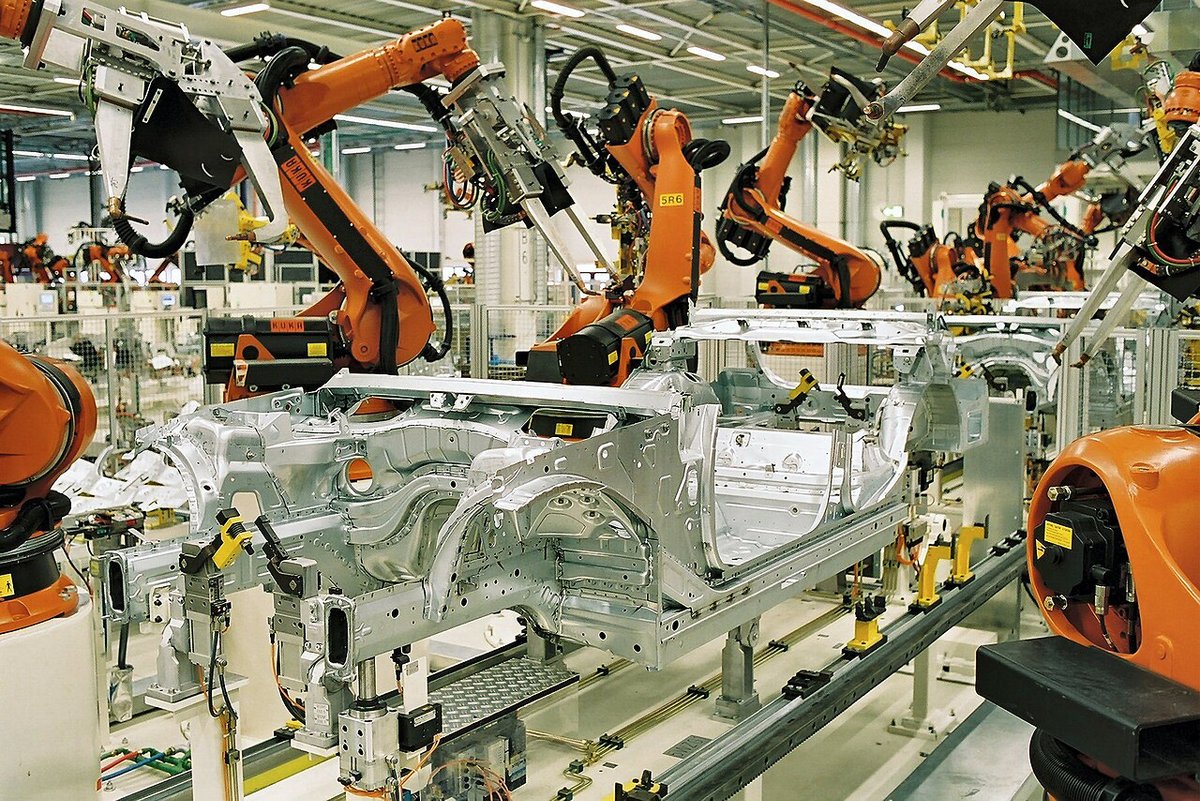
Its history runs from steam-engine governors through the transfer lines, industrial robots and programmable logic controllers of postwar manufacturing.[5][4][6][7] Machine learning and large language models have since extended automation from the routine, rule-based tasks that earlier computers took over toward non-routine cognitive work, prompting new studies of how many jobs are exposed.[8][9][10] Research on these systems often separates automation, where a system completes a task with little human input, from augmentation, where it works alongside a person; Anthropic's Economic Index has tracked that split in real Claude usage since February 2025.[11][12]
Definitions
Parasuraman and colleagues quote three senses from the Oxford English Dictionary: automatic control of the manufacture of a product through a number of successive stages; the application of automatic control to any branch of industry or science; and, by extension, the use of electronic or mechanical devices to replace human labor.[1] They also argue that automation is not the same thing as modernization. Replacing a computer with a more powerful one, or electrical cables with fiber optics, does not necessarily constitute automation; their definition instead asks whether a machine now performs a function that a human operator performed or could perform.[1]
Writers in the 1950s offered their own definitions. In a February 1956 article, the Dartmouth economics professor Clyde E. Dankert described automation as, at its core, the application of the principle of automatic control to industrial and commercial processes, and quoted a definition issued at the First International Automation Exposition in New York in November 1954: "the substitution of mechanical, hydraulic, pneumatic, electrical, and electronic devices for human organs of observation, decision, and effort, so as to increase productivity, control quality, and reduce costs."[3]
In economics, Daron Acemoglu and Pascual Restrepo treat production as a set of tasks allocated between capital and labor. Automation in their framework lets capital replace labor in tasks it previously performed, which shifts the task content of production against labor; the creation of new tasks in which labor has a comparative advantage pushes the other way.[2] This task-based view underlies much of the research on AI and employment described below.
History
Governors and feedback control
Self-regulating machinery is much older than the word. In 1868 James Clerk Maxwell published "On Governors" in the Proceedings of the Royal Society, defining a governor as the part of a machine that keeps its velocity nearly uniform despite changes in driving power or resistance, and discussing Watt's governor for steam engines among other designs.[5] Maxwell treated the stability of the governed motion as the central problem and reduced it to the condition that the real roots, and the real parts of the complex roots, of a certain equation all be negative.[5]
"Automation" at Ford
Dankert's 1956 account says the word came into use in the latter part of the 1940s, when Harder coined it, and that the consultant John Diebold thought of the word too, "but apparently after Mr. Harder."[3] Diebold's book Automation: The Advent of the Automatic Factory was published by Van Nostrand in 1952.[13] According to Dankert, the word made little headway with the public until 1953 and 1954, when it "burst forth in a great wave of publicity."[3]
The historian David A. Hounshell ties the term to Ford's postwar reorganization. In April 1947 Harder organized an Automation Department within his Manufacturing Division and charged its engineers with developing inexpensive, reliable methods of automating the transfer of materials in process from one operation to another.[4] Each device had to cost less than $3,000, roughly 10 to 15 percent more than the annual wages of an average fully employed blue-collar autoworker at the time, and pay for itself within a year, which in Hounshell's reading meant that each device had to eliminate at least one worker.[4] Ford's new Cleveland Engine Plant used transfer machines to a greater extent than any other automobile plant in the world, linked by the Automation Department's handling devices so that almost no labor was needed to load and unload them.[4]
When production began in Cleveland, Ford was hailed as the pioneer of automation, and for a brief period its executives and public relations department presented the technology as a revolution that would soon produce the workerless factory.[4] Fear of automation spread among Ford's production workers and the wider American workforce, and the debate led to two congressional inquiries, in 1955 and 1960.[4] One of the epigraphs to Hounshell's paper is a passage from the 1989 book Made in America, edited by Michael Dertouzos and colleagues, arguing that the US auto industry's practice of assigning a dedicated machine to each task produced inflexible automation, so that by the 1960s even a small change in an engine's dimensions could require millions of dollars of new tooling.[4]
Industrial robots
In 1954 the inventor and entrepreneur George Devol filed a patent for a "programmed article transfer" device that could store step-by-step digital commands for moving parts in a factory.[6] He and the entrepreneur Joseph Engelberger built a prototype in 1958 and later founded Unimation, the first robotics company.[6] In 1961 the first Unimate went into service at a General Motors plant in Ewing Township, New Jersey, extracting hot metal parts from a casting machine; IEEE Spectrum's robot guide calls it "the first industrial robot ever built."[6] Carmakers went on to use Unimates to automate metalworking and welding.[6]
Programmable logic controllers
Before programmable controllers, factory machinery was sequenced by cabinets of hard-wired relays, which took hours to troubleshoot and had to be largely rewired whenever the process changed.[14] In 1968 General Motors' Hydra-Matic division sought computer control to replace hard-wired relay systems that were not flexible enough for production changes, and the contract went to Bedford Associates, led by the mechanical engineer Richard E. "Dick" Morley.[7] GM's requirements included a solid-state system that was flexible like a computer but priced competitively with relay logic, programmable in the relay "ladder logic" that maintenance electricians already understood, able to work amid dirt, moisture, electromagnetism and vibration, and modular enough to repair and expand.[14] The result was the Modicon 084, named because it was Bedford's 84th project; it was first used at GM in March 1969 to control the production of automatic transmissions for Cadillac, Chevrolet and Pontiac.[7] Modicon became part of Schneider Electric in 1995.[7]
Computers and routine work
David Autor, Frank Levy and Richard Murnane argued in a 2003 study that computers execute procedural, rule-based logic, so they substitute for routine cognitive and manual tasks while complementing non-routine problem solving and interactive work.[8] Using data on job task requirements from 1960 to 1998, they found that computerization was associated with falling relative demand for routine tasks and rising relative demand for non-routine cognitive tasks, and that these shifts explained 30 to 40 percent of the growth in relative demand for college-educated workers between 1970 and 1998.[8]
Autor later connected the limits of this kind of automation to an observation the philosopher Michael Polanyi made in 1966: "We can know more than we can tell." He argued that the paradox Polanyi identified, that tacit knowledge of how the world works often exceeds explicit understanding, foretold much of the history of computerization over five decades, and noted that contemporary computer science tries to overcome it by building machines that learn from human examples.[15]
Machine learning and generative AI
Carl Benedikt Frey and Michael Osborne's 2013 Oxford study of 702 occupations started from that shift. They argued that machine learning and mobile robotics, built on large datasets, allow computers to substitute for labor across a wide range of non-routine tasks, limited mainly by engineering bottlenecks in perception and manipulation, creative intelligence and social intelligence.[9] They estimated that 47 percent of US employment was in the high-risk category, meaning occupations potentially automatable "over some unspecified number of years, perhaps a decade or two."[9]
Large language models prompted new estimates. A 2023 study by Tyna Eloundou, Sam Manning, Pamela Mishkin and Daniel Rock found that around 80 percent of the US workforce could have at least 10 percent of their work tasks affected by LLMs, and about 19 percent at least half of their tasks; the authors said they were not predicting when the models would be developed or adopted.[10] They estimated that an LLM alone could complete about 15 percent of US worker tasks significantly faster at the same quality, rising to 47 to 56 percent with software built on top of the models.[10]
Benchmarks introduced in 2025 try to measure directly how much paid work AI systems can complete. OpenAI's GDPval covers work activities from 44 occupations in the nine sectors that contribute most to US GDP, and its authors reported that the best frontier models were approaching industry experts in the quality of their deliverables.[16] The Remote Labor Index, built from real-world, economically valuable projects, found that AI agents performed near the floor: in the October 2025 paper introducing it, the highest-performing agent achieved an automation rate of 2.5 percent.[17] Usage data on coding agents point the same way: Anthropic's June 2026 Economic Index report describes Claude Code as an agentic tool whose sessions are on average more automated than those in chat or Claude Cowork.[18]
Industrial automation
NIST's guide to operational technology security describes the main control architectures used in industrial automation.[19]
| System | What it does (per NIST SP 800-82r3) | Typical settings |
|---|---|---|
| Programmable logic controller (PLC) | Controller with user-programmable memory for I/O control, logic, timing, counting, PID control and arithmetic; the local controller inside larger systems | Discrete processes such as automobile assembly lines |
| Distributed control system (DCS) | Supervisory control loop that coordinates many local controllers at one site, using feedback or feedforward loops to hold conditions near set points | Refineries, chemical plants, power generation, pharmaceuticals |
| Supervisory control and data acquisition (SCADA) | Centralized monitoring and control of geographically dispersed assets through remote terminal units or PLCs | Pipelines, water systems, electric grids, rail |
| Human-machine interface (HMI) | Hardware or software through which an operator interacts with a controller | From push-button panels to industrial PCs running HMI software |
NIST notes that PLCs serve as the control components in both SCADA and DCS systems, and that a DCS limits the effect of any single fault by modularizing production.[19] Smaller configurations in which a PLC is the primary controller generally lack a central control server or HMI, and so mainly provide closed-loop control with minimal human involvement.[19]
The International Federation of Robotics (IFR) reported in September 2026 that the operational stock of industrial robots rose 9 percent to a record 5 million units in 2025, driven by an 11 percent jump in annual installations to more than 600,000 new robots.[20] The IFR's president said the five-million mark was more than double the number seven years earlier.[20] China accounted for 59 percent of 2025 installations with 354,000 units, and the IFR forecast 655,000 installations worldwide in 2026 and 806,000 in 2029.[20]
Levels and types of automation
Because automation is a matter of degree, researchers have proposed scales describing how much of a task a machine handles. Parasuraman, Sheridan and Wickens present a 10-point scale, based on a 1978 MIT report by Sheridan and William Verplank on undersea teleoperators, that runs from fully manual performance to full automation.[1] At level 2 the computer offers the human several options but has no further say; at level 4 it suggests one alternative and the human keeps authority to execute it or choose another; at level 6 it gives the human only a limited time to veto before acting.[1] Their air traffic control example is a conflict detection system that suggests a resolution (level 4); at level 6 or above, the system would carry out its own resolution unless the controller intervened.[1]
The same paper argues that automation can be applied separately to four stages of human information processing, each at its own level.[1]
| Type | What is automated | Examples given by Parasuraman et al. |
|---|---|---|
| Information acquisition | Sensing and registering input data | Radar scanning, listing aircraft by handling priority, sensors on an industrial robot |
| Information analysis | Prediction and integration of data | Cockpit predictor displays, process-plant trend displays |
| Decision and action selection | Choosing among alternatives | Expert systems, ground proximity warning (level 4), automatic ground collision avoidance (level 7) |
| Action implementation | Executing the chosen action | Automatic sorting and stapling in a photocopier, automated air traffic handoffs |
In adaptive automation, the level or type of automation changes with the situation during operation rather than being fixed at design time.[1]
For AI agents, a 2025 Stanford study by Yijia Shao, Erik Brynjolfsson, Diyi Yang and colleagues proposed a five-level Human Agency Scale, from H1 (the agent handles the task entirely on its own) to H5 (the agent cannot function without continuous human involvement).[21] The authors present it as a human-centered complement to the SAE levels of driving automation used for autonomous vehicles, and treat H1 and H2 as suited to automation and H3 to H5 as suited to augmentation.[21]
Human factors
In "Ironies of Automation" (1983), Lisanne Bainbridge argued that automating industrial processes can expand rather than eliminate problems with the human operator.[22] Designers who try to remove the operator still leave the operator the tasks they cannot work out how to automate, and because physical skills deteriorate when they are not used, a formerly experienced operator who has been monitoring an automated process may no longer be able to take over smoothly.[22] Bainbridge also noted that a system installed because it does the job better than people still relies on people to check that it is working, although vigilance studies show that humans cannot keep effective watch on a source where little happens for more than about half an hour.[22] Her paper framed the problem as the irony that "the more advanced a control system is, so the more crucial may be the contribution of the human operator."[22]
Parasuraman and colleagues list several human performance costs of poorly chosen automation: reduced situation awareness when the machine makes decisions, complacency or over-trust when automation is highly but not perfectly reliable, and "clumsy" automation that is hard to engage and raises workload instead of lowering it, as well as skill degradation.[1]
Automation and augmentation
Brynjolfsson's 2022 essay "The Turing Trap" argued that as machines become better substitutes for human labor, workers lose economic and political bargaining power, whereas AI aimed at augmenting people lets them keep the power to insist on a share of the value created and produces new capabilities, products and services.[23] He wrote that technologists, business executives and policymakers face excess incentives for automation rather than augmentation.[23]
The Anthropic Economic Index turned the distinction into a usage measurement. Its first report, published February 10, 2025, drew on more than four million Claude.ai conversations from December 2024 and January 2025, mapped a sample of one million of them to tasks in the US Department of Labor's O*NET database, and classified conversations by collaboration pattern.[12][11] Directive conversations (complete task delegation with minimal interaction) and feedback loops (task completion guided by environmental feedback) count as automation; task iteration, learning and validation count as augmentation.[11]
| Report | Sample | Finding |
|---|---|---|
| February 2025 | Claude.ai, December 2024 and January 2025 | 57% augmentation, 43% automation; about 36% of occupations used AI for at least a quarter of their tasks[11][24] |
| September 2025 | Claude.ai, August 2025 | Directive conversations rose from 27% to 39%; first report in which automation exceeded augmentation[24] |
| September 2025 | First-party API (business use), August 2025 | 77% of business uses showed automation patterns, against about 50% on Claude.ai[24] |
| January 2026 | Claude.ai, November 2025 | Augmentation 52%, automation 45%; directive share down to 32%[25] |
| January 2026 | First-party API, November 2025 | About three-quarters of interactions classified as automation[25] |
Anthropic's researchers have offered competing readings of these shifts. The September 2025 report said the rise in directive use could reflect better models that need fewer follow-up refinements, or users learning to delegate, and that the two explanations would carry different labor-market implications.[24] The January 2026 report said the November data suggested the August spike had overstated how quickly the move toward automation was happening, though the automation share remained above its level of nearly a year earlier.[25] The June 2026 report found that people who used Claude in more automated ways also reported higher current and anticipated exposure of their work to AI.[18]
Workers' stated preferences add another angle. In the Stanford study, which surveyed 1,500 workers about more than 844 tasks across 104 occupations, workers expressed positive attitudes toward AI-agent automation for 46.1 percent of tasks, mainly to free time for higher-value work, while equal partnership (H3) was the dominant preferred level in 45.2 percent of occupations.[21] The authors found that 41.0 percent of Y Combinator company-task mappings fell in zones where worker desire for automation was low.[21]
Labor-market evidence
Theory
In 1930 John Maynard Keynes described "technological unemployment" as unemployment caused by the discovery of ways of economizing on labor outrunning the pace at which new uses for labor can be found, and called it "only a temporary phase of maladjustment."[26]
Acemoglu and Restrepo's framework splits the effects of automation into several forces. The displacement effect, as machines take over tasks, tends to lower labor demand and wages; it is offset in part by a productivity effect, because cost savings raise demand for labor in tasks that are not automated, and by capital accumulation and the improvement of existing machinery.[27] They argue that these offsets are incomplete, that automation raises output per worker more than wages and so reduces labor's share of national income, and that the strongest counterweight is the creation of new labor-intensive tasks.[27] Their framework also allows for automation being introduced at an excessive rate, possibly at the expense of other productivity-enhancing technologies.[27] In a 2019 decomposition of US industry data, they attributed slower employment growth over the previous three decades to a faster displacement effect, especially in manufacturing, a weaker reinstatement effect, and slower productivity growth than in earlier decades.[2]
Autor's 2015 essay "Why Are There Still So Many Jobs?" argued that automation has not wiped out most jobs because it also complements labor, raises output and increases demand for labor, and that commentators tend to overstate machine substitution and overlook these complementarities.[28] In his account, the interplay between machine and human comparative advantage lets computers substitute for workers in routine, codifiable tasks while amplifying workers' comparative advantage in problem-solving skills, adaptability and creativity.[28]
Estimates of automation risk
Headline estimates of how many jobs are exposed to or at risk from automation depend heavily on method and on what is being measured.
| Study | Scope | Method | Headline estimate |
|---|---|---|---|
| Frey and Osborne (2013) | 702 US occupations | Occupation-level probability of computerization | 47% of US employment at high risk[9] |
| Arntz, Gregory and Zierahn (2016, OECD) | 21 OECD countries | Task-based, allowing for variation within occupations | 9% of jobs automatable on average (6% in Korea, 12% in Austria)[29] |
| Eloundou et al. (2023) | US workforce | Task exposure to LLMs, rated by humans and GPT-4 | ~80% of workers have at least 10% of tasks exposed; ~19% at least 50%[10] |
| Anthropic Economic Index (2025) | Claude.ai usage | Observed conversations mapped to O*NET tasks | ~36% of occupations use AI in at least a quarter of their tasks[11] |
| World Economic Forum (2025) | Over 1,000 companies in 55 economies | Employer survey | 170 million jobs created and 92 million displaced by 2030 from all structural trends (technology, economy, demographics, green transition), net gain of 78 million[30] |
Arntz and colleagues argued that occupation-level studies such as Frey and Osborne's likely overestimate automatability, because many occupations rated high-risk contain tasks that are hard to automate.[29] In the World Economic Forum survey, 41 percent of employers said they planned to reduce their workforce as AI automates certain tasks, while 77 percent planned to upskill workers.[30]
Robots and wages
Studies of industrial robots have reached different conclusions in different settings. Acemoglu and Restrepo estimated negative effects of robots on employment and wages across US commuting zones: one more robot per thousand workers reduced the employment-to-population ratio by 0.2 percentage points and wages by 0.42 percent.[31] Georg Graetz and Guy Michaels, using panel data on 17 countries from 1993 to 2007, estimated that increased robot use contributed about 0.36 percentage points to annual labor productivity growth and did not significantly reduce total employment, although it reduced the employment share of low-skilled workers.[32]
On wage inequality, Acemoglu and Restrepo estimated that between 50 and 70 percent of the changes in the US wage structure over four decades were accounted for by relative wage declines of worker groups specialized in routine tasks in industries undergoing rapid automation.[33] They argued that large changes in wage inequality can go hand in hand with modest productivity gains.[33]
Generative AI
Early studies found large productivity gains on specific tasks. In a preregistered experiment with 453 college-educated professionals doing writing tasks, Shakked Noy and Whitney Zhang found that access to ChatGPT cut average completion time by 40 percent and raised output quality by 18 percent, with participants with weaker skills benefiting most.[34] Brynjolfsson, Danielle Li and Lindsey Raymond studied 5,172 customer support agents and found that a generative AI assistant raised issues resolved per hour by 15 percent on average; less experienced and lower-skilled workers improved in both speed and quality, while the most experienced and skilled saw small speed gains and small declines in quality.[35]
Evidence on employment is more mixed:
- Anders Humlum and Emilie Vestergaard linked adoption surveys to Danish administrative records and estimated precise null effects of AI chatbots on earnings and recorded hours, ruling out effects larger than 2 percent two years after ChatGPT's launch, even though most employers in exposed occupations had adopted chatbot initiatives.[36]
- Brynjolfsson, Bharat Chandar and Ruyu Chen, using ADP payroll data through June 2026, found no evidence of widespread, economy-wide job displacement, but reported in an August 2026 revision that employment of workers aged 22 to 25 in AI-exposed occupations stood 19 percent below where it would have been had it kept pace with less-exposed peers.[37] The declines were concentrated in occupations where AI use mainly substitutes for human tasks, while employment was flat or rising where AI mainly complements workers; the authors describe the results as early, descriptive indicators rather than causal estimates.[37]
- At the macroeconomic level, Acemoglu estimated in 2024 that AI would raise total factor productivity by no more than 0.66 percent over 10 years, and possibly by less than 0.53 percent, and predicted that AI would widen the gap between capital and labor income.[38]
Employers' stated reasons for layoffs are another indicator. The outplacement firm Challenger, Gray & Christmas, which began tracking artificial intelligence as a distinct reason for announced US job cuts in 2023, counted 121,401 announced cuts citing AI from January through October 2026, about 20 percent of all announced cuts, and 193,226 since tracking began.[39] AI dominated layoff announcements through the spring and summer of 2026, according to the firm, but by October market and economic conditions had overtaken it as the leading reason for the year.[39]
Continue reading
- Industrial robotAn industrial robot is an automatically controlled, reprogrammable, multipurpose manipulator programmable in three or more axes, which can be either fixed in place or mobile for use in industrial automation…Mentioned 7 times above
- Robotic Process AutomationRobotic process automation (RPA) is a category of enterprise software in which software robots, usually just called bots, operate other applications through their graphical user interfaces, reproducing the…Listed in See also
- Automation BiasAutomation bias is the tendency for humans to favor suggestions and outputs from automated decision-making systems over contradictory information from non-automated sourcesListed in See also
- Warehouse automationWarehouse automation is the use of machinery, control software, and increasingly machine learning to move, store, sort, and pick goods inside distribution centers and fulfillment centers.Listed in See also
- Dark FactoryA dark factory, also called a lights-out factory, is a manufacturing or logistics facility that runs production with little or no human presence on the floor.Listed in See also
- Collaborative robotA collaborative robot (commonly called a cobot) is a robot designed to physically interact with humans in a shared workspace without safety fencing.Listed in See also
More from See also
References
- ^1 ^2 ^3 ^4 ^5 ^6 ^7 ^8 ^9Parasuraman, R., Sheridan, T. B., Wickens, C. D. "A model for types and levels of human interaction with automation". IEEE Transactions on Systems, Man, and Cybernetics, Part A: Systems and Humans, vol. 30, no. 3, pp. 286-297, May 2000. doi.org/...3468.844354
- ^1 ^2 ^3Acemoglu, D., Restrepo, P. "Automation and New Tasks: How Technology Displaces and Reinstates Labor". NBER Working Paper 25684, 2019; published in Journal of Economic Perspectives, vol. 33, no. 2, pp. 3-30, 2019. nber.org/...w25684
- ^1 ^2 ^3 ^4Dankert, C. E. "Automation". Dartmouth Alumni Magazine, February 1956. archive.dartmouthalumnimagazine.com/...automation
- ^1 ^2 ^3 ^4 ^5 ^6 ^7 ^8Hounshell, D. A. "Ford Automates: Technology and Organization in Theory and Practice". Business and Economic History, vol. 24, no. 1, pp. 59-71, Fall 1995. thebhc.org/...p0059-p0071.pdf
- ^1 ^2 ^3Maxwell, J. C. "On Governors". Proceedings of the Royal Society of London, vol. 16, pp. 270-283, 1868. doi.org/...rspl.1867.0055
- ^1 ^2 ^3 ^4 ^5IEEE Spectrum. "Unimate". ROBOTS: Your Guide to the World of Robotics. robotsguide.com/...unimate
- ^1 ^2 ^3 ^4Schneider Electric. "Výročí Modiconu: první programovatelný automat na světě slaví 55 let" (Modicon anniversary: the world's first programmable controller turns 55). Schneider Electric Czech Republic press release, June 29, 2023. se.com/...av%C3%AD-55-let-649d3c86da2a429fb1093064
- ^1 ^2 ^3Autor, D., Levy, F., Murnane, R. "The Skill Content of Recent Technological Change: An Empirical Exploration". NBER Working Paper 8337, 2001; published in Quarterly Journal of Economics, vol. 118, no. 4, pp. 1279-1333, 2003. nber.org/...w8337
- ^1 ^2 ^3 ^4Frey, C. B., Osborne, M. A. "The Future of Employment: How Susceptible Are Jobs to Computerisation?". Oxford Martin School working paper, September 17, 2013; published in Technological Forecasting and Social Change, vol. 114, pp. 254-280, 2017. oxfordmartin.ox.ac.uk/..._Future_of_Employment.pdf
- ^1 ^2 ^3 ^4Eloundou, T., Manning, S., Mishkin, P., Rock, D. "GPTs are GPTs: An Early Look at the Labor Market Impact Potential of Large Language Models". arXiv:2303.10130, March 2023. arxiv.org/...2303.10130
- ^1 ^2 ^3 ^4 ^5Anthropic. "The Anthropic Economic Index". February 10, 2025. anthropic.com/...the-anthropic-economic-index
- ^1 ^2Handa, K., Tamkin, A., McCain, M., Huang, S., Durmus, E., et al. "Which Economic Tasks are Performed with AI? Evidence from Millions of Claude Conversations". arXiv:2503.04761, February 2025. arxiv.org/...2503.04761
- ^Diebold, J. Automation: The Advent of the Automatic Factory. Van Nostrand, 1952. Open Library record. openlibrary.org/...OL6115426M
- ^1 ^2AutomationDirect. "History of the PLC". Library.AutomationDirect.com, August 5, 2015. library.automationdirect.com/history-of-the-plc
- ^Autor, D. H. "Polanyi's Paradox and the Shape of Employment Growth". NBER Working Paper 20485, September 2014. nber.org/...w20485
- ^Patwardhan, T., Dias, R., Proehl, E., et al. "GDPval: Evaluating AI Model Performance on Real-World Economically Valuable Tasks". arXiv:2510.04374, October 2025. arxiv.org/...2510.04374
- ^Mazeika, M., Gatti, A., Menghini, C., et al. "Remote Labor Index: Measuring AI Automation of Remote Work". arXiv:2510.26787, October 2025. arxiv.org/...2510.26787
- ^1 ^2Anthropic. "Anthropic Economic Index report: Cadences". June 26, 2026. anthropic.com/...economic-index-june-2026-report
- ^1 ^2 ^3Stouffer, K., Pease, M., Tang, C., Zimmerman, T., Pillitteri, V., Lightman, S., Hahn, A., Saravia, S., Sherule, A., Thompson, M. "Guide to Operational Technology (OT) Security". NIST Special Publication 800-82r3, National Institute of Standards and Technology, September 2023. doi.org/...NIST.SP.800-82r3
- ^1 ^2 ^3International Federation of Robotics. "Five Million Robots now Operate in Factories Globally". Press release, September 24, 2026. ifr.org/...obots-now-operate-in-factories-globally
- ^1 ^2 ^3 ^4Shao, Y., Zope, H., Jiang, Y., Pei, J., Nguyen, D., Brynjolfsson, E., Yang, D. "Future of Work with AI Agents: Auditing Automation and Augmentation Potential across the U.S. Workforce". arXiv:2506.06576, June 2025. arxiv.org/...2506.06576
- ^1 ^2 ^3 ^4Bainbridge, L. "Ironies of Automation". Automatica, vol. 19, no. 6, pp. 775-779, 1983. doi.org/...0005-1098(83)90046-8
- ^1 ^2Brynjolfsson, E. "The Turing Trap: The Promise & Peril of Human-Like Artificial Intelligence". Daedalus, vol. 151, no. 2, pp. 272-287, 2022. doi.org/...daed_a_01915
- ^1 ^2 ^3 ^4Anthropic. "Anthropic Economic Index report: Uneven geographic and enterprise AI adoption". September 15, 2025. anthropic.com/...nomic-index-september-2025-report
- ^1 ^2 ^3Anthropic. "Anthropic Economic Index report: Economic primitives". January 15, 2026. anthropic.com/...conomic-index-january-2026-report
- ^Keynes, J. M. "Economic Possibilities for our Grandchildren" (1930). In Essays in Persuasion, W. W. Norton, 1963, pp. 358-373. econ.yale.edu/...keynes1.pdf
- ^1 ^2 ^3Acemoglu, D., Restrepo, P. "Artificial Intelligence, Automation and Work". NBER Working Paper 24196, January 2018. nber.org/...w24196
- ^1 ^2Autor, D. H. "Why Are There Still So Many Jobs? The History and Future of Workplace Automation". Journal of Economic Perspectives, vol. 29, no. 3, pp. 3-30, Summer 2015. aeaweb.org/articles
- ^1 ^2Arntz, M., Gregory, T., Zierahn, U. "The Risk of Automation for Jobs in OECD Countries: A Comparative Analysis". OECD Social, Employment and Migration Working Papers, No. 189, OECD Publishing, 2016. ideas.repec.org/...189-en
- ^1 ^2World Economic Forum. "Future of Jobs Report 2025: 78 Million New Job Opportunities by 2030 but Urgent Upskilling Needed to Prepare Workforces". Press release, January 8, 2025. weforum.org/...illing-needed-to-prepare-workforces
- ^Acemoglu, D., Restrepo, P. "Robots and Jobs: Evidence from US Labor Markets". Journal of Political Economy, vol. 128, no. 6, pp. 2188-2244, 2020. doi.org/...705716
- ^Graetz, G., Michaels, G. "Robots at Work". The Review of Economics and Statistics, vol. 100, no. 5, pp. 753-768, December 2018. ideas.repec.org/...v100y2018i5p753-768
- ^1 ^2Acemoglu, D., Restrepo, P. "Tasks, Automation, and the Rise in US Wage Inequality". NBER Working Paper 28920, June 2021; published in Econometrica, vol. 90, no. 5, pp. 1973-2016, 2022. nber.org/...w28920
- ^Noy, S., Zhang, W. "Experimental evidence on the productivity effects of generative artificial intelligence". Science, vol. 381, no. 6654, pp. 187-192, July 14, 2023. doi.org/...science.adh2586
- ^Brynjolfsson, E., Li, D., Raymond, L. "Generative AI at Work". arXiv:2304.11771; published in Quarterly Journal of Economics, vol. 140, no. 2, pp. 889-942, 2025. arxiv.org/...2304.11771
- ^Humlum, A., Vestergaard, E. "Still Waters, Rapid Currents: Early Labor Market Transformation under Generative AI". NBER Working Paper 33777, May 2025, revised March 2026 (first circulated as "Large Language Models, Small Labor Market Effects"). nber.org/...w33777
- ^1 ^2Brynjolfsson, E., Chandar, B., Chen, R. "Canaries in the Coal Mine? Six Facts about the Recent Employment Effects of Artificial Intelligence". Stanford Digital Economy Lab working paper, 2025, revised August 12, 2026. digitaleconomy.stanford.edu/...es-in-the-coal-mine
- ^Acemoglu, D. "The Simple Macroeconomics of AI". NBER Working Paper 32487, May 2024; published in Economic Policy, vol. 40, no. 121, pp. 13-58, 2025. nber.org/...w32487
- ^1 ^2Challenger, Gray & Christmas. "October Layoffs at Three-Year Low; Seasonal Hiring Plans Up 26%". November 5, 2026. challengergray.com/...-seasonal-hiring-plans-up-26
Improve this article
Add missing citations, update stale details, or write a clearer explanation. Anyone can edit: changes go live when you publish, and every edit is checked by an editor.
2 revisions · v2 · 5,131 words · full history
Fact-checks are independent of edits: a reviewer re-verifies the article against its sources and stamps the date. How we verify
Research and drafting on this wiki are AI-assisted, under named human editorial standards. How AI is used here
Reviewer note: Independent fact-check before publication on November 18, 2026: 112 claims checked against 47 cited and independent sources; 0 material and 8 minor corrections applied before publication.
Cite this page: AI Wiki. "Automation." aiwiki.ai, updated 18 Nov 2026, fact-checked 18 Nov 2026. CC BY 4.0. https://aiwiki.ai/wiki/automation