

Jacob Steinhardt
Jacob Steinhardt is an American statistician and computer scientist who is an associate professor of statistics, with a joint appointment in electrical engineering and computer sciences (EECS), at the University of California, Berkeley, and the co-founder and chief executive of Transluce, a nonprofit research lab building open tools for understanding and overseeing advanced AI systems. He is known for foundational work in AI safety and the robustness of machine learning systems, for helping create the widely used MMLU and MATH benchmarks, for research on reward hacking and scalable oversight, and for empirical studies of AI forecasting. [1][2]
Steinhardt runs an influential research group at Berkeley whose alumni include several prominent figures in AI safety, among them Dan Hendrycks, director of the Center for AI Safety, and Collin Burns, a former researcher at OpenAI and Anthropic [15]. He also writes the blog "Bounded Regret," known for its analysis of how quickly AI capabilities advance. [1][10]
Education
Steinhardt earned a Bachelor of Science in mathematics from the Massachusetts Institute of Technology in 2012, the same year he was named a Hertz Fellow. He completed a PhD in computer science at Stanford University in 2018, advised by Percy Liang. His dissertation, "Learning from Untrusted Data," developed algorithms for statistical estimation that stay reliable when a fraction of the input is arbitrarily corrupted, a theme of robustness that runs through much of his later work. [3][9]
Around his doctorate he became closely involved with the emerging field of AI safety. He conducted research at OpenAI and served as a technical advisor to Open Philanthropy. In the fall of 2019 he joined the UC Berkeley Department of Statistics as an assistant professor and was later promoted to associate professor, holding a joint appointment in EECS and affiliating with the Berkeley Artificial Intelligence Research (BAIR) lab. [1][3]
Research contributions
Steinhardt describes his research as aimed at ensuring that machine learning systems are understood by, and aligned with, the people who use them. His group has worked across robustness, reward specification, interpretability, and the empirical science of how AI systems change as they scale. [1]
Robustness and distribution shift
Early in his career Steinhardt worked on the theory and practice of robust machine learning. With Moses Charikar and Gregory Valiant he published "Learning from Untrusted Data" at STOC 2017, giving algorithms that recover accurate estimates even when most of the data is adversarially chosen. He extended these ideas to security in "Certified Defenses for Data Poisoning Attacks" (NeurIPS 2017), which provides provable bounds on how much an attacker who inserts malicious training examples can degrade a model. His group later studied how image classifiers degrade under natural distribution shift, the gap between curated benchmarks and the messier data a model meets in deployment. [9]
Reward hacking and specification
A recurring concern in Steinhardt's work is reward hacking, in which a system optimizes a proxy objective in ways that diverge from what its designers intended. In 2016 he was one of six co-authors, led by Dario Amodei, of "Concrete Problems in AI Safety," an influential agenda that framed safe exploration, robustness to distributional shift, scalable oversight, and avoiding reward hacking as concrete engineering challenges rather than distant speculation. With his students Alexander Pan and Kush Bhatia he published "The Effects of Reward Misspecification: Mapping and Mitigating Misaligned Models" (ICLR 2022), which showed empirically that more capable agents often exploit a misspecified reward more aggressively, sometimes through sharp phase transitions in which a small increase in capability produces a large drop in true performance. [7][8]
Scalable oversight and emergent behavior
As large models grew, Steinhardt's group turned to scalable oversight, the problem of supervising systems whose behavior humans cannot fully check by hand. This included work on eliciting a model's latent knowledge and on automatically discovering failures in machine learning systems, lines of research that fed directly into the founding of Transluce. He also argued that scale produces qualitative, not merely quantitative, change. In a widely read 2022 essay series titled "More Is Different for AI," he contended that emergent capabilities make future systems hard to predict from present ones, and that this unpredictability is itself a safety problem. Separately, with Zachary Lipton, he co-wrote "Troubling Trends in Machine Learning Scholarship" (2018), a critique of common methodological and communication failures in the field. [1][11][19]
Benchmarks
Steinhardt is closely associated with two benchmarks that became standard yardsticks for large language models. Both were led by Dan Hendrycks, then a Berkeley PhD student co-advised by Steinhardt and Dawn Song, with Steinhardt as a senior author.
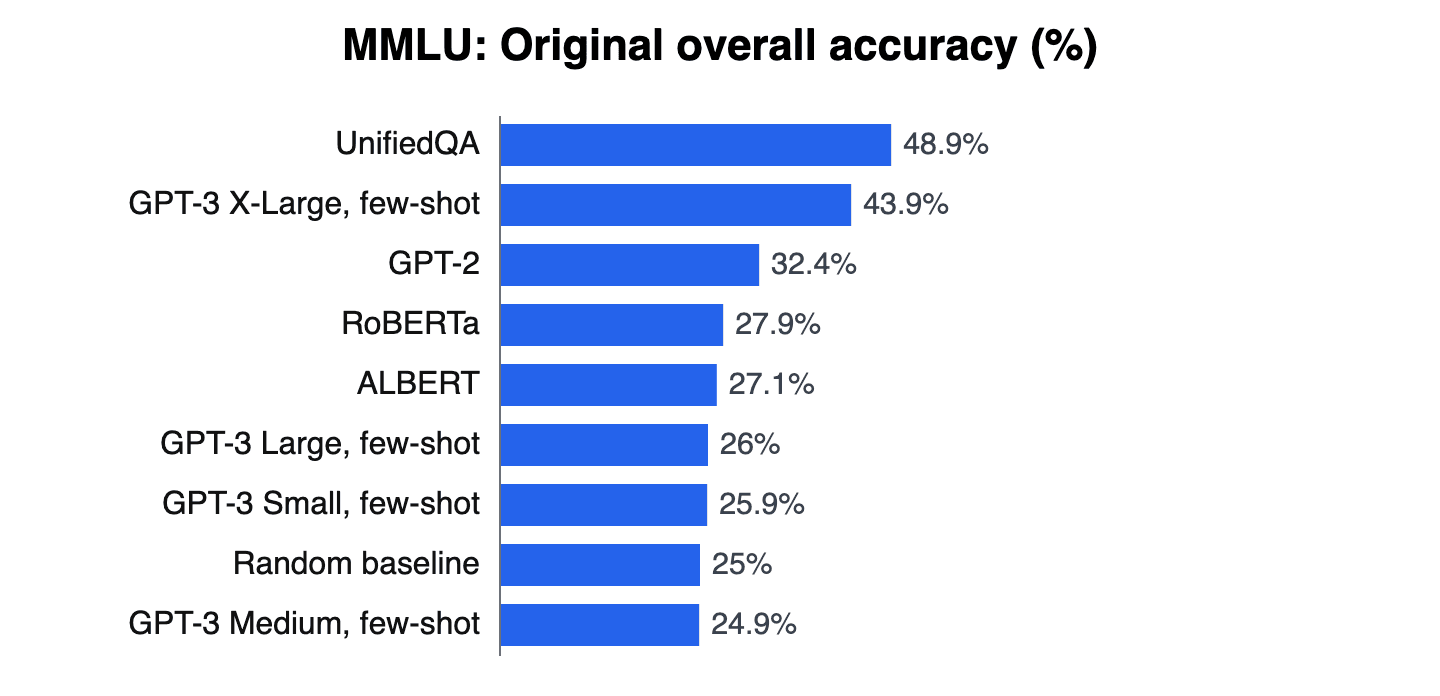
MMLU, short for Measuring Massive Multitask Language Understanding, was introduced in a 2020 paper (published at ICLR 2021). It poses roughly 16,000 multiple-choice questions across 57 subjects, from elementary mathematics to professional law and medicine, and quickly became one of the most cited measures of broad knowledge and reasoning in language models. The MATH benchmark, presented at NeurIPS 2021, consists of 12,500 competition mathematics problems with full step-by-step solutions and was designed to be far harder than existing math datasets. The same collaboration also produced the ETHICS benchmark for testing models against shared human values. [5][6][20]
These benchmarks later played a central role in Steinhardt's forecasting work, because their difficulty made them natural test cases for predicting the pace of AI progress.
Transluce
Steinhardt co-founded Transluce together with Sarah Schwettmann, a research scientist from MIT CSAIL who had built MAIA, an early pipeline of interpretability agents. A 2025 UC Berkeley profile says he took a sabbatical from Berkeley in July 2023 to launch the lab. [14] The organization launched publicly on October 23, 2024, as a nonprofit whose stated mission is to build open, scalable technology for understanding AI systems and steering them in the public interest. Steinhardt serves as co-founder and chief executive. [2][4]
Transluce's launch centered on AI agents that help people investigate other AI systems. It released an automated pipeline that generates human-readable descriptions of the internal features of a model, producing a database of descriptions for all 458,752 MLP neurons in Meta's Llama 3.1 8B model; an observability interface called Monitor for inspecting and steering those features; and behavior-elicitation agents that automatically search for specified behaviors in frontier models such as Llama 405B and GPT-4. The code and explainer models were open-sourced on GitHub and Hugging Face at the end of October 2024. In March 2025 the lab released Docent [18], a system for rapidly analyzing AI agent transcripts to surface bugs, scaffolding problems, and unexpected behaviors, and continued work on investigator agents for eliciting pathological behaviors and jailbreaks from frontier models. [4][13]
Steinhardt is also one of the scientific advisors of LawZero, the nonprofit AI safety lab launched by Yoshua Bengio in June 2025 to pursue safe-by-design "Scientist AI." [12][17]
Forecasting
Steinhardt has run a multi-year program of empirical AI forecasting, commissioning predictions about future benchmark performance and then scoring how accurate they were. Beginning in August 2021, his research group commissioned forecasts through the crowd-forecasting platform Hypermind of state-of-the-art results on MMLU and MATH for each June from 2022 through 2025, and he later compared them with forecasts from the Metaculus community and from the superforecasters and AI experts of the XPT tournament run by Karger et al. [10]
The consistent finding was that forecasters substantially underestimated the pace of progress. In the first round, forecasters expected MMLU accuracy to rise only modestly, to about 57 percent by mid-2022, whereas the actual result reached roughly 68 percent, an outcome the forecasters had rated as highly unlikely. [16] The pattern repeated the next year: for performance by mid-2023, the Hypermind crowd predicted a median MMLU score of 72.5 percent against an actual 86.4 percent, while MATH reached 69.6 percent, a result that fell within the range Hypermind's forecasters had predicted. Across the exercise Steinhardt's own forecasts and the Metaculus community tended to be the most accurate, AI domain experts came next, and the broad crowd platform fared worst. He uses his blog "Bounded Regret" (published at bounded-regret.ghost.io) to document these results and to argue that the field systematically under-forecasts capability gains, which has implications for how seriously to take rapid future advances. [10]
Selected milestones
| Year | Milestone |
|---|---|
| 2012 | BS in mathematics, MIT; named a Hertz Fellow |
| 2016 | Co-authors "Concrete Problems in AI Safety" |
| 2017 | "Learning from Untrusted Data" (STOC); "Certified Defenses for Data Poisoning Attacks" (NeurIPS) |
| 2018 | PhD in computer science, Stanford (advisor Percy Liang) |
| 2019 | Joins UC Berkeley statistics faculty |
| 2020 to 2021 | Senior author on the MMLU and MATH benchmarks |
| 2021 | Launches Hypermind AI forecasting study on MMLU and MATH |
| 2022 | "The Effects of Reward Misspecification" (ICLR); "More Is Different for AI" essays |
| July 2023 | Begins a sabbatical from Berkeley to build Transluce with Sarah Schwettmann (per a 2025 UC Berkeley profile) |
| October 23, 2024 | Transluce launches publicly with neuron-description tools, Monitor, and investigator agents |
| 2025 | Transluce releases Docent; Steinhardt listed as a LawZero scientific advisor |
As of 2026 Steinhardt leads Transluce while holding his associate professorship at UC Berkeley, where his group continues to work on interpretability, oversight, and the measurement of AI progress. [1][2][4]
Continue reading
- AI safetyAI safety is the research and practice of preventing or reducing unacceptable harm from artificial intelligence systems.Mentioned 7 times above
- MMLUMMLU, short for Massive Multitask Language Understanding, is an English-language AI benchmark for evaluating broad academic and professional knowledge through four-option multiple-choice questions.Mentioned 7 times above
- Machine LearningMachine learning (ML) is a branch of artificial intelligence that gives computers the ability to learn from data and improve their performance on tasks without being explicitly programmed.Mentioned 5 times above
- Reward hackingReward hacking (also called specification gaming) is a failure mode in artificial intelligence in which a system maximizes its given objective or reward signal through unintended shortcuts, exploits, or…Mentioned 4 times above
- Scalable oversightScalable oversight is the AI safety problem of how humans can reliably supervise, evaluate, and provide training signal to artificial intelligence systems whose capabilities approach, equal, or exceed those of…Mentioned 4 times above
- University of California, BerkeleyUC Berkeley is the public research university most responsible for the open-source infrastructure that runs modern AI: its systems labs created Apache Spark, Ray, and vLLM, and its Berkeley Artificial…Linked in the introduction

More to read
Topics:People
References
- ^1 ^2 ^3 ^4 ^5 ^6"Jacob Steinhardt." UC Berkeley faculty homepage. jsteinhardt.stat.berkeley.edu
- ^1 ^2 ^3"Steinhardt Announces Co-founding of Transluce, a Non-profit AI research lab." UC Berkeley Department of Statistics, October 23, 2024. statistics.berkeley.edu/...-profit-ai-research-lab
- ^1 ^2"Jacob Steinhardt." Hertz Foundation. hertzfoundation.org/...jacob-steinhardt
- ^1 ^2 ^3"Releasing AI-driven tools for understanding AI systems." Transluce, October 2024. transluce.org/releasing-ai-tools
- ^Dan Hendrycks, Collin Burns, Steven Basart, Andy Zou, Mantas Mazeika, Dawn Song, Jacob Steinhardt. "Measuring Massive Multitask Language Understanding." ICLR 2021; arXiv:2009.03300. arxiv.org/...2009.03300
- ^Dan Hendrycks, Collin Burns, Saurav Kadavath, Akul Arora, Steven Basart, Eric Tang, Dawn Song, Jacob Steinhardt. "Measuring Mathematical Problem Solving With the MATH Dataset." NeurIPS 2021; arXiv:2103.03874. arxiv.org/...2103.03874
- ^Dario Amodei, Chris Olah, Jacob Steinhardt, Paul Christiano, John Schulman, Dan Mane. "Concrete Problems in AI Safety." arXiv:1606.06565, 2016. arxiv.org/...1606.06565
- ^Alexander Pan, Kush Bhatia, Jacob Steinhardt. "The Effects of Reward Misspecification: Mapping and Mitigating Misaligned Models." ICLR 2022; arXiv:2201.03544. arxiv.org/...2201.03544
- ^1 ^2Moses Charikar, Jacob Steinhardt, Gregory Valiant. "Learning from Untrusted Data." STOC 2017; arXiv:1611.02315. arxiv.org/...1611.02315
- ^1 ^2 ^3Jacob Steinhardt. "AI Forecasting: Two Years In." Bounded Regret. bounded-regret.ghost.io/...g-ml-forecasts-for-2023
- ^Jacob Steinhardt. "More Is Different for AI." Bounded Regret, 2022. bounded-regret.ghost.io/more-is-different-for-ai
- ^"Jacob Steinhardt." LawZero team page. lawzero.org/...jacob-steinhardt
- ^"Monitor: An AI-Driven Observability Interface." Transluce. transluce.org/observability-interface
- ^"Steering AI for the good of humanity." UC Berkeley College of Computing, Data Science, and Society, April 2, 2025. cdss.berkeley.edu/...steering-ai-good-humanity
- ^"Collin Burns." Personal homepage. collinpburns.com
- ^Jacob Steinhardt. "AI Forecasting: One Year In." Bounded Regret, July 3, 2022. bounded-regret.ghost.io/ai-forecasting-one-year-in
- ^"Team." LawZero. lawzero.org/...team
- ^Kevin Meng, Vincent Huang, Jacob Steinhardt, Sarah Schwettmann. "Introducing Docent." Transluce, March 24, 2025. transluce.org/introducing-docent
- ^Zachary C. Lipton, Jacob Steinhardt. "Troubling Trends in Machine Learning Scholarship." arXiv:1807.03341, 2018. arxiv.org/...1807.03341
- ^Dan Hendrycks, Collin Burns, Steven Basart, Andrew Critch, Jerry Li, Dawn Song, Jacob Steinhardt. "Aligning AI With Shared Human Values." ICLR 2021; arXiv:2008.02275. arxiv.org/...2008.02275
Improve this article
Add missing citations, update stale details, or write a clearer explanation. Anyone can edit: changes go live when you publish, and every edit is checked by an editor.
5 revisions · v5 · 1,892 words · full history
Fact-checks are independent of edits: a reviewer re-verifies the article against its sources and stamps the date. How we verify
Research and drafting on this wiki are AI-assisted, under named human editorial standards. How AI is used here
Reviewer note: Independent fact-check of the full article against its cited sources (70 claims, 21 sources fetched); 5 material + 9 minor fixed
Cite this page: AI Wiki. "Jacob Steinhardt." aiwiki.ai, updated 8 Jun 2026, fact-checked 5 Nov 2026. CC BY 4.0. https://aiwiki.ai/wiki/jacob_steinhardt