

NVIDIA GeForce RTX 5090
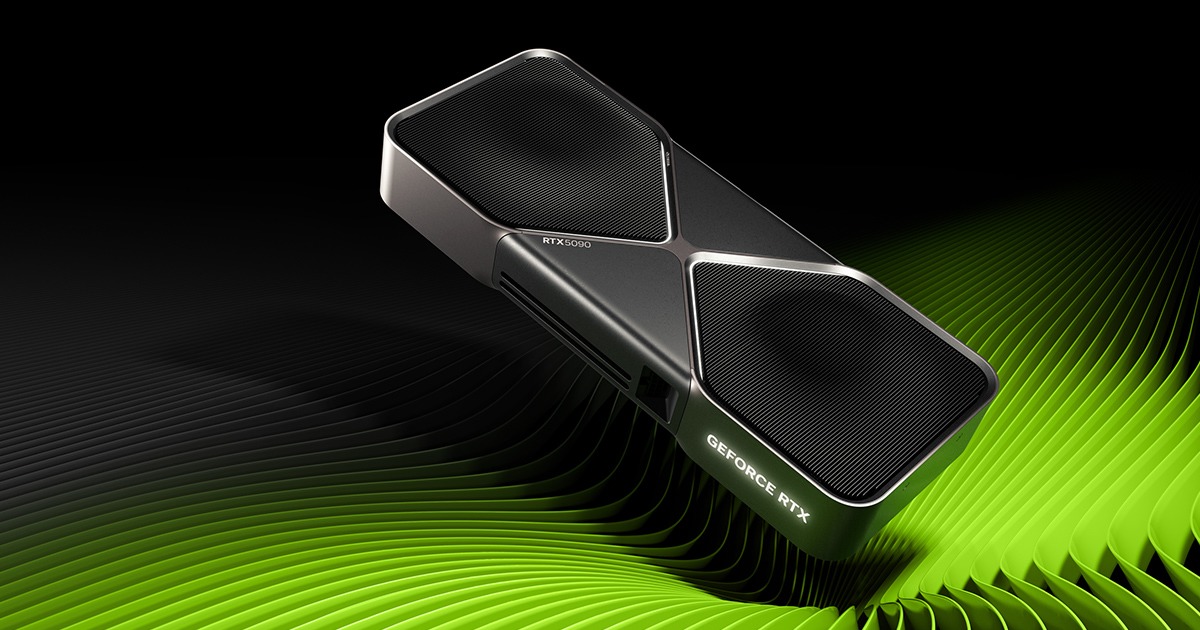
The NVIDIA GeForce RTX 5090 is a consumer graphics card built on the GB202 processor of RTX Blackwell, the consumer version of NVIDIA's Blackwell architecture. NVIDIA unveiled it at CES on January 6, 2025 and put it on sale on January 30, 2025 at $1,999, calling it the fastest GeForce RTX GPU to date [1]. It has 21,760 CUDA cores, 680 fifth-generation Tensor Cores that add FP4 support, and 32 GB of GDDR7 memory at 1,792 GB/s [2]. That memory made it a sought-after card for running and fine-tuning open-weight models locally and for building small AI servers, and GPU marketplaces rent it by the hour [3][4][5]. US export rules bar its sale to China, where NVIDIA sold the RTX 5090 D and later the 24 GB RTX 5090 D V2 instead [6][7][8]. In 2026 a memory shortage and AI demand pushed US prices above $4,000 by mid-year and to $5,000 or more by September, and by October 2026 the card had nearly disappeared from US retail amid an unconfirmed report that NVIDIA had stopped supplying the GB202 chip for it [9][10][4][11].
Development and launch
NVIDIA announced the GeForce RTX 50 series at CES with the RTX 5090 as its flagship. Jensen Huang said that "Blackwell, the engine of AI, has arrived for PC gamers, developers and creatives" [1]. NVIDIA said the RTX 5090 had 92 billion transistors and more than 3,352 trillion AI operations per second (TOPS), and that with its DLSS 4 software it outperformed the RTX 4090 by up to two times [1]. NVIDIA sold Founders Edition cards through its own website and selected retailers, alongside partner designs [1]; the Founders Edition occupies two expansion slots [12].
Supply was short from the start. Tom's Hardware's review listed availability among the card's drawbacks [13], and in March 2025 the publication wrote that MSRPs were "effectively non-existent," noting that NVIDIA itself was selling small numbers of Founders Edition cards at its GTC conference from a mobile "food truck" [14].
AI software support also lagged the hardware. The RTX 5090 reports CUDA compute capability 12.0 [12]. When the card went on sale, NVIDIA advised developers to move to CUDA 12.8 and TensorRT 10.8, and PyTorch's Linux support for the cards was available only in nightly builds [15]. PyTorch 2.7, released on April 23, 2025, added Blackwell support as a prototype feature, along with prebuilt CUDA 12.8 packages [16]. In Tom's Hardware's launch review, the card could not yet run the TensorRT versions of UL's Procyon AI benchmarks [17].
Specifications
| Specification | GeForce RTX 5090 |
|---|---|
| Architecture | NVIDIA Blackwell (RTX) |
| GPU | GB202 |
| Process | TSMC 4N (NVIDIA custom 4 nm process) |
| Transistors | 92.2 billion |
| Die size | 750 mm² |
| Streaming multiprocessors | 170 |
| CUDA cores | 21,760 |
| Tensor Cores | 680 (fifth generation) |
| RT cores | 170 (fourth generation) |
| Boost clock / base clock | 2.41 GHz / 2.01 GHz |
| Memory | 32 GB GDDR7 |
| Memory interface | 512-bit |
| Memory data rate | 28 Gbps |
| Memory bandwidth | 1,792 GB/s |
| L2 cache | 96 MB (98,304 KB) |
| Total graphics power | 575 W |
| Required system power | 1,000 W |
| Power connector | One 600 W PCIe Gen 5 cable, or four 8-pin cables through the included adapter |
| Host interface | PCIe 5.0 |
| NVLink | Not supported |
| CUDA compute capability | 12.0 |
| Launch price (US) | $1,999 |
The figures come from Appendix A of NVIDIA's RTX Blackwell whitepaper [2], NVIDIA's product page [12] and the launch announcement [1]. A full GB202 has 192 streaming multiprocessors, 24,576 CUDA cores and 128 MB of L2 cache, of which the RTX 5090 enables 170 SMs and 96 MB [2]. Version 1.1 of the whitepaper added that the card's GDDR7 has error-correcting code built into the memory chips, always enabled, with single-bit correction [2].
How fast is the RTX 5090 at AI math?
The fifth-generation Tensor Cores support FP16, BF16, TF32, INT8 and FP8, and add FP4 and FP6 operations [2]; NVIDIA called the RTX 50 series the first consumer GPUs to support FP4 [1]. NVIDIA's whitepaper lists peak rates at the 2,407 MHz boost clock as a dense figure and a "sparse" figure that assumes 2:4 structured sparsity and is twice as high [2].
| Operation | Dense | Sparse (2:4) |
|---|---|---|
| FP4, FP32 accumulate | 1,676 TFLOPS | 3,352 TFLOPS |
| FP8, FP32 accumulate | 419 TFLOPS | 838 TFLOPS |
| FP8, FP16 accumulate | 838 TFLOPS | 1,676 TFLOPS |
| FP16 or BF16, FP32 accumulate | 209.5 TFLOPS | 419 TFLOPS |
| FP16, FP16 accumulate | 419 TFLOPS | 838 TFLOPS |
| TF32 | 104.8 TFLOPS | 209.5 TFLOPS |
| INT8 | 838 TOPS | 1,676 TOPS |
| FP32 (non-Tensor) | 104.8 TFLOPS | Not applicable |
The marketed "3,352 AI TOPS" is the sparse FP4 rate; the dense FP4 rate is 1,676 [2][1].
Why the FP16-accumulate figures are not comparable with data-center specifications
As on earlier GeForce cards, NVIDIA lists the RTX 5090's Tensor Core throughput with FP32 accumulation at half the rate with FP16 accumulation, so its FP16-accumulate figures are twice its FP32-accumulate figures [2]. NVIDIA's data-center GPUs do not halve the rate: the H100 SXM5 is rated at 989.4 dense TFLOPS for FP16 with either FP16 or FP32 accumulation, and 1,978.9 dense TFLOPS for FP8 with either [18]. A data-center headline number therefore lines up with the RTX 5090's FP32-accumulate rows. On that like-for-like basis the RTX 5090 offers about 21% of an H100 SXM5's dense FP16, BF16 and FP8 throughput, about 53% of its memory bandwidth and 40% of its memory [2][18].
| Specification | GeForce RTX 4090 | GeForce RTX 5090 | H100 SXM5 |
|---|---|---|---|
| Dense FP16 / BF16 Tensor, FP32 accumulate | 165.2 TFLOPS | 209.5 TFLOPS | 989.4 TFLOPS |
| Dense FP8 Tensor, FP32 accumulate | 330.3 TFLOPS | 419 TFLOPS | 1,978.9 TFLOPS |
| Dense FP4 Tensor | Not supported | 1,676 TFLOPS | Not listed |
| Memory | 24 GB GDDR6X | 32 GB GDDR7 | 80 GB HBM3 |
| Memory bandwidth | 1,008 GB/s | 1,792 GB/s | 3,352 GB/s |
| CUDA cores | 16,384 | 21,760 | 16,896 (FP32 cores) |
| Power | 450 W | 575 W | 700 W |
| Form factor | PCIe 4.0 card | PCIe 5.0 card | SXM5 module |
RTX 4090 and RTX 5090 figures are from the RTX Blackwell whitepaper [2]; H100 figures, which use high-bandwidth memory, are from version 1.04 of the Hopper whitepaper [18]. Relative to the RTX 4090, the RTX 5090 has 33% more CUDA cores, 27% more dense FP16 and FP8 throughput and 78% more memory bandwidth [2], at a launch price $400 higher ($1,999 against $1,599) [19][1].
How is the RTX 5090 used for AI?
Local inference
For inference, the extra 8 GB over the RTX 4090 widens the range of models that fit on one card, but the largest open models remain out of reach. Answer.AI calculated in 2024 that a 70-billion-parameter model still takes 35 GB after 4-bit quantization [20], more than the RTX 5090's 32 GB. OpenAI's gpt-oss-20b, a mixture-of-experts model with 21 billion parameters of which 3.6 billion are active, runs within 16 GB, while the larger gpt-oss-120b needs a single 80 GB GPU [21]. NVIDIA said in August 2025 that the gpt-oss models, the first models in MXFP4 format supported on its RTX cards, ran at up to 256 tokens per second on the RTX 5090 in tools such as Ollama and llama.cpp [22].
Ollama's documentation lists the RTX 5090 among supported GPUs with compute capability 12.0 [23]. vLLM's documentation lists Blackwell, with Ada Lovelace and Hopper, among the architectures on which it performs native FP8 computation [24]. NVIDIA says FP4 cuts a model's memory needs to less than half of FP16 and, using its TensorRT Model Optimizer, causes "virtually no loss in quality" [2].
Fine-tuning
Fine-tuning needs memory beyond the model weights, for activations, gradients and optimizer state [20], so the RTX 5090's 32 GB leaves more working room than a 24 GB card. PyTorch's Blackwell support arrived in version 2.7 in April 2025 [16], and the fine-tuning library Unsloth supports Blackwell cards including the RTX 5060 through RTX 5090 [25].
Image generation
NVIDIA's whitepaper gives Black Forest Labs' FLUX.dev model as an example. At FP16 the model needs more than 23 GB of memory, so among GeForce cards only the RTX 4090 and RTX 5090 can hold it; at FP4 it needs less than 10 GB. NVIDIA says an RTX 5090 using FP4 generates a 30-step image in just over five seconds, against 15 seconds for an RTX 4090 at FP16 [2]. NVIDIA's TensorRT 10.8, released alongside the card, added FP4 support, which NVIDIA said made FLUX more than twice as fast as FP16 on the RTX 4090 [15].
Benchmark results
| Date | Source | Test | Result |
|---|---|---|---|
| 2025-01-23 | Tom's Hardware | UL Procyon AI tests (TensorRT) | Would not run on the RTX 5090 at review time [17] |
| 2025-01-27 | Phoronix | llama.cpp, Llama 3.1 8B, text generation | 1.58 times the RTX 4090 [3] |
| 2025-01-27 | Phoronix | llama.cpp, Llama 3.1 8B, prompt processing | About 17% faster than the RTX 4090 [3] |
| 2025-05-12 | NVIDIA (vendor claim) | FLUX.dev image, 30 steps | Just over 5 seconds at FP4 [2] |
| 2025-08-05 | NVIDIA (vendor claim) | gpt-oss in Ollama or llama.cpp | Up to 256 tokens per second [22] |
Phoronix ran its tests with Meta's Llama 3.1 8B on Linux and found that, although the RTX 5090 drew much more power than earlier cards, its performance per watt in text generation was comparable to the RTX 4090's [3].
Export controls
The RTX 5090 is among the high-end graphics cards that US export controls bar from export to China [6]. Tom's Hardware summarized in October 2026 that GPUs with the processing power of an RTX 4090 or more had been banned for export to China since November 2023 [26].
RTX 5090 D
NVIDIA introduced a China version, the RTX 5090 D, with the rest of the RTX 50 series in January 2025. It kept the RTX 5090's full specifications, including its clocks, but carried an AI rating of 2,375 TOPS instead of 3,352, about 29% lower [7]. A user on the Chiphell forum reported that the driver capped the card's performance three seconds after detecting AI inference or cryptocurrency-mining workloads (apparently not generative AI), that its power limit could not be changed, and that it would not work in multi-GPU setups; Tom's Hardware described the limits as purported [7]. Tom's Hardware gave its launch price as $2,299 [8].
2025 suspension and the RTX 5090 D V2
After the US government imposed new license requirements on NVIDIA's H20 data-center chip in April 2025, TrendForce, citing the Chinese outlet MyDrivers, reported on May 7, 2025 that NVIDIA had suspended RTX 5090 D shipments to its board partners and canceled unfilled second-quarter orders. There was no official sales ban, and the report suggested that the card's compute or memory bandwidth had crossed a US threshold [27].
In August 2025 NVIDIA introduced the RTX 5090 D V2. It keeps the 21,760 CUDA cores, 2,375 AI TOPS and 575 W rating, but has 24 GB of GDDR7 on a 384-bit bus with 1,344 GB/s of bandwidth, 25% less capacity and bandwidth than the original, at the same $2,299 price [8]. Tom's Hardware noted that the cut mattered most for AI, "the primary use case scenario for these graphics cards in China" [8].
Gray market and conversions
Standard RTX 5090s reached China anyway. In July 2025 Tom's Hardware described a Bilibili video of a Shenzhen company that took retail RTX 5090s from brands such as Zotac, Palit and Inno3D, moved the GPU and memory chips onto new circuit boards, and fitted two-slot blower coolers so that up to eight cards could fit in one server chassis [28]. In October 2025, after photos of pallets of MSI-branded RTX 5090s in China circulated online, MSI said it "has never officially sold or distributed the GeForce RTX 5090 in China" and that serial-number tracking showed the cards were parallel imports [6]. In October 2026 the Financial Times reported, according to Tom's Hardware, that Chinese technology companies had bought more than one million NVIDIA gaming and workstation GPUs in a single year, mostly the RTX Pro 6000D, RTX Pro 5000 and RTX 5090, to make up for a shortfall of domestic AI chips [29].
Retailers in the United States tightened sales as well. In October 2026 a Micro Center customer in California reported having to sign an "Advanced Computing Product Purchaser Declaration" with photo identification, the installation address and the intended end use before buying an RTX 5090; the form states that Micro Center will not sell the product to anyone who intends to export it "regardless of destination" [26].
Market and pricing
Retail prices
The RTX 5090 has rarely sold at its list price. Tom's Hardware's price tracking found in August 2026 that its lowest-ever US price was the $1,999 list price itself [9].
| Date | Observation | Source |
|---|---|---|
| 2025-01-30 | On sale at $1,999 (US list price) | NVIDIA [1] |
| 2025-03-25 | eBay average over the previous 30 days $4,222 (209 sales); best retail listing found $3,999 | Tom's Hardware [14] |
| 2025-09 | Cheapest US listing about $2,250 | Tom's Hardware, reported 2026-09-01 [10] |
| 2026-01-15 | Prices up as much as 79% over the previous three months | Tom's Hardware [30] |
| 2026-06 | Median price $4,299 | Tom's Hardware, reported 2026-09-14 [4] |
| 2026-08-03 | Best US price $4,288 | Tom's Hardware [9] |
| 2026-09-01 | Cheapest US listing $4,999 (Zotac Solid OC at Newegg); cheapest in Germany 4,850 euros | Tom's Hardware [10] |
| 2026-09-14 | First-party online stock gone in the US; third-party sellers asking about $6,400 to $9,500; $4,299 in a Micro Center store | Tom's Hardware [4] |
| 2026-10-13 | Available from three third-party resellers, at $7,199 or more | Tom's Hardware [29] |
What caused the 2026 shortage?
NVIDIA itself acknowledged a memory constraint. In January 2026 the leaker MEGAsizeGPU claimed that NVIDIA had cut graphics card supply to its board partners by 15% to 20% [30]. In February 2026 The Information reported that NVIDIA would release no new gaming GPUs that year and had deprioritized an RTX 50 Super refresh because of the memory shortage; NVIDIA told Tom's Hardware that "Demand for GeForce RTX GPUs is strong, and memory supply is constrained. We continue to ship all GeForce SKUs and are working closely with our suppliers to maximize memory availability." [31] NVIDIA's commentary on its second fiscal quarter of 2027, published in August 2026, said consumer PC sales had been "tempered by elevated memory and systems prices" [32]. Tom's Hardware wrote in September 2026 that GPU prices, like those of SSDs and RAM, were being squeezed as components were diverted to enterprise customers building AI systems, and that RAM prices had risen 500% in 12 months [10].
Demand from AI buyers added to the pressure. Tom's Hardware attributed demand for the RTX 5090 to AI, noting that NVIDIA's professional RTX Pro 5000, which has the same GPU with fewer active shader units, 48 GB of memory and less bandwidth, sold for $7,000 to $9,000, which made the RTX 5090 look attractive for building AI servers even at $5,000 or more [4]. On October 10, 2026 Tom's Hardware reported an unverified claim, from a leaked factory notice shared by the leaker @hongxing2020, that NVIDIA would no longer supply GB202 chips for any RTX 5090 model, including the China versions, and would reserve them for professional and data-center cards. NVIDIA did not respond to a request for comment, and the publication noted that existing inventory would keep cards on sale for some time [11]. NVIDIA also uses GB202 in its RTX PRO professional cards, such as the RTX Pro 5500, which has the RTX 5090's 21,760 CUDA cores with 84 GB of memory; Tom's Hardware said the full RTX Pro 6000, with 96 GB, can sell for $15,000 [11].
Data-center use and the GeForce license
Despite its consumer branding, the RTX 5090 was rented out by GPU marketplaces and smaller clouds within weeks of launch as a source of AI compute. Vast.ai had a rental page for it by March 2025 [33], RunPod listed it in its Secure Cloud and Community Cloud tiers by June 2025 [5], and SaladCloud, which rents out idle consumer GPUs, listed it the same month [34].
NVIDIA's driver license restricts such use. The version on NVIDIA's US website in October 2026 says GeForce or Titan software "is licensed for use only on GeForce or Titan hardware products you own" and "is not licensed for datacenter deployment," and bars users from providing "commercial hosting services with the SOFTWARE" [35]. The restriction dates from a clause NVIDIA added at the turn of 2018, which allowed only blockchain processing in data centers; an NVIDIA spokesperson told The Register at the time that the company did not intend to prohibit research uses "that do not operate at data center scale" [36]. The license covers NVIDIA's driver software rather than the hardware [36].
Rental prices
The following list prices were captured from providers' pricing pages on the dates shown. Prices across providers are compared in cloud GPU pricing comparison.
| Date | Provider | Listed price for one RTX 5090 | Source |
|---|---|---|---|
| 2025-03-17 | Vast.ai | $0.67 to $0.74 per hour (marketplace range shown) | [33] |
| 2025-06-10 | SaladCloud | $0.27 per hour for the GPU in its pricing calculator; $0.294 per hour for an instance with 4 vCPUs and 8 GB of RAM at batch priority | [34] |
| 2025-06-13 | Runpod | $0.94 per hour (Secure Cloud); $0.69 per hour (Community Cloud) | [5] |
| 2026-10-12 | Runpod | $1.19 per hour | [37] |
Reception and issues
Tom's Hardware gave the RTX 5090 its Editor's Choice award in January 2025, calling it the fastest GPU around in most cases and listing its AI performance, 32 GB of GDDR7 on a 512-bit bus and PCIe 5.0 interface among its strengths; it criticized driver problems in some games and applications, the card's price and power draw, and its availability [13].
Early owners reported melted power connectors. In February 2025 the YouTuber Roman "der8auer" Hartung examined a failed RTX 5090 setup that had used a third-party cable, then tested his own RTX 5090 Founders Edition: one of the six 12 V wires carried more than 22 amperes, against a limit of 9.5 amperes per pin in the 12VHPWR and 12V-2x6 standards, and the cable's power-supply end exceeded 150 degrees Celsius within four minutes [38]. Tom's Hardware concluded that uneven current distribution could burn or melt the cable [38].
In February 2025 NVIDIA also confirmed that some cards had shipped with a missing raster operations pipeline (ROP) unit. It said "less than 0.5% (half a percent) of GeForce RTX 5090 / 5090D and 5070 Ti GPUs" had "one fewer ROP than specified," that the average graphics performance loss was 4% "with no impact on AI and Compute workloads," and that owners could obtain replacements from the board maker. It added: "The production anomaly has been corrected." [39]
Continue reading
- NvidiaNvidia Corporation is an American technology company that designs graphics processing units (GPUs) and is the world's dominant supplier of hardware for artificial intelligenceMentioned 48 times above
- FP4 (4-bit floating point)FP4 (4-bit floating point) is a numerical format that stores a real number in just 4 bits, the smallest floating-point type in mainstream use for deep learning.Mentioned 12 times above
- CUDACUDA (Compute Unified Device Architecture) is NVIDIA's platform and programming model for general-purpose computation on its graphics processing units.Mentioned 11 times above
- NVIDIA BlackwellNVIDIA Blackwell is a family of graphics processing unit architectures and computing platforms developed by NVIDIA.Mentioned 10 times above
- Tensor CoreA Tensor Core is a specialized execution unit inside NVIDIA GPUs that computes a small matrix multiplication and accumulation, D = A x B + CMentioned 4 times above
- NVIDIA GeForce RTX 4090The NVIDIA GeForce RTX 4090 is a consumer graphics card built on the AD102 processor of NVIDIA's Ada Lovelace architecture.Mentioned 12 times above

More to read
Topics:AI ComputeAI HardwareNVIDIA
References
- ^1 ^2 ^3 ^4 ^5 ^6 ^7 ^8 ^9"NVIDIA Blackwell GeForce RTX 50 Series Opens New World of AI Computer Graphics." NVIDIA Newsroom, 2025-01-06. nvidianews.nvidia.com/...d-of-ai-computer-graphics
- ^1 ^2 ^3 ^4 ^5 ^6 ^7 ^8 ^9 ^10 ^11 ^12 ^13 ^14"NVIDIA RTX Blackwell GPU Architecture" (whitepaper, version 1.1). NVIDIA, 2025-05-12. images.nvidia.com/...lackwell-gpu-architecture.pdf
- ^1 ^2 ^3 ^4"Llama.cpp AI Performance With The GeForce RTX 5090 Review." Phoronix, 2025-01-27. phoronix.com/...nvidia-rtx5090-llama-cpp
- ^1 ^2 ^3 ^4 ^5"Nvidia's RTX 5090 vanishes from online retail in the US: third-party sellers now demand as much as $9,500 for Nvidia's fastest GPU." Tom's Hardware, 2026-09-14. tomshardware.com/...d9-500-for-nvidias-fastest-gpu
- ^1 ^2 ^3"Pricing for GPU Instances, Storage, and Serverless" (Runpod pricing page, archived snapshot). Runpod via Internet Archive, 2025-06-13. web.archive.org/...pricing
- ^1 ^2 ^3"MSI fervently denies RTX 5090 sales in China after pallets of illicit GPUs spotted in the country." Tom's Hardware, 2025-10-15. tomshardware.com/...-unrelated-to-our-sales-policy
- ^1 ^2 ^3"China-tailored RTX 5090D has AI and cryptomining limiters: multi-GPU config is also locked." Tom's Hardware, 2025-01-16. tomshardware.com/...ulti-gpu-config-is-also-locked
- ^1 ^2 ^3 ^4"Nvidia RTX 5090D V2 limits AI performance even more with 25% less VRAM and bandwidth: downgraded gaming flagship keeps same $2,299 MSRP in China." Tom's Hardware, 2025-08-12. tomshardware.com/...eps-same-usd2299-msrp-in-china
- ^1 ^2 ^3"GPU prices keep surging in 2026: lack of sale discounts and rising VRAM costs keep current-gen prices sky-high." Tom's Hardware, 2026-08-03. tomshardware.com/...-can-you-still-buy-a-cheap-gpu
- ^1 ^2 ^3 ^4"Nvidia's top-end RTX 5090 gaming GPU now costs at least $5,000: Blackwell cards continue to endure drastic price hikes." Tom's Hardware, 2026-09-01. tomshardware.com/...-to-endure-drastic-price-hikes
- ^1 ^2 ^3"Nvidia reportedly halts GeForce RTX 5090 production in favor of AI data center and professional GPUs." Tom's Hardware, 2026-10-10. tomshardware.com/...rumored-as-new-gaming-flagship
- ^1 ^2 ^3"GeForce RTX 5090 Graphics Cards" (product page and full specifications). NVIDIA, accessed 2026-10-15. nvidia.com/...rtx-5090
- ^1 ^2"Nvidia GeForce RTX 5090 Founders Edition review: Blackwell commences its reign with a few stumbles." Tom's Hardware, 2025-01-23. tomshardware.com/...nvidia-geforce-rtx-5090-review
- ^1 ^2"These are the best GPU 'deals' based on real-world scalper pricing and our FPS per dollar test results." Tom's Hardware, 2025-03-25. tomshardware.com/...ices-cost-up-to-twice-the-msrp
- ^1 ^2"New AI SDKs and Tools Released for NVIDIA Blackwell GeForce RTX 50 Series GPUs." NVIDIA Technical Blog, 2025-01-30. developer.nvidia.com/...geforce-rtx-50-series-gpus
- ^1 ^2"PyTorch 2.7 Release." PyTorch, 2025-04-23. pytorch.org/...pytorch-2-7
- ^1 ^2"Nvidia RTX 5090: Content Creation, Professional Apps, and AI" (page 7 of the RTX 5090 Founders Edition review). Tom's Hardware, 2025-01-23. tomshardware.com/...nvidia-geforce-rtx-5090-review
- ^1 ^2 ^3"NVIDIA H100 Tensor Core GPU Architecture" (whitepaper, version 1.04). NVIDIA, 2023-05-04. dam-cdn.nvd.orangelogic.com/...0117r17n8042d73.pdf
- ^"NVIDIA Delivers Quantum Leap in Performance, Introduces New Era of Neural Rendering With GeForce RTX 40 Series." NVIDIA Newsroom, 2022-09-20. nvidianews.nvidia.com/...ith-geforce-rtx-40-series
- ^1 ^2"You can now train a 70b language model at home." Answer.AI, 2024-03-06. answer.ai/...2024-03-06-fsdp-qlora
- ^"openai/gpt-oss-20b" (model card). Hugging Face, accessed 2026-10-15. huggingface.co/...gpt-oss-20b
- ^1 ^2"OpenAI's New Open Models Accelerated Locally on NVIDIA GeForce RTX and RTX PRO GPUs." NVIDIA Blog, 2025-08-05. blogs.nvidia.com/...rtx-ai-garage-openai-oss
- ^"Hardware support: Nvidia." Ollama documentation, accessed 2026-10-15. docs.ollama.com/gpu
- ^"FP8 W8A8." vLLM documentation, accessed 2026-10-15. docs.vllm.ai/...fp8
- ^"Fine-tuning LLMs with Blackwell, RTX 50 series & Unsloth." Unsloth documentation, accessed 2026-10-15. docs.unsloth.ai/...kwell-rtx-50-series-and-unsloth
- ^1 ^2"Micro Center requires photo ID and signed no-export pledge to buy Nvidia RTX 5090 gaming GPU." Tom's Hardware, 2026-10-02. tomshardware.com/...mise-gpu-will-remain-in-the-us
- ^"NVIDIA Reportedly Suspends RTX 5090D Shipments in China amid U.S. Export Curbs, Cancels Q2 Orders." TrendForce, 2025-05-07. trendforce.com/...s-export-curbs-cancels-q2-orders
- ^"RTX 5090s get ready to blow with AI-focused makeovers in China: industrial production lines transplant GPU and memory from gaming cards onto server-ready PCBs with blower-style coolers." Tom's Hardware, 2025-07-25. tomshardware.com/...pcbs-with-blower-style-coolers
- ^1 ^2"Chinese AI companies buy 1 million Nvidia gaming and workstation GPUs in a single year, report claims." Tom's Hardware, 2026-10-13. tomshardware.com/...o-bridge-gap-in-compute-demand
- ^1 ^2"Gamers face another crushing blow as Nvidia allegedly slashes GPU supply by 20%, leaker claims." Tom's Hardware, 2026-01-15. tomshardware.com/...-geforce-gaming-gpu-until-2027
- ^"Report claims Nvidia will not be releasing any new RTX gaming GPUs in 2026, RTX 60 series likely debuting in 2028." Tom's Hardware, 2026-02-05. tomshardware.com/...series-likely-debuting-in-2028
- ^"CFO Commentary on Second Quarter Fiscal 2027 Results." NVIDIA, 2026-08-26. s201.q4cdn.com/...Q2FY27-CFO-Commentary.pdf
- ^1 ^2"RTX 5090 GPU Rental" (Vast.ai pricing page, archived snapshot). Vast.ai via Internet Archive, 2025-03-17. web.archive.org/...RTX-5090
- ^1 ^2"Salad GPU Cloud Pricing" (SaladCloud pricing page, archived snapshot). SaladCloud via Internet Archive, 2025-06-10. web.archive.org/...pricing
- ^"NVIDIA Driver License Agreement" (License for Customer Use of GeForce Software). NVIDIA, accessed 2026-10-15. nvidia.com/...geforce-license
- ^1 ^2"Nvidia: Using cheap GeForce, Titan GPUs in servers? Haha, nope!" The Register, 2018-01-03. theregister.com/...nvidia_server_gpus
- ^"GPU Cloud Pricing" (Runpod pricing page, archived snapshot). Runpod via Internet Archive, 2026-10-12. web.archive.org/...pricing
- ^1 ^2"RTX 5090 cable overheats to 150 degrees Celsius: uneven current distribution likely the culprit." Tom's Hardware, 2025-02-11. tomshardware.com/...istribution-likely-the-culprit
- ^"Nvidia confirms 'rare issue' with some RTX 5090 and RTX 5070 Ti GPUs." TechRadar, 2025-02-23. techradar.com/...affected-and-to-get-a-replacement
Improve this article
Add missing citations, update stale details, or write a clearer explanation. Anyone can edit: changes go live when you publish, and every edit is checked by an editor.
2 revisions · v2 · 4,060 words · full history
Fact-checks are independent of edits: a reviewer re-verifies the article against its sources and stamps the date. How we verify
Research and drafting on this wiki are AI-assisted, under named human editorial standards. How AI is used here
Cite this page: AI Wiki. "NVIDIA GeForce RTX 5090." aiwiki.ai, updated 28 Oct 2026. CC BY 4.0. https://aiwiki.ai/wiki/nvidia_geforce_rtx_5090