

ASUS
ASUS (ASUSTeK Computer Inc.) is a Taiwanese maker of computer hardware and electronics, headquartered in Beitou District, Taipei, and listed on the Taiwan Stock Exchange under stock code 2357.[1] Founded in 1989 by four engineers, it began as a motherboard designer and grew into a major PC and component brand that sells laptops (Zenbook, Vivobook, ExpertBook), desktops, motherboards, graphics cards, monitors, networking gear and, under its Republic of Gamers (ROG) sub-brand, gaming hardware.[2][3] Since the mid-2020s, much of its growth has come from AI servers.[4][17] ASUS builds NVIDIA GPU servers and rack-scale systems such as the GB300 NVL72, sells deskside machines based on the NVIDIA DGX Spark and NVIDIA DGX Station designs, and markets AI PCs and "agent computers" for running AI agents locally.[4][5][6]
In 2025, ASUS reported record brand revenue of NT$688.9 billion, up 26% from 2024. Its enterprise segment grew 85% that year.[4] In August 2026 the company raised its full-year AI server growth target to at least 150%.[7]
| Field | Value |
|---|---|
| Legal name | ASUSTeK Computer Inc.[1] |
| Founded | 1989, Taipei (registered establishment date 2 April 1990 in the company's investor profile)[1][2] |
| Co-founders | Tung Tzu-hsien (T.H. Tung), Hsu Shi-chang (Ted Hsu), Hsieh Wei-chi, Liao Min-hsiung[3][16] |
| Headquarters | Beitou District, Taipei, Taiwan[1] |
| Listing | Taiwan Stock Exchange, code 2357, listed 14 November 1996[1] |
| Chairman | Jonney Shih (Chairman and Chief Branding Officer)[8] |
| Chief executives | S.Y. Hsu and Samson Hu (Co-CEOs)[8] |
| 2025 revenue | NT$688.9 billion brand revenue; NT$738.9 billion group consolidated revenue[4][9] |
| 2025 net income | NT$48.2 billion (group consolidated, after tax)[9] |
| Sub-brands | ROG (Republic of Gamers), ProArt[5] |
| AI-related subsidiary | Taiwan Web Service Corporation (TWSC)[11] |
History
Founding and motherboards
ASUS traces its origin to a conversation in a Taipei coffee shop in 1989, where a few engineers talked about building a "small and beautiful company."[2] The Taiwan Design Research Institute names the co-founders as Tung Tzu-hsien (T.H. Tung), Hsieh Wei-chi, Liao Min-hsiung and Hsu Shi-chang (Ted Hsu); Tung had worked at Acer before co-founding ASUS.[3][16] According to ASUS, within eight months the team had produced the Cache 386/33 and ISA 486/25 motherboards, which were used in products from IBM and ALR.[2]
Jonney Shih has been chairman since 1993 and was also CEO until 2007.[12] ASUS listed on the Taiwan Stock Exchange in November 1996 and launched its first notebook, the P6300, in 1997.[1][2] ASUS says it was shipping more than 55 million motherboards a year by 2006, about a third of the global market.[2]
Brands, ROG and the Eee PC
ASUS founded Republic of Gamers (ROG) in 2006 as a gaming sub-brand, with early products such as the ROG Crosshair motherboard, and later added graphics cards, laptops, desktops and peripherals.[2] Under Shih, ASUS developed the Eee PC, a small, low-cost notebook that the company credits with starting the netbook category; Forbes Asia named it Product of the Year in 2008.[2][12] In 2014 ASUS launched the ZenFone smartphone line, and in 2018 it unveiled the first ROG Phone at Computex.[2][12]
Splitting off manufacturing: Unihan and Pegatron
ASUS used to run a large contract-manufacturing business alongside its own brand. On 2 July 2007 it announced it would split into three companies by January 2008, subject to regulatory approval. The ASUS brand business would stay in the listed company, PC-related manufacturing would become Unihan Technology, and casing, module and non-PC contract work would become Pegatron Technology.[13] Co-founder T.H. Tung became chairman and CEO of Pegatron.[3]
On 11 December 2009, ASUS announced a spin-off of Pegatron. ASUS would cut its stake to 25% and reduce its own capital by 85%, and shareholders would receive about 0.15 new ASUS shares and 0.4 Pegatron shares for each ASUS share they held. The spin-off date was moved up to 1 June 2010.[14] Pegatron debuted on the Taiwan Stock Exchange on 24 June 2010, rising 8.19% to NT$38.95. An analyst quoted by the Taipei Times said the spin-off would let ASUS put more into promoting its brand worldwide, as Acer was doing. Acer had earlier spun off its contract manufacturing into Wistron.[15][13]
Later leadership changes
In April 2016, ASUS announced that it was bringing co-founder Ted Hsu back from Pegatron, where he was vice chairman, to fill the new post of chief strategy officer from the following month. The role covered R&D, quality, customer service, and the cloud computing and AI businesses.[16] As of October 2026, ASUS's investor site lists Hsu as Vice Chairman and Chief Strategy Officer, S.Y. Hsu and Samson Hu as Co-CEOs, and Joe Hsieh as Chief Operating Officer.[8]
Pause in smartphones
At a company year-end gala on 16 January 2026, Shih said that "Asus will no longer add new mobile phone models in the future," confirming earlier reports that no new Zenfone or ROG Phone would launch. He named AI robotics and AI glasses as areas the company would pursue instead, and ASUS said existing phones would keep receiving support.[17] Earlier that month, at CES 2026, ROG had announced the ROG XREAL R1 gaming glasses, made with XREAL.[18]
Financial results
ASUS reports two sets of figures: "brand" financials, which it uses in investor presentations, and group consolidated results filed under IFRS, which include subsidiaries and are larger.[4][9]
| Period | Revenue | Net income after tax | Basis | Source |
|---|---|---|---|---|
| 2024 | NT$548.5 billion | n/a | Brand | [4] |
| 2025 | NT$688.9 billion (+26%) | n/a | Brand | [4] |
| 2025 | NT$738.9 billion | NT$48.2 billion | Group consolidated | [9] |
| Q4 2025 | NT$189.8 billion (+34% YoY) | NT$11.4 billion | Brand (unaudited) | [4] |
| Q1 2026 | NT$208.4 billion | NT$11.2 billion | Group consolidated | [19] |
| Q2 2026 | About NT$241 billion (+39% YoY) | About NT$19 billion (+94% YoY) | Brand, as reported by Futurum | [20] |
| H1 2026 | NT$466.1 billion | NT$31.5 billion | Group consolidated | [19] |
In ASUS's 2025 investor deck, enterprise products made up 27% of brand revenue (up 85% from 2024), gamer products 43% (up 17%) and consumer products 30% (up 4%). In Q4 2025, revenue from the Infrastructure Solutions Business Group, which sells servers, rose 290% year on year. For Q1 2026, ASUS guided server revenue to four to five times the year-earlier level.[4] In Q2 2026 that group supplied 36% of brand revenue. Futurum, citing the company's results call, reported that HGX-type systems made up roughly 60% of server revenue and GB300 NVL72 full racks close to 30%.[20] On 12 August 2026, ASUS raised its full-year AI server growth target from 100% to at least 150%. Taiwan News, citing CTEE (the Commercial Times), reported that ASUS's server business brought in more than NT$120 billion in 2025, and that AI servers made up about 90% of the server business.[7]
Business groups
ASUS's investor materials report results for four business groups. The product descriptions below follow those materials.[4][20]
| Business group | Main products | ASUS-reported highlights |
|---|---|---|
| System Business Group | PCs, including ROG gaming PCs and commercial PCs | 45% of brand revenue in Q2 2026; commercial PC shipments up 100% year on year in Q4 2025[4][20] |
| Open Platform Business Group | Motherboards and graphics cards | 19% of brand revenue in Q2 2026; ASUS calls itself the global No. 1 in motherboards and graphics cards, citing market research and internal data[4][20] |
| Infrastructure Solutions Business Group (ISBG) | AI servers, rack-scale systems, storage, supercomputers | 36% of brand revenue in Q2 2026; revenue up 290% year on year in Q4 2025[4][20] |
| AIoT Business Group | Edge AI platforms, robotics and healthcare AI | Revenue up 50% year on year in Q4 2025[4] |
AI products and strategy
ASUS describes its strategy as "Ubiquitous AI. Incredible Possibilities" and presents itself as offering AI across infrastructure, physical AI and AI PCs.[5]
AI PCs
ASUS's first Copilot+ PC under Microsoft's program was the Vivobook S 15, announced on 20 May 2024. It used Qualcomm's Snapdragon X Elite processor, whose neural processing unit is rated at 45 TOPS.[21] At Computex in June 2026, ASUS added the Ascent QN10, which it presented as its first Qualcomm-powered mini PC, which ASUS says is the first AI mini PC with an 80 TOPS NPU (Snapdragon X2 Elite). It also showed ProArt P16 and P14 laptops built on NVIDIA RTX Spark, with up to 128GB of unified memory.[10]
Deskside AI supercomputers
ASUS is one of the system builders that sell their own versions of NVIDIA's deskside AI systems.
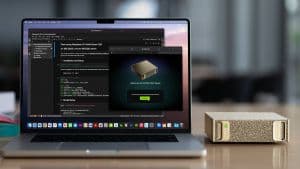
- Ascent GX10 is ASUS's version of the DGX Spark design. It uses the NVIDIA GB10 Grace Blackwell Superchip (a 20-core Arm CPU plus a Blackwell GPU) with 128GB of unified memory, and ASUS rates it at up to 1 petaflop of FP4 AI performance for models of up to 200 billion parameters. The chassis measures 150 x 150 x 51 mm. ASUS said it would go on sale on 15 October 2025, and two units can be linked over ConnectX-7 at 200 Gb/s.[22] In October 2026 ASUS said the GX10 was also available with 64GB of memory and that up to four units could be clustered.[6]
- ExpertCenter Pro ET900N G3 is ASUS's version of the GB300 DGX Station, described below.
ExpertCenter Pro ET900N G3
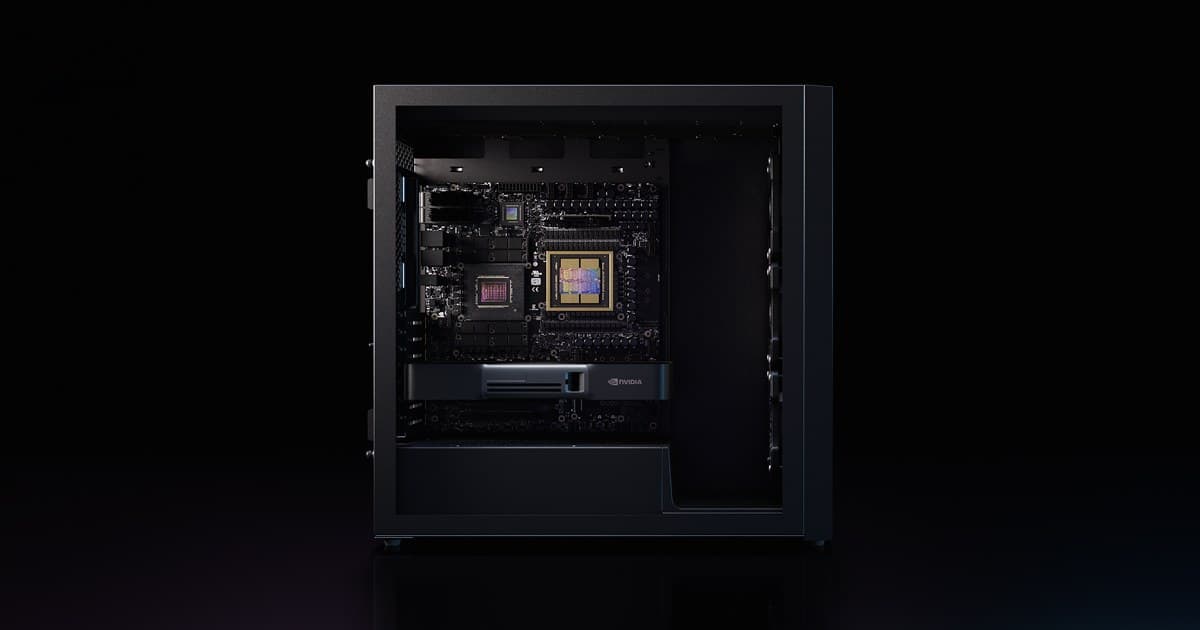
ASUS showed the ET900N G3 at NVIDIA GTC Paris in June 2025, calling it the first system powered by the GB300 Grace Blackwell Ultra Superchip and quoting up to 784GB of coherent memory.[23] The shipping product, which ASUS announced as available worldwide on 15 June 2026, carries 748GB. For why the figure dropped, see the NVIDIA DGX Station article.[24][25]
| Specification | ExpertCenter Pro ET900N G3 |
|---|---|
| Platform | NVIDIA DGX Station GB300 architecture[24] |
| Superchip | NVIDIA GB300 Grace Blackwell Ultra Desktop Superchip (72-core Grace CPU, Neoverse V2; Blackwell Ultra GPU)[25] |
| Memory | 748GB coherent memory (252GB HBM3e on the GPU plus 496GB LPDDR5X on the CPU)[24][26] |
| AI performance | Up to 20 petaflops (ASUS figure; StorageReview lists it as NVFP4 with sparsity)[24][26] |
| Networking | NVIDIA ConnectX-8 SuperNIC with two QSFP112 ports; 10GbE; separate 1GbE port for the BMC[25][26] |
| Storage | Up to four M.2 2280 NVMe SSDs, 8TB total (ASUS listing)[25] |
| Expansion | Room for one additional NVIDIA RTX PRO Blackwell GPU[25][26] |
| Cooling and power | Closed-loop liquid cooling; 1,600W 80 PLUS Titanium power supply; ASUS quotes about 50 dB in Auto mode at full load without an add-in GPU[25][26] |
| Size and weight | 584 x 232 x 565 mm; 27 kg (StorageReview)[26] |
| Software | Ubuntu with NVIDIA AI developer tools; Windows support planned; supports NVIDIA AI Enterprise, NVIDIA NemoClaw and NVIDIA OpenShell[24][25] |
In its launch release, ASUS said its engineers ran a stress test with vLLM on a large Qwen model, which it did not identify more precisely. The test reached about 864 output tokens per second and about 1,600 tokens per second for input and output combined.[24] The product page bundles ASUS's Zenni AI Hub software, which ASUS says can deploy and route between LLMs, manage Multi-Instance GPU (MIG) partitions, cluster several ET900N G3 units over a LAN, and provide access to OpenClaw and Hermes agents.[25]
StorageReview published a hands-on review on 23 September 2026. Across 14 models and two vLLM workloads, the ET900N G3's peak throughput came within 2% of MSI's XpertStation WS300, another GB300 DGX Station, in 24 of 28 comparisons. The reviewers noted that both machines use the same NVIDIA baseboard. Results included 9,280 output tokens per second on gpt-oss-120B at 128 concurrent streams. On GLM-5.2, with about 215GB of expert weights offloaded to the Grace CPU's memory, the system produced 139 output tokens per second at 32 streams, which StorageReview said four RTX PRO 6000 cards could not match. ASUS-specific additions included carry handles, a dedicated fan over the network optics, and a Titanium-rated power supply.[26]
On 17 October 2026, Harrison Kinsley, who runs the Sentdex programming channel on YouTube, wrote on X that he was running "nemotron 120B A12B" with 64 concurrent requests at "a bit over 100 tok/sec each for an aggregate of almost 7K tok/sec" on a single GB300 machine, which he identified as an ASUS DGX Station.[27] ASUS quoted the post on 20 October 2026 to promote the ET900N G3, using the hashtag #ASUSAgentComputer.[28] In a write-up dated 18 October 2026, Kinsley identified the model as Nemotron 3.5 Super VL, running an NVIDIA NVFP4 checkpoint; NVIDIA also uses the 120B-A12B designation (120 billion total parameters, about 12 billion active) for the earlier Nemotron 3 Super.[29][38] These figures come from one user's post and are not a controlled benchmark.
AI servers and rack-scale systems
ASUS says its server business dates back to 1995.[23] Its current data-center lines include the ESC and XA series of GPU servers. At NVIDIA GTC in March 2025, ASUS introduced an "AI POD" built on the NVIDIA GB300 NVL72 platform, with 72 Blackwell Ultra GPUs, 36 Grace CPUs, up to 40TB of high-speed memory per rack and full liquid cooling, and said it had already secured "substantial order placements."[30] At SC25 in November 2025, ASUS showed the system under the model name XA GB721-E2. It also reported deploying the ESC NM2N721-E1, a GB200 NVL72 system aimed at national-scale "sovereign AI" platforms.[31] In June 2025 ASUS described Nebius as a partner, saying the two were moving from GB200 NVL72 deployments to GB300 NVL72.[23]
At Computex 2026, ASUS showed the XA VR721-E3, an AI POD based on NVIDIA Vera Rubin NVL72, along with servers built on HGX Rubin NVL8. It also said it had adopted NVIDIA DSX to simulate AI factory designs before building them.[10] At GTC Berlin in October 2026, ASUS showcased the XA P2N-E2, a 2U server built on NVIDIA Vera CPUs, along with RTX PRO 6000 servers built on NVIDIA MGX.[6]
Supercomputers
ASUS built "Nano4," the NVIDIA HGX H200 portion of the "晶創26" system at Taiwan's National Center for High-performance Computing (NCHC). Nano4 has 220 H200 nodes, each with eight GPUs. It debuted at No. 29 on the November 2025 TOP500 list, with a measured 81.55 petaflops (Rmax) at 2.214 MW. The second part of the system uses two GB200 NVL72 racks.[4][32] TOP500 lists the Nano4 hardware as ASUS ESC N8-E11V servers and credits the system to "ASUSTeK / Taiwan AI Cloud / Taiwan Mobile." The same site listing shows an earlier ASUS ESC4000 cluster, Formosa 4, from 2011.[33]
Taiwan Web Service and the Formosa Foundation Model
Taiwan Web Service Corporation (TWSC, also styled TWS) is an ASUS AI and cloud subsidiary. In May 2023 the Taipei Times described it as about 80% owned by ASUS, with NT$670 million of paid-in capital and more than 200 engineers, and reported that it had taken part in building NCHC's Taiwania 3 supercomputer.[34] On 17 May 2023, TWSC showed the Formosa Foundation Model (FFM), a 176-billion-parameter large language model focused on Traditional Chinese, which ASUS said was "powered by" the Taiwania 2 supercomputer, and offered to enterprises through an "AI Foundry Service." ASUS claimed it was on par with GPT-3.5.[11][34] In September 2023 TWSC released FFM-Llama2, a Traditional Chinese model trained from Meta's Llama 2 and intended for enterprise fine-tuning.[35]
Agentic AI software and "agent computers"
By 2026, ASUS was marketing PCs, workstations and deskside systems as "agent computers" for running AI agents locally. Its microsite covers configurations from single-GPU PCs to the ET900N G3. ASUS says the ET900N G3 can scale to more than 50 users and argues that running small models locally can reduce spending on cloud API tokens.[36]
- Zenni Claw, introduced at Computex 2026, is a personal agentic AI application for ASUS PCs. It comes with ready-made skills and routes tasks between local and cloud models. ASUS released a beta for supported devices on 24 July 2026.[10][37]
- ASUS AI HUB is the governance layer of the Enterprise Agentic AI Solution that ASUS announced at GTC Berlin 2026. It handles registering, governing and monitoring agents across an organization and runs alongside NVIDIA AI Enterprise. ASUS also announced partnerships with Hermes Agent and ComfyUI for local agent and creative workflows.[6]
- The Ascent GX10 is positioned by ASUS as a hub for NemoClaw-based agent applications, using OpenShell for sandboxing. It won a Computex 2026 Best Choice Award in the AI Computing and Tech category.[10]
Continue reading
- NVIDIA GB300 NVL72The NVIDIA GB300 NVL72 is a liquid-cooled, rack-scale AI computing system that integrates 72 NVIDIA Blackwell Ultra (B300) GPUs and 36 Arm-based NVIDIA Grace CPUs into a single NVLink fabric, delivering 1.1…Mentioned 4 times above
- NVIDIA DGX StationNVIDIA DGX Station is a line of deskside artificial intelligence workstations from NVIDIA, each marketed as a "personal AI supercomputer" that puts data-center-class compute next to a developer's desk rather…Mentioned 3 times above
- NVIDIA DGX SparkNVIDIA DGX Spark is a compact, deskside AI development system, marketed by NVIDIA as a "personal AI supercomputer," that puts a Grace Blackwell superchip on a desktop and delivers up to 1 petaFLOP (1,000 TOPS)…Mentioned twice above
- NVIDIA DGX Station for WindowsNVIDIA DGX Station for Windows is a deskside artificial intelligence supercomputer announced by NVIDIA on June 1, 2026, at NVIDIA GTC Taipei during COMPUTEX 2026.Listed in See also
- Foxconn (Hon Hai Precision Industry)Foxconn, officially Hon Hai Precision Industry Co., Ltd. (Chinese: 鴻海精密工業股份有限公司; trading as Hon Hai Technology Group)Listed in See also
- Quanta ComputerQuanta Computer Inc. (Chinese: 廣達電腦; pinyin: Guǎngdá Diànnǎo; TWSE: 2382) is a Taiwanese electronics manufacturer headquartered in Taoyuan, Taiwan, and one of the two largest contract manufacturers of AI…Listed in See also




More from See also
More to read
References
- ^1 ^2 ^3 ^4 ^5 ^6ASUS Investor Relations. "Company Profile." Accessed 30 October 2026. asus.com/...about_profile
- ^1 ^2 ^3 ^4 ^5 ^6 ^7 ^8 ^9ASUS. "About ASUS History." Accessed 30 October 2026. asus.com/About-ASUS-History
- ^1 ^2 ^3 ^4Taiwan Design Research Institute. "Pegatron Group founder Tung Tzu-Hsien to Receive Honorary Award at the 2022 Golden Pin Design Awards." 2022. tdri.org.tw/...99
- ^1 ^2 ^3 ^4 ^5 ^6 ^7 ^8 ^9 ^10 ^11 ^12 ^13 ^14 ^15ASUSTeK. "4Q 2025 Investor Conference" (presentation, unaudited brand consolidated financials). 10 March 2026. asus.com/...2025Q4%20IR.pdf
- ^1 ^2 ^3ASUS Pressroom. "ASUS Launches ExpertCenter Pro ET900N G3 Built on NVIDIA DGX Station Architecture" (About ASUS boilerplate). 15 June 2026. press.asus.com/...et900n-g3-nvidia-gb300-blackwell
- ^1 ^2 ^3 ^4StorageNewsletter. "Nvidia GTC Berlin 2026: ASUS Unveils Enterprise Agentic AI Solution and Full-Stack Agent Computer" (ASUS press release). 22 October 2026. storagenewsletter.com
- ^1 ^2Taiwan News. "Taiwan's Asus lifts full-year AI server revenue growth target to 150%." 13 August 2026. taiwannews.com.tw/...6420610
- ^1 ^2 ^3ASUS Investor Relations. "Board of Directors." Accessed 30 October 2026. asus.com/...governance_board
- ^1 ^2 ^3 ^4ASUS Investor Relations. "Quarterly Results, Year 2025: 2025 Q4 Financial Results (consolidated)." 10 March 2026. asus.com/...ir_quarterly
- ^1 ^2 ^3 ^4ASUS Pressroom. "ASUS Brings Enterprise-to-Edge AI to Life at Computex 2026." 2 June 2026. press.asus.com/...putex-2026-enterprise-to-edge-ai
- ^1 ^2ASUS Pressroom. "TWS Showcases Enterprise-level Large-scale Traditional Chinese Language Models at the AIHPCcon Taiwan AI Supercomputing Conference." 17 May 2023. press.asus.com/...wan-ai-supercomputing-conference
- ^1 ^2 ^3ASUS Investor Relations. "Management Team" (Jonney Shih biography). Accessed 30 October 2026. asus.com/...governance_mgt
- ^1 ^2Nystedt, Dan. "Motherboard maker Asustek to split into three." InfoWorld (IDG News Service), 2 July 2007. infoworld.com/...ker-asustek-to-split-into-three-2
- ^Taipei Times. "Asustek, Pegatron eye same-day listing." 2 January 2010. taipeitimes.com/...2003462434
- ^Taipei Times. "Asustek shares higher after spinoff." 25 June 2010. taipeitimes.com/...2003476338
- ^1 ^2 ^3Taipei Times (republished by Liberty Times). "Pegatron's Ted Hsu to join Asustek." 20 April 2016. news.ltn.com.tw/...1669958
- ^1 ^2Notebookcheck. "Asus chairman confirms pause on smartphone launches to focus on AI technology like smart glasses." 19 January 2026. notebookcheck.net/...-like-smart-glasses.1207082.0
- ^ASUS Pressroom. "ASUS Republic of Gamers Announces ROG XREAL R1 AR Gaming Glasses." 5 January 2026. press.asus.com/...rog-xreal-r1-ar-gaming-glasses
- ^1 ^2ASUS Investor Relations. "Quarterly Results, Year 2026: 2026 Q1 and Q2 Financial Results (consolidated)." 12 May and 12 August 2026. asus.com/...ir_quarterly
- ^1 ^2 ^3 ^4 ^5 ^6Futurum Group. "ASUS Q2 FY 2026 Earnings Hit Record Revenue on AI Servers." 14 August 2026. futurumgroup.com/...t-record-revenue-on-ai-servers
- ^Notebookcheck. "Asus launches the Vivobook S 15 with Snapdragon X Elite as first Copilot+ device." 20 May 2024. notebookcheck.net/...first-Copilot-device.838560.0
- ^Guru3D. "ASUS Ascent GX10 Brings Grace Blackwell AI Performance to the Desktop." 14 October 2025. guru3d.com/...ckwell-ai-performance-to-the-desktop
- ^1 ^2 ^3ASUS Pressroom. "ASUS Announces Key Milestone with Nebius and Showcases NVIDIA GB300 NVL72 System at GTC Paris 2025." 11 June 2025. press.asus.com/...asus-nvidia-gb300-nvl72-ai-factory
- ^1 ^2 ^3 ^4 ^5 ^6ASUS Pressroom. "ASUS Launches ExpertCenter Pro ET900N G3 Built on NVIDIA DGX Station Architecture." 15 June 2026. press.asus.com/...et900n-g3-nvidia-gb300-blackwell
- ^1 ^2 ^3 ^4 ^5 ^6 ^7 ^8ASUS. "ExpertCenter Pro ET900N G3" (product page). Accessed 30 October 2026. asus.com/...expertcenter-pro-et900n-g3
- ^1 ^2 ^3 ^4 ^5 ^6 ^7Beeler, Brian (StorageReview). "ASUS ExpertCenter Pro ET900N G3 Review: The GB300 DGX Station Gets Handles, Titanium Power, and Cooled Optics." 23 September 2026. storagereview.com/...rtcenter-pro-et900n-g3-review
- ^Harrison Kinsley (@Sentdex). Post on X. 17 October 2026. x.com/...2111600208966472017
- ^ASUS (@ASUS). Post on X. 20 October 2026. x.com/...2112506619913482247
- ^NVIDIA. Model cards "NVIDIA-Nemotron-3-Super-120B-A12B-BF16" and "NVIDIA-Nemotron-3.5-Super-VL-120B-A12B-BF16." Hugging Face. huggingface.co/...-Nemotron-3-Super-120B-A12B-BF16 ; huggingface.co/...tron-3.5-Super-VL-120B-A12B-BF16
- ^ASUS Pressroom. "ASUS Unveils the Latest ASUS AI POD Featuring NVIDIA GB300 NVL72." 18 March 2025. press.asus.com/...d-featuring-nvidia-gb-300-nvl-72
- ^ASUS Pressroom. "ASUS Showcases NVIDIA GB300 NVL72 at SC25." 17 November 2025. press.asus.com/...nvidia-gb300-nvl72-sc25-showcase
- ^National Center for High-performance Computing. "Supercomputer '晶創26' First Showcased in SC25 and Ranked 29th on the TOP500 List." November 2025. nchc.org.tw/...4029
- ^TOP500. "National Center for High Performance Computing" (site listing). Accessed 30 October 2026. top500.org/...48468
- ^1 ^2Taipei Times. "Taiwan Web Service Corp launches AI app." 19 May 2023. taipeitimes.com/...2003800046
- ^ASUS Pressroom. "ASUS Subsidiary TWSC Release Large Language Model for Taiwanese Culture and Traditional Mandarin Applications." 26 September 2023. press.asus.com/...raditional-mandarin-applications
- ^ASUS. "The Right Agent Computer for Cloud, Local, or Hybrid AI" (Agent Computer microsite). Accessed 30 October 2026. asus.com/...agent-computer
- ^ASUS Pressroom. "ASUS Releases Beta Version of Zenni Claw for Supported ASUS Devices." 24 July 2026. press.asus.com/...eases-beta-version-of-zenni-claw
- ^Kinsley, Harrison. "A Datacenter at Home." Reflections (hkinsley.com), October 18, 2026. hkinsley.com/...a-datacenter-at-home
Improve this article
Add missing citations, update stale details, or write a clearer explanation. Anyone can edit: changes go live when you publish, and every edit is checked by an editor.
2 revisions · v2 · 3,443 words · full history
Fact-checks are independent of edits: a reviewer re-verifies the article against its sources and stamps the date. How we verify
Research and drafting on this wiki are AI-assisted, under named human editorial standards. How AI is used here
Reviewer note: xg29 independent verification (41 sources, ~175 claims); 1 material and 6 minor fixes applied pre-publish; v2 dates Kinsley's write-up (18 Oct 2026) per the DGX Station verifier
Cite this page: AI Wiki. "ASUS." aiwiki.ai, updated 30 Oct 2026, fact-checked 30 Oct 2026. CC BY 4.0. https://aiwiki.ai/wiki/asus