

Azure Machine Learning
Azure Machine Learning (often shortened to Azure ML) is Microsoft's managed cloud service for building, training, deploying and operating machine learning models on Microsoft Azure. Microsoft's documentation describes it as a service that "accelerates and manages the machine learning (ML) project lifecycle," aimed at data scientists, ML engineers, application developers and platform teams who need to put models into production in a secure and auditable way.[1] It supports models built in open-source frameworks such as PyTorch, TensorFlow and scikit-learn, and it bundles tools for automated machine learning, distributed training, managed inference endpoints, MLOps and model monitoring.[1]
The name has covered two different products. The first, launched in preview in July 2014 and built around a drag-and-drop tool called Azure Machine Learning Studio, was later renamed Machine Learning Studio (classic) and retired on August 31, 2024.[2][3][6] The second, a code-first platform that became generally available as the "Azure Machine Learning service" in December 2018, is the product that carries the name today.[7] Since 2023 Azure ML has also offered generative AI tools, and its workspace resource underpins the hub-based projects of Microsoft's AI application platform, now called Microsoft Foundry.[13][16][17]
History
| Date | Event |
|---|---|
| 2014-06-16 | Microsoft announces Azure Machine Learning, with a public preview promised for July[2] |
| July 2014 | Public preview opens at Microsoft's Worldwide Partner Conference[3] |
| 2015-02-18 | Azure Machine Learning (the Studio product) becomes generally available[4] |
| 2018-12-04 | The code-first Azure Machine Learning service becomes generally available[7][8] |
| 2019-11-05 | Studio web experience, designer, automated ML UI, notebooks and data labeling enter preview[9] |
| 2020-09-30 | Azure Machine Learning designer becomes generally available[10] |
| 2021-12-01 | New Machine Learning Studio (classic) resources can no longer be created[6] |
| 2022-05-25 | Managed online endpoints become generally available[11] |
| 2023-05-23 | Foundation models in the model catalog enter preview; an upcoming prompt flow preview is announced[13] |
| 2024-08-31 | Machine Learning Studio (classic) retired[6] |
| 2025-09-30 | Support for CLI v1 ends[14] |
| 2026-06-30 | Support for Python SDK v1 ends[14] |
Azure Machine Learning Studio (2014 to 2024)
Microsoft announced Azure Machine Learning on June 16, 2014, in a post by Joseph Sirosh, then corporate vice president of Microsoft's Data Group. He described it as "a fully-managed cloud service for building predictive analytics solutions" and said it drew on algorithms Microsoft had developed for products such as Xbox and Bing.[2] Scott Guthrie announced the public preview in his opening keynote at the 2014 Worldwide Partner Conference. According to Roger Barga, group program manager for the service, more than 1,000 users had provisioned roughly 1,300 workspaces by the second day of the conference.[3]
The service reached general availability on February 18, 2015, announced at the Strata + Hadoop World conference. The release added Python support (through the Anaconda distribution) alongside R, APIs for retraining published models, a "Learning with Counts" feature that used Azure HDInsight to build compact features from terabyte-scale data, a community gallery of experiments, and prebuilt web services for recommendations, anomaly detection and text analytics.[4] Users assembled experiments mostly by dragging and dropping modules in a browser and could publish a finished experiment as a managed web service.[5] Trade press reported that a free tier included 10 GB of storage and that new pricing took effect on April 1, 2015.[5]
Microsoft later called this product Machine Learning Studio (classic). It stopped allowing new Studio (classic) resources on December 1, 2021, and retired the service on August 31, 2024, directing customers to Azure Machine Learning.[6] When it previewed the Azure Machine Learning designer in 2019, Microsoft encouraged Studio (classic) users to try it.[9]
Azure Machine Learning service (2018 onward)
The current platform became generally available on December 4, 2018, at Microsoft's Connect(); 2018 event, under the name Azure Machine Learning service. Microsoft said it let developers build models faster with automated machine learning, train on automatically configured cloud compute from any Python environment using open-source frameworks, and manage workflows with "DevOps for machine learning," with deployment to the cloud and the edge. General availability pricing took effect on February 1, 2019.[7][8] VentureBeat reported that the release supported PyTorch, TensorFlow and scikit-learn, automated hyperparameter tuning, and a preview of model explainability.[8]
At Microsoft Ignite in November 2019 Microsoft previewed a browser-based studio with three authoring options: a no-code drag-and-drop designer, an automated ML interface, and managed notebooks. The same announcement added data labeling, dataset and model registries, data drift monitoring, R support, and the open-source fairness toolkit Fairlearn.[9] The designer reached general availability on September 30, 2020.[10]
The second generation of the developer interfaces, Python SDK v2 and the Azure CLI ml extension v2, reorganized the service around YAML-defined "jobs" that replaced v1's separate experiments, runs and pipelines.[14] Managed online endpoints, which take over serving, scaling, securing and monitoring of real-time models, became generally available in May 2022.[11] Microsoft deprecated SDK v1 on March 31, 2025; support for CLI v1 ended on September 30, 2025, and support for SDK v1 ended on June 30, 2026. Existing v1 workflows keep running, but Microsoft says they may be exposed to security risks or breaking changes, and new features ship only in v2.[14]
Generative AI features (2023 onward)
At Microsoft Build on May 23, 2023, Microsoft announced an upcoming preview of prompt flow, a tool for prompting, evaluating, tuning and operationalizing large language model workflows, and put foundation models into preview in a unified model catalog that combined open-source models curated by Azure ML, models from the Hugging Face Hub and Azure OpenAI models. The same announcement extended the Responsible AI dashboard to text and image data in preview.[13] As of November 2026 the model catalog lists hundreds of models from providers including Azure OpenAI, Mistral AI, Meta, Cohere, NVIDIA and Hugging Face, along with models trained by Microsoft.[1]
Microsoft has since scheduled prompt flow for retirement. Its documentation says prompt flow in both Microsoft Foundry and Azure Machine Learning will be retired on April 20, 2027, that it is no longer recommended for new development, and that existing applications should move to the Microsoft Agent Framework.[1]
Architecture
Workspaces
The top-level resource is the workspace, which groups jobs, data assets, models, components, pipelines and endpoints, and keeps a history of training runs with logs, metrics, lineage metadata and a snapshot of the scripts used.[19] A workspace depends on several other Azure resources, which the service creates if the user does not supply them: an Azure Storage account for artifacts and uploaded data, Azure Key Vault for secrets, Azure Application Insights for endpoint diagnostics, and Azure Container Registry for custom Docker environments.[19] Microsoft's documentation suggests one workspace per project so that costs and configuration can be tracked at the project level, and it notes that a workspace cannot be moved to a different subscription.[19]
A hub workspace is a variant that centrally manages security, networking, compute and quota for a team. Project workspaces created under a hub inherit its settings and share one managed virtual network, a single private link endpoint and the hub's compute quota.[15] Hub workspaces do not support some features of ordinary workspaces, including compute clusters and batch endpoints; Microsoft recommends serverless compute instead of clusters there.[15]
Compute
Azure ML manages three kinds of compute itself: single-node compute instances, compute clusters (single-node or multinode clusters that autoscale when jobs are submitted) and serverless compute, which leaves the compute lifecycle entirely to the service.[20] Users can also attach unmanaged resources such as remote virtual machines, Azure Databricks, Azure HDInsight and Kubernetes clusters.[20] The GPU virtual machine series listed as supported include NVIDIA T4, A100, H100 and H200 machines.[20]
For inference, models run in Docker containers on either Azure ML endpoints (managed online endpoints for real-time scoring and batch endpoints for asynchronous scoring) or on Azure Machine Learning Kubernetes, which can run on premises, in other clouds or at the edge, including clusters connected through Azure Arc.[14][20]
Authoring interfaces
Users work with the service through the web-based Azure Machine Learning studio, the Python SDK v2, the Azure CLI v2 and Azure Resource Manager REST APIs.[1] The studio includes managed Jupyter notebooks (which can also be opened in VS Code), visualizations of run metrics, the drag-and-drop designer, a no-code automated ML interface and data labeling projects for images and text.[1]
Training
Azure ML runs training scripts written in common Python frameworks, including PyTorch, TensorFlow, scikit-learn, XGBoost and LightGBM, and also supports R and .NET.[1] It offers hyperparameter tuning for arbitrary parameterized commands and multinode distributed training for PyTorch, TensorFlow and MPI, the last of which can be used with Horovod. Apache Spark workloads run on serverless Spark compute or attached Azure Synapse Spark pools.[1]
Automated machine learning
Automated ML (AutoML) trains many pipelines in parallel, trying different algorithms, featurization steps and hyperparameters, and ranks the resulting models by a chosen metric. Microsoft says the feature is based on work from Microsoft Research.[21] It supports classification, regression, time-series forecasting, computer vision (image classification, object detection and instance segmentation) and natural language processing tasks such as text classification and named entity recognition using pretrained BERT models.[21] Forecasting options include Auto-ARIMA, Prophet and ForecastTCN learners and rolling-origin cross-validation. By default AutoML also builds voting and stacking ensembles, choosing their members with the Caruana ensemble selection algorithm, and models can be converted to ONNX.[21]
Deployment
Managed endpoints take care of the infrastructure behind batch and real-time scoring. An online endpoint can host several deployments of a model and split traffic among them, so a new version can be tested on a small share of requests before taking more.[1] The May 2022 general availability release of managed online endpoints listed blue/green deployment, schedule-based and metric-based autoscaling, key and token authentication, managed identities, and support for no-code, low-code and custom-container deployments, including NVIDIA Triton and MLflow models.[11]
MLOps features
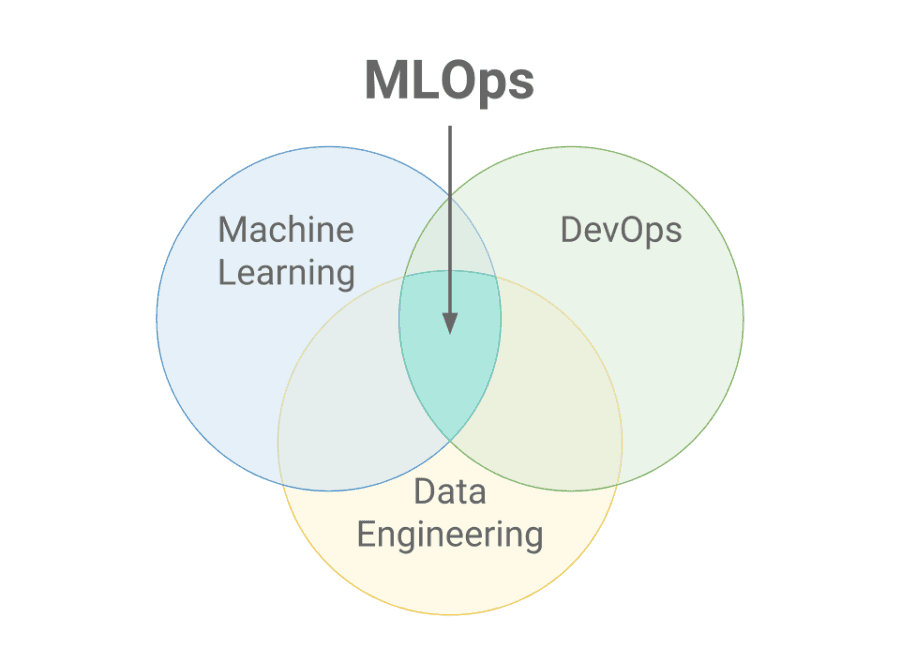
Azure ML's MLOps tooling includes Git integration, pipeline scheduling, Azure Event Grid triggers, and integration with CI/CD systems such as GitHub Actions and Azure DevOps. Jobs record code snapshots, logs and outputs, along with lineage between jobs, data, containers and compute.[1]
- MLflow. Workspaces are MLflow-compatible: an Azure ML workspace can act as the MLflow tracking server for code running anywhere, and Microsoft recommends MLflow logging because the v2 SDK has no logging functions of its own. MLflow models can be deployed to real-time and batch endpoints without a scoring script or environment definition.[22]
- Registries. Azure Machine Learning registries store models, environments, components and data assets outside any one workspace, so a model trained in a development workspace can be deployed from the registry to endpoints in test or production workspaces, including ones in other subscriptions or regions.[23]
- Model monitoring. Built-in monitoring signals for tabular models cover data drift, prediction drift, data quality, feature attribution drift and model performance, compared against training data or recent production data. A preview signal scores generative AI applications on groundedness, relevance, fluency, similarity and coherence using GPT-assisted metrics. Alerts can trigger retraining workflows through Event Grid.[24] (See concept drift and model monitoring.)
- Responsible AI dashboard. First introduced in December 2021, the dashboard brings together a data explorer, fairness assessment, model interpretability, error analysis, counterfactual analysis and causal analysis, and can produce a PDF scorecard for non-technical stakeholders.[12] Microsoft lists it among the features offered through the v2 interfaces.[14] (See responsible AI.)
Security and integrations
Azure ML's security integrations include Azure Virtual Networks with network security groups, Azure Key Vault and Azure Container Registry behind a virtual network, and Azure role-based access control. Microsoft states that the service "doesn't store or process your data outside of the region where you deploy."[1] Other integrations include Azure Synapse Analytics for Spark processing, Azure Arc for Kubernetes environments, Azure SQL Database and Blob Storage, Azure App Service for hosting ML-powered applications, and Microsoft Purview for cataloguing data assets. An Apache Airflow provider can submit workflows to Azure ML.[1]
Relationship to Microsoft Foundry
Microsoft's generative AI development platform has been renamed twice: Azure AI Studio became Azure AI Foundry, which later became Microsoft Foundry.[17] Azure Machine Learning sits beneath part of it. Foundry's own documentation says its hub resource "is an implementation of Azure Machine Learning": a Foundry hub is an Azure ML workspace of kind hub (resource type Microsoft.MachineLearningServices/workspace), and a hub-based project is a workspace of kind project, used for custom model training and model hosting.[16] Azure ML's documentation likewise says hub workspaces are the same resource type as Foundry hubs and can be used from both Azure Machine Learning studio and the Foundry portal.[19] Hub-based projects open in the Foundry portal for generative AI work and in Azure ML studio for custom model training.[16]
In 2025 Microsoft introduced a separate resource model for Foundry.[18] The newer Foundry resource and Foundry projects are Cognitive Services accounts of kind AIServices (Microsoft.CognitiveServices/account) rather than Azure ML workspaces.[16] In a June 2025 post, Microsoft said new agent and model-centric capabilities would land only on the new Foundry project type, while hub-based projects would continue to support custom model training in Azure Machine Learning studio, CLI and SDK.[18] As of November 2026, Microsoft's documentation describes hub-based projects as accessible in the "Foundry (classic)" portal, with new investment focused on Foundry projects.[17]
In practice the two products split along that line. Foundry is organized around agents, model access and generative AI applications, and its catalog lists more than 10,000 models.[17] Azure ML remains the service for training, tuning, deploying and monitoring custom models, although its studio also offers a model catalog and generative AI tools.[1]
Pricing
Microsoft does not charge separately for Azure Machine Learning itself. Customers pay for the compute it uses and for other Azure services it consumes, such as Blob Storage, Key Vault, Container Registry and Application Insights.[25] Compute instances continue to bill for disk, public IP and load balancer even when stopped, and Microsoft recommends setting cluster minimums to zero nodes, or using serverless compute, to avoid idle charges.[20]
Continue reading
- MLflowMLflow is an open-source platform for managing the end-to-end machine learning lifecycle, covering experiment tracking, model packaging, a model registry, deployment, and (since 2025) generative-AI…Mentioned 6 times above
- MLOpsMLOps (Machine Learning Operations) is a set of practices, principles, and tools for deploying, monitoring, and maintaining machine learning models in production reliably and efficiently.Mentioned 3 times above
- Azure OpenAI ServiceAzure OpenAI Service is Microsoft's enterprise cloud offering that delivers OpenAI's frontier large language models and generative artificial intelligence through the Microsoft Azure platform, pairing models…Mentioned twice above
- Microsoft AzureMicrosoft Azure is the public cloud computing platform operated by Microsoft, and the world's second-largest cloud provider, behind Amazon Web Services (AWS) and ahead of Google Cloud.Listed in See also
- Amazon SageMakerAmazon SageMaker is Amazon Web Services' fully managed machine learning platform for building, training, and deploying models at scale, first launched at AWS re:Invent on November 29, 2017 and rebranded in…Listed in See also
- Google Vertex AIGoogle Vertex AI is the unified machine learning and generative artificial intelligence platform offered by Google Cloud, announced at Google I/O on May 18Listed in See also


More from See also
More to read
References
- ^1 ^2 ^3 ^4 ^5 ^6 ^7 ^8 ^9 ^10 ^11 ^12 ^13Microsoft. "What is Azure Machine Learning?". Microsoft Learn, updated September 4, 2026. learn.microsoft.com/...t-is-azure-machine-learning
- ^1 ^2 ^3Joseph Sirosh. "Microsoft Azure Machine Learning combines power of comprehensive machine learning with benefits of cloud". Official Microsoft Blog, June 16, 2014. blogs.microsoft.com/...ning-with-benefits-of-cloud
- ^1 ^2 ^3Roger Barga. "Users Embrace Azure ML Public Preview". Machine Learning Blog (Microsoft Learn archive), July 18, 2014. learn.microsoft.com/...ace-azure-ml-public-preview
- ^1 ^2Joseph Sirosh. "Announcing the General Availability of Azure Machine Learning". Machine Learning Blog (Microsoft Learn archive), February 18, 2015. learn.microsoft.com/...y-of-azure-machine-learning
- ^1 ^2Gladys Rama. "Microsoft Azure Machine Learning Hits General Availability". Redmond Channel Partner, February 18, 2015. rcpmag.com/...microsoft-azure-ml-released
- ^1 ^2 ^3 ^4Microsoft. "Machine Learning Studio (classic)". Microsoft Lifecycle, November 2, 2022. learn.microsoft.com/...ine-learning-studio-classic
- ^1 ^2 ^3Microsoft. "Cloud Platform Release Announcements for December 4, 2018". Microsoft Learn archive, December 4, 2018. learn.microsoft.com/...cements-for-december-4-2018
- ^1 ^2 ^3Kyle Wiggers. "Microsoft makes Azure Machine Learning generally available, updates Azure IoT Edge services". VentureBeat, December 4, 2018. venturebeat.com/...updates-azure-iot-edge-services
- ^1 ^2 ^3The Microsoft Azure Team. "Azure Machine Learning - ML for all skill levels". Azure Blog, November 5, 2019. azure.microsoft.com/...ing-ml-for-all-skill-levels
- ^1 ^2Lu Zhang. "Simplify and accelerate AI for the entire data science team with Azure Machine Learning designer". Microsoft Tech Community, September 30, 2020. techcommunity.microsoft.com/...1718404
- ^1 ^2 ^3Sethu Raman. "Announcing the general availability of managed online endpoints in Azure Machine Learning". Microsoft Tech Community, May 25, 2022. techcommunity.microsoft.com/...3396485
- ^Minsoo (Microsoft). "Responsible AI Dashboard and Scorecard in Azure Machine Learning". Microsoft Tech Community, May 24, 2022 (updated October 13, 2022). techcommunity.microsoft.com/...3391068
- ^1 ^2 ^3Jessica Hawk. "Build next-generation, AI-powered applications on Microsoft Azure". Azure Blog, May 23, 2023. azure.microsoft.com/...ications-on-microsoft-azure
- ^1 ^2 ^3 ^4 ^5 ^6Microsoft. "Upgrade from v1 to v2". Microsoft Learn, updated February 5, 2026. learn.microsoft.com/...how-to-migrate-from-v1
- ^1 ^2Microsoft. "What is an Azure Machine Learning hub workspace?". Microsoft Learn, updated March 26, 2026. learn.microsoft.com/...concept-hub-workspace
- ^1 ^2 ^3 ^4Microsoft. "Hubs and hub-based project overview (classic)". Microsoft Learn, updated December 24, 2025. learn.microsoft.com/...ai-resources
- ^1 ^2 ^3 ^4Microsoft. "What is Microsoft Foundry?". Microsoft Learn, updated August 13, 2026. learn.microsoft.com/...what-is-foundry
- ^1 ^2deeikele (Microsoft). "Build recap: new Azure AI Foundry resource, Developer APIs and Tools". Microsoft Tech Community, June 26, 2025. techcommunity.microsoft.com/...4427241
- ^1 ^2 ^3 ^4Microsoft. "What is a workspace?". Microsoft Learn, updated February 10, 2026. learn.microsoft.com/...concept-workspace
- ^1 ^2 ^3 ^4 ^5Microsoft. "Understand compute targets". Microsoft Learn, updated March 31, 2026. learn.microsoft.com/...concept-compute-target
- ^1 ^2 ^3Microsoft. "What is automated ML? AutoML". Microsoft Learn, updated November 24, 2025. learn.microsoft.com/...concept-automated-ml
- ^Microsoft. "MLflow and Azure Machine Learning". Microsoft Learn, updated October 6, 2025. learn.microsoft.com/...concept-mlflow
- ^Microsoft. "Machine Learning registries". Microsoft Learn, updated July 6, 2026. learn.microsoft.com/...e-learning-registries-mlops
- ^Microsoft. "Model monitoring in production". Microsoft Learn, updated January 27, 2026. learn.microsoft.com/...concept-model-monitoring
- ^Microsoft Azure. "Azure Machine Learning pricing". Microsoft Azure. azure.microsoft.com/...machine-learning
Improve this article
Add missing citations, update stale details, or write a clearer explanation. Anyone can edit: changes go live when you publish, and every edit is checked by an editor.
1 revision · v1 · 2,780 words · full history
Fact-checks are independent of edits: a reviewer re-verifies the article against its sources and stamps the date. How we verify
Research and drafting on this wiki are AI-assisted, under named human editorial standards. How AI is used here
Reviewer note: Independent fact-check before publication on November 18, 2026: 96 claims checked against 26 cited and independent sources; 0 material and 3 minor corrections applied before publication.
Cite this page: AI Wiki. "Azure Machine Learning." aiwiki.ai, updated 18 Nov 2026, fact-checked 18 Nov 2026. CC BY 4.0. https://aiwiki.ai/wiki/azure_ml