

EngineAI SE01
| EngineAI SE01 | |
|---|---|
 | |
| General information | |
| Manufacturer | EngineAI |
| Country of origin | China |
| Year unveiled | 2024 |
| Status | In production |
| Price range | $20,000 to $30,000 USD |
| Height | 170 cm (5 ft 7 in) |
| Weight | 55 kg (121 lb) |
| Degrees of freedom | 32 |
| Max walking speed | 2 m/s (7.2 km/h) |
| Peak joint torque | 330 N-m |
| Battery runtime | ~2 hours |
| Computing | Dual NVIDIA + Intel processors |
| Website | engineai.com.cn |
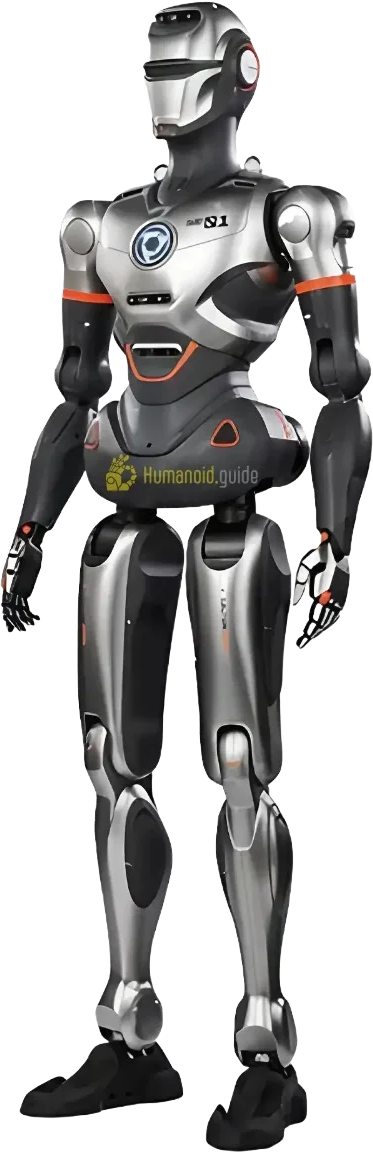
The EngineAI SE01 is a full-size, general-purpose humanoid robot unveiled on October 24, 2024 by EngineAI (formally Shenzhen EngineAI Robotics Technology Co., Ltd.), a Chinese robotics startup headquartered in Shenzhen. Standing 170 cm tall and weighing 55 kg with 32 degrees of freedom, the SE01 was the company's first full-size humanoid and the platform EngineAI says was the first to overcome "the challenge of natural gait in humanoid robots," using an end-to-end neural network trained with reinforcement learning and imitation learning to produce a fluid, straight-knee, human-like walk.[1][2] Priced from $20,000 to $30,000 and offered for global sale beginning December 24, 2024, the SE01 reached worldwide attention in January 2025 when footage of it striding through Shenzhen was so lifelike that viewers, including NVIDIA senior research scientist Jim Fan, briefly questioned whether the video was real or AI-generated.[5][6]
The SE01 sits at the center of EngineAI's product lineup as a mid-size platform bridging the gap between the compact PM01 (138 cm, ~40 kg) and the larger, industrially focused T800 (173 cm, 75 kg). While the PM01 prioritizes affordability and agility for research and education, and the T800 targets heavy industrial tasks with 450 N-m of peak torque and a solid-state battery, the SE01 was designed as a versatile general-purpose humanoid optimized for natural locomotion, modular hardware expansion, and a balance of industrial and research applications.[3][4]
Videos of the SE01 walking through the streets of Shenzhen went viral in late 2024 and early 2025, with viewers initially accusing the footage of being CGI due to the robot's remarkably natural gait. NVIDIA senior research scientist Jim Fan shared the footage on X (formerly Twitter), questioning whether it was real or generated by an AI video tool, before confirming its authenticity through independent sources.[5][6] The SE01 subsequently appeared at the CCTV 2025 New Year's Eve Gala and debuted internationally at CES 2025 alongside the PM01 and SA01.[7][8]
Priced between $20,000 and $30,000 depending on configuration, the SE01 became available for global sales on December 24, 2024, in both Commercial and Educational editions.[3][9]
EngineAI: Company Background
EngineAI was founded in October 2023 by Zhao Tongyang, a serial robotics entrepreneur who began his career in Internet-of-Things devices in 2012 before pivoting to bipedal robotics in 2016. Zhao founded a company called Dogotix that pioneered early humanoid research in China. After Dogotix shifted to quadruped robots and was acquired by XPENG Motors for nearly $100 million in 2020, Zhao co-founded Shenzhen Pengxing Intelligent Research Co., Ltd. as a joint venture with XPENG. At Pengxing, he led the development of the XPENG PX5 bipedal humanoid, which was showcased at NVIDIA's GTC 2024 conference.[10][11]
After departing XPENG Robotics, Zhao took his intellectual property and core engineering team to establish EngineAI in Shenzhen's Nanshan District, basing the company at the Shenzhen Bay Innovation and Technology Center. The team includes engineers from leading global institutions, including UC Berkeley, Tsinghua University, Purdue University, and the University of Tokyo.[5][12] The company secured nearly 100 million yuan (~$14 million) in angel funding shortly after incorporation and moved with remarkable speed, releasing four robot platforms in its first 14 months of operation.[10]
By early 2026, EngineAI had raised over 1 billion yuan across multiple funding rounds from investors including JD.com, CATL Capital, Luxshare Precision, and Yintai Holdings. A $200 million Series B round in April 2026, led by Henan Investment Group's Huirong Fund and Luxshare Precision, pushed the company's valuation past 10 billion yuan (approximately $1.4 billion), making it a unicorn less than three years after founding.[13][14][28]
When was the SE01 unveiled?
Design Philosophy
The SE01 was conceived as EngineAI's flagship proof-of-concept for natural bipedal locomotion. Rather than focusing primarily on payload capacity or industrial strength, the development team prioritized solving the longstanding challenge of achieving a smooth, human-like walking gait in a full-size humanoid robot. Traditional humanoid robots have been characterized by what engineers refer to as "choppy steps, bent knees, and stomping," caused by mechanical deadlock issues in joint actuators and reliance on conservative control algorithms that prioritize stability over naturalness.[1][2]
EngineAI's approach was to develop proprietary joint modules and train locomotion policies using end-to-end neural networks rather than relying on traditional force sensors and planetary roller screw actuators. This design philosophy reduced component costs while simultaneously improving movement quality, as the neural network could leverage inertia and gravity for energy-efficient, stable motion instead of fighting against them.[2][15]
Unveiling (October 24, 2024)
EngineAI officially unveiled the SE01 on October 24, 2024, at a launch event in Shenzhen, under the banner that the robot "Successfully Overcomes the Challenge of Natural Gait in Humanoid Robots for the First Time."[1] The company released demonstration footage showing the robot walking outdoors through Shenzhen streets with a fluid, striding gait that immediately attracted global attention. Founder and CEO Zhao Tongyang stated at the launch: "Our goal is to make robotics technology truly serve humanity, and through continuous deepening of technological innovation and market expansion, we aim to bring embodied intelligent robots into every aspect of life."[1]
The unveiling positioned the SE01 as EngineAI's entry into the full-size humanoid market, complementing the SA01 bipedal research platform that the company had released earlier in July 2024. EngineAI announced plans to complete its full product line by the end of 2024 and set a target of producing and selling over 1,000 units across all platforms by 2025.[2][16] That target was not met. In the May 2026 announcement of its Shenzhen manufacturing base the company described its own trajectory as running "from our first test machine in 2024, to the small-scale production of hundreds of PM01 units in 2025, and now to the qualitative leap toward a 10,000-unit delivery capability," which places 2025 output in the hundreds rather than above a thousand.[32]
The Viral Walking Video
In late 2024 and early January 2025, footage of the SE01 walking outside EngineAI's office at the Shenzhen Bay Innovation and Technology Center in Nanshan District went viral on social media platforms worldwide. The video showed the robot walking alongside humans with a remarkably natural gait, prompting widespread debate about its authenticity.[5][6]
Jim Fan, a senior research scientist at NVIDIA working on the GR00T humanoid foundation model project, posted the footage on X and asked whether it was genuine or had been generated by Sora, OpenAI's AI video generation tool. The clip sparked intense discussion, with some viewers questioning lighting reflections and movement patterns, while others believed the footage appeared authentic. Fan ultimately confirmed the robot's authenticity through reliable sources, explaining: "The controller is a neural net trained in Isaac simulator using reinforcement learning and then sim2real."[5][6]
The verification from a respected NVIDIA researcher lent significant credibility to EngineAI's claims and drew attention to the company's technical capabilities. STAR Market Daily and EETimes China independently confirmed the video was not AI-generated, further solidifying the SE01's reputation as a genuine breakthrough in bipedal locomotion.[6]
CCTV 2025 New Year's Eve Gala
The SE01 made a high-profile public appearance at the CCTV 2025 New Year's Eve Gala ("Setting Sail 2025"), one of the most-watched television events in China. The robot's appearance at the gala introduced EngineAI's technology to a mainstream Chinese audience of hundreds of millions of viewers. The performance took place alongside broader robotics showcases from other Chinese companies including AgiBot and UniX AI, reflecting the growing prominence of robotics in Chinese media and cultural events.[7][17]
China also held its first-ever robot Spring Festival "Gala" on January 20, 2025, organized by local authorities in Beijing, which featured humanoid robots from multiple manufacturers and was streamed online to a national audience.[17]
CES 2025 International Debut
The SE01 made its international commercial debut at CES 2025 in Las Vegas (January 7 to 10, 2025), where EngineAI showcased it alongside the SA01 research platform and the newly launched PM01 compact humanoid. EngineAI described the three robots as forming a "revolutionary robotics lineup."[8][18]
At CES, the SE01 was positioned as the company's full-size general-purpose humanoid designed for industrial labor scenarios, featuring high load capacity and the ability to handle tasks such as heavy lifting and precision assembly in complex factory environments. The demonstration highlighted the robot's human-like actions including squatting, push-ups, and running, with EngineAI claiming athletic performance "comparable to international athletes."[8]
The CES appearance introduced EngineAI to the global technology community and generated significant media coverage, particularly notable given the company's youth of barely 15 months at the time.[18]
Technical Specifications
Physical Design
The SE01 stands 1,700 mm (170 cm / 5 ft 7 in) tall, 520 mm deep, and 270 mm wide. It weighs approximately 55 kg (121 lb) with its battery installed. The frame is constructed from aerospace-grade aluminum alloy with composite plastic covers, providing structural durability while keeping weight manageable for agile bipedal locomotion. The design features soft curved surfaces prioritizing safety around humans, with an operational design lifespan exceeding 10 years.[1][9][19]
The SE01's 170 cm height was chosen to approximate the stature of an average adult human, allowing the robot to operate in environments designed for people, including standard doorways, corridors, and workspaces. At 55 kg, it is lighter than many competing full-size humanoids, reflecting EngineAI's optimization for agility and natural movement rather than raw strength.[9]
A notable design feature is the modular chest cavity, which allows easy integration of different sensors and end-effectors for different applications. The chest includes a quick-release system for swapping head and hand modules, enabling users to configure the SE01 for specific use cases without requiring extensive hardware modification.[20][21]
Degrees of Freedom
The SE01 features 32 degrees of freedom distributed across the body:
| Body region | DOF per side | Total DOF | Notes |
|---|---|---|---|
| Legs | 6 per leg | 12 | Hip (3), Knee (1), Ankle (2) |
| Arms | 4 per arm | 8 | Shoulder (2), Upper arm (1), Elbow (1) |
| Hands | 6 per hand | 12 | Dexterous manipulation |
| Total | 32 |
The 6-DOF leg configuration provides full hip, knee, and ankle articulation for the natural gait that defines the SE01. Each leg features three hip joints for omnidirectional movement, a single knee joint, and two ankle joints for precise foot placement and balance control during walking, running, and squatting.[9][19]
The 8-DOF arm system (4 per arm) enables the SE01 to perform manipulation tasks including object grasping and precision assembly work. The 12-DOF hand system (6 per hand) provides dexterous manipulation capability, allowing the robot to handle objects of varying shapes and sizes.[9][19]
Joint Actuator System
The SE01's propulsion system is built around EngineAI's proprietary joint modules, developed entirely in-house. The company independently developed three types of joint modules: harmonic, planetary, and ball-screw, each optimized for different positions in the robot's kinematic chain.[1][2]
| Parameter | Value |
|---|---|
| Peak joint torque | 330 N-m |
| Peak knee torque | 186 N-m |
| Force-control precision | 0.2 N-m (power joints) |
| Encoder type | Dual encoders per joint |
| Wiring | In-joint cable routing |
| Bearing type | Cross-roller bearings |
| Cooling | Forced-air cooling at critical joints |
The harmonic joint modules are the primary innovation, delivering smooth torque control that eliminates the jerky movements typical of conventional humanoid actuators. The dual encoders per joint provide precise position and velocity feedback for the neural network control system, while cross-roller bearings ensure smooth articulation under load. In-joint cable routing reduces snag risk and improves the robot's aesthetic profile.[1][9][15]
A key design decision was the elimination of traditional six-dimensional force sensors and planetary roller screw actuators from the locomotion system. By relying on the neural network controller to manage force distribution and balance through learned policies rather than explicit force feedback, EngineAI reduced both component cost and mechanical complexity while achieving superior gait performance.[2][15]
Computing Architecture
The SE01 employs a dual-processor computing architecture combining NVIDIA and Intel hardware:
| Component | Details |
|---|---|
| GPU | NVIDIA (AI inference and perception) |
| CPU | Intel (real-time motion control) |
| Operating system | Linux-based (Engine Sense stack) |
| API | RESTful API; ROS-compatible SDK |
| Supported platforms | Cross-platform algorithm deployment |
| Connectivity | Wi-Fi, Ethernet |
| Cloud integration | OTA updates, telemetry, model updates |
The NVIDIA processor handles high-performance AI inference for perception, decision-making, and machine learning tasks, while the Intel processor manages real-time motion control and basic system functions. The dual-processor architecture enables the robot to simultaneously process complex visual data from its multi-camera system and execute low-latency motor commands for stable locomotion.[1][9][19]
The SE01 runs EngineAI's proprietary "Engine Sense" software stack on a Linux-based operating system, with a ROS-compatible API and SDK for third-party development. The software supports over-the-air (OTA) updates via Ethernet or Wi-Fi, allowing EngineAI to push software improvements and new capabilities to deployed units remotely.[9][22]
Sensor and Perception Suite
The SE01 integrates a comprehensive multi-modal sensor system branded "Engine Sense" for environmental awareness and navigation:
| Sensor type | Component | Notes |
|---|---|---|
| Stereo cameras | 3 sets of high-precision stereo cameras | Visual neural network for 3D perception |
| Depth camera | Intel RealSense D435 | RGB-D depth sensing |
| LiDAR | 360-degree scanner | Environmental mapping, obstacle avoidance |
| HD cameras | 6 units | 3D perception and visual coverage |
| Microphone array | Multi-microphone system | Voice command recognition |
| IMU / Gyroscope | Inertial measurement unit | Balance and orientation tracking |
| Force sensors | Joint-integrated | Torque feedback and contact detection |
| Temperature sensors | Joint-integrated | Thermal monitoring for cooling system |
The three sets of high-precision stereo cameras form what EngineAI describes as an "advanced visual neural network system," providing real-time 3D spatial perception for navigation and object recognition. The Intel RealSense D435 depth camera adds RGB-D depth sensing for close-range interaction and manipulation tasks, while the 360-degree LiDAR enables millisecond-level environmental modeling for SLAM-based navigation and path planning.[1][9][19]
The multi-sensor fusion system combines data from all sensor modalities into a unified perception pipeline, enabling the SE01 to build detailed 3D maps of its surroundings and navigate dynamically in real time. This perception architecture supports autonomous navigation in both structured indoor environments and unstructured outdoor settings.[19][22]
Power System
The SE01 is powered by a quick-swap lithium-ion battery system:
| Parameter | Value |
|---|---|
| Battery capacity | 10,000 mAh |
| Battery voltage | 54.6 V |
| Total energy | 546 Wh |
| Runtime | ~2 hours continuous operation |
| Charging time | ~2 hours (54.6 V, 5 A) |
| Battery design | Quick-release swap mechanism |
The quick-release battery mechanism allows users to swap battery packs in the field without tools, extending operational time by carrying spare packs. This design is shared with the PM01 platform, providing cross-compatibility in battery accessories across EngineAI's product lineup.[9][19]
Safety and Environmental Ratings
The SE01 includes several safety features and certifications:
| Feature | Details |
|---|---|
| Ingress protection | IP66 |
| Safety certifications | CE, ISO 13849, ISO/TS 15066 |
| Operating temperature | 0 to 40 degrees Celsius |
| Operating humidity | 20% to 60% |
| Safety features | Emergency stop button, power disconnect interlocks, collision avoidance |
The IP66 rating indicates protection against powerful water jets and complete dust ingress, making the SE01 suitable for both indoor and certain outdoor deployment scenarios. The ISO/TS 15066 certification relates to collaborative robot safety, confirming the SE01 meets standards for safe operation in proximity to humans.[19]
Full Specifications Summary
| Category | Specification | Value |
|---|---|---|
| Physical | Height | 170 cm (5 ft 7 in) |
| Physical | Width | 270 mm |
| Physical | Depth | 520 mm |
| Physical | Weight (with battery) | 55 kg (121 lb) |
| Physical | Frame material | Aerospace-grade aluminum alloy |
| Physical | Design lifespan | 10+ years |
| Mobility | Total degrees of freedom | 32 |
| Mobility | DOF per leg | 6 |
| Mobility | DOF per arm | 4 |
| Mobility | DOF per hand | 6 |
| Mobility | Max walking speed | 2 m/s (7.2 km/h, 4.5 mph) |
| Actuation | Peak joint torque | 330 N-m |
| Actuation | Peak knee torque | 186 N-m |
| Actuation | Force-control precision | 0.2 N-m |
| Actuation | Joint types | Harmonic, planetary, ball-screw |
| Manipulation | Payload capacity | 15 kg per arm |
| Computing | GPU | NVIDIA |
| Computing | CPU | Intel |
| Computing | OS | Linux (Engine Sense stack) |
| Sensors | Stereo cameras | 3 sets (high-precision) |
| Sensors | Depth camera | Intel RealSense D435 |
| Sensors | LiDAR | 360-degree |
| Sensors | HD cameras | 6 units |
| Sensors | Additional | Microphone array, IMU, force sensors, temperature sensors |
| Power | Battery capacity | 10,000 mAh (546 Wh) |
| Power | Runtime | ~2 hours |
| Power | Battery type | Quick-release lithium-ion |
| Connectivity | Wireless | Wi-Fi |
| Connectivity | Wired | Ethernet |
| Safety | IP rating | IP66 |
| Safety | Certifications | CE, ISO 13849, ISO/TS 15066 |
How does the SE01 walk like a human?
The SE01's defining technical achievement is its natural human-like walking gait, which EngineAI describes as a breakthrough in bipedal locomotion. The gait system represents the convergence of custom hardware design and advanced machine learning control.
End-to-End Neural Network Control
The SE01's locomotion is governed by an end-to-end neural network that takes raw sensor data as input and outputs motor commands directly, bypassing the traditional pipeline of separate perception, planning, and control modules. This architecture allows the robot to learn complex, adaptive walking behaviors that account for the full dynamics of the mechanical system, including the interplay between inertia, gravity, and joint compliance.[1][2][15]
The neural network was trained using a combination of two approaches:
-
Reinforcement learning: The control policy was trained in simulation using NVIDIA's Isaac Sim environment, where the robot explored vast numbers of walking strategies through trial and error. Reward functions incentivized natural, energy-efficient gaits while penalizing unstable or mechanically stressful movements.[5][22]
-
Imitation learning: EngineAI used optical motion capture technology to collect large volumes of human walking data, which served as reference trajectories for the learning algorithm. By combining imitation of human movement patterns with reinforcement learning optimization, the system produced gaits that are both functionally effective and visually natural.[2][15]
Sim-to-Real Transfer
The transition from simulation-trained policies to real-world hardware used extensive domain randomization techniques to ensure robustness. During training, the simulation environment varied friction coefficients, mass distributions, motor delays, sensor noise, and external disturbances (such as random pushes) to produce control policies that transfer reliably to physical hardware despite the inevitable gap between simulated and real-world physics.[5][22]
Why does the natural gait matter?
Traditional humanoid walking typically relies on Zero Moment Point (ZMP) or model predictive control approaches that produce stable but rigid, mechanical-looking gaits. The SE01's neural network approach represents a shift toward learned locomotion that can exploit the full dynamics of the mechanical system. Dr. Talha Salam of the 1950.AI research lab noted the significance of the breakthrough, highlighting that the SE01's gait narrows the gap between robotic and human movement in a way that could accelerate practical deployment of humanoid robots in human-centric environments.[23]
The gait technology developed for the SE01 was subsequently transferred to the PM01, which uses the same end-to-end neural network locomotion control system adapted for its smaller form factor. The PM01's lower center of mass and lighter weight enabled even more dynamic applications of this technology, including the world's first humanoid front flip in February 2025.[3][24]
How much does the SE01 cost?
The SE01 is available in two editions targeting different user segments:
| Feature | Commercial Edition | Educational (EDU) Edition |
|---|---|---|
| Target user | Industrial deployers | Researchers, developers, educators |
| Secondary development | Limited | Full support |
| ROS compatibility | Basic | Full |
| Open-source code access | Limited | Full |
| Price range | $20,000 to $30,000 USD | $20,000 to $30,000 USD |
EngineAI co-founder Yao Qiyuan indicated that full-sized models like the SE01 would likely be priced between $20,500 (150,000 yuan) and $27,350 (200,000 yuan), balancing premium capabilities with market accessibility.[9][25]
During a launch promotional period from December 24, 2024, through March 31, 2025, both editions were offered at a unified price of 88,000 yuan (approximately $12,000 to $13,700 USD), and customers who purchased the Commercial edition received an automatic upgrade to the Educational edition at no additional cost. This promotional pricing matched the PM01's launch price, making the full-size SE01 temporarily available at the same cost as the compact model.[3][8]
Some third-party retailers have listed the SE01 at higher prices, with one source citing approximately $54,000, reflecting variation across configurations and international distribution channels.[22]
What is the SE01 used for?
Industrial Automation
The SE01 is designed for industrial labor scenarios including heavy lifting, precision assembly, and operation in complex factory environments. Its 15 kg per arm payload capacity, combined with the 32-DOF articulation and 330 N-m peak joint torque, enables it to handle a range of manufacturing tasks. The robot's human-scale dimensions allow it to operate at standard workstations and assembly lines designed for human workers.[8][9]
Research and Development
The EDU edition's ROS-compatible SDK, open-source code access, and RESTful API make the SE01 a capable platform for academic and corporate research into bipedal locomotion, embodied AI, computer vision, and human-robot interaction. The modular chest cavity enables researchers to integrate custom sensors and end-effectors for specialized experiments.[9][19][22]
Customer Service and Hospitality
The SE01 targets deployment in service environments including guided tours, retail customer interaction, reception duties, and hospitality roles. Its natural walking gait and human-scale proportions make it less intimidating in public-facing scenarios compared to more mechanically rigid humanoid platforms.[19][22]
Education
The EDU edition provides a full-size bipedal platform for robotics education programs at universities and training institutions. Students and educators can use the open-source SDK to develop custom locomotion algorithms, perception systems, and interaction behaviors.[8][19]
Security and Patrol
The SE01's 360-degree LiDAR perception, SLAM-based navigation, and autonomous operation capabilities make it suitable for security patrol applications. While EngineAI has demonstrated this use case more extensively with the PM01 (which was deployed alongside Shenzhen police), the SE01's larger size and higher payload capacity could support more extensive sensor packages for security deployments.[19][26]
Position in the EngineAI Product Lineup
The SE01 occupies a specific niche within EngineAI's rapidly expanding product portfolio. It was the company's second robot (after the SA01) and first full-size humanoid, establishing the core locomotion technology that would later be adapted across the entire product family.
| Model | Type | Height | Weight | DOF | Approx. price | Release | Key differentiator |
|---|---|---|---|---|---|---|---|
| SA01 | Bipedal research platform | ~100 cm | ~40 kg | N/A | $5,400 | July 2024 | Entry-level research, open-source |
| SE01 | Full-size general-purpose | 170 cm | 55 kg | 32 | $20,000 to $30,000 | October 2024 | Natural gait, modular design |
| PM01 | Compact humanoid | 138 cm | ~40 kg | 23-24 | $12,000 to $13,700 | December 2024 | Affordable, agile, acrobatic |
| SAO2 | Companion robot | 125 cm | 25 kg | 26-28 | ~$5,300 | 2024 | Home companion, LLM-powered |
| T800 | Full-size industrial | 173 cm | 75 kg | 43 | $25,000+ | December 2025 | High torque, solid-state battery |
Relationship to the PM01
The PM01 was developed as a compact, more affordable alternative to the SE01. It inherits the same end-to-end neural network locomotion control system and the same joint module technology, but at a smaller 138 cm form factor with 23 to 24 degrees of freedom (compared to the SE01's 32). The PM01 is 32 cm shorter and approximately 15 kg lighter, which gives it a lower center of mass that proved advantageous for dynamic maneuvers such as the world's first humanoid front flip.[3][24]
The PM01 uses the same Intel N97 CPU and NVIDIA Jetson Orin computing architecture, the same Intel RealSense depth cameras, and the same 10,000 mAh quick-release battery system. However, the PM01's reduced DOF count (particularly in the arms and hands) and smaller payload capacity make it less suited for industrial manipulation tasks where the SE01's larger frame and greater articulation are advantageous.[3]
Relationship to the T800
The T800, unveiled in December 2025, represents an evolution beyond the SE01 toward heavier industrial applications. At 173 cm and 75 kg, the T800 is slightly taller and 20 kg heavier, with 43 degrees of freedom (including 7-DOF dexterous hands) compared to the SE01's 32. The T800's 450 N-m peak joint torque significantly exceeds the SE01's 330 N-m, and its solid-state battery delivers 4 to 5 hours of runtime versus the SE01's 2 hours.[4]
The T800 also features a tiered computing architecture with options up to NVIDIA Jetson Thor (approximately 2,000 TOPS), far exceeding the SE01's dual-processor setup. However, the T800's starting price of $25,000 and heavier weight make it less accessible and portable than the SE01 for research and lighter-duty applications.[4]
Technology Transfer
The SE01 served as the foundational platform for the locomotion technology that EngineAI subsequently deployed across its entire product lineup. The end-to-end neural network gait control, the proprietary harmonic joint modules, and the dual-processor computing architecture were all developed first for the SE01 and then adapted, with appropriate modifications, for the PM01, SAO2, and T800. In this sense, the SE01 was not merely a product but a technology demonstrator that validated EngineAI's core engineering approach.[2][3][4]
How does the SE01 compare to other humanoid robots?
The SE01 competes in the emerging market for full-size, general-purpose humanoid robots, a segment that has grown rapidly since 2023 with multiple Chinese and American manufacturers bringing products to market.
| Robot | Manufacturer | Height | Weight | DOF | Max speed | Approx. price | Country |
|---|---|---|---|---|---|---|---|
| SE01 | EngineAI | 170 cm | 55 kg | 32 | 2 m/s | $20,000 to $30,000 | China |
| H1 | Unitree | 180 cm | 47 kg | 27 | 1.5 m/s | ~$90,000 | China |
| H2 | Unitree | 182 cm | 70 kg | 31 | 3 m/s | ~$29,900 | China |
| GR-2 | Fourier Intelligence | 175 cm | 63 kg | 53 | 2 m/s | ~$100,000+ | China |
| Optimus Gen 3 | Tesla | 173 cm | 57 kg | 28+ | N/A | Not yet for sale | USA |
| Figure 02 | Figure AI | 170 cm | 60 kg | 41 | 1.2 m/s | Not publicly available | USA |
The SE01's primary competitive advantages are its natural walking gait, aggressive pricing ($20,000 to $30,000 compared to six-figure prices for some competitors), and modular hardware design. Its 2 m/s walking speed is competitive among full-size humanoids and notably faster than typical human walking pace. The 32-DOF articulation provides a good balance of mobility and manipulation capability.[9][19]
Compared to Unitree's H1, which was released earlier and had an established install base, the SE01 offers a more natural gait and lower price point but comes from a much younger company with less production history. The Unitree H2, released later, surpasses the SE01 in speed (3 m/s) and DOF but at a comparable or slightly higher price point.[9]
Compared to American competitors like Tesla's Optimus and Figure AI's platforms, the SE01 and other Chinese manufacturers hold a distinct advantage in near-term commercial availability and aggressive pricing. Tesla's Optimus is not yet sold to third-party buyers, and Figure AI has not disclosed public pricing.[4]
Production and Availability
The SE01 became available for global sales on December 24, 2024, alongside the PM01 compact humanoid. EngineAI reported delivering nearly 100 units across all platforms within five months of beginning sales.[3][8]
The company targeted production and sales of over 1,000 units across all models by 2025 and has since prepared for the delivery of 4,000 to 5,000 units across its full lineup in 2026, reflecting a significant scaling of production capacity. A major milestone came when Duolun Technology signed a three-year purchase order for 2,000 PM01 units, though comparable large-scale orders for the SE01 specifically have not been publicly disclosed.[13][14]
EngineAI has established an end-to-end digital smart manufacturing base to support mass production. The company's Series B investment from Luxshare Precision, one of the world's largest electronics contract manufacturers, is expected to bolster manufacturing capabilities and help achieve cost efficiencies needed for aggressive pricing at scale.[13]
The SE01 is currently available in China, the United States, Germany, Japan, and Singapore, with distribution through both direct sales and third-party retailers. It is also available through regional distributors in the Middle East, including Dubai, Saudi Arabia, Kuwait, Qatar, Bahrain, and Oman.[19][27]
2026 developments: factory ramp and Hong Kong IPO
EngineAI's manufacturing scaled sharply in 2026. On May 29, 2026, the company opened a 12,000-square-meter intelligent manufacturing base in Shenzhen's Honghualing area and began mass deliveries of the T800, with the plant designed to roll out one T800 humanoid every 15 minutes (four per hour).[30] The company is targeting delivery of 4,000 to 5,000 humanoid units in 2026, roughly a fourfold increase over the approximately 1,000 units it aimed for in 2025, and has signaled an objective of scaling to 30,000 to 50,000 units annually by 2027.[28][30]
The April 2026 Series B was anchored by Luxshare Precision and Henan Investment Group's Huirong Fund, and EngineAI reported holding over 500 million yuan in framework orders across three primary sectors: industrial manufacturing, security and patrol, and retail and tourism.[28] In June 2026, Bloomberg reported that EngineAI had filed confidentially for a Hong Kong initial public offering, working with China International Capital Corp. and Citic Securities on the prospective share sale, a step that would make it one of the first dedicated humanoid robot makers to pursue a public listing.[29][31]
Limitations
Two-hour battery life. The SE01's approximately two-hour runtime from its 10,000 mAh battery is adequate for demonstrations and short deployments but insufficient for extended autonomous missions or full work shifts. While the quick-swap battery system allows field replacement, this remains a practical limitation for industrial deployments requiring sustained operation. The T800's 4 to 5 hour runtime from a solid-state battery represents EngineAI's solution to this constraint in its later platform.[4][9]
Limited arm articulation. With only 4 degrees of freedom per arm (compared to 7 per arm on the T800 and 5 per arm on the PM01), the SE01's upper-body manipulation capabilities are more constrained than some competitors. The Fourier GR-2, for instance, offers 53 total DOF with significantly more dexterous manipulation. For tasks requiring complex arm movements and fine manipulation, the SE01's arm configuration may be limiting.[9][19]
Closed-source core software. While the EDU edition provides an open-source SDK and ROS-compatible API, the SE01's core "Engine Sense" software stack remains proprietary and closed-source. This contrasts with the fully open-source approaches of some competing platforms and may limit the depth of customization available to researchers.[19][22]
Young manufacturer. EngineAI was founded in October 2023, had delivered roughly 100 units across all platforms in its first five months of sales (which began on December 24, 2024), and by its own account produced only hundreds of PM01 units across 2025 as a whole; volume manufacturing began when the Shenzhen base opened in May 2026.[30][32] The company's ability to sustain large-scale production, provide long-term support, and honor warranty commitments therefore remains less proven than that of more established competitors like Unitree, which has been operating since 2016 and shipped over 5,500 humanoid robots in 2025.[13][14]
Specification variability. Some third-party sources report differing specifications for the SE01, likely reflecting differences between Commercial and EDU editions, prototype versus production specifications, or evolving hardware revisions. For example, some sources describe the robot as having 12 DOF joint motors rather than 32 total DOF, which may refer to the primary locomotion joints rather than the full articulation count. Prospective buyers should confirm specifications directly with EngineAI.[9][19][22]
See Also
- Humanoid robot
- EngineAI
- EngineAI PM01
- EngineAI T800
- EngineAI SAO2
- Unitree H1
- Unitree H2
- Tesla Optimus
- Reinforcement Learning
- ROS (Robot Operating System)
- NVIDIA
- Embodied AI
References
- ^1 ^2 ^3 ^4 ^5 ^6 ^7 ^8 ^9 ^10"Meet EngineAI All-new Robotics SE01, Successfully Overcomes the Challenge of Natural Gait in Humanoid Robots for the First Time." GlobeNewswire, October 25, 2024. globenewswire.com/...oid-Robots-for-the-First-Time
- ^1 ^2 ^3 ^4 ^5 ^6 ^7 ^8 ^9"EngineAI Unveils SE01, an Impressive Robot That Walks Like a Human." Maginative, October 2024. maginative.com/...ive-robot-the-walks-like-a-human
- ^1 ^2 ^3 ^4 ^5 ^6 ^7 ^8"Breaking Through with Strength, Leading the Future: EngineAI Launches the PM01 Humanoid Robot." Yahoo Finance / Newsfile Corp, December 24, 2024. finance.yahoo.com/...ing-future-engineai-001700809
- ^1 ^2 ^3 ^4 ^5 ^6"The Pinnacle of Humanoid Technology: The EngineAI T800 Is Officially Unveiled." Newsfile Corp, December 2, 2025. newsfilecorp.com/...AI-T800-Is-Officially-Unveiled
- ^1 ^2 ^3 ^4 ^5 ^6 ^7"ENGINEAI's SE01 Humanlike Walk: Real or CGI?" Mike Kalil, January 2025. mikekalil.com/...engine-ai-shenzen
- ^1 ^2 ^3 ^4 ^5"A Viral Video of EngineAI's SE01 Robot Walking puts Chinese Robotics Firm in Spotlight." Maginative, January 10, 2025. maginative.com/...inese-robotics-firm-in-spotlight
- ^1 ^2"SE01 by EngineAI Robotics." HumanoidSpecs. humanoidspecs.com/...engineai-se01
- ^1 ^2 ^3 ^4 ^5 ^6 ^7"EngineAI Debuts at CES 2025 with Revolutionary Robotics Lineup." PR Newswire, January 7, 2025. prnewswire.com/...ionary-robotics-lineup-302347746
- ^1 ^2 ^3 ^4 ^5 ^6 ^7 ^8 ^9 ^10 ^11 ^12 ^13 ^14 ^15 ^16 ^17 ^18"SE01 by EngineAI: Price, Details, Review 2026." OriginOfBots. originofbots.com/...-details-specifications-rating
- ^1 ^2"Engine AI." Wikipedia. en.wikipedia.org/...Engine_AI
- ^"Xpeng to unveil fifth-gen humanoid robot built on 70% of its EV tech." KR Asia, 2024. kr-asia.com/...id-robot-built-on-70-of-its-ev-tech
- ^"EngineAI Robotics: The Launch of SE01." Geekheads, October 30, 2024. geekheads.co.uk/...eai-robotics-the-launch-of-se01
- ^1 ^2 ^3 ^4"EngineAI Secures $200 Million Series B as Manufacturing Giant Luxshare Joins the Cap Table." Humanoids Daily, 2026. humanoidsdaily.com/...luxshare-joins-the-cap-table
- ^1 ^2 ^3"EngineAI Raises $200 Million in Series B, Valuation Exceeds RMB 10 Billion." Pandaily, 2026. pandaily.com/...b-valuation-exceeds-rmb-10-billion
- ^1 ^2 ^3 ^4 ^5"SE01 becomes world-first humanoid robot to achieve human-like gait." Interesting Engineering, October 2024. interestingengineering.com/...-se01-humanoid-robot
- ^"EngineAI debuts its 'revolutionary robotics lineup' at CES." Robotics and Automation News, January 10, 2025. roboticsandautomationnews.com/...88418
- ^1 ^2"First robot Spring Festival 'Gala' makes debut online." People's Daily Online, January 21, 2025. en.people.cn/...c90000-20268588
- ^1 ^2"EngineAI Debuts at CES 2025 with Revolutionary Robotics Lineup." PR Newswire APAC, January 2025. en.prnasia.com/...ary-robotics-lineup-475514.shtml
- ^1 ^2 ^3 ^4 ^5 ^6 ^7 ^8 ^9 ^10 ^11 ^12 ^13 ^14 ^15 ^16 ^17"EngineAI SE 01 - Robot Details, Use Case and Specifications." Aparobot. aparobot.com/...enginai-se-01
- ^"EngineAI SE01 Humanoid Robot's Shockingly Realistic Gait." Mike Kalil, October 2024. mikekalil.com/...engineai-se01
- ^"EngineAI SE01 AI Robot with Humanlike Movement." Robotic Gizmos. roboticgizmos.com/engineai-se01
- ^1 ^2 ^3 ^4 ^5 ^6 ^7 ^8 ^9"EngineAI SE01: Specs, Shockingly Realistic Walk, and the New Race for Affordable Humanoids." Humanoid Press. humanoid.press/...i-se01-humanoid-robot-gait-price
- ^"Human-Like Gait in Robots: The Significance of EngineAI's SE01 Breakthrough." Dr. Talha Salam, 1950.AI. 1950.ai/...ficance-of-engineai-s-se01-breakthrough
- ^1 ^2"World's first humanoid robot that performs frontflip unveiled in China." Interesting Engineering, February 24, 2025. interestingengineering.com/...noid-robot-frontflip
- ^"China's humanoid robot stuns experts with 'unreal' human-like gait." Interesting Engineering, January 2025. interestingengineering.com/...-humanoid-robot-walk
- ^"Robot joins police for routine patrol." EyeShenzhen, February 19, 2025. eyeshenzhen.com/...content_31469161
- ^"ENGINEAI SE01 - Available in Dubai, UAE, Saudi Arabia, Kuwait, Qatar, Bahrain & Oman." Reliable Robotics. reliablerobotics.ai/...engineai-se01
- ^1 ^2 ^3"EngineAI Secures $200 Million Series B as Manufacturing Giant Luxshare Joins the Cap Table." Humanoids Daily, April 9, 2026. humanoidsdaily.com/...luxshare-joins-the-cap-table
- ^"Humanoid Robot Manufacturer EngineAI Is Said to File for Hong Kong IPO." Bloomberg, June 12, 2026. bloomberg.com/...is-said-to-file-for-hong-kong-ipo
- ^1 ^2 ^3"One T800 humanoid robot every 15 mins, ENGINEAI's new factory claims." Interesting Engineering, 2026. interestingengineering.com/...manoid-robot-factory
- ^"EngineAI files confidentially for Hong Kong IPO." Crypto Briefing, June 2026. cryptobriefing.com/engineai-hong-kong-ipo-filing
- ^1 ^2"EngineAI Launches Shenzhen Intelligent Manufacturing Base as First Batch of T800 Humanoid Robots Roll Off the Production Line to Begin Mass Delivery." PR Newswire, May 29, 2026. prnewswire.com/...to-begin-mass-delivery-302785384
Improve this article
Add missing citations, update stale details, or suggest a clearer explanation. Every suggestion is reviewed for sourcing before it goes live.
7 revisions · v8 · 6,078 words · full history
Fact-checks are independent of edits: a reviewer re-verifies the article against its sources and stamps the date. How we verify
Research and drafting on this wiki are AI-assisted, under named human editorial standards. How AI is used here
Cite this page: AI Wiki. "EngineAI SE01." aiwiki.ai, updated 1 Aug 2026. CC BY 4.0. https://aiwiki.ai/wiki/engineai_se01