

NVIDIA Grace
NVIDIA Grace is an Arm-based data-center central processing unit (CPU) from Nvidia, built from 72 Arm Neoverse V2 cores with co-packaged LPDDR5X memory and a coherent NVLink-C2C interconnect that links it to Nvidia GPUs at 900 GB/s. Announced in 2021 and available from 2023, it is Nvidia's first server-class CPU and was designed not as a standalone x86 competitor but as a high-bandwidth host processor for accelerated computing. Grace anchors Nvidia's flagship superchips, including the dual-die Grace CPU Superchip (144 cores), the GH200 Grace Hopper Superchip (Grace plus an H100/H200 GPU), and the GB200 Grace Blackwell Superchip (Grace plus two Blackwell GPUs), and it powers a number of large supercomputers. [1][2][7]
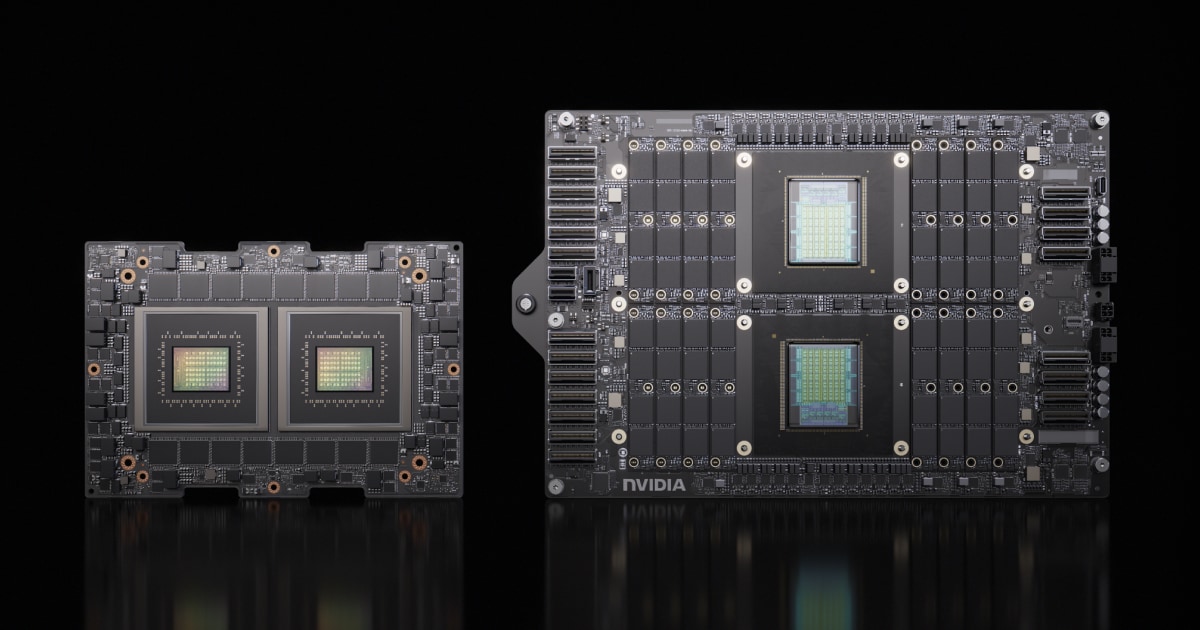
Nvidia markets Grace as "the breakthrough CPU for the modern data center that delivers twice the performance at the same power as leading traditional CPUs" and positions it as "the CPU foundation for AI factories." [3] Its successor, the Vera CPU, was launched at GTC on March 16, 2026, with partner availability in the second half of 2026. [13]
What is NVIDIA Grace?
NVIDIA Grace is a data-center CPU developed by Nvidia and based on Arm Neoverse V2 cores. Announced in 2021, Grace is the company's first server-class CPU and marks Nvidia's entry into a market historically dominated by x86 processors from Intel and AMD. Rather than competing as a general-purpose server chip, Grace was designed primarily to act as a tightly coupled host processor for Nvidia's data-center GPUs, joined to them by a high-bandwidth coherent interconnect called NVLink-C2C. [1][2]
When was Grace announced and how is it named?
Nvidia announced Grace on April 12, 2021, during the company's GPU Technology Conference (GTC) keynote. It was positioned as a CPU built for giant AI and high-performance computing (HPC) workloads, intended to relieve the data-movement and memory bottlenecks that arise when feeding very large models to accelerators. At launch, Nvidia stated that availability was expected in early 2023. [2]
The processor is named after Grace Hopper, the American computer-science pioneer and U.S. Navy rear admiral who helped develop early compilers and the COBOL programming language. The naming is deliberately paired with Nvidia's GPU architecture names: the Hopper GPU generation shares Grace Hopper's surname, so that the combined CPU-plus-GPU module became the "Grace Hopper" Superchip. The first announced adopters were the Swiss National Supercomputing Centre (CSCS) and the U.S. Department of Energy's Los Alamos National Laboratory, both of which planned Grace-powered systems built by Hewlett Packard Enterprise. [2]
What are Grace's specifications?
Grace is built from Arm Neoverse V2 cores, a high-performance core design implementing the Armv9-A instruction set. A single Grace die integrates 72 cores. Each core includes Nvidia's implementation of the Scalable Vector Extension 2 (SVE2), configured as four 128-bit vector units per core, alongside the older NEON SIMD instructions. [1][3]
The cache hierarchy provides 64 KB of L1 instruction cache and 64 KB of L1 data cache per core, plus 1 MB of L2 cache per core. Cores, memory controllers, and I/O are tied together by Nvidia's Scalable Coherency Fabric (SCF), which the company quotes at more than 3.2 TB/s of total bisection bandwidth. [1]
A defining feature of Grace is its memory subsystem. Instead of using socketed DIMMs, Grace co-packages server-class LPDDR5X memory with error-correction code (ECC) directly alongside the CPU. Nvidia states that LPDDR5X delivers twice the bandwidth and 10x better energy efficiency than DDR4, and up to 53 percent more bandwidth than eight-channel DDR5 at one-eighth the power per GB/s, at the cost of fixed, non-upgradeable capacity. A single Grace CPU provides up to 480 GB of LPDDR5X capacity and up to about 500 GB/s of memory bandwidth (512 GB/s in the 120 GB and 240 GB configurations, 384 GB/s with 480 GB). [4]
The table below summarizes a single Grace die.
| Specification | NVIDIA Grace (single die) |
|---|---|
| Cores | 72 Arm Neoverse V2 (Armv9-A) |
| Vector | 4x 128-bit SVE2 per core, plus NEON |
| L1 cache | 64 KB instruction + 64 KB data per core |
| L2 cache | 1 MB per core |
| Memory | Up to 480 GB co-packaged LPDDR5X with ECC |
| Memory bandwidth | Up to 512 GB/s (384 GB/s with 480 GB) |
| On-chip fabric | Scalable Coherency Fabric (SCF), more than 3.2 TB/s bisection |
| Chip-to-chip link | NVLink-C2C, 900 GB/s bidirectional |
| Announced / available | April 2021 / 2023 |
What is NVLink-C2C and why does it matter?
NVLink-C2C ("chip-to-chip") is the coherent interconnect that allows Grace to function as a high-bandwidth companion to Nvidia GPUs or to a second Grace die. Derived from Nvidia's fourth-generation NVLink technology, the link provides 900 GB/s of total bidirectional bandwidth, which Nvidia describes as seven times the bandwidth of a PCIe Gen5 x16 connection. [1][2][4]
Crucially, NVLink-C2C is cache-coherent. When Grace is paired with a GPU, the CPU and GPU share a single unified memory address space, so the GPU can directly access the CPU's large LPDDR5X pool and the CPU can access the GPU's high-bandwidth memory without explicit data copies. This coherent CPU-GPU memory model is the central design idea behind the Grace-based superchips and is well suited to AI training, inference, and HPC applications whose working sets exceed GPU memory alone. [4]
What are the Grace product variants?
Grace appears in several distinct products. As a standalone CPU it is sold as the Grace CPU Superchip; it also serves as the host processor inside Nvidia's GPU-bearing superchips.
| Product | CPU | GPU | NVLink-C2C link | Notable use |
|---|---|---|---|---|
| Grace CPU Superchip | Two Grace dies (144 cores) | None | Grace to Grace, 900 GB/s | HPC, CPU-bound and memory-bound workloads |
| Grace CPU C1 | One Grace die (72 cores) | None | n/a | Single-socket cloud, edge, storage, telco |
| GH200 Grace Hopper | One Grace (72 cores) | One Hopper H100/H200 | Grace to GPU, 900 GB/s | AI and HPC, unified memory |
| GB200 Grace Blackwell | One Grace (72 cores) | Two Blackwell GPUs | Grace to two GPUs, 900 GB/s | GB200 NVL72 rack-scale AI |
| GB300 Grace Blackwell | One Grace (72 cores) | Two Blackwell Ultra GPUs | Grace to two GPUs | GB300 NVL72, reasoning inference |
What is the Grace CPU Superchip?
The Grace CPU Superchip joins two Grace dies on a single module using NVLink-C2C, presenting 144 Arm Neoverse V2 cores to the operating system. It is aimed at HPC and large AI workloads that benefit from high single-thread performance, very high memory bandwidth, and strong data-movement capability, but that do not require a GPU on the same module.
| Specification | Grace CPU Superchip |
|---|---|
| Cores | 144 Arm Neoverse V2 (two dies of 72) |
| Vector | 4x 128-bit SVE2 per core, plus NEON |
| L1 cache | 64 KB instruction + 64 KB data per core |
| L2 cache | 1 MB per core |
| L3 cache | 234 MB per Superchip |
| Memory | Up to 960 GB co-packaged LPDDR5X with ECC |
| Memory bandwidth | Up to 1 TB/s (768 GB/s with 960 GB) |
| Die-to-die link | NVLink-C2C, 900 GB/s bidirectional |
| I/O | Up to 8x PCIe Gen5 x16 (up to 1 TB/s total) |
| Power | Up to 500 W TDP including memory |
The Superchip carries 234 MB of distributed L3 cache across the two dies and supports up to eight PCIe Gen5 x16 interfaces, which can be bifurcated for flexible I/O. Nvidia rates the complete module, including its co-packaged memory, at up to 500 W. [1][3][6]
What is the GH200 Grace Hopper Superchip?
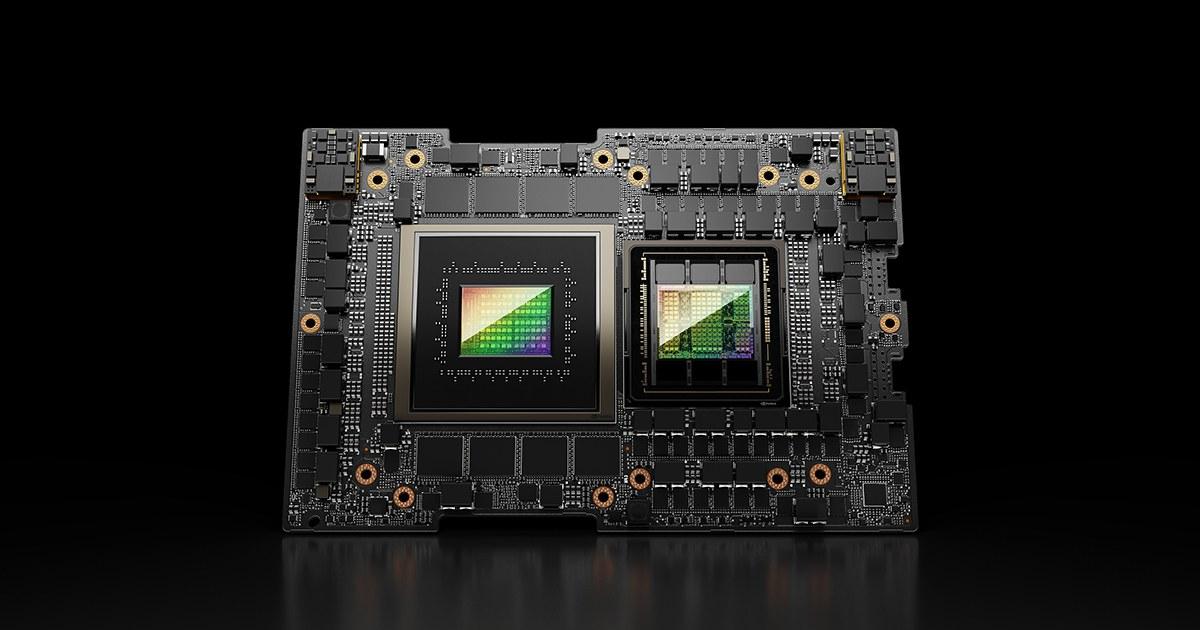
The GH200 combines a 72-core Grace CPU with a Hopper-generation GPU (an H100, and later an H200-class part) over NVLink-C2C, producing a single module with a coherent CPU-plus-GPU memory space. Two memory configurations shipped: an HBM3 version with 96 GB of GPU memory for 576 GB of total fast memory, and an HBM3e version with 144 GB of GPU memory for 624 GB of total fast memory. The HBM3e variant pairs faster GPU memory with the same 480 GB of LPDDR5X on the Grace side. A two-socket variant, the GH200 NVL2, links two GH200 modules over NVLink to expose 144 Arm cores and 288 GB of HBM3e in a single node. [5][7][8]
What are the GB200 and GB300 Grace Blackwell superchips?
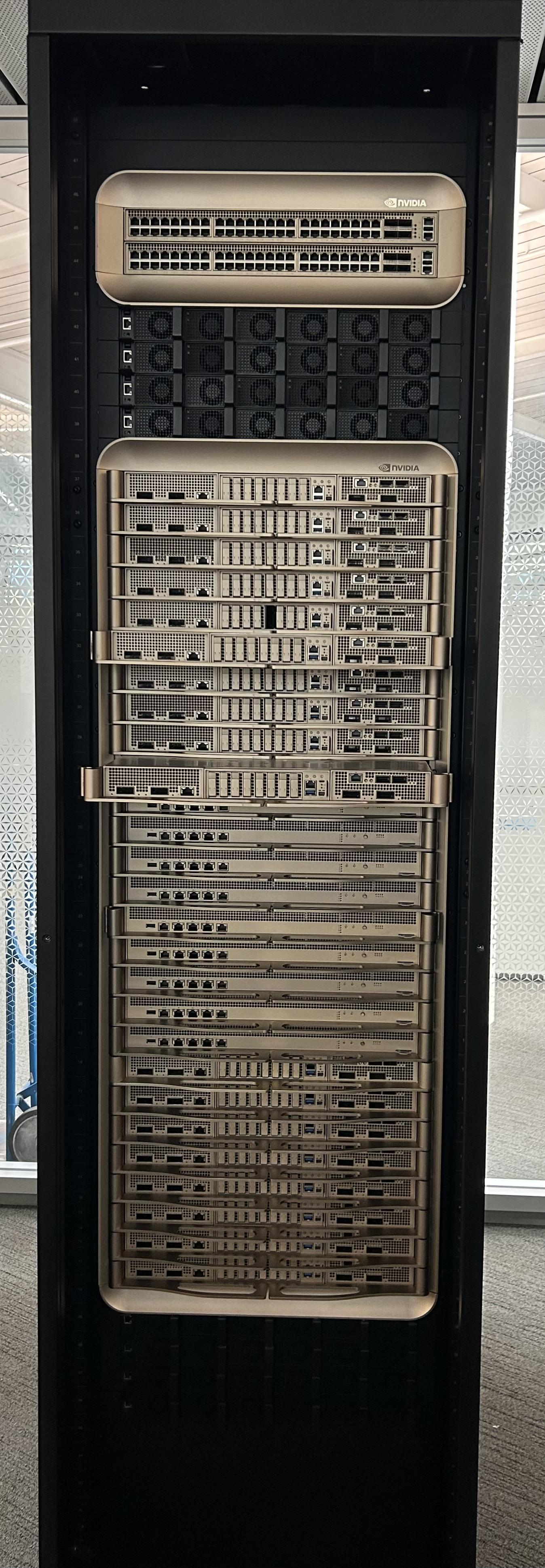
In the Blackwell generation, Nvidia shifted the CPU-to-GPU ratio. The GB200 Grace Blackwell Superchip, introduced alongside the Blackwell platform at GTC on March 18, 2024, pairs a single Grace CPU with two Blackwell GPUs over NVLink-C2C, a 1:2 CPU-to-GPU ratio. These superchips are the building blocks of the rack-scale GB200 NVL72, a liquid-cooled system that connects 36 Grace CPUs and 72 Blackwell GPUs into a single 72-GPU NVLink domain that behaves as one very large accelerator. Nvidia states that the GB200 NVL72 delivers up to 30x faster real-time trillion-parameter LLM inference compared with the same number of H100 GPUs. The successor GB300 NVL72 keeps the same topology, combining 36 Grace CPUs with 72 Blackwell Ultra GPUs and targeting reasoning and test-time-scaling inference workloads. [9][10]
Where is Grace deployed?
Grace and Grace Hopper hardware underpins a wave of HPC and AI supercomputers delivered largely by Hewlett Packard Enterprise and Eviden. Notable systems include:
- Alps, at the Swiss National Supercomputing Centre (CSCS), one of the first major Grace Hopper deployments.
- Venado, at Los Alamos National Laboratory, the first U.S. system powered by Nvidia Grace technology, combining Grace CPU Superchip nodes and Grace Hopper nodes, which Nvidia said in 2022 would exceed 10 AI exaflops.
- JUPITER, at the Julich Supercomputing Centre in Germany, built on Eviden's BullSequana XH3000 platform using a quad-GH200 architecture and Quantum-2 InfiniBand networking; in November 2025 it became Europe's first exascale supercomputer, reaching 1 exaflop/s on the Linpack benchmark. [15]
- Isambard-AI, at the University of Bristol in the United Kingdom, built on the HPE Cray EX platform and ultimately scaling to thousands of GH200 Superchips.
Nvidia has also cited additional Grace Hopper systems such as EXA1-HE in France, Helios in Poland, and Miyabi in Japan, reflecting broad adoption across national HPC centers. [11][12]
What is Grace's successor?
At GTC in March 2026, Nvidia launched the Vera CPU as Grace's successor and the host processor of the Vera Rubin platform. Where Grace used licensed Arm Neoverse V2 cores, Vera moves to 88 fully custom Nvidia-designed "Olympus" Arm-compatible cores, which Nvidia claims deliver substantially higher per-core performance. Vera also expands memory to up to 1.5 TB of LPDDR5X on detachable SOCAMM modules with up to 1.2 TB/s of bandwidth and pairs with the Rubin generation of GPUs in rack-scale systems, continuing the coherent CPU-plus-GPU design philosophy that Grace established. [13][14]
Why is Grace significant?
Grace represents Nvidia's first serious move into data-center CPUs and a strategic bet on the Arm architecture for the server room. By co-packaging high-bandwidth LPDDR5X memory and tying the CPU to its GPUs with a coherent NVLink-C2C link, Nvidia reframed the CPU not as a standalone competitor to x86 server parts but as an integral, high-bandwidth host for accelerated computing. That approach, embodied first in the Grace CPU Superchip and Grace Hopper and then scaled up dramatically in the Grace Blackwell GB200 and GB300 NVL72 racks, has become a defining feature of Nvidia's AI-infrastructure strategy and set the template carried forward by the Vera CPU. [1][7][9]
Continue reading
- NvidiaNvidia Corporation is an American technology company that designs graphics processing units (GPUs) and is the world's dominant supplier of hardware for artificial intelligenceMentioned 38 times above
- NVLinkNVLink is NVIDIA's proprietary high-bandwidth, low-latency, cache-coherent point-to-point interconnect for directly connecting GPUs to other GPUs and, in some configurations, to host CPUs.Mentioned 15 times above
- Arm HoldingsArm Holdings plc is a British semiconductor IP and software design company headquartered in Cambridge, England, whose CPU, GPU, and neural-processor designs sit inside more than 99% of the world's smartphones…Mentioned 11 times above
- NVIDIA GH200 Grace Hopper SuperchipThe NVIDIA GH200 Grace Hopper Superchip is a single-module processor from NVIDIA that combines a 72-core Grace Arm CPU with a Hopper-generation H100-class GPU on one packageMentioned 8 times above
- NVIDIA GB200 NVL72The NVIDIA GB200 NVL72 is a rack-scale AI computing system that packages 72 Blackwell GPUs and 36 Grace CPUs into a single liquid-cooled rackMentioned 8 times above
- Central processing unitA central processing unit (CPU) is the general-purpose processor that executes a computer's instruction stream.Linked in the introduction


More to read
Topics:AI ComputeAI HardwareNVIDIA
References
- ^1 ^2 ^3 ^4 ^5 ^6 ^7NVIDIA, "NVIDIA Grace CPU Superchip Architecture In Depth," NVIDIA Technical Blog. developer.nvidia.com/...chip-architecture-in-depth
- ^1 ^2 ^3 ^4 ^5NVIDIA, "NVIDIA Announces CPU for Giant AI and High Performance Computing Workloads," NVIDIA Newsroom, April 12, 2021. nvidianews.nvidia.com/...mance-computing-workloads
- ^1 ^2 ^3NVIDIA, "NVIDIA Grace CPU and Arm Architecture." nvidia.com/...grace-cpu
- ^1 ^2 ^3NVIDIA, "Introducing the NVIDIA Grace CPU Superchip." nvidia.com/...grace-cpu-superchip
- ^NVIDIA, "Introducing the NVIDIA Grace Hopper Superchip." nvidia.com/...grace-hopper-superchip
- ^ServeTheHome, "NVIDIA Grace Superchip Features 144 Cores, 960GB of RAM and 128 PCIe Gen5 Lanes." servethehome.com/...8-pcie-gen5-lanes-arm-neoverse
- ^1 ^2 ^3NVIDIA, "NVIDIA Unveils Next-Generation GH200 Grace Hopper Superchip Platform," NVIDIA Newsroom. nvidianews.nvidia.com/...perchip-with-hbm3e-memory
- ^AnandTech, "NVIDIA Unveils GH200 Grace Hopper GPU with HBM3e Memory." anandtech.com/...race-hopper-gpu-with-hbm3e-memory
- ^1 ^2NVIDIA, "GB200 NVL72." nvidia.com/...gb200-nvl72
- ^NVIDIA, "NVIDIA Blackwell Platform Arrives to Power a New Era of Computing," NVIDIA Newsroom, March 18, 2024. nvidianews.nvidia.com/...er-a-new-era-of-computing
- ^NVIDIA, "NVIDIA Grace Hopper Ignites New Era of AI Supercomputing," NVIDIA Newsroom. nvidianews.nvidia.com/...-era-of-ai-supercomputing
- ^HPCwire, "Nvidia's Grace Superchips to Debut on Venado Supercomputer." hpcwire.com/...ps-to-debut-on-venado-supercomputer
- ^1 ^2NVIDIA, "NVIDIA Launches Vera CPU, Purpose-Built for Agentic AI," NVIDIA Newsroom. nvidianews.nvidia.com/...pose-built-for-agentic-ai
- ^NVIDIA, "NVIDIA Vera CPU Delivers High Performance, Bandwidth, and Efficiency for AI Factories," NVIDIA Technical Blog. developer.nvidia.com/...fficiency-for-ai-factories
- ^Forschungszentrum Julich, "Europe's First Supercomputer Reaches 1 ExaFLOP/s," press release, November 17, 2025. fz-juelich.de/...supercomputer-reaches-1-exaflop-s
Improve this article
Add missing citations, update stale details, or write a clearer explanation. Anyone can edit: changes go live when you publish, and every edit is checked by an editor.
7 revisions · v7 · 2,204 words · full history
Fact-checks are independent of edits: a reviewer re-verifies the article against its sources and stamps the date. How we verify
Research and drafting on this wiki are AI-assisted, under named human editorial standards. How AI is used here
Reviewer note: Independent fact-check of the full article against its cited sources (70 claims, 17 sources fetched); 2 material + 10 minor fixed
Cite this page: AI Wiki. "NVIDIA Grace." aiwiki.ai, updated 28 Oct 2026, fact-checked 4 Nov 2026. CC BY 4.0. https://aiwiki.ai/wiki/nvidia_grace