

Ruslan Salakhutdinov
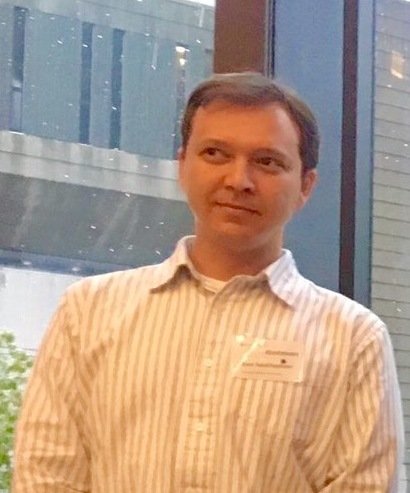
Ruslan Salakhutdinov (often called Russ Salakhutdinov) is a machine learning researcher and the UPMC Professor of Computer Science in the Machine Learning Department at Carnegie Mellon University (CMU), known for early work on deep learning with Geoffrey Hinton and for co-authoring dropout [1][12][18]. He earned his PhD at the University of Toronto in 2009 under Hinton, taught at Toronto from 2011 to 2016, and moved to CMU in February 2016 [2][3][4]. In October 2016 he became Apple's first director of AI research while keeping his CMU post, and he later served as VP of Research for generative AI at Meta before returning to CMU [5][7][9]. His research has run from Boltzmann machines and deep generative models through language model pretraining (XLNet) to benchmarks and training methods for AI agents [15][27][29].
Education
Salakhutdinov completed a bachelor's degree at High Point University in North Carolina between 1998 and 2001, with a double major in computer science and mathematics [3]. He then took a Master of Science in computer science at the University of Toronto (2001 to 2003), with a thesis titled "Optimization Algorithms for Learning" [3]. Between his master's and doctoral studies he worked at the Canadian Imperial Bank of Commerce in Toronto from 2003 to 2005 [3].
He returned to the University of Toronto for a PhD in machine learning from 2005 to 2009, spending the summer of 2008 as an intern at Yahoo Research in New York [3]. His doctoral thesis, "Learning Deep Generative Models," was supervised by Geoffrey Hinton [4]. The thesis set out to show that deep generative models with many layers of latent variables and millions of parameters could be trained efficiently, and that the features they learned were useful for object recognition, information retrieval, classification and regression [4].
Career
Academic posts
After his PhD, Salakhutdinov spent two years as a postdoctoral associate at the Massachusetts Institute of Technology, split between the Department of Brain and Cognitive Sciences and the Computer Science and Artificial Intelligence Laboratory (CSAIL) [2][3]. In August 2011 he joined the University of Toronto as an assistant professor in the Department of Computer Science and the Department of Statistical Sciences [3]. He moved to CMU's Machine Learning Department as an associate professor in February 2016 [3]. His CMU homepage now lists him as the UPMC Professor of Computer Science in that department [1].
| Period | Position | Institution |
|---|---|---|
| 1998-2001 | BSc, computer science and mathematics | High Point University [3] |
| 2001-2003 | MSc, computer science | University of Toronto [3] |
| 2005-2009 | PhD, computer science (machine learning) | University of Toronto [3][4] |
| 2009-2011 | Postdoctoral associate | MIT (BCS and CSAIL) [3] |
| 2011-2016 | Assistant professor | University of Toronto [3] |
| 2016- | Associate professor, later UPMC Professor | Carnegie Mellon University [1][3] |
| From 2016 | Director of AI research | Apple [5][6] |
| by 2025 | VP of Research, GenAI | Meta [7][8] |
Apple
On October 17, 2016, Salakhutdinov announced on Twitter that he was joining Apple as a director of AI research "in addition to my work at CMU," and invited people to apply to his team [5]. MIT Technology Review described it as Apple's first director of AI, a new role meant to help Siri and other products draw on academic AI research, and reported that he would keep working part time at CMU while hiring a team of researchers for Apple [5]. TechCrunch called it what appeared to be a newly created position [6]. In comments reported by the magazine, he described work on systems that could answer a question by reading Wikipedia articles and other external knowledge bases [5].
His Bluesky profile describes him as a former director of AI research at Apple and as a co-founder of Perceptual Machines, which it says was acquired by Apple [8]. In a May 2026 podcast interview he said he had built a startup with a couple of his students and that this was how he ended up at Apple [9]. His CV from this period lists an Apple research award, with him as principal investigator, running from 2017 to 2019 [3].
Meta
By 2025 Salakhutdinov held the title VP of Research, GenAI at Meta alongside his CMU professorship; the Vector Institute used that title for him as a speaker at its Remarkable 2025 event, and his Bluesky profile lists the role with a focus on multimodal LLMs and AI agents [7][8]. In the May 2026 interview he said that after his CMU group built early agent systems, Microsoft and Meta took an interest and his team went on to build inside Meta [9]. The podcast's guest biography described the Meta role in the past tense, and in the interview he said he was back at CMU and launching a new startup [9]. Neither source gives the dates on which he joined or left Meta.
Research
Salakhutdinov lists his research interests as deep learning, probabilistic graphical models and large-scale optimization [1]. A 2025 Vector Institute biography credited him with more than 250 papers [7].
Deep generative models and pretraining
With Hinton he wrote "Reducing the Dimensionality of Data with Neural Networks," published in Science in July 2006 [12]. The paper showed that a deep autoencoder, a multilayer network with a small central layer trained to reconstruct its input, could learn low-dimensional codes that worked much better than principal component analysis, provided its weights were first initialized close to a good solution before being fine-tuned by gradient descent [12].
In 2009 he and Hinton introduced deep Boltzmann machines, a learning algorithm for Boltzmann machines with many layers of hidden variables [15]. The method estimated the two expectations in the log-likelihood gradient in different ways, a variational approximation for the data-dependent term and persistent Markov chains for the data-independent term, and used a layer-by-layer pretraining phase to initialize inference [15]. On MNIST and NORB the models learned good generative models and performed well at digit and object recognition [15]. The same year, the two published "Semantic hashing" in the International Journal of Approximate Reasoning [16].
Later generative-model work included the importance weighted autoencoder (IWAE), written with Yuri Burda and Roger Grosse in 2015 [23]. IWAE kept the architecture of the variational autoencoder but trained on a strictly tighter lower bound on the log-likelihood obtained by importance weighting several posterior samples [23].
Collaborative filtering
Salakhutdinov also worked on recommender systems, evaluating his models on the large Netflix movie-rating dataset [14]. At ICML 2007, with Andriy Mnih and Hinton, he applied restricted Boltzmann machines to collaborative filtering [13]. At NIPS 2007, he and Mnih presented Probabilistic Matrix Factorization (PMF), a matrix factorization model whose cost scales linearly with the number of observations and that handled the large, sparse and imbalanced Netflix data well [14]. A constrained variant improved predictions for users with few ratings, and a linear combination of several PMF models with RBM models reached an error rate of 0.8861, which the authors reported was nearly 7% better than Netflix's own system [14].
Dropout
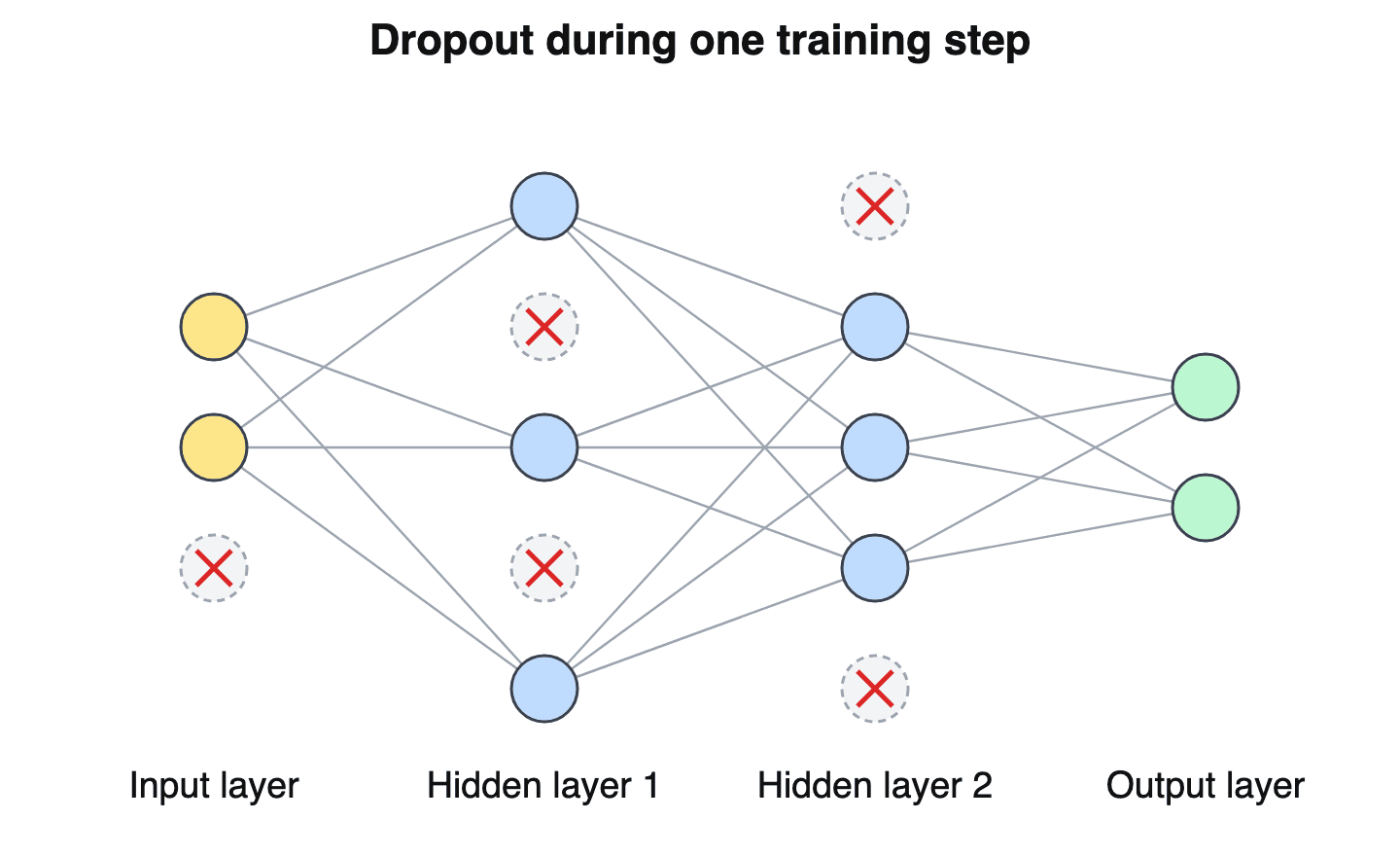
Salakhutdinov is a co-author of the work that introduced dropout. A July 2012 arXiv paper by Hinton, Nitish Srivastava, Alex Krizhevsky, Ilya Sutskever and Salakhutdinov reported that randomly omitting half of a network's feature detectors on each training case greatly reduced overfitting and set new records for speech and object recognition [17]. The full treatment, "Dropout: A Simple Way to Prevent Neural Networks from Overfitting," appeared in the Journal of Machine Learning Research in 2014 [18]. It described training as sampling from an exponential number of "thinned" networks and approximating their average at test time with a single network with scaled-down weights, and reported gains in vision, speech recognition, document classification and computational biology [18].
Vision, language and multimodal learning
In his last years at Toronto and his first at CMU he co-authored several widely used papers on sequence models, multimodal learning and learning on sets:
| Paper | Year | Venue | Contribution |
|---|---|---|---|
| Show, Attend and Tell (Xu, Ba, Kiros, Cho, Courville, Salakhutdinov, Zemel, Bengio) | 2015 | ICML [19] | Attention-based image captioning model |
| Unsupervised Learning of Video Representations using LSTMs (Srivastava, Mansimov, Salakhutdinov) | 2015 | ICML [20] | Encoder-decoder LSTMs that reconstruct or predict video sequences |
| Skip-Thought Vectors (Kiros, Zhu, Salakhutdinov and others) | 2015 | NIPS [21] | Unsupervised sentence encoder trained to reconstruct surrounding sentences in books |
| Human-level concept learning through probabilistic program induction (Lake, Salakhutdinov, Tenenbaum) | 2015 | Science [22] | One-shot learning of handwritten characters by representing concepts as simple programs |
| Deep Sets (Zaheer, Kottur, Ravanbakhsh, Poczos, Salakhutdinov, Smola) | 2017 | NIPS [24] | Characterization of permutation-invariant functions on sets |
The Science paper with Brenden Lake and Joshua Tenenbaum addressed the gap between people, who can often learn a new concept from a single example, and machine learning systems that need many examples [22]. Its model represented handwritten characters as simple programs chosen to best explain the examples under a Bayesian criterion, reached human-level performance on a one-shot classification task while outperforming deep learning approaches of the time, and in "visual Turing tests" of creative generalization often behaved in ways indistinguishable from people [22].
Language models and question answering
At CMU, Salakhutdinov co-authored several language papers with his PhD student Zhilin Yang and others. HotpotQA (EMNLP 2018), written with Yang, Peng Qi, Saizheng Zhang, Yoshua Bengio, William W. Cohen and Christopher Manning, is a dataset for explainable multi-hop question answering [25]. Transformer-XL (ACL 2019), led by Zihang Dai, added a segment-level recurrence mechanism and a new positional encoding to the transformer so that language models could use context beyond a fixed length [26]. XLNet (2019), with Yang, Dai, Yiming Yang, Jaime Carbonell and Quoc Le, proposed a generalized autoregressive pretraining method that learns bidirectional context by maximizing the expected likelihood over permutations of the factorization order, and reported that it outperformed BERT on 20 tasks under comparable settings [27].
Embodied AI and agents
His group has also worked on embodied AI and reinforcement learning. "Object Goal Navigation using Goal-Oriented Semantic Exploration" (2020), with Devendra Singh Chaplot, Dhiraj Gandhi and Abhinav Gupta, built an episodic semantic map to explore unseen environments and was the winning entry of the CVPR 2020 Habitat ObjectNav Challenge [28].
His more recent papers concern language model agents for the web. VisualWebArena (ACL 2024), led by Jing Yu Koh, is a benchmark of visually grounded web tasks for multimodal agents [29]. "Tree Search for Language Model Agents" (2024) proposed a best-first tree search that runs at inference time within the actual web environment, which the authors described as the first tree search algorithm for language model agents shown to work on realistic web tasks [30]. InSTA (2025), with Brandon Trabucco and colleagues, is a pipeline for training web agents without human annotation: a language model proposes tasks for 150,000 websites, agents attempt them, and a language model judges which trajectories succeeded [31]. He is also among the senior co-authors of BrowserGym, a framework for web agent research [34].
Students
Salakhutdinov's group page lists former students and postdocs who went on to faculty and industry research posts [32]. They include Zhilin Yang (PhD, CMU, listed as moving on to an assistant professorship at Tsinghua University); Nitish Srivastava and Jamie Ryan Kiros (PhDs at Toronto); Ben Eysenbach (PhD, CMU, later at Princeton); Devendra Singh Chaplot and Manzil Zaheer (PhDs, CMU); and postdoctoral fellows Roger Grosse, Yuri Burda and Alexander Schwing [32]. The page also lists Jimmy Ba, later a University of Toronto faculty member, among its Toronto alumni [32].
Professional service
Salakhutdinov was one of the two program chairs of the 2019 International Conference on Machine Learning (ICML), with Kamalika Chaudhuri, and the two edited its proceedings [10][33]. He was general chair of ICML 2024 in Vienna [11]. His CV lists area chair roles at NIPS, ICML, CVPR and ICLR in the 2010s and tutorial chair duties at ICML 2014 and 2018, and his biography lists him as an action editor of the Journal of Machine Learning Research [2][3]. He has taught tutorials on deep learning at venues including the Simons Institute at Berkeley and the Machine Learning Summer School in Tübingen [1][3].
Awards and honours
| Year | Honour |
|---|---|
| 2011 | Fellow, Neural Computation and Adaptive Perception program, Canadian Institute for Advanced Research (CIFAR) [3] |
| 2012 | Best Student Paper Award, Conference on Uncertainty in Artificial Intelligence [3] |
| 2012 | Early Researcher Award; Connaught New Researcher Award [3] |
| 2013 | Sloan Research Fellowship [3] |
| 2013 | Microsoft Research Faculty Fellowship [3] |
| 2014 | Google Faculty Award [3] |
| 2016 | Canada Research Chair in Statistical Machine Learning [3] |
| 2016 | Pioneers of AI Research, NVIDIA [3] |
His biography also describes him as a Senior Fellow of CIFAR [2].
Views on AI agents
In the May 2026 DataFramed interview, Salakhutdinov named coding as the most exciting current use case for agents and attributed faster progress in coding and math to the fact that answers there can be checked, unlike many web and computer-use tasks [9]. He described credit assignment over long tasks, where training mostly receives a signal only at the end, as an open research problem, and said that models being confidently wrong was a fundamental difficulty [9]. He said he would not yet let an agent book a flight for him, and that agents would need to be "almost like 99.99% accurate" before he fully trusted them [9]. He also expected people to keep reviewing critical decisions and said dexterous manipulation, such as grasping any cup rather than one trained example, remained extremely difficult for robots [9].
Continue reading
- DropoutDropout is a regularization technique for neural networks that randomly sets a fraction of neuron activations to zero during trainingMentioned 4 times above
- Geoffrey HintonGeoffrey Hinton (born December 6, 1947) is a British-Canadian computer scientist whose research has focused on neural networks, representation learning, and computational accounts of learning in the brain.Mentioned twice above
- XLNetXLNet is a generalized autoregressive pretraining method for natural language processing that combines the strengths of autoregressive and autoencoding language models.Mentioned twice above
- VisualWebArenaVisualWebArena (often abbreviated VWA) is a benchmark of 910 realistic, visually grounded web tasks for evaluating multimodal autonomous AI agents, released in January 2024 by researchers at Carnegie Mellon…Listed in See also
- Machine LearningMachine learning (ML) is a branch of artificial intelligence that gives computers the ability to learn from data and improve their performance on tasks without being explicitly programmed.Mentioned 11 times above
- Apple Inc.Apple Inc. is an American multinational technology company headquartered in Cupertino, California.Mentioned 10 times above

More to read
References
- ^1 ^2 ^3 ^4 ^5Ruslan Salakhutdinov. "Ruslan Salakhutdinov" (homepage). Machine Learning Department, Carnegie Mellon University. cs.cmu.edu/~rsalakhu
- ^1 ^2 ^3 ^4Ruslan Salakhutdinov. "Bio". Carnegie Mellon University. cs.cmu.edu/...bio
- ^1 ^2 ^3 ^4 ^5 ^6 ^7 ^8 ^9 ^10 ^11 ^12 ^13 ^14 ^15 ^16 ^17 ^18 ^19 ^20 ^21 ^22 ^23 ^24 ^25Ruslan Salakhutdinov. "Curriculum vitae". Carnegie Mellon University. cs.cmu.edu/...cv_web.pdf
- ^1 ^2 ^3 ^4Salakhutdinov, Ruslan. "Learning Deep Generative Models". PhD thesis, University of Toronto (advisor: Geoffrey Hinton), TSpace, 2009. tspace.library.utoronto.ca/...19226
- ^1 ^2 ^3 ^4 ^5Will Knight. "Apple Gets Its First Director of AI". MIT Technology Review, 2016-10-17. technologyreview.com/...s-its-first-director-of-ai
- ^1 ^2Devin Coldewey. "Apple hires CMU professor as director of AI research to smarten up Siri". TechCrunch, 2016-10-17. techcrunch.com/...f-ai-research-to-smarten-up-siri
- ^1 ^2 ^3 ^4Vector Institute. "Ruslan Salakhutdinov" (speaker profile). Remarkable 2025. vectorinstitute.swoogo.com/...ruslan-salakhutdinov
- ^1 ^2 ^3Russ Salakhutdinov. "Russ Salakhutdinov (@rsalakhu.bsky.social)" (profile). Bluesky. bsky.app/...rsalakhu.bsky.social
- ^1 ^2 ^3 ^4 ^5 ^6 ^7 ^8DataCamp. "How AI Agents Will Work While You Sleep with Ruslan Salakhutdinov, Professor at Carnegie Mellon". DataFramed podcast #358, 2026-05-04. datacamp.com/...i-agents-will-work-while-you-sleep
- ^ICML. "2019 ICML Organizing Committee". International Conference on Machine Learning. icml.cc/...Committees
- ^ICML. "2024 ICML Organizing Committee". International Conference on Machine Learning. icml.cc/...Committees
- ^1 ^2 ^3G. E. Hinton, R. R. Salakhutdinov. "Reducing the Dimensionality of Data with Neural Networks". Science 313(5786):504-507, 2006-07-28. doi.org/...science.1127647
- ^Ruslan Salakhutdinov, Andriy Mnih, Geoffrey Hinton. "Restricted Boltzmann machines for collaborative filtering". Proceedings of the 24th International Conference on Machine Learning, pp. 791-798, 2007. doi.org/...1273496.1273596
- ^1 ^2 ^3Andriy Mnih, Ruslan Salakhutdinov. "Probabilistic Matrix Factorization". Advances in Neural Information Processing Systems 20 (NIPS 2007). papers.nips.cc/...7dedf1eb4e6e52a37ea7bcd-Abstract
- ^1 ^2 ^3 ^4Ruslan Salakhutdinov, Geoffrey Hinton. "Deep Boltzmann Machines". Proceedings of the Twelfth International Conference on Artificial Intelligence and Statistics, PMLR 5:448-455, 2009. proceedings.mlr.press/...salakhutdinov09a
- ^Ruslan Salakhutdinov, Geoffrey Hinton. "Semantic hashing". International Journal of Approximate Reasoning 50(7):969-978, 2009. doi.org/...j.ijar.2008.11.006
- ^Geoffrey E. Hinton, Nitish Srivastava, Alex Krizhevsky, Ilya Sutskever, Ruslan R. Salakhutdinov. "Improving neural networks by preventing co-adaptation of feature detectors". arXiv:1207.0580, 2012. arxiv.org/...1207.0580
- ^1 ^2 ^3Nitish Srivastava, Geoffrey Hinton, Alex Krizhevsky, Ilya Sutskever, Ruslan Salakhutdinov. "Dropout: A Simple Way to Prevent Neural Networks from Overfitting". Journal of Machine Learning Research 15(56):1929-1958, 2014. jmlr.org/...srivastava14a
- ^Kelvin Xu, Jimmy Ba, Ryan Kiros, Kyunghyun Cho, Aaron Courville, Ruslan Salakhudinov, Rich Zemel, Yoshua Bengio. "Show, Attend and Tell: Neural Image Caption Generation with Visual Attention". Proceedings of the 32nd International Conference on Machine Learning, PMLR 37:2048-2057, 2015. proceedings.mlr.press/...xuc15
- ^Nitish Srivastava, Elman Mansimov, Ruslan Salakhudinov. "Unsupervised Learning of Video Representations using LSTMs". Proceedings of the 32nd International Conference on Machine Learning, PMLR 37:843-852, 2015. proceedings.mlr.press/...srivastava15
- ^Ryan Kiros, Yukun Zhu, Ruslan Salakhutdinov, Richard Zemel, Raquel Urtasun, Antonio Torralba, Sanja Fidler. "Skip-Thought Vectors". Advances in Neural Information Processing Systems 28 (NIPS 2015). papers.nips.cc/...06832082290ad8544a8da27-Abstract
- ^1 ^2 ^3Brenden M. Lake, Ruslan Salakhutdinov, Joshua B. Tenenbaum. "Human-level concept learning through probabilistic program induction". Science 350(6266):1332-1338, 2015-12-11. doi.org/...science.aab3050
- ^1 ^2Yuri Burda, Roger Grosse, Ruslan Salakhutdinov. "Importance Weighted Autoencoders". arXiv:1509.00519, 2015. arxiv.org/...1509.00519
- ^Manzil Zaheer, Satwik Kottur, Siamak Ravanbakhsh, Barnabas Poczos, Ruslan Salakhutdinov, Alexander J Smola. "Deep Sets". Advances in Neural Information Processing Systems 30 (NIPS 2017). papers.nips.cc/...a1aa27e363d86d40ff442fe-Abstract
- ^Zhilin Yang, Peng Qi, Saizheng Zhang, Yoshua Bengio, William W. Cohen, Ruslan Salakhutdinov, Christopher D. Manning. "HotpotQA: A Dataset for Diverse, Explainable Multi-hop Question Answering". EMNLP 2018, arXiv:1809.09600. arxiv.org/...1809.09600
- ^Zihang Dai, Zhilin Yang, Yiming Yang, Jaime Carbonell, Quoc V. Le, Ruslan Salakhutdinov. "Transformer-XL: Attentive Language Models Beyond a Fixed-Length Context". ACL 2019, arXiv:1901.02860. arxiv.org/...1901.02860
- ^1 ^2Zhilin Yang, Zihang Dai, Yiming Yang, Jaime Carbonell, Ruslan Salakhutdinov, Quoc V. Le. "XLNet: Generalized Autoregressive Pretraining for Language Understanding". arXiv:1906.08237, 2019. arxiv.org/...1906.08237
- ^Devendra Singh Chaplot, Dhiraj Gandhi, Abhinav Gupta, Ruslan Salakhutdinov. "Object Goal Navigation using Goal-Oriented Semantic Exploration". arXiv:2007.00643, 2020. arxiv.org/...2007.00643
- ^1 ^2Jing Yu Koh, Robert Lo, Lawrence Jang, Vikram Duvvur, Ming Chong Lim, Po-Yu Huang, Graham Neubig, Shuyan Zhou, Ruslan Salakhutdinov, Daniel Fried. "VisualWebArena: Evaluating Multimodal Agents on Realistic Visual Web Tasks". ACL 2024, arXiv:2401.13649. arxiv.org/...2401.13649
- ^Jing Yu Koh, Stephen McAleer, Daniel Fried, Ruslan Salakhutdinov. "Tree Search for Language Model Agents". arXiv:2407.01476, 2024. arxiv.org/...2407.01476
- ^Brandon Trabucco, Gunnar Sigurdsson, Robinson Piramuthu, Ruslan Salakhutdinov. "InSTA: Towards Internet-Scale Training For Agents". arXiv:2502.06776, 2025. arxiv.org/...2502.06776
- ^1 ^2 ^3Ruslan Salakhutdinov. "My Group". Carnegie Mellon University. cs.cmu.edu/...people
- ^Kamalika Chaudhuri, Ruslan Salakhutdinov (eds.). "Proceedings of the 36th International Conference on Machine Learning". PMLR volume 97, 2019. proceedings.mlr.press/v97
- ^Thibault Le Sellier De Chezelles, Maxime Gasse, Alexandre Drouin, Massimo Caccia, Léo Boisvert, et al. (including Graham Neubig and Ruslan Salakhutdinov). "The BrowserGym Ecosystem for Web Agent Research". arXiv:2412.05467, 2024. arxiv.org/...2412.05467
Improve this article
Add missing citations, update stale details, or write a clearer explanation. Anyone can edit: changes go live when you publish, and every edit is checked by an editor.
2 revisions · v2 · 3,109 words · full history
Fact-checks are independent of edits: a reviewer re-verifies the article against its sources and stamps the date. How we verify
Research and drafting on this wiki are AI-assisted, under named human editorial standards. How AI is used here
Reviewer note: Independent fact-check before publication on November 18, 2026: 96 claims checked against 36 cited and independent sources; 1 material and 7 minor corrections applied before publication.
Cite this page: AI Wiki. "Ruslan Salakhutdinov." aiwiki.ai, updated 18 Nov 2026, fact-checked 18 Nov 2026. CC BY 4.0. https://aiwiki.ai/wiki/ruslan_salakhutdinov